
B2B Referral Program: How to Build One That Drives Revenue
Most B2B brands already get referrals by accident. Here’s how to turn them into a system: readiness checks, a 5-step build, and why most programs stall.
-d82615.webp&w=3840&q=95)
Summarize this post with AI
Most B2B brands already get referrals. A wholesale buyer mentions you to a peer at a trade show, a procurement manager forwards your catalog to a colleague at another company, and a deal lands without you spending a cent on ads. The problem is that almost none of it is tracked, rewarded, or repeatable. It just happens, quietly, when it happens.
A B2B referral program turns that accident into a system. Instead of hoping your best accounts talk about you, you give them a clear reason to, a simple way to do it, and a reward when their introduction turns into a real order.
This guide is for ecommerce and wholesale brands - the kind selling to other businesses through a Shopify B2B store, a wholesale channel, or company-level accounts. We'll cover what a B2B referral program actually is, whether you're ready for one, the five steps to build it, why most of them stall, and how to keep yours running past launch week.
What Is a B2B Referral Program?
A B2B referral program is a formal process for turning existing business customers into a source of new ones. You track which of your accounts make introductions, and you reward them when those introductions become qualified leads or paying customers.
The "formal" part is what separates it from word of mouth. A real program has three moving pieces: a unique share link or code for each referring account, an easy way for them to pass it along, and an automatic way to attribute and pay out the reward once a referred company buys.
B2B referrals work differently from the consumer version, and the differences shape everything you build:
- Longer sales cycles. A referred company rarely buys the same day. There's a buying committee, a sample order, maybe a quarter of back-and-forth. Your reward timing has to survive that.
- Higher order value. A single wholesale account can be worth more than hundreds of retail orders, so a referral that lands one is worth rewarding generously.
- Fewer, warmer referrers. You don't have a million customers. You have a few dozen or a few hundred accounts, and the good ones know exactly which peers would be a fit.
So a B2B referral program isn't a louder version of a consumer one. It's a quieter, higher-stakes one - fewer participants, bigger payouts, longer timelines.
The Benefit of Referral Sales in B2B
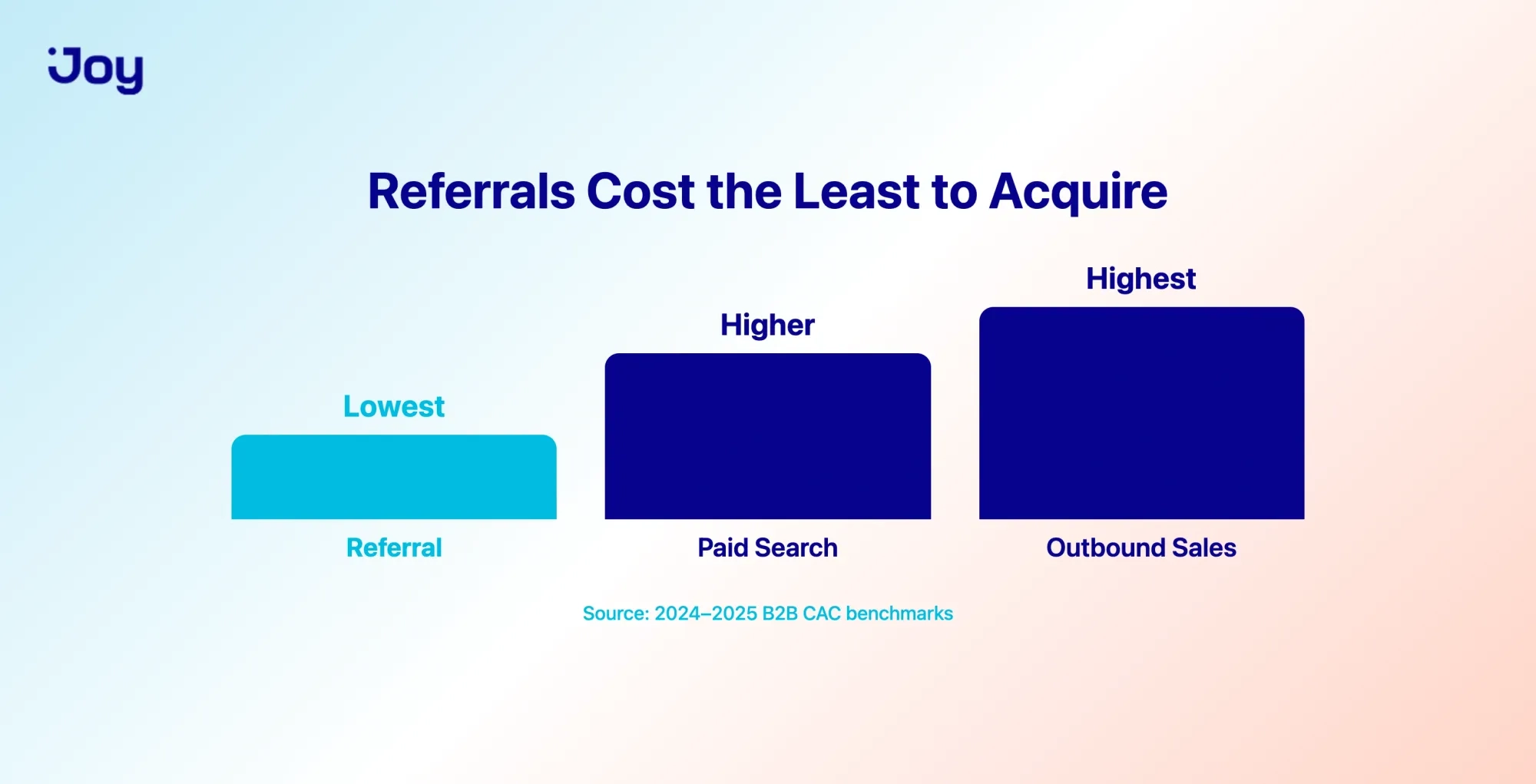
According to First Page Sage's B2B customer acquisition cost data, referrals are consistently among the least expensive channels for a B2B company, while paid search and outbound sales are among the most expensive. Recent 2024 to 2025 benchmark roundups put referral acquisition in the low hundreds of dollars per customer, against roughly $800 for paid search and close to $2,000 for outbound sales. The exact figures vary by industry, but the ratio holds everywhere: a referred customer costs a fraction of a cold one.
That gap matters more every year. Acquisition costs across B2B have climbed by 40 to 60% since 2023 as ad platforms have gotten more expensive and inboxes have become harder to reach. When your paid channels keep getting pricier, a channel that runs on customer goodwill instead of ad spend stops being a nice-to-have.
Cost is only half of it. Referred accounts also tend to be better accounts:
- They arrive pre-trusted because someone they respect has already vouched for you, which reduces the buying committee's hesitation.
- They tend to fit better, because your existing customers usually know which peers actually need what you sell.
- They often stick around longer, since a relationship that started with a trusted introduction has less reason to churn.
Put the two together - lower cost to acquire and higher quality once acquired - and a healthy referral program quietly improves your blended LTV-to-CAC ratio, the benchmark most B2B operators watch (3:1 is the common floor). You're not just buying cheaper customers. You're buying ones more likely to stay above that line.
3 Signs to Check Before You Build a B2B Referral Program
A referral program amplifies what you already have. If customers love you, it spreads that love faster. If they don't, it spreads silence. So before you build anything, check three things honestly.
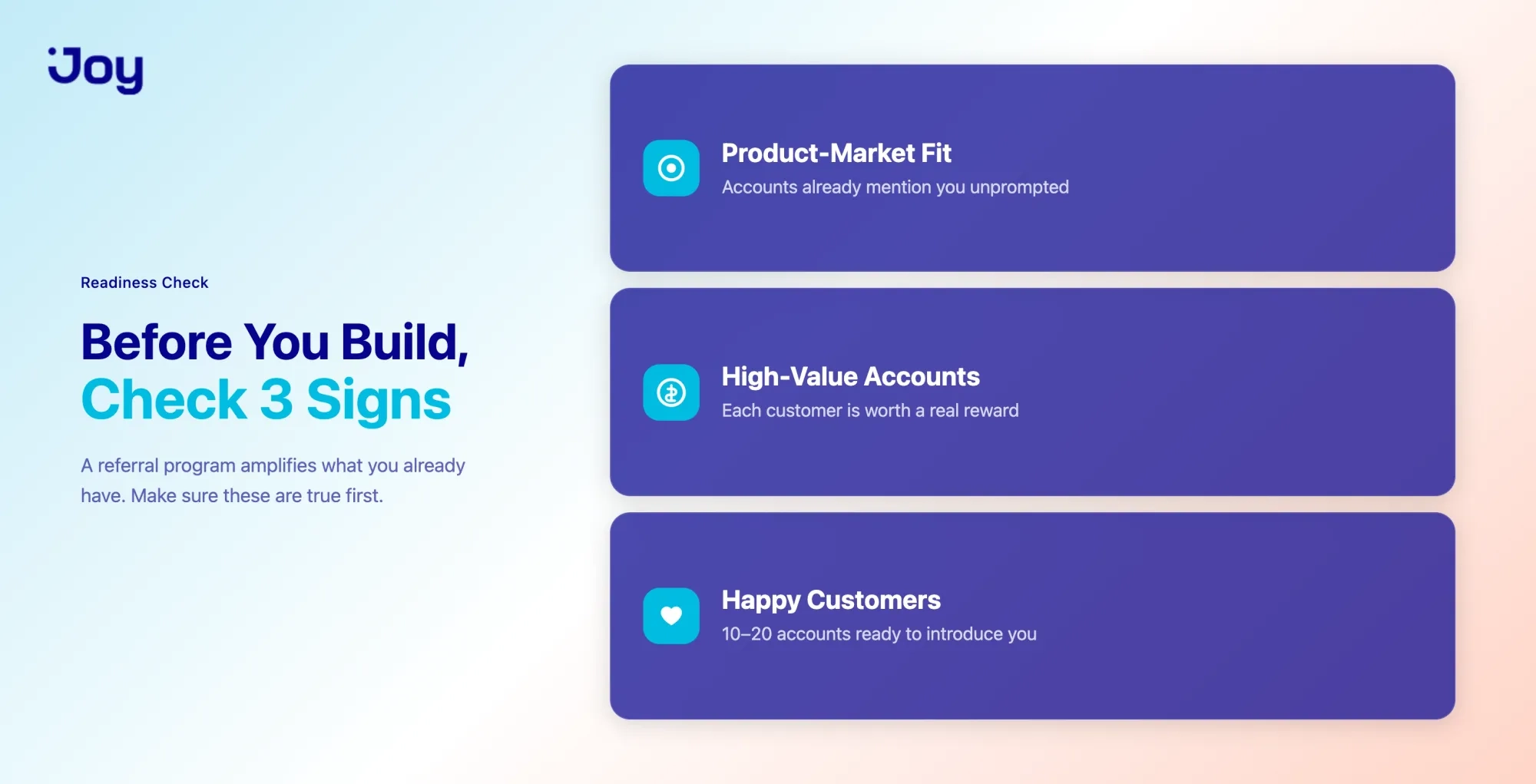
1. You've reached product-market fit
Customers refer products they're genuinely happy with. If your accounts are still on the fence - reordering out of habit, not enthusiasm - a referral program won't manufacture excitement they don't feel.
A quick gut check: are accounts already mentioning you unprompted? Do you get the occasional "a colleague told me about you" without trying? If yes, there's a current to channel. If not, fix the product or the experience first. The program can wait.
2. Your accounts are worth referring to
B2B referral economics work best when each customer is valuable enough to justify a real reward and achieves that value quickly. A high order value gives you room to offer a meaningful incentive. Reasonable time-to-value means the referred company sees the benefit before they lose interest.
If your average wholesale account is worth a few thousand dollars a year, you can afford to reward a successful referral well - and you should.
3. You have happy customers to ask
You need a base of accounts who'd say yes without feeling used. The simplest way to find them is to look at who reorders most, who responds warmly to your team, and who's been with you longest. Those are your first invitations - not a blast to your entire customer list.
If you can name 10 or 20 accounts right now who'd happily introduce you to a peer, you're ready. If you can't, spend your energy creating a few more of those before you launch.
5 Steps to Build a B2B Referral Program
Once you've cleared the readiness checks, building the program itself is mostly a series of clear decisions. Here are the five that matter.
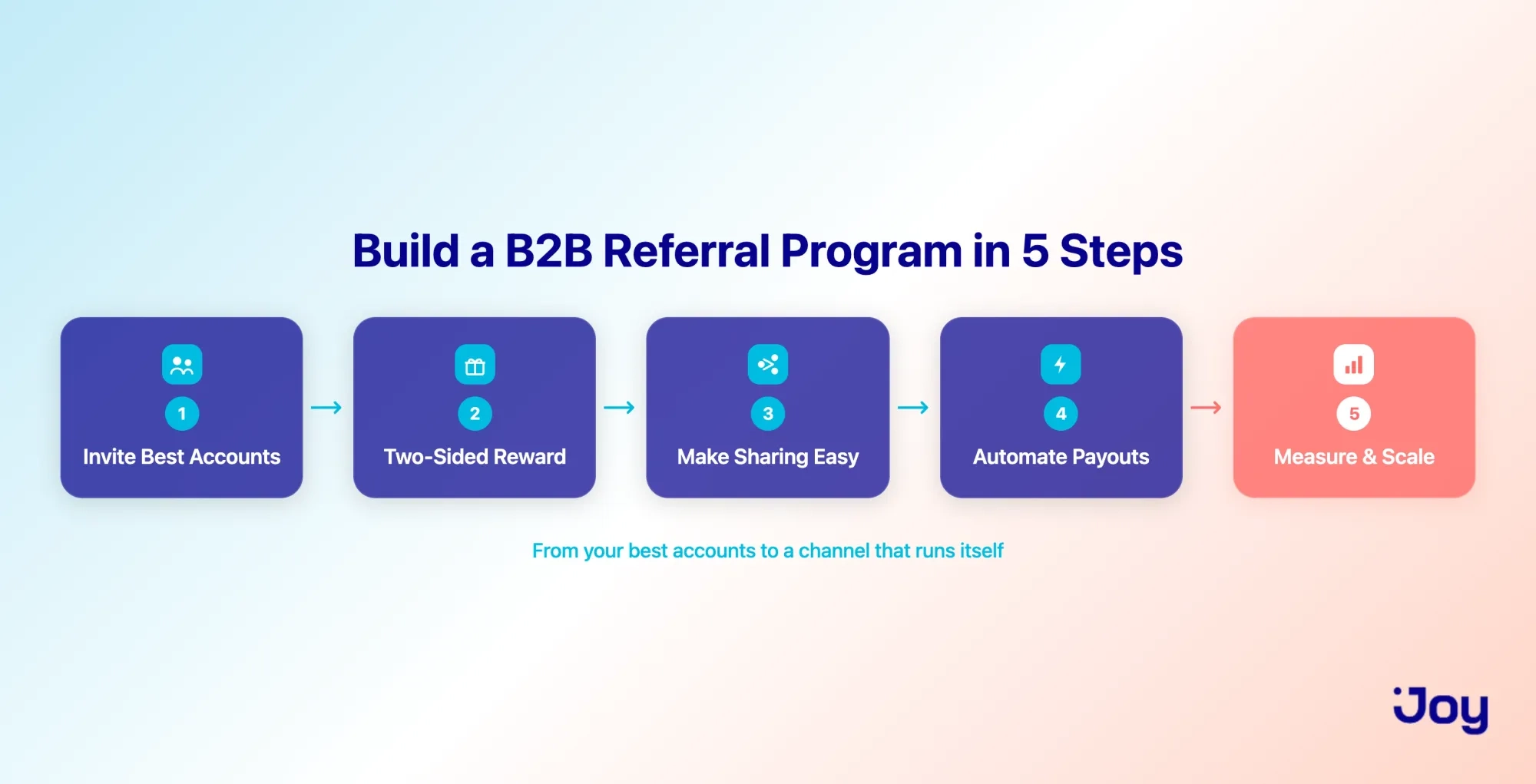
Step 1: Decide who to invite first
Don't open the program to everyone on day one. Start with your best accounts - the reorderers, the long-tenured, the ones who already speak well of you. They convert at higher rates, they refer better-fit companies, and their early participation tells you whether your offer actually lands before you scale it.
Invite them directly. A personal email from someone on your team whom they recognize will always outperform a generic banner. You can widen access later once the mechanics are proven.
Step 2: Design a two-sided, revenue-linked reward
This is the decision that makes or breaks the program, so give it real thought.
Reward both sides. The referring account gets something for the introduction; the referred company gets something for trying you. A one-sided reward feels like you're asking your customer to do free sales work. A two-sided one feels like a favor that helps their peer, too - which is exactly the frame that makes people comfortable sharing.
Tie the payout to a real order, not a click or a signup. In B2B, a click means almost nothing - the value is in a closed deal. Pay the reward when the referred company places a qualifying order, so you're spending on outcomes instead of activity.
For longer sales cycles, consider a multi-step reward: a small thank-you when the referred company books a demo or places a first sample order, and the full reward when they convert to a real account. That keeps your referrer engaged through a buying cycle that might run a full quarter.
On reward type, cash and account credit both work well in B2B. Store credit pulls the referrer back to reorder; cash or a gift card is cleaner when the buyer and the budget-holder are different people. Match the reward to who's actually doing the referring.
Step 3: Make sharing effortless
Every extra step costs you referrals. Your job is to remove them.
Give each account a unique share link or code to ensure automatic attribution. Write the referral message for them - a short, ready-to-send note they can forward without having to find the words. And make it obvious who you'd like them to refer ("brands like yours that sell to retailers" beats a vague "tell your friends").
A simple referral landing page that explains the offer, the reward, and the steps does a lot of quiet work here. When a referrer forwards your link, the receiving company should land on a page that clearly outlines the next step.
Step 4: Automate tracking and payouts
This is where do-it-yourself programs fall apart. The moment you're tracking referrals in a spreadsheet and paying rewards by hand, the program becomes a chore someone forgets about by month two.
You want the system to handle the boring parts: attributing each referred order to the right account, holding the reward until the order qualifies, and issuing it automatically. On Shopify, a referral and loyalty app handles this natively - issuing unique links, attributing orders, and triggering rewards without manual reconciliation. If you're running B2B on Shopify, you can connect referral rewards into the same flows you already use for company accounts and wholesale pricing, so the whole thing runs in the background.
Step 5: Measure what tells you it's working
Track a small set of numbers, so you know whether to keep investing:
- Referral rate: the share of active accounts that actually share. 5-15% is a healthy range; below that, your offer or prompt needs work.
- Invite-to-order conversion: how many introductions become paying accounts. This is the number that proves the program pays for itself.
- Referral CAC: what each referred account costs you in rewards, which you can compare against your blended acquisition cost from other channels.
If referrals are converting and your referral CAC sits well below your paid channels, you have a program worth expanding. If not, the metrics will tell you which step to fix.
Why Most B2B Referral Programs Fail
Plenty of B2B brands launch a referral program and watch it go quiet within a couple of months. It's rarely the idea that's wrong - it's one of a few predictable mistakes.
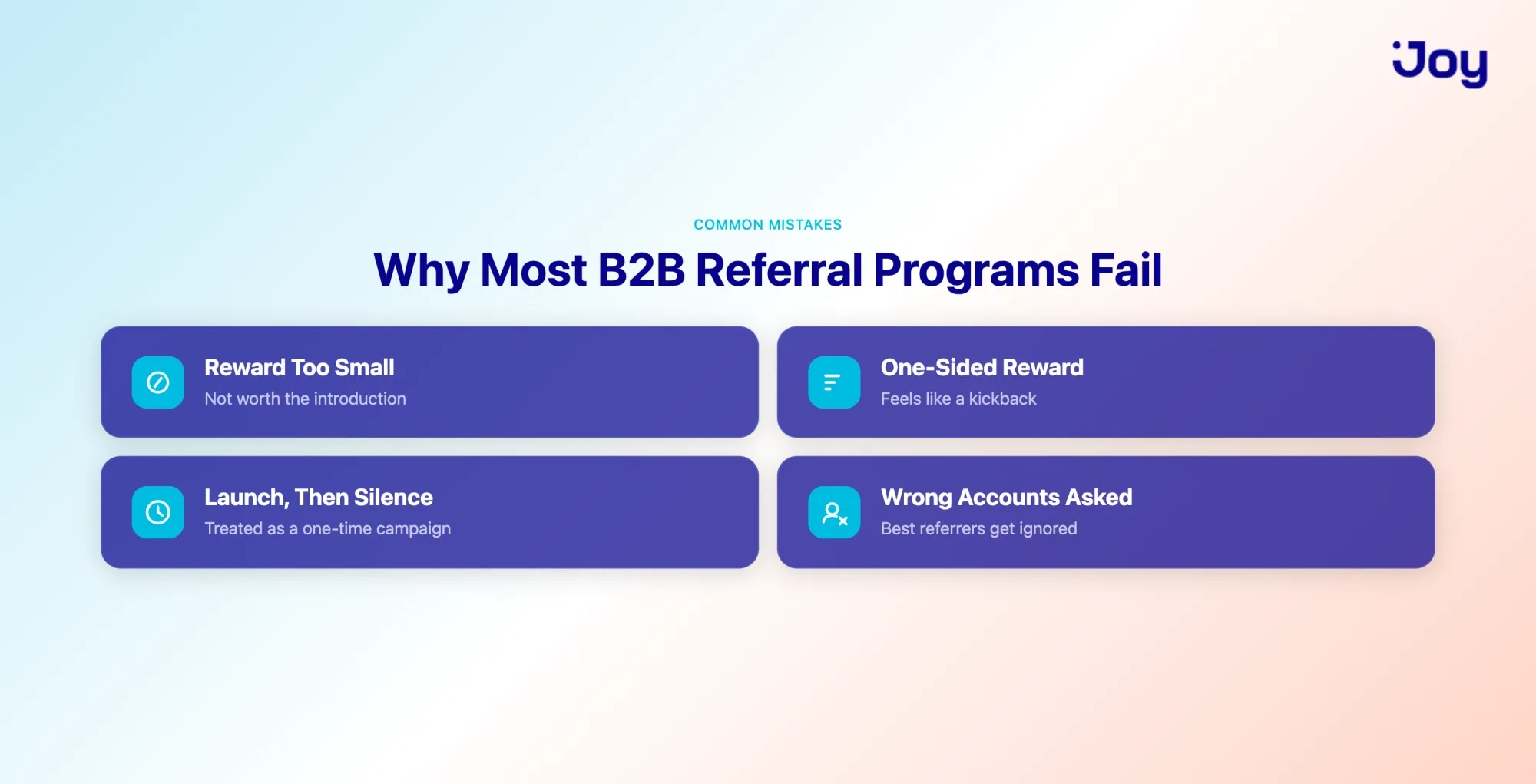
The reward isn't worth the effort. A token discount won't move a busy procurement manager to introduce you to a peer. In B2B, the customer relationships are valuable, and people protect them. If the reward doesn't feel proportional to the favor you're asking, accounts simply won't bother.
It's one-sided. When only the referrer gets paid, sharing feels transactional - like the customer is doing your sales for a kickback. Rewarding the referred company, too, reframes the whole thing as a helpful introduction, which is far easier to send.
It's treated as a campaign, not an operation. A launch email, a week of attention, then silence. Referral programs compound slowly; they need ongoing reminders at the right moments - after a positive support interaction, after a reorder, after a customer hits a milestone. A program nobody's reminded about is a program nobody uses.
Nobody's asking the right accounts. Leaving the program open and hoping people find it wastes your best referrers. The accounts most likely to refer are the ones you should be inviting by name.
The payout is manual. Spreadsheet tracking and hand-issued rewards don't survive contact with a busy month. Rewards get delayed, referrers lose trust, and the program dies of neglect rather than bad strategy.
Notice that none of these are about the offer being too small or too big. They're about mechanics - who you ask, what both sides get, and whether the thing runs itself.
Getting Started
A B2B referral program isn't a growth hack. It's a way to formalize something your best accounts already do - recommend you - and reward them for it consistently.
Start small. Name the 10 or 20 accounts most likely to refer, design a two-sided reward tied to a real order, and give them a simple way to share. Automate the tracking so it runs without you, measure whether referred accounts convert, then widen access once you know it works.
If you're on Shopify, Joy runs your referral program and loyalty program as one system - unique share links, automatic order attribution, and rewards that issue on their own - so the channel keeps compounding instead of stalling after launch week. You might start with a single referral reward and grow from there.
Frequently Asked Questions
What's the difference between a B2B and a B2C referral program?
B2B programs deal with longer sales cycles, higher order values, and fewer referrers. That means reward payouts often come in multiple steps timed to a longer buying cycle, the incentives are larger per referral, and you invite a smaller, more selective group of accounts rather than your entire customer base.
How much should I reward a B2B referral?
Enough that it feels proportional to the favor you're asking. Because a single B2B account can be worth thousands a year, you have room to reward generously - and you should, since a too-small reward is one of the most common reasons these programs stall. Tie the size to the value of a closed account, not to a flat discount.
When should I pay out the reward?
When the referred company places a qualifying order, not when they click a link or sign up. For longer cycles, a two-step payout works well: a small thank-you at first contact or sample order, and the full reward when they convert to a real account.
Do I need software, or can I track referrals manually?
You can start manually, but manual tracking is the most common reason B2B referral programs quietly die. Once you're attributing orders and issuing rewards by hand, it becomes a task someone forgets. An app that handles attribution and payouts automatically keeps the program alive past launch month.
Can I run a B2B referral program on Shopify?
Yes. If you sell wholesale or run B2B on Shopify, setting up a referral program issues unique share links, attributes referred orders, and triggers rewards automatically - and can connect into the same flows you use for company accounts and pricing.

Written by
Thomas Nguyen is the CEO & Co-founder of Joy, a loyalty solution for Shopify and eCommerce brands. With years of experience building high-performance Shopify apps, Thomas aims to help merchants grow through customizable and retention-focused tools.
Related reading
 How-to Guide
Set Up Your BFCM Loyalty in 15 Minutes
Set up BFCM loyalty in fifteen minutes, then spend a sixteenth placing one real order with both the sale discount and a reward on it.
 Thomas Nguyen
-4b0e2f.webp&w=3840&q=75) How-to Guide
How-to GuideReferral Partner Program: A 6-Step Guide to Real Revenue
A practical guide to building a referral partner program: how it differs from customer referrals, a 6-step setup, commission models, the metrics that matter, and why most stall.
Thomas Nguyen How-to Guide
Building Brand Loyalty for Ecommerce Brands in 2026: A Complete Playbook
Building brand loyalty is how smart ecommerce brands grow without chasing ads. Learn simple ways to turn buyers into repeat fans.
Thomas Nguyen How-to Guide
Black Friday Checklist That Turns Traffic Into Revenue
Four settings on a Black Friday checklist take days, not minutes. A 14-day points approval period lands BFCM points on 11 December.
Thomas Nguyen How-to Guide
Shopify BFCM Guide: Black Friday 2026 Is 27 November
Black Friday 2026 is 27 November and Cyber Monday is 30 November. Shopify changed how it counts BFCM customers, so 81M is not growth.
Thomas Nguyen How-to Guide
What Is Coalition Loyalty Program and How to Build a Successful One
Coalition loyalty programs unite multiple brands to offer seamless rewards across businesses. This guide explores how they work, their benefits, and steps to create a successful program.
Thomas Nguyen