
Customer Loyalty and Customer Satisfaction: Why Happy Customers Still Leave (And How to Fix It)
Customer satisfaction is a score; loyalty is a behavior. Confusing the two leaves you with a store full of happy one-time buyers. Here's the difference, why satisfaction alone fails, and a framework to close the gap.
Summarize this post with AI
Your store has a 4.8-star average. Customers leave positive reviews. Support tickets close fast. And yet, your repeat purchase rate is flat.
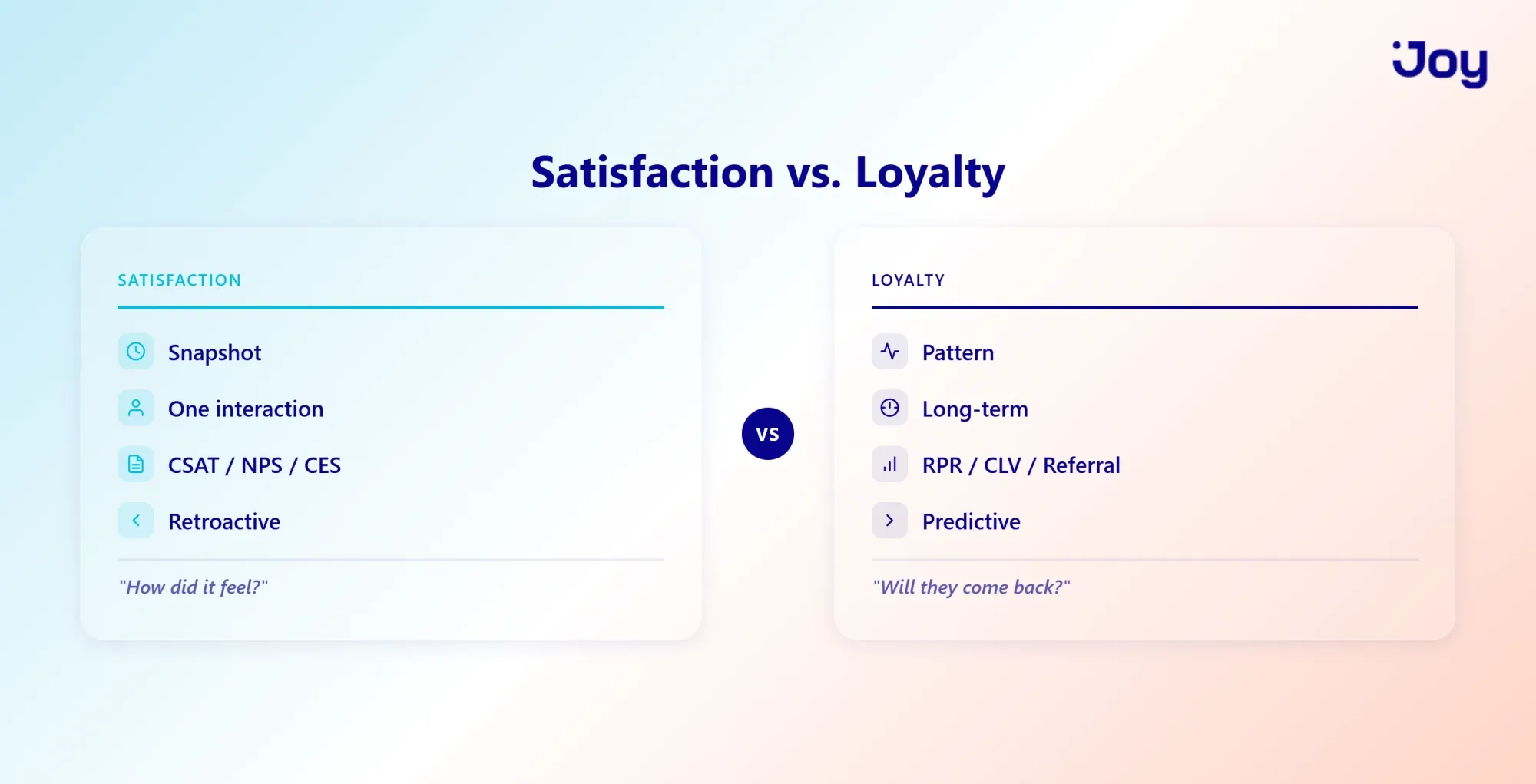
This is the Satisfaction Trap, and it's the most expensive mistake in ecommerce. Customer satisfaction and customer loyalty aren't the same thing. Satisfaction is a score. A snapshot of how a customer felt after one interaction. Loyalty is a behavior, a pattern of choosing your brand over and over, even when alternatives exist. Confuse the two, and you end up optimizing for the wrong outcome: a store full of happy one-time buyers.
Here's what this article covers: the difference between customer satisfaction and customer loyalty, why satisfaction alone fails, and a concrete framework to close the gap.
What Is Customer Satisfaction?
Customer satisfaction is a customer's emotional response to a specific interaction. A purchase. A delivery. A support ticket. It's a snapshot: how did that experience feel?
Brands typically measure it through three metrics. CSAT (Customer Satisfaction Score) captures post-interaction sentiment on a 1-5 scale. NPS (Net Promoter Score) measures the likelihood to recommend on a 0-10 scale. And CES (Customer Effort Score) gauges how much effort a customer had to invest to complete a task.
All three metrics are retroactive. They tell you what happened. They don't tell you what the customer will do next. A satisfied customer was pleased with their last order. But that feeling? It's not a prediction of their next one.
What Is Customer Loyalty?
Customer loyalty is something fundamentally different. It's a long-term behavioral pattern. The loyal customer returns by choice, refers others, resists competitor offers, and pays a premium without needing a discount to justify it.
That premium piece matters more than most brands realize. Price tolerance is one of the clearest signals of loyalty. Loyal customers are less price-sensitive and willing to pay more because their decisions are driven by relationships, not comparison shopping.
The metrics that capture loyalty are also forward-looking. Repeat purchase rate tracks whether customers actually come back. Customer lifetime value (CLV) measures a customer's value over time. And referral revenue reveals whether loyal customers are bringing in new buyers on your behalf.
The compounding is clearly evident in the data. Reichheld and Schefter (Bain & Company, HBR, July 2000) found that repeat customers in apparel e-tail spend more than twice as much in months 24 to 30 of their relationship as they do in the first six months. That's what loyalty builds into over time.
Customer Satisfaction vs. Customer Loyalty: Why the Distinction Matters
Both concepts sound positive. So why does the distinction matter?
Because satisfaction and loyalty look the same from the outside. The customer bought. The customer is happy. But they diverge completely at what happens next. Satisfaction creates no forward momentum, no structural reason to return. Loyalty does.
And this is exactly why a store can have excellent reviews and a flat repeat purchase rate at the same time. The experience was good. But the system to convert that experience into return behavior didn't exist.
This gap is invisible in most dashboards. Standard analytics tools report satisfaction signals but don't flag the absence of loyalty signals. You see positive reviews. You don't see the customers who never came back.
Satisfaction tells you the past was good. Customer loyalty and retention tell you the future will be profitable.
The Satisfaction Trap: Why Happy Customers Still Leave
A store can have excellent reviews, high CSAT scores, and fast-resolving support, and still lose customers to competitors every month. That's the Satisfaction Trap.
The reason is simple. Satisfaction creates no structural reason to return. A satisfied customer felt good about their last experience with you. But in ecommerce, where switching costs are near zero, feeling good isn't enough. The next ad from a competitor with a similar product and a first-order discount? It wins.
Satisfaction is table stakes. It keeps customers from leaving angry. It doesn't keep them from leaving indifferent.
Picture a skincare brand with 4.9-star reviews and a 15% repeat purchase rate. Customers loved the product. They just never had a reason to come back to that specific store when a dozen alternatives were one search away.
So, where does customer experience quality fit? Fast shipping, easy returns, responsive support: all of these matter. But they're necessary conditions, not sufficient ones. Great CX builds the foundation that loyalty needs. Without it, no loyalty system works. With it alone, loyalty still doesn't happen.
Most brands optimize for CSAT, reviews, and delivery speed. All satisfaction signals. Few have a system that converts satisfaction into a reason to return. Strong first experience, weak repeat rate. Sound familiar?
The financial cost of this pattern is staggering. Bain & Company (HBR, October 2014) found that acquiring a new customer costs 5 to 25 times more than retaining an existing one. Every satisfied customer who doesn't return is a sunk acquisition cost, and a new one who must be paid for from scratch.
Satisfaction protects the experience. Loyalty protects the revenue. You need both, and they require different systems.
To understand what actually converts a satisfied customer into a loyal one, you first need to know which metrics reveal the gap.
The Metrics That Reveal the Gap
If you only track satisfaction metrics, you'll never see the gap. Loyalty requires a different set of measurements, ones that look forward rather than backward.
The two categories break down like this:
| Metric | What It Measures | What It Tells You | Satisfaction or Loyalty? |
|---|---|---|---|
| CSAT | Quality of a single interaction | Did the last experience feel good? | Satisfaction |
| NPS | Intent to recommend | Are customers emotionally committed enough to advocate? | Leading loyalty signal |
| Repeat Purchase Rate | Behavioral return pattern | Are satisfied customers actually coming back? | Loyalty |
| Customer Lifetime Value (CLV) | Total revenue per customer over time | What is loyalty compounding into financially? | Loyalty |
| Referral Revenue | Revenue from customers who refer others | Are loyal customers driving acquisition for you? | Loyalty (advanced) |
These are the customer loyalty metrics and satisfaction metrics that reveal whether your system is working or stalling. Tracking both categories together is where the diagnostic power lives.
When CSAT is rising, but repeat purchase rate stays flat, you're watching the Satisfaction Trap unfold in real time. Good experiences that don't convert into returning customers. Something is missing between the first order and the second.
But when CSAT is strong, and repeat purchase rate is climbing alongside growing CLV, satisfaction and loyalty are working together. Each visit builds the next.
The difference between those two scenarios isn't the quality of the experience. It's whether a system exists to convert that experience into ongoing behavior.
For a deeper guide to tracking each of these metrics, see our complete breakdown of customer loyalty analytics. And for Shopify-specific benchmarks on repeat purchase rate and retention, check our guide to Shopify customer retention.
How to Turn Satisfied Customers into Loyal Ones: 4 Strategies
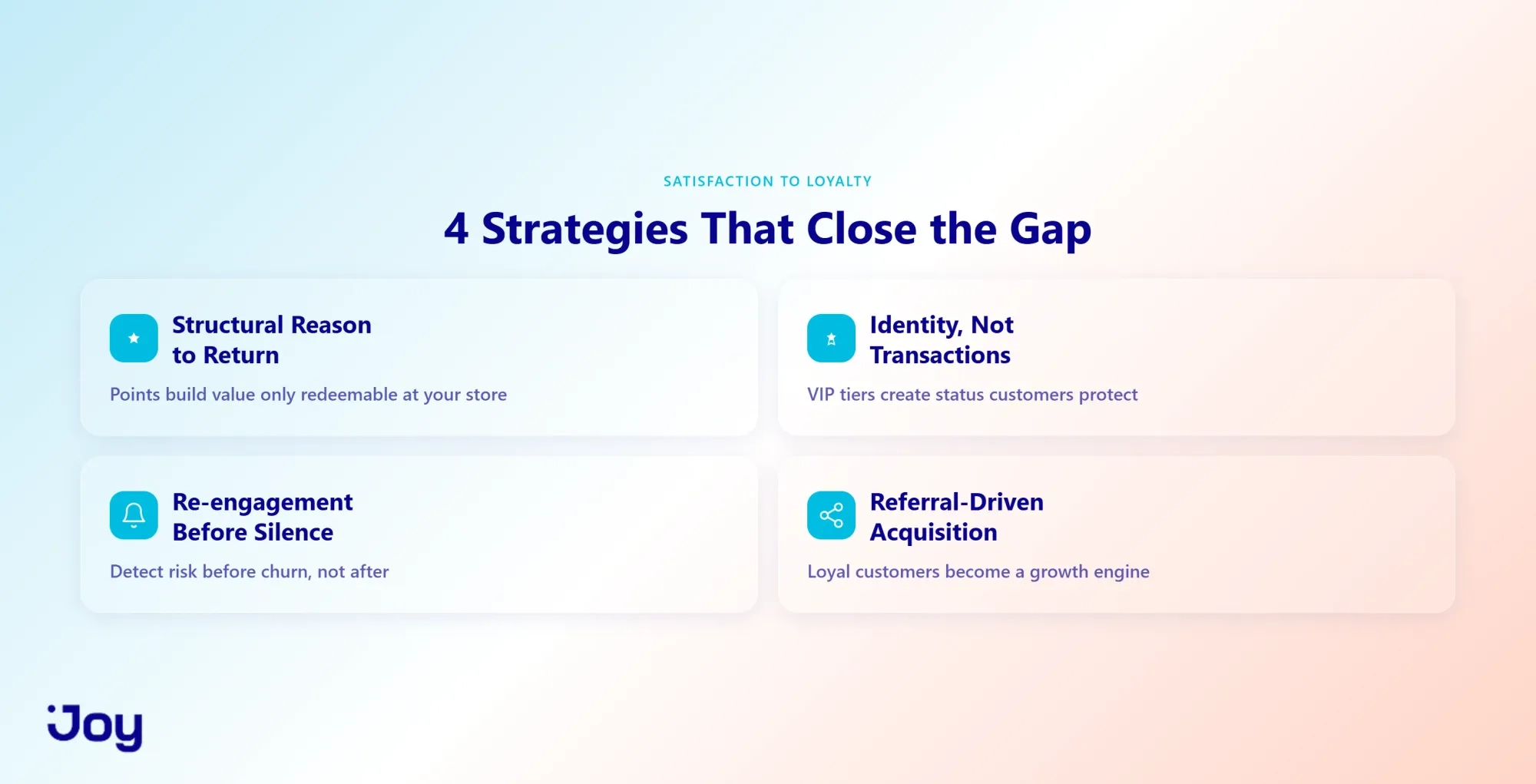
The metrics reveal the gap. These four strategies close it, each addressing a different root cause of the Satisfaction Trap.
Strategy 1: Give Satisfied Customers a Structural Reason to Return
Satisfaction creates goodwill. But goodwill alone doesn't produce a second purchase. A reason does. And the most effective reason is the earned value that exists only at your store and can only be redeemed by coming back.
A points program does exactly this. Every purchase builds a balance that the customer is motivated to redeem. They're not returning for a generic discount. They're returning for something they already own. That sense of accumulated value transforms a passive "I liked that store" into an active "I need to go back."
Strategy 2: Create Identity, Not Just Transactions
A satisfied customer has a good impression of your brand. A loyal customer has an identity tied to it. The gap between them is recognized belonging (a sense that this brand is for people like me).
VIP tiers create this shift. A customer who reaches Silver or Gold status isn't just a buyer anymore. They're a member. And status creates a reason to maintain the relationship because they don't want to lose what they've built. That psychological investment turns repeat purchasing from a habit into a commitment.
Strategy 3: Build the Re-engagement System Before Customers Go Quiet
Most brands intervene after churn has already happened, pouring money into win-back campaigns, heavy discounts, and desperate emails. Wrong sequence. By the time a customer stops engaging, re-acquisition costs nearly as much as new acquisition.
The right sequence flips this entirely. If a customer's purchase interval extends beyond their historical average, they're at risk, not lost. A timely points reminder or a milestone notification at that moment converts at dramatically higher rates than a post-churn offer. The key is detecting the gap before it closes, not scrambling after it's already shut.
Strategy 4: Convert Loyalty into Referral-Driven Acquisition
The highest expression of customer loyalty is referral. When a customer trusts your brand enough to stake their own reputation on recommending it, that's not just a retention win. It's an acquisition engine.
The numbers back this up. Bain & Company (Frederick Reichheld, HBR, 2014) found that a 5% increase in retention can drive 25% to 95% profit growth. Referral compounds this further: loyal customers who refer bring in new customers at near-zero acquisition cost, while themselves spending more over time.
Together, these four strategies form a complete bridge from satisfaction to loyalty. Each one addresses a specific failure point in the Satisfaction Trap.
Want to see how these four strategies work together as one system? Explore Joy's loyalty platform →
For a deeper dive into converting first-time buyers, see our guide on turning one-time buyers into repeat customers. And for the full case on why structured loyalty programs outperform satisfaction-only approaches, explore the benefits of loyalty programs.
Why the System Matters More Than Any Single Tactic
Can one of these strategies work on its own?
No. Customer satisfaction is a result of a good product and a good experience. Customer loyalty is a result of a system, one that gives customers a reason to return, a status to protect, and an advocacy channel to express commitment.
No single tactic produces loyalty in isolation. A points program without tiers creates transactional behavior. Tiers without re-engagement automation lose members silently. Referral programs without a loyalty foundation produce one-time advocates, not recurring ones.
The system that works combines all four layers: satisfaction as the experience layer, a loyalty program as the behavioral layer, re-engagement automation as the retention layer, and a referral program as the acquisition layer. Each layer amplifies the others.
The brands that win at retention don't manage these as separate initiatives bolted together. They run all four layers as one integrated system. That integration is where the compounding happens.
For the ROI case behind building this system versus repeatedly spending on acquisition, see our guide on customer retention cost. For a comprehensive retention strategy, explore our ecommerce customer retention guide.
The Bottom Line
Satisfaction is what customers feel after a good experience. Loyalty is what they do: return, refer, and stay, because a system earned it.
The Satisfaction Trap closes the moment you stop treating them as the same thing. Good CX is necessary. Not sufficient. The brands who convert satisfaction into loyalty are the ones who build the structure (points, tiers, re-engagement, referral) that gives every good experience a forward-looking reason to become the next one.
The goal is loyal customers. The kind who return without being asked, refer without being incentivized, and choose your brand even when a cheaper alternative exists. That requires all four layers working together.
Want to see what a complete satisfaction-to-loyalty system looks like in practice? Explore Joy's loyalty platform and see how the best brands turn satisfied customers into repeat buyers and advocates.
Frequently Asked Questions
What is the difference between customer loyalty and customer satisfaction?
Customer satisfaction measures how a customer feels about a specific interaction. A snapshot. Customer loyalty measures long-term behavior: whether a customer returns, refers, and resists switching to competitors. Satisfaction is necessary but not sufficient for loyalty. Without a deliberate engagement system, a satisfied customer has no structural reason to return.
Can a customer be satisfied but not loyal?
Yes, and it's more common than most brands realize. In ecommerce, where switching costs are near zero, satisfied customers defect daily. Not because they had a bad experience, but because they had no reason to return over a competitor's offer. Satisfaction protects against angry churn. Loyalty protects against indifferent churn.
What is the relationship between customer satisfaction and customer loyalty?
Satisfaction is the foundation loyalty builds on. Consistently positive experiences create the emotional goodwill that makes loyalty possible. But loyalty requires more: a points program, VIP status, referral incentives, all structural reasons for a satisfied customer to choose you repeatedly rather than defaulting to whoever reaches them next.
How do you measure customer loyalty vs. customer satisfaction?
Satisfaction is measured by CSAT (post-interaction score) and NPS (intent to recommend). Loyalty is measured by repeat purchase rate, CLV, and referral revenue. Tracking both together reveals whether you're delivering good experiences that actually convert into long-term revenue, or good experiences that customers enjoy once and don't repeat.
How do you turn satisfied customers into loyal ones?
Four strategies work together: (1) give satisfied customers a structural reason to return through a points program, (2) create identity-based commitment through VIP tiers, (3) automate re-engagement before customers go quiet, and (4) convert loyal customers into referral revenue through a referral program. The combination creates a system, not a campaign.
Why is customer loyalty more valuable than customer satisfaction?
Because loyalty compounds. Satisfied customers produce a good review. Loyal customers produce a second purchase, a referral, and a third purchase. Research by Reichheld and Schefter (Bain & Company, HBR 2000) found that in apparel e-tail, repeat customers spend more than twice as much in months 24 to 30 as in their first six months. Satisfaction creates a moment. Loyalty creates a multiplier.

Written by
Thomas Nguyen is the CEO & Co-founder of Joy, a loyalty solution for Shopify and eCommerce brands. With years of experience building high-performance Shopify apps, Thomas aims to help merchants grow through customizable and retention-focused tools.
Related reading
 How-to Guide
Brand Affinity vs Brand Loyalty: The Strategic Difference That Drives Ecommerce LTV (2026 Guide)
Confused about brand affinity vs brand loyalty? Discover the key difference and how it drives retention, margins, and LTV growth.
 Thomas Nguyen
 How-to Guide
Brand Extension vs Brand Loyalty: How Ecommerce Brands Should Decide When to Grow
Most ecommerce owners think more products mean more revenue. But they confuse brand extension with brand loyalty, and that confusion quietly drains their margins.
Thomas Nguyen How-to Guide
How to Measure Brand Loyalty: 6 Critical Metrics for 2026
Likes don't equal loyalty - and neither do single-purchase sales. This guide breaks down how to measure brand loyalty with 6 critical metrics: LTV, repeat purchase rate, retention rate, point redemption, NPS, and UGC. Plus benchmarks for 2026 - when acquisition costs are 4× higher.
Thomas Nguyen How-to Guide
How to Build a Customer Loyalty Survey That Prevents Churn
Most brands feel churn coming but never ask why. A well-designed customer loyalty survey flags at-risk customers while they're still buying — covering NPS, CSAT, and CES, question design, and how to turn feedback into retention action.
Thomas Nguyen How-to Guide
Brand Loyalty Questionnaire: 9 Strategic Steps for 2026
Likes don't reveal why customers stay. A brand loyalty questionnaire does. This guide breaks down 9 strategic steps to design, distribute, and act on surveys — from NPS and CSAT setup to automated follow-ups — so you can stop guessing and start retaining at lower acquisition costs.
Thomas Nguyen How-to Guide
Customer Loyalty Analytics: How to Measure and Improve Your Program
Customer Loyalty Analytics is basically about using data to understand how loyal your customers are and how to make them even more loyal. It helps businesses see how well their loyalty programs are working and find ways to improve them
Thomas Nguyen