
Best Shopify Membership Apps: Appstle $19, No Member Fee
Appstle charges $19 with no per-member fee. Inveterate publishes no price at all. Seven apps and what each pricing panel does not say.
Summarize this post with AI
Across the seven Shopify membership apps compared here, read from their live App Store listings on 8 October 2026, the number on the price card is the whole price on exactly one of them. Appstle Memberships runs $19 to $79 a month by member cap with "No per member fee or hidden fees!" printed on every card. The other six put the real cost in the additional-charges line underneath: a percentage of membership transactions on Conjured, a per-member fee on Bold and Simplee, a percentage per subscription on Subi, a promotional headline on YOYO, and on Inveterate nothing beyond "Free to install" and "See our website for full pricing details!".
So this article does what the category does not: transcribe what each panel says, what it stops short of saying, and where the money leaves your account. Every plan, feature and price was read from each app's live listing on 8 October 2026. Install counts are the number of live Shopify stores running the app on the same date.
Key takeaways
- Appstle Memberships is the only app here whose price card is the price: $19 for 100 members a month, $39 for 500, $79 for 750, no per-member fee, free to 25 members.
- Conjured charges a percentage of all membership transactions on top of its monthly fee, and the percentage falls as the fee rises: 2.9% at $9.99, 1.9% at $19, 0.9% at $69, minimum $0.10 per transaction.
- Bold prices purely per member at $0.13 a month with no base fee and the first 10 members free forever, the only linear model in the group.
- Simplee publishes a range rather than a price: $9.75 a month plus a per-member fee "ranging from $0.05 - $0.30", with the bands unpublished.
- YOYO shows $1 a month on three different tiers, with the real prices of $9, $59 and $199 in the additional-charges line as a limited BFCM offer.
- Inveterate's real pricing, and whether it takes a revenue share, is unresolved. Its listing publishes one card reading "Free to install" and points to its own site, which this research did not fetch.
What the seven panels publish
Feature bullets are nearly identical across these seven listings. The price models are where the apps differ, and that is the part nobody transcribes.
| App | Live stores | Rating / reviews | Card price | What the card leaves out |
|---|---|---|---|---|
| Appstle Memberships | 2,947 | 5.0 / 919 | Free to install | Nothing. "No per member fee" |
| Subi | 2,681 | 4.9 / 925 | Free to install | 1.6% per subscription from $29 |
| Bold Memberships & Loyalty | 449 | 4.4 / 86 | Free to install | $0.13 per member per month |
| YOYO | 433 | 5.0 / 173 | Free | $1 tiers become $9, $59, $199 |
| Simplee Memberships | 398 | 4.9 / 76 | Free | $0.05 to $0.30 per active member |
| Conjured Memberships | 372 | 4.9 / 88 | Free | 1.9% of membership revenue from $19 |
| Inveterate | 178 | 4.9 / 12 | Free to install | Everything |
1. Appstle Memberships — the only panel where the price is the price
Best for: brands that need a budgetable membership line and a forecastable member count. Appstle's cards read "No per member fee or hidden fees!" on all four tiers, so a brand modelling a 400-member programme knows it costs $39 a month and keeps costing $39 until it crosses 500 members. No other app here lets you say that.
Not ideal for: programmes expected to pass 750 members inside a year. The ladder stops there and the top card ends with "PING US FOR ENTERPRISE, APIs & WEBHOOK", so a brand needing API access or scaling past 750 is negotiating rather than buying, at a price that is not public.
2,947 live Shopify stores run Appstle Memberships. The listing read 5.0 stars from 919 reviews on 8 October 2026, the highest rating in this group.
What it actually does
- The free tier covers 25 members a month with membership management, member-only discounts and gated access, customer and order tagging, a member portal and automatic billing.
- Starter at $19 covers 100 members and adds dunning management, all third-party integrations and performance analytics; Business at $39 covers 500 and adds portal HTML editing, cancellation and retention management and one-off member perks; Business Premium at $79 covers 750 and adds custom email domain settings and bulk automations.
- Works with Shopify POS, Checkout, Customer accounts and Shopify Flow.
What to check before you commit
The unit is "members per month", and the listing does not define whether that counts active, new or billed members. Ask before modelling a programme with churn in it. The panel renders four cards, the App Store maximum, and links out, so a tier between $79 and the enterprise conversation may exist.
2. Subi — memberships priced as subscriptions, with a percentage on top
Best for: brands selling memberships alongside subscription boxes or prepaid plans, where one vendor should own both recurring contracts. Subi's tiers buy down the transaction percentage rather than raising a cap, from 1.6% at $29 to 0.8% at $119 to 0.4% at $479, so a programme with real recurring revenue gets cheaper per dollar as it grows rather than hitting a wall.
Not ideal for: small programmes treated as a perk rather than a revenue line. At $29 plus 1.6% per subscription transaction, a brand billing $2,000 a month in memberships pays $29 plus roughly $32, so the percentage already matches the subscription before the programme is meaningful, and the fee scales with the thing you are trying to grow.
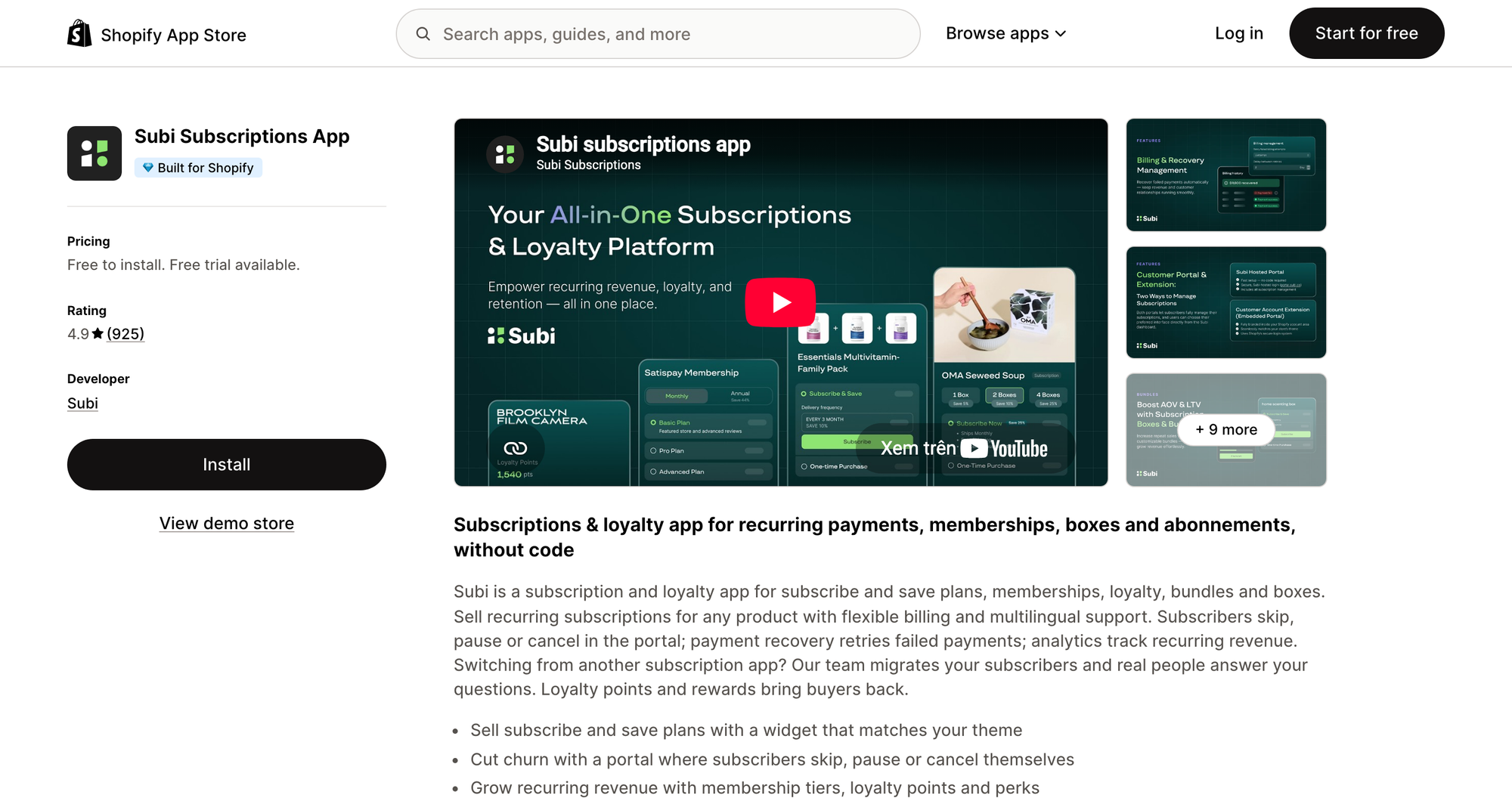
2,681 live Shopify stores run Subi. The listing read 4.9 stars from 925 reviews on 8 October 2026.
What it actually does
- Free to install covers membership management and perks, automatic recurring payments, a customer portal, subscription bundles and boxes, and custom billing dates.
- Starter at $29 plus 1.6% per subscription transaction adds unlimited subscriptions and revenue, widget, portal and email customisation, prepaid subscriptions and failed-payment retry. The Subi tier at $119 plus 0.8% adds quick checkout links, free shipping, cancellation tools and loyalty rewards; Subi Plus at $479 plus 0.4% adds advanced analytics and a customer success manager.
What to check before you commit
Do the crossover arithmetic first, because the cheap plan is the expensive one above a certain volume. Starter to the Subi tier costs $90 more a month and saves 0.8%, so the two meet at roughly $11,250 a month in membership transactions and $119 is cheaper above that.
3. Bold Memberships & Loyalty — one card, one number, per member
Best for: brands that want the cost of a membership programme to be a single arithmetic operation. Bold publishes one plan, Scale, free to install at $0.13 per member per month with the first 10 members free forever, no base fee and no transaction fees, so a 500-member programme costs $63.70 a month and a 5,000-member programme costs $648.70, with nothing else to read.
Not ideal for: large programmes and brands that want a vendor investing in the product. The linear model publishes no volume discount, so Bold is the cheapest option here at small scale and among the dearest at large scale. Its listing also holds the lowest rating in the group, 4.4, with 11 one-star reviews out of 86, which for an app listed since 2016 is a thin and uneven feedback base.
449 live Shopify stores run Bold's membership app. The listing read 4.4 stars from 86 reviews on 8 October 2026.
What it actually does
- The single Scale plan is free to install at $0.13 per member per month, makes the first 10 members free forever and is free for the first 30 days, with no base fees and no transaction fees. Works with Shopify POS, Checkout, Customer accounts and Shopify Flow, plus Bold Subscriptions and Stripe.
What to check before you commit
The per-member unit is the whole commercial model, so establish what Bold counts as a member and when it stops counting one. A programme with monthly churn pays for departures if the count is taken at the wrong moment, and the listing does not say. Then compare against Appstle: at 150 members Bold is $18.20 against Appstle's $19, and at 500 members Bold is $63.70 against $39.
4. YOYO — three tiers all showing $1, with the real prices underneath
Best for: brands wanting memberships inside a loyalty programme rather than beside one. YOYO's free Starter tier includes the membership feature, a POS extension and redemption, and wishlist, referral and loyalty widgets up to 100 monthly orders, so a small programme runs on one app with nothing to reconcile.
Not ideal for: anyone budgeting from the price card. Three separate tiers display "$1/month", and the additional-charges lines carry the actual prices: "$9 after first month" on Essential, "$59 after first month" on Growth and "$199 after first month" on Enterprise, each labelled a limited BFCM offer. A brand reading the cards and not the footnotes will under-budget by up to $198 a month.
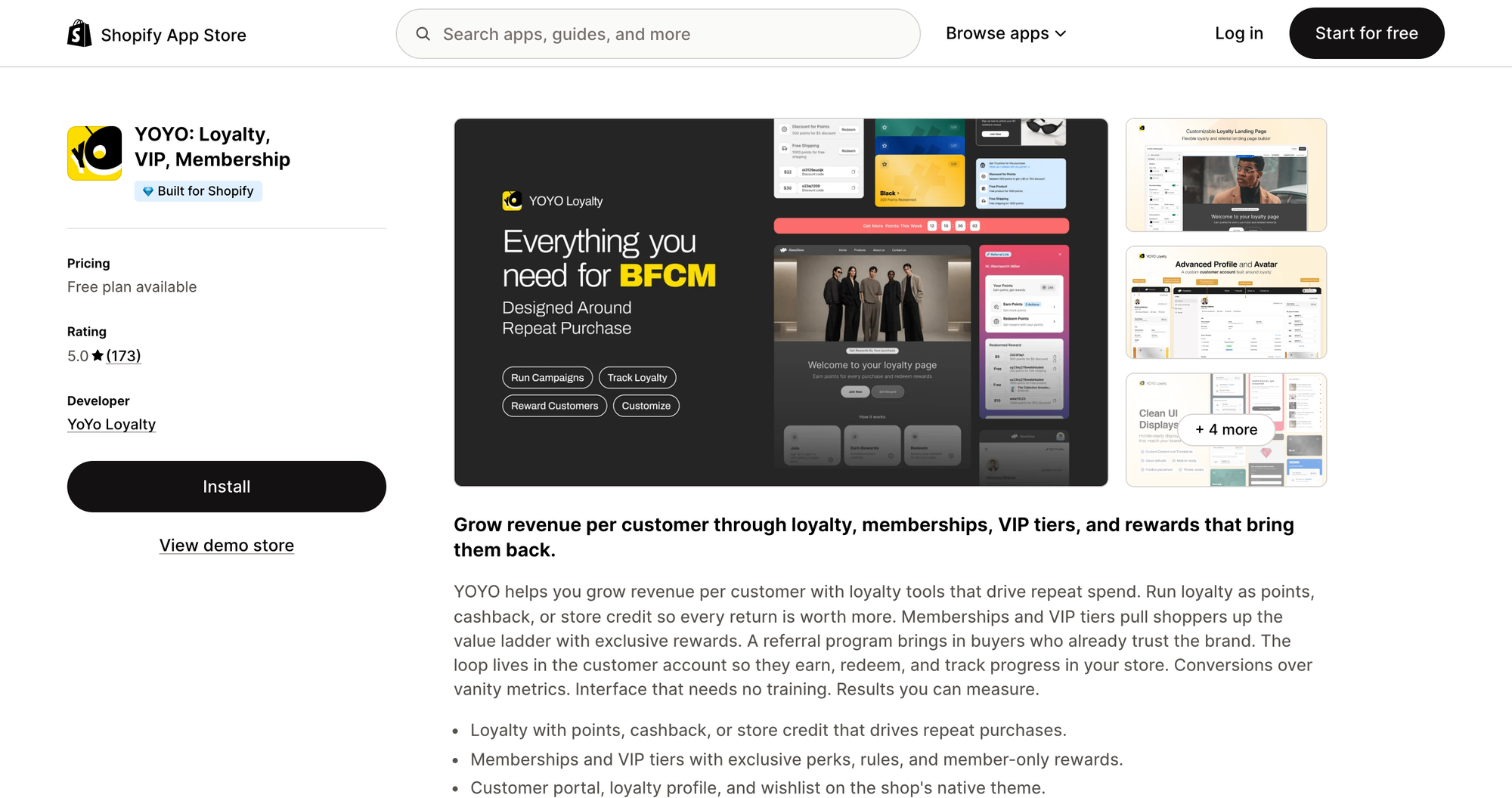
433 live Shopify stores run YOYO. The listing read 5.0 stars from 173 reviews on 8 October 2026, and the app launched on 10 April 2025.
What it actually does
- Starter is free to 100 monthly orders with loyalty points, cashback and store credit, the membership feature, a POS extension, referral widgets and win-back emails.
- Essential, $1 then $9, reaches 500 monthly orders and adds a storefront loyalty page; Growth, $1 then $59, reaches 2,000 and adds VIP tiers, a custom email sender domain, API access and Hydrogen support; Enterprise, $1 then $199, reaches 5,000.
What to check before you commit
The unit here is monthly orders, not members, which makes YOYO incomparable to the rest of the list without your order volume as well as your member count. A 400-member programme inside a 2,500-order store sits on Enterprise at $199. Then get the promotional end date in writing, because "limited BFCM offer" carries none on the listing.
5. Simplee Memberships — a per-member range, not a per-member price
Best for: brands that need store credit and POS discounts inside the membership programme at a low entry price. Simplee's Growth plan starts at $9.75 a month and names store credits for membership orders, member discounts at POS, restricted content and discounted trials.
Not ideal for: anyone who needs a number to put in a model. The additional-charges line reads "Monthly fee for active members, ranging from $0.05 - $0.30. Member fees decrease as your program grows", and the bands at which it decreases are not published. At 1,000 active members that range is the difference between $50 and $300 a month, a sixfold spread on the dominant cost line.
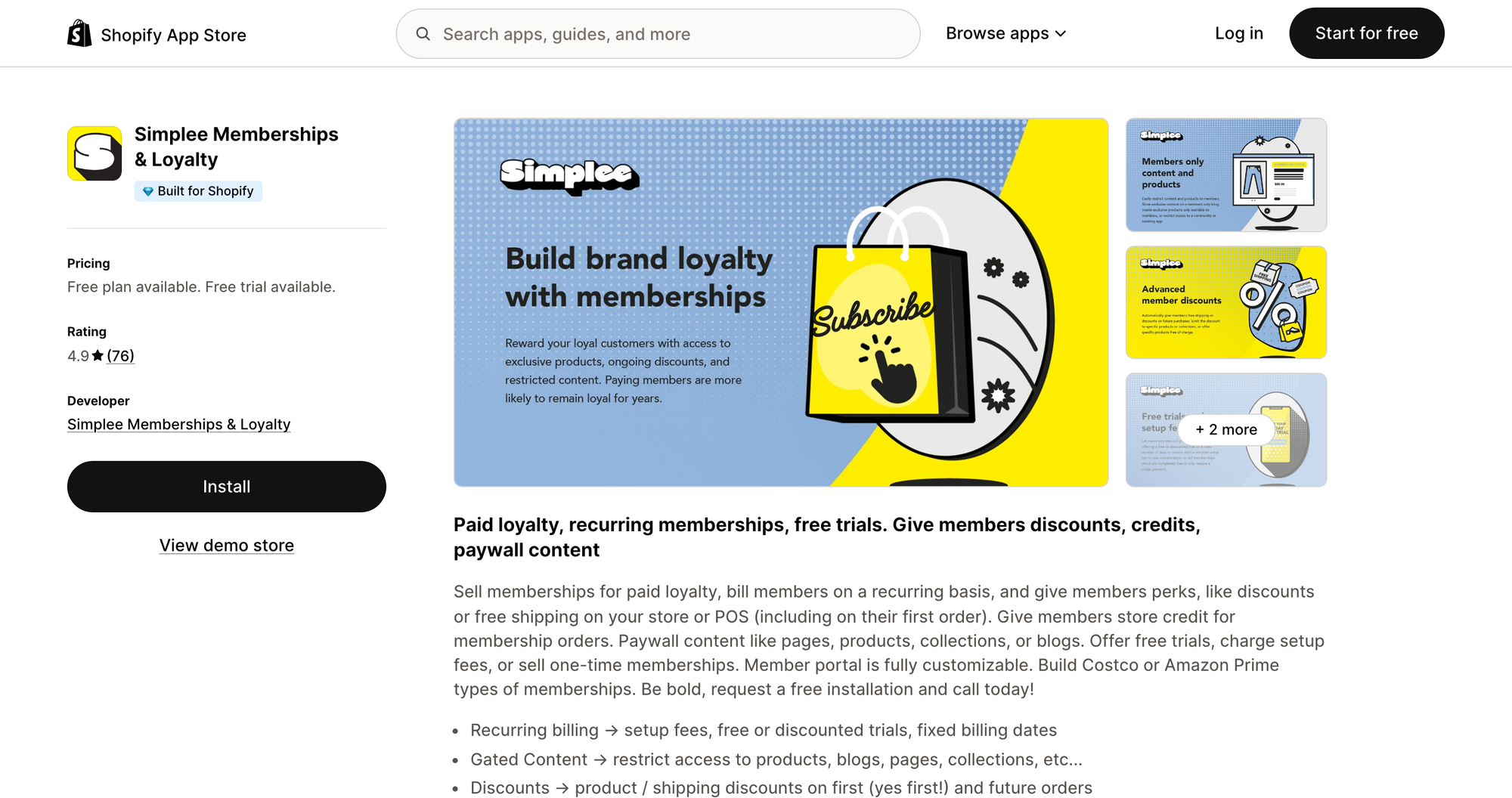
398 live Shopify stores run Simplee Memberships. The listing read 4.9 stars from 76 reviews on 8 October 2026, 75 of them five-star and none below four.
What it actually does
- A free Developer Store plan, with Shopify Plus test stores handled by contacting the vendor.
- Growth at $9.75 covers unlimited memberships and perks, restricted content for products, blogs and pages, automatic member discounts, member shipping, store credits and POS discounts.
What to check before you commit
Get the per-member bands in writing before installing, because the published range leaves the largest cost in your model undetermined. Ask at what member counts the fee steps down, and what counts as an active member. The panel renders two cards and links out, so this is not the full ladder.
6. Conjured Memberships — the percentage falls as the fee rises
Best for: brands with a small, high-value membership programme who would rather pay a percentage than a cap. Conjured's $9.99 Limited Special tier plus 2.9% of membership transactions means a programme billing $1,000 a month costs about $39, which is the cheapest route to unlimited members and unlimited membership revenue in this comparison.
Not ideal for: programmes at scale that stay on the cheap tier. At $50,000 a month in membership transactions, $9.99 plus 2.9% is roughly $1,460 while $69 plus 0.9% is roughly $519, so the entry plan costs over $900 a month more than the dear one. The $0.10 per-transaction minimum also makes Conjured a poor fit for low-value monthly memberships.
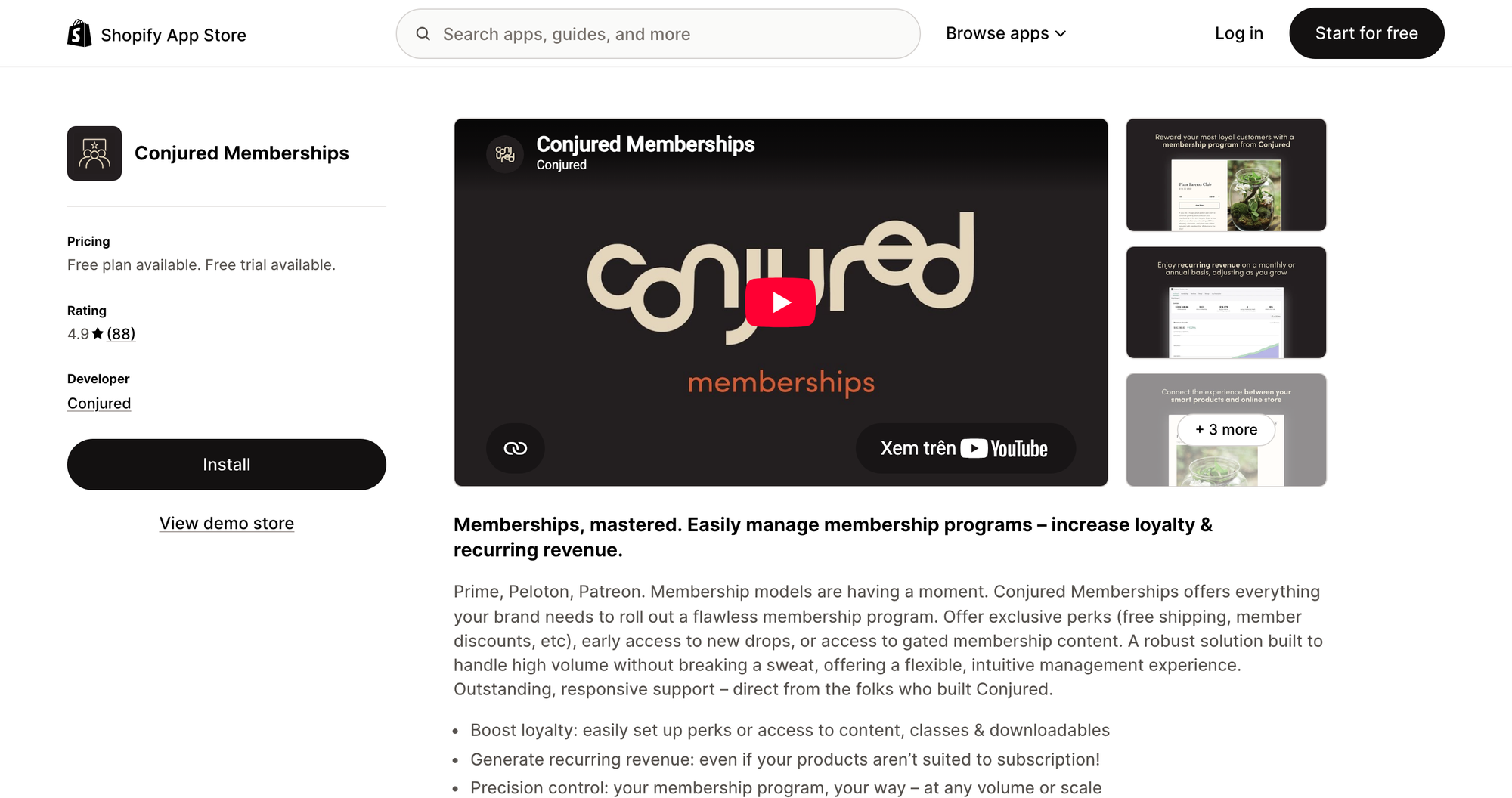
372 live Shopify stores run Conjured Memberships. The listing read 4.9 stars from 88 reviews on 8 October 2026.
What it actually does
- A free plan for Shopify Partner and Plus development stores, plus Limited Special at $9.99 plus 2.9% of all membership transactions, minimum $0.10 per transaction.
- Starter at $19 plus 1.9% covers unlimited members and unlimited membership revenue, fully customisable HTML and emails, members-only pricing, perks and content; Growth at $69 plus 0.9% is the scaling tier, with enterprise pricing available.
What to check before you commit
Run the crossover first, because this is the clearest case in the category of the cheap plan being the expensive one. Starter beats Limited Special above roughly $900 a month in membership transactions, and Growth beats Starter above roughly $5,000. Note the minimum too: $0.10 per transaction on a $5 monthly membership is a 2% floor regardless of tier.
7. Inveterate — the listing publishes no price
Best for: brands prepared to run a sales conversation to find out what a membership programme costs, typically because they want the paid-membership model Inveterate is known for and have shortlisted it on reputation rather than price. Its named integration set, which includes Klaviyo, Postscript, Gorgias, Rebuy and Tapcart, signals who the product is sold to, so a brand already running that stack will find the hand-offs already built.
Not ideal for: any brand comparing options on published information. Inveterate's panel renders a single card reading "Free to install" with no feature bullets, and its only additional-charges line reads "See our website for full pricing details!". That is less than any other app here publishes.
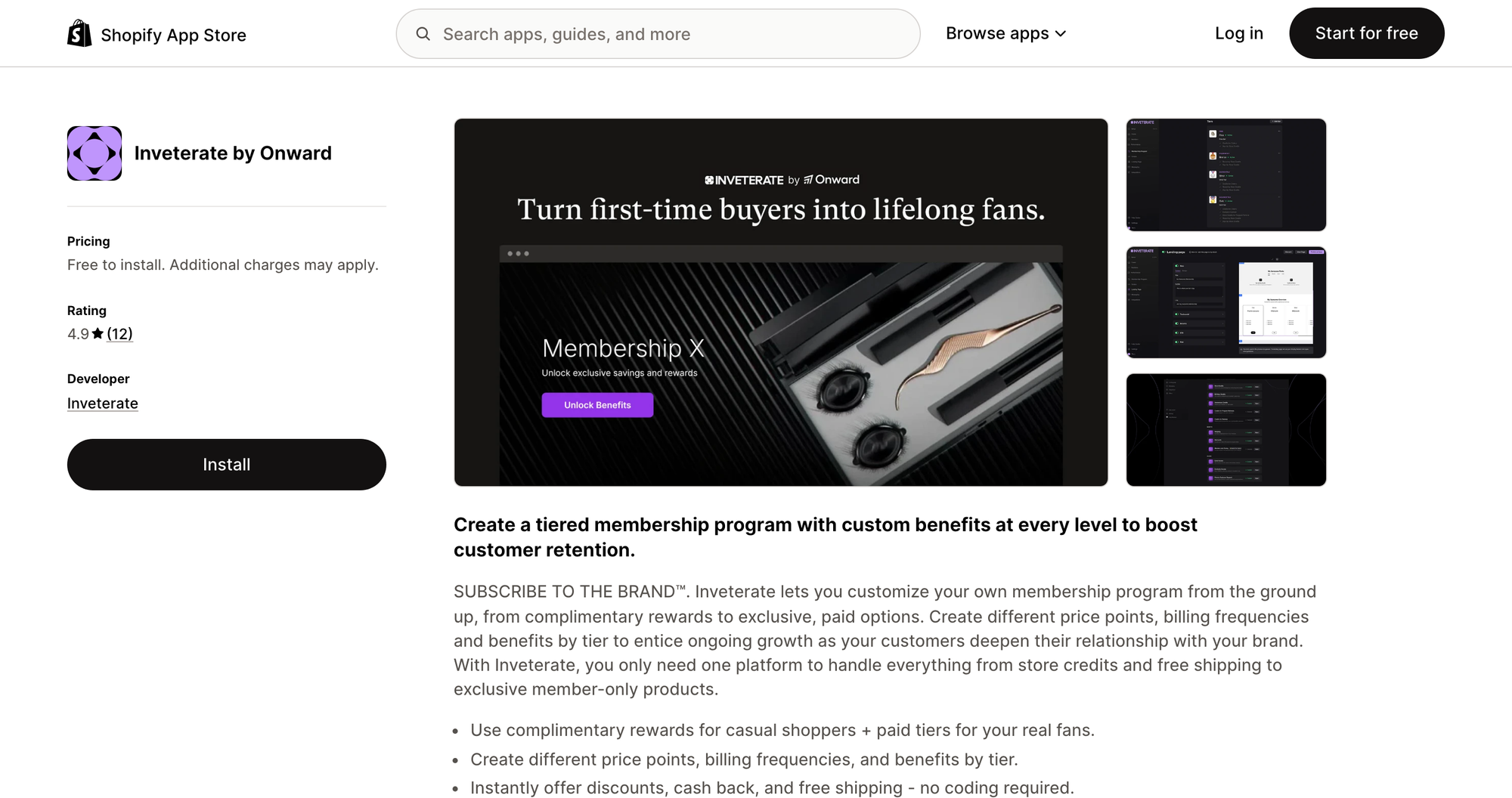
178 live Shopify stores run Inveterate. The listing read 4.9 stars from 12 reviews on 8 October 2026, the thinnest feedback base here by a wide margin.
What it actually does
- The listing names integrations with Shopify POS, Checkout, Customer accounts, Klaviyo, Postscript, Gorgias, Rebuy and Tapcart, a notably enterprise-leaning stack. Beyond that, the pricing panel names no features and no plan contents at all.
What to check before you commit
Two things are unresolved here: Inveterate's actual prices, and whether it takes a revenue share of membership sales. Both live on inveterate.com, which was not fetched for this comparison, so neither is stated in either direction. Ask for the pricing in writing, ask whether a percentage of membership revenue is involved, and ask what Shopify plan tier is required.
How to choose between the four pricing models
Three numbers decide this. Members and member churn set the cost on Appstle, Bold and Simplee: Appstle is flat inside each cap, Bold is linear with no published discount, Simplee is a range you have to ask about. Monthly membership revenue sets the cost on Conjured and Subi, and both get cheaper per dollar as you move up, which inverts the instinct to start cheap. Monthly store orders set the cost on YOYO alone.
Then the crossovers. Under roughly 160 members, Bold at $0.13 each is cheapest. Between 160 and 750 members with revenue under about $900 a month, Appstle's capped tiers are. Above roughly $5,000 a month in membership revenue, Conjured's Growth tier beats its own cheaper plans.
A paid membership is a loyalty programme with a price on the door, so the design questions are the same: what the member gets that non-members cannot, and whether the perk recovers the fee. Paid loyalty programmes covers the model, VIP and tiered loyalty programmes cover the free alternative that often works better, and loyalty programme cost covers pricing the line. The Shopify subscription apps comparison prices the adjacent category the same way.
What the pricing panels tell you about the category
The transcription is the finding. Six of seven listings put the real cost below the price card, one publishes no price at all, and no two apps meter the same unit. Appstle Memberships earns the top position on one ground: it is the only app whose published price survives contact with your spreadsheet. So write down your member count, your membership revenue and your store orders, then read the additional-charges line on every card rather than the price.
Frequently asked questions
What is the best Shopify membership app? Appstle Memberships, on published pricing and adoption. It runs on the most live Shopify stores here. Its listing read 5.0 stars from 919 reviews on 8 October 2026, and it is the only app where the price on the card is the whole cost, with "No per member fee or hidden fees!" on every tier.
How much do Shopify membership apps cost? The units are not comparable. Appstle charges $19 to $79 a month by member cap. Bold charges $0.13 per member per month. Conjured charges $9.99 to $69 plus 0.9% to 2.9% of membership transactions. Subi charges $29 to $479 plus 0.4% to 1.6% per subscription transaction. Simplee charges $9.75 plus $0.05 to $0.30 per active member. YOYO prices on monthly orders.
What does Inveterate cost? Its Shopify App Store listing does not say. The panel shows one card reading "Free to install" and an additional-charges line reading "See our website for full pricing details!". Whether Inveterate takes a revenue share is also unstated, so ask for both in writing.
Is there a free Shopify membership app? Appstle's free tier covers up to 25 members a month with no per-member fee, YOYO's free Starter tier includes the membership feature up to 100 monthly orders, and Bold makes the first 10 members free forever.
Which membership app works with Shopify POS? Appstle, Subi, Bold, Simplee and Inveterate all name Shopify POS on their listings, and YOYO names a free POS extension with redemption on its Starter tier. Conjured does not name POS.
Should a membership programme replace a points programme? They solve different problems. A points programme rewards behaviour you already want and costs you only on redemption. A paid membership collects revenue up front and commits you to a perk every month, a harder promise and a better one when the perk is structural.

Written by
Thomas Nguyen is the CEO & Co-founder of Joy, a loyalty solution for Shopify and eCommerce brands. With years of experience building high-performance Shopify apps, Thomas aims to help merchants grow through customizable and retention-focused tools.
Related reading
 Shopify apps
Affiliate App Fees: ReferralCandy 10.5%, GoAffPro 0%
Total cost at $5,000, $25,000 and $100,000 of monthly affiliate revenue across seven apps and four different pricing shapes.
 Thomas Nguyen
 Shopify apps
EU Withdrawal Button Apps: Two Start Free, One Charges
EU Directive 2023/2673 became mandatory on 19 June 2026. Four withdrawal-button apps on price, scope and what each listing leaves out.
Thomas Nguyen Shopify apps
Best Free Shopify Loyalty Apps: 50 to 400 Orders Free
Free-tier caps run from 50 orders on CWILL to 400 on LoyaltyLion. The full table, plus what crossing each cap actually costs.
Thomas Nguyen Shopify apps
Shopify Subscription Fees: Seal $89.95, Recharge $1,671
Total cost at 100, 500 and 2,000 subscribers across six apps. Recharge Starter passes Seal's top tier at 382 subscribers.
Thomas Nguyen Shopify apps
Govalo Pricing: 2.9% of Gift Card Value on Every Plan
The percentage never goes away, not even on the $399 Enterprise tier. Six alternatives priced against a $20,000 gift-card month.
Thomas Nguyen Shopify apps
Best Shopify Subscription Apps: Seal 0%, Recharge 1.49%
At $50,000 a month in subscription revenue Appstle costs $100, Seal $24.95 and Recharge about $844. Eight apps and who each one suits.
Thomas Nguyen