
Best Shopify Subscription Apps: Seal 0%, Recharge 1.49%
At $50,000 a month in subscription revenue Appstle costs $100, Seal $24.95 and Recharge about $844. Eight apps and who each one suits.
Summarize this post with AI
At $50,000 a month in subscription revenue, Appstle Subscriptions costs $100, Seal costs $24.95, Shopify Subscriptions costs nothing, and Recharge costs about $844. That is the whole category in one line, and it is the line most comparisons leave out, because they quote the monthly fee and skip the transaction fee sitting on top of it.
Four of the eight apps below charge 0% per transaction: Seal, Appstle, Recurpay and Shopify Subscriptions. Four charge a percentage: Recharge at 1.49%, Loop at 1.0%, PayWhirl from 3% down to 0.75%, and Bold at 2% falling to 0.9%. The percentage apps buy you cancellation-prevention flows, dunning depth and implementation support. Whether that is worth $800 a month is the actual decision.
Key takeaways
- Appstle Subscriptions has 8,938 reviews at 5.0 stars — more public feedback than any other subscription app, and 2.9 times Recharge's 3,127.
- Shopify Subscriptions is free and first-party and rated 3.7 from 844 reviews on 7 October 2026, with 19% of them one-star. It is the lowest-rated app in this comparison by a wide margin.
- Appstle meters you by subscription revenue; Seal meters you by subscription count. A store with 100 subscriptions at $200 each pays $5.95 on Seal and $100 on Appstle. A store with 400 subscriptions at $10 each pays $24.95 on Seal and $10 on Appstle.
- Recharge's $499 Plus plan only costs less than its $99 Starter plan above roughly $267,000 a month in subscription revenue. Below that, Plus is the more expensive option.
- Recharge is the only app here with a 60-day free trial, and the only one whose entry price is $25 for the first 50 subscribers with no transaction fee.
- Every app here is built on Shopify's native subscriptions framework, so the subscription mechanic itself is not what differs. Retention tooling and billing model are.
What you are actually buying
Shopify's own subscriptions purchase option and selling plans framework is what every app in this list runs on. The recurring charge, the subscription contract and the customer's payment method are platform primitives. No app in this comparison invented them, and no app can be meaningfully better at them.
So the differences land in three places, and they are what each section below is judged on.
Churn control. Failed payments and voluntary cancellations are where subscription revenue leaks, and dunning depth, retry schedules and cancellation flows are the only features that move those numbers. This is also where the economics justify spending: Harvard Business Review's summary of the retention research puts acquiring a new customer at five to 25 times the cost of keeping one, and cites Frederick Reichheld's finding at Bain & Company that lifting retention 5% raises profit 25% to 95%. A subscription app that recovers one failed payment a day is doing retention work at acquisition prices.
Where the subscriber can self-serve. A customer portal that lets someone skip, swap or reschedule without emailing support prevents the cancellation that a locked portal causes. Checkout-level control depends on Shopify's checkout UI extensions, which are Plus-only.
How you are billed. Flat fee, percentage of subscription revenue, subscription count cap, or revenue cap. This is the single biggest cost variable in the category and the one least often laid out.
The transaction fee is the price
Every rating, review count and price below was read from each app's live Shopify App Store listing on 7 October 2026, and each app name links to its listing so you can check it in one click. Install counts are the number of live Shopify stores running the app on the same date.
| App | Installs | Rating / reviews | Entry plan | Transaction fee |
|---|---|---|---|---|
| Recharge | 52,220 | 4.8 / 3,127 | $25 | 1.49% + 19¢ |
| Seal | 34,158 | 4.9 / 3,130 | free | 0% |
| Appstle | 32,512 | 5.0 / 8,938 | free | 0% |
| Shopify Subscriptions | 15,787 | 3.7 / 844 | free | 0% |
| Recurpay | 8,062 | 5.0 / 572 | $9 | 0% |
| Bold | 6,322 | 4.0 / 381 | $24.99 | 2% |
| PayWhirl | 4,810 | 4.7 / 191 | free | 3% |
| Loop | 4,091 | 5.0 / 780 | free | 1.0% |
What each one costs at $50,000 a month in subscription revenue
| App | Plan | Monthly | Transaction | Total |
|---|---|---|---|---|
| Shopify Subscriptions | free | $0 | 0% | $0 |
| Seal | Legend, up to 500 subscriptions | $24.95 | 0% | $24.95 |
| Appstle | Business Premium, up to $100,000/mo | $100 | 0% | $100 |
| Bold | Scale | $74.99 | 0.9% = $450 | $524.99 |
| Loop | Starter | $99 | 1.0% = $500 | $599 |
| PayWhirl | Traction | $29 | 1.5% = $750 | $779 |
| Recharge | Starter | $99 | 1.49% = $745 | $844 + 19¢ per order |
Prices read off the live Shopify App Store listings on 7 October 2026. Recharge and Loop also add a per-order amount; Recharge's is 19¢, which on 2,000 monthly orders is another $380.
The gap between the top and bottom of that table is roughly 34 times. Nothing about the subscription mechanic differs that much. What differs is what you get alongside it.
1. Recharge — the incumbent, priced as a platform
Best for: brands above roughly $250,000 a month in subscription revenue with a real retention problem to solve, where a percentage fee buys implementation help, cancellation-prevention flows and benchmarks against comparable brands. If you have someone whose job is subscriber retention, Recharge gives them tooling the cheap apps do not.
Not ideal for: stores below six figures a month. At $50,000 you pay roughly $800 a month for software four competitors provide for under $100, and the retention features only pay for themselves once the revenue they protect is large enough to notice.
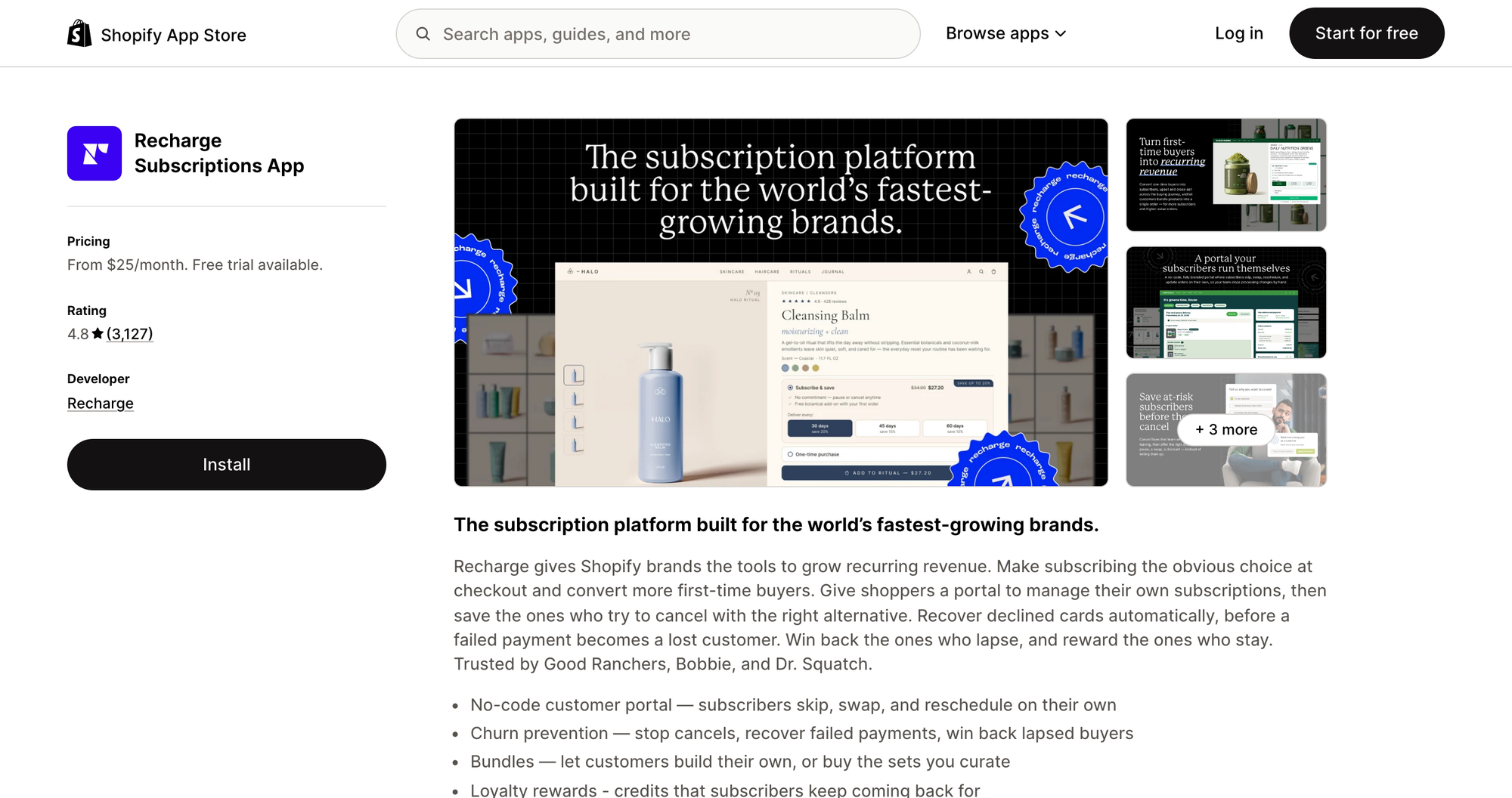
52,220 installs, 4.8 stars from 3,127 reviews.
What it actually does
- Recharge ships a subscription-first product page widget and a no-code customer portal, so the two surfaces a subscriber touches most are configurable without a developer.
- Smart cancellation prevention and failed payment recovery — the two features that directly change churn rather than describing it.
- Upsell and cross-sell inside the subscription flow, so an existing subscriber is a merchandising surface rather than a fixed monthly amount.
- Analytics with industry benchmarks, which no other app in this list offers. Knowing your churn is 6% matters less than knowing whether 6% is good for your category.
What to check before you commit
Three prices, and the middle one is the trap. The $25 plan covers your first 50 subscribers with no transaction fee, which makes Recharge the cheapest serious way to start in this entire comparison. Starter is $99 plus 1.49% plus 19¢ per transaction. Plus is $499 plus 1.34% plus 19¢.
Do the crossover arithmetic before picking Plus. The $400 monthly difference is only recovered by the 0.15% fee saving at about $267,000 a month in subscription revenue. Below that, Plus costs more than Starter for the same percentage maths plus hands-on implementation.
Recharge also warns on its listing that external charges may be billed separately from your Shopify invoice. The 60-day free trial is the longest in the category by a factor of two, which is long enough to actually measure churn rather than guess at it.
2. Seal Subscriptions — 0% fees, metered by subscription count
Best for: high-value, low-count subscriptions. A hundred subscribers at $200 a month is the exact shape this pricing rewards — coffee clubs with large bags, supplement protocols, B2B replenishment. Seal also gives full API and webhooks access on the free plan, which makes it the cheapest way to run subscriptions on a custom front end.
Not ideal for: stores with thousands of low-ticket subscriptions. Seal counts subscriptions, not revenue, and the published ladder stops at 500. Past that you are asking for a quote while a revenue-metered competitor would still be charging $30.
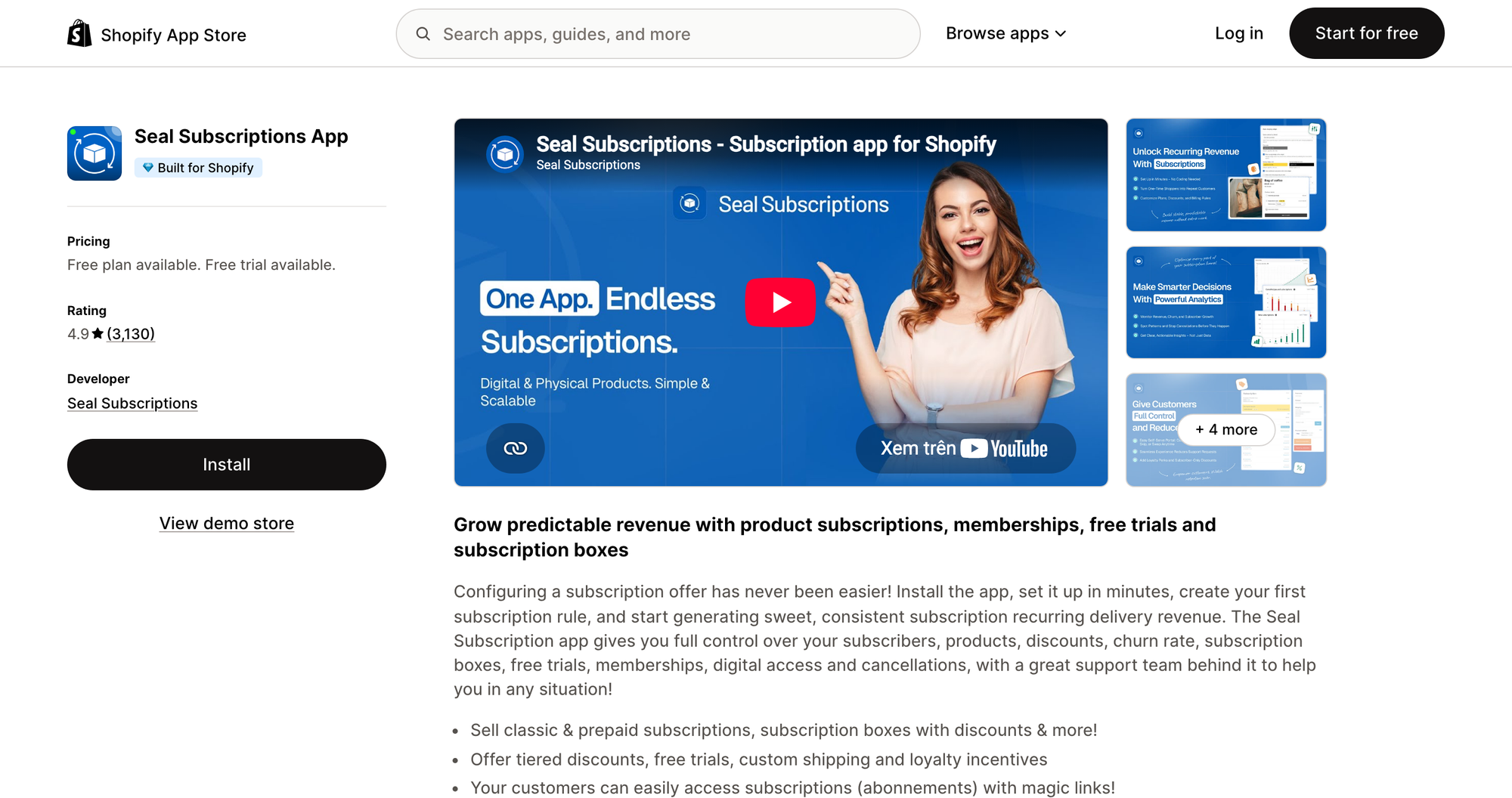
34,158 installs, 4.9 stars from 3,130 reviews.
What it actually does
- Seal includes full API and webhooks access on every plan including free — only Recurpay matches that, and it is the single most underrated line in this comparison for anyone running headless.
- Tiered subscription discounts, product swaps and automations, auto-recalculated delivery costs and recurring invoices, all on the free plan.
- A passwordless customer portal, renewal reminders and discounts applied on product swaps from $5.95. The renewal reminder matters more than it sounds: a surprise charge is a chargeback and a cancellation at once.
- A payment calendar, custom cancellation flow, quick checkout wizard and one-click checkout links from $9.95.
- Fixed schedules for magazines and other date-based products on the $24.95 Legend plan.
What to check before you commit
Every plan says "unlimited revenue" and caps subscription count: 50 free, 100 at $5.95, 250 at $9.95, 500 at $24.95. That is the opposite of how Appstle charges, and the two diverge hard at the extremes. A store with 100 subscriptions at $200 each does $20,000 a month and pays Seal $5.95; the same store pays Appstle $100. Reverse the shape — 400 subscriptions at $10 each, $4,000 a month — and Seal charges $24.95 while Appstle charges $10.
Work out both numbers, subscriber count and subscription revenue, before comparing these two. One favours each app.
3. Appstle Subscriptions — the most-reviewed app in the category
Best for: stores with many low-ticket subscriptions, and anyone who wants build-a-box or bundling without paying a percentage. Appstle also includes hands-on migration on the free plan, which makes it the cheapest way to leave a percentage-based app.
Not ideal for: stores whose subscription revenue is high relative to subscriber count, where Seal's count-based ladder is dramatically cheaper. Also worth care if you plan to raise prices: Appstle's caps are on revenue, so a price increase moves you up a tier with no change in subscriber count.
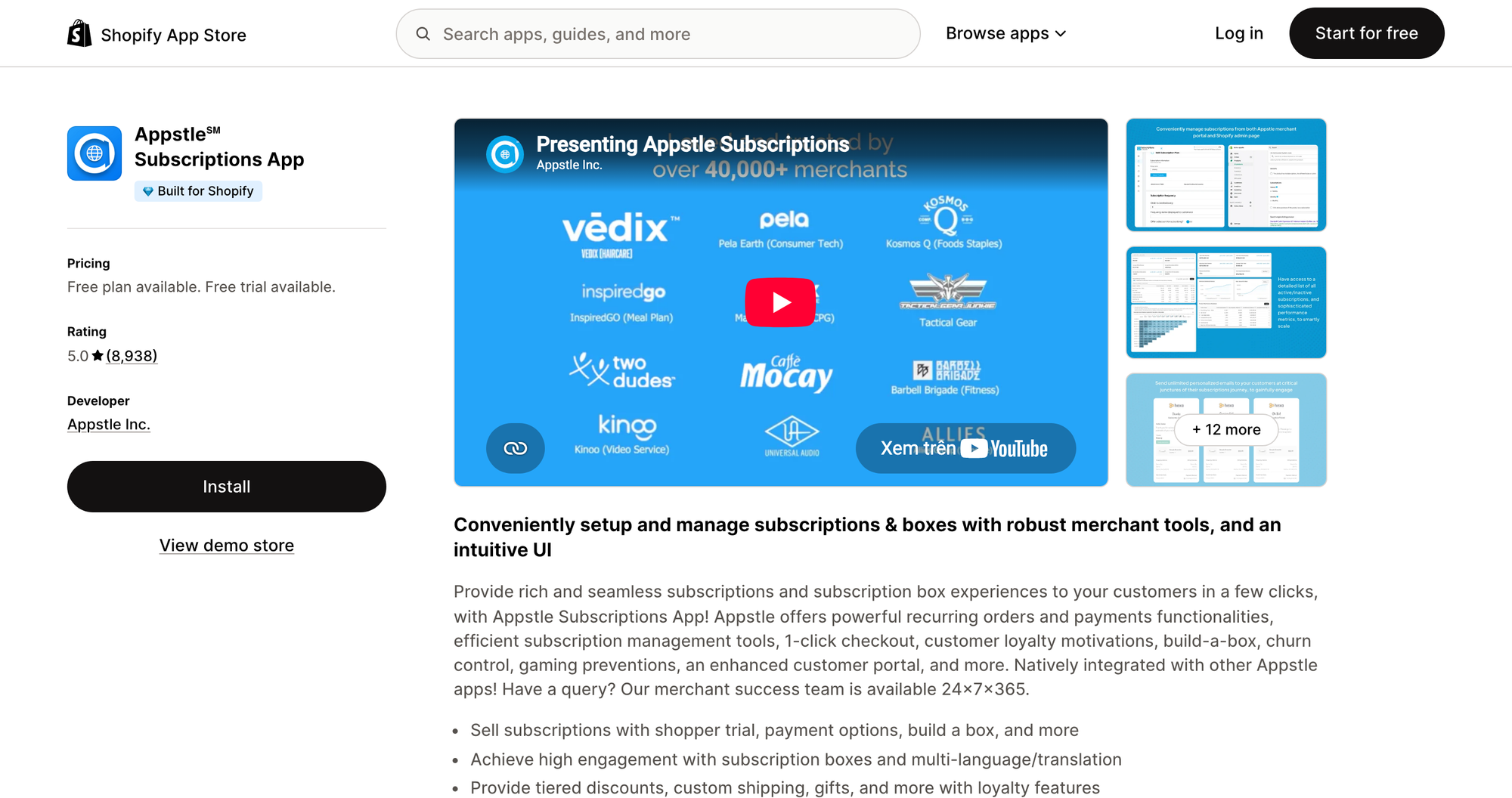
32,512 installs, 5.0 stars from 8,938 reviews.
What it actually does
- Appstle charges 0% transaction fee on every plan including free, capping revenue instead: $500 a month free, $5,000 at $10, $15,000 at $30, $100,000 at $100.
- Hands-on migration included on the free plan. Migration is normally a paid-tier or professional-services line, and it is the main switching cost in this category.
- Build-a-box and bundling, action logs, customised widget themes and placements, retention tools and cancellation control from the $30 Business plan.
- Product swap, automatic price and address sync, checkout links and a custom email domain from $100.
- Loyalty features — discounts and rewards attached to subscriptions — from the $10 Starter plan.
What to check before you commit
8,938 reviews at a 5.0 average is the strongest public record in this category and nearly three times Recharge's. Read a sample rather than the average: a perfect score across that many reviews says as much about the review prompt as about the product.
Annual billing saves 20%. And model the revenue caps against your roadmap, not against today — $15,000 a month sounds distant until a 20% price rise and a good quarter put you through it.
4. Shopify Subscriptions — free, first-party, and the lowest-rated here
Best for: validating that subscriptions work for your catalogue at all, with no budget and simple needs. It is first-party, so there is no third-party billing, no migration and no vendor risk while you find out whether customers will subscribe.
Not ideal for: any store whose subscription revenue already matters. Shopify Subscriptions has no dunning depth, no cancellation flows, no build-a-box and no API, and the rating suggests the gap between free and adequate is real for a lot of merchants.
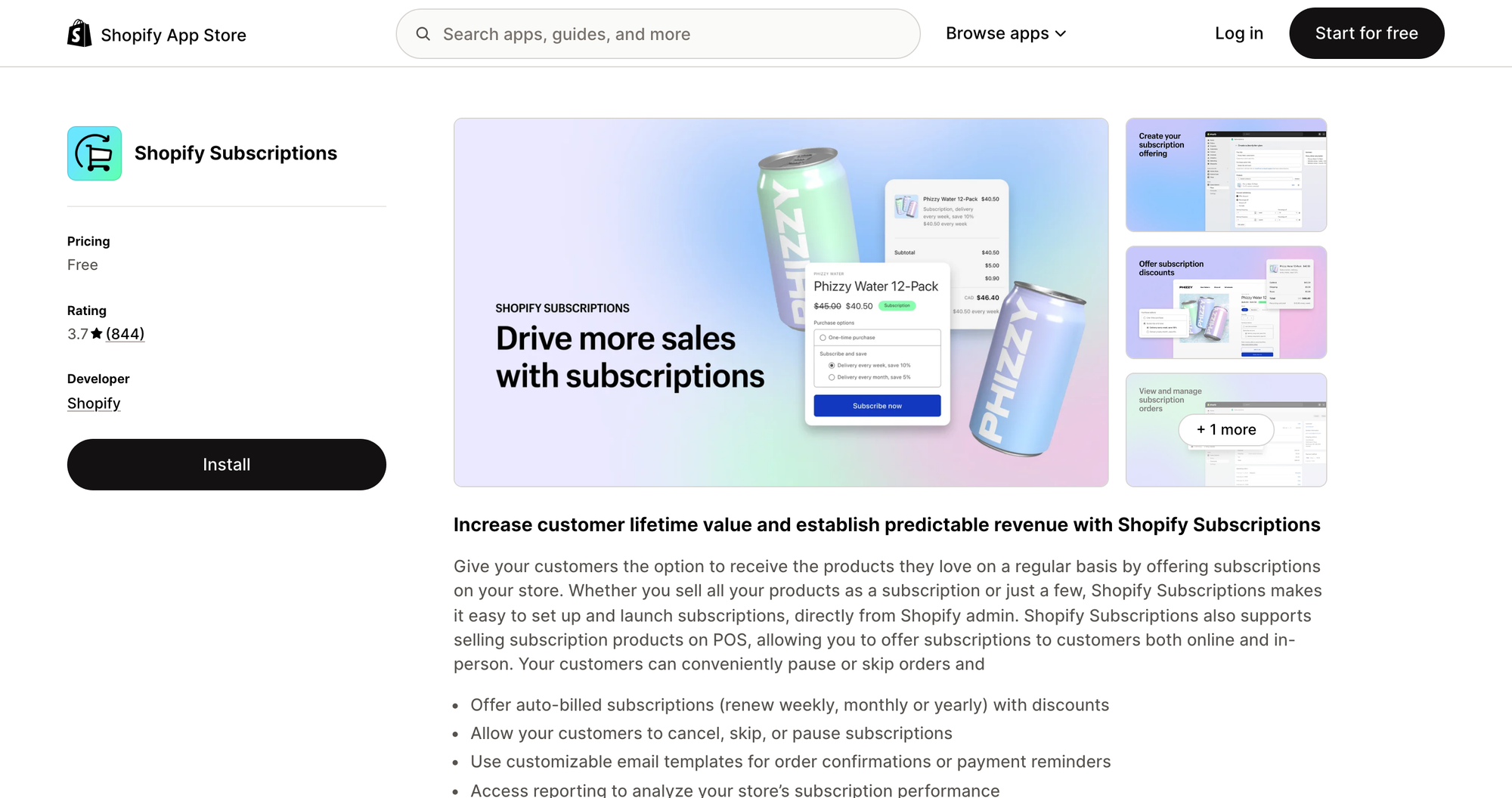
15,787 installs, 3.7 stars from 844 reviews.
What to check before you commit
The rating distribution is the finding: 47% five-star, 12% four, 13% three, 8% two and 19% one-star. One in five merchants who reviewed it gave the lowest possible score. No other app in this comparison is below 4.0, and most are above 4.7.
It is also free and first-party. Both of those things are true at once, and the sensible reading is that Shopify Subscriptions is a good place to validate demand and a common place to outgrow — which is what a free first-party app is for. Decide in advance what number moves you off it.
5. Loop Subscriptions — retention tooling, 1% fee
Best for: DTC brands treating subscription as a programme rather than a payment schedule — gamified subscriber journeys, personalised cancellation offers, bundles the subscriber builds themselves. Loop publishes a 15-attempt dunning schedule, which is the most explicit retry policy on any listing here.
Not ideal for: stores below about $120,000 a month, where Loop's own Pro plan costs more than its Starter plan, and any store that will not actually configure the retention flows. The 1% only pays for itself if someone uses what it buys.
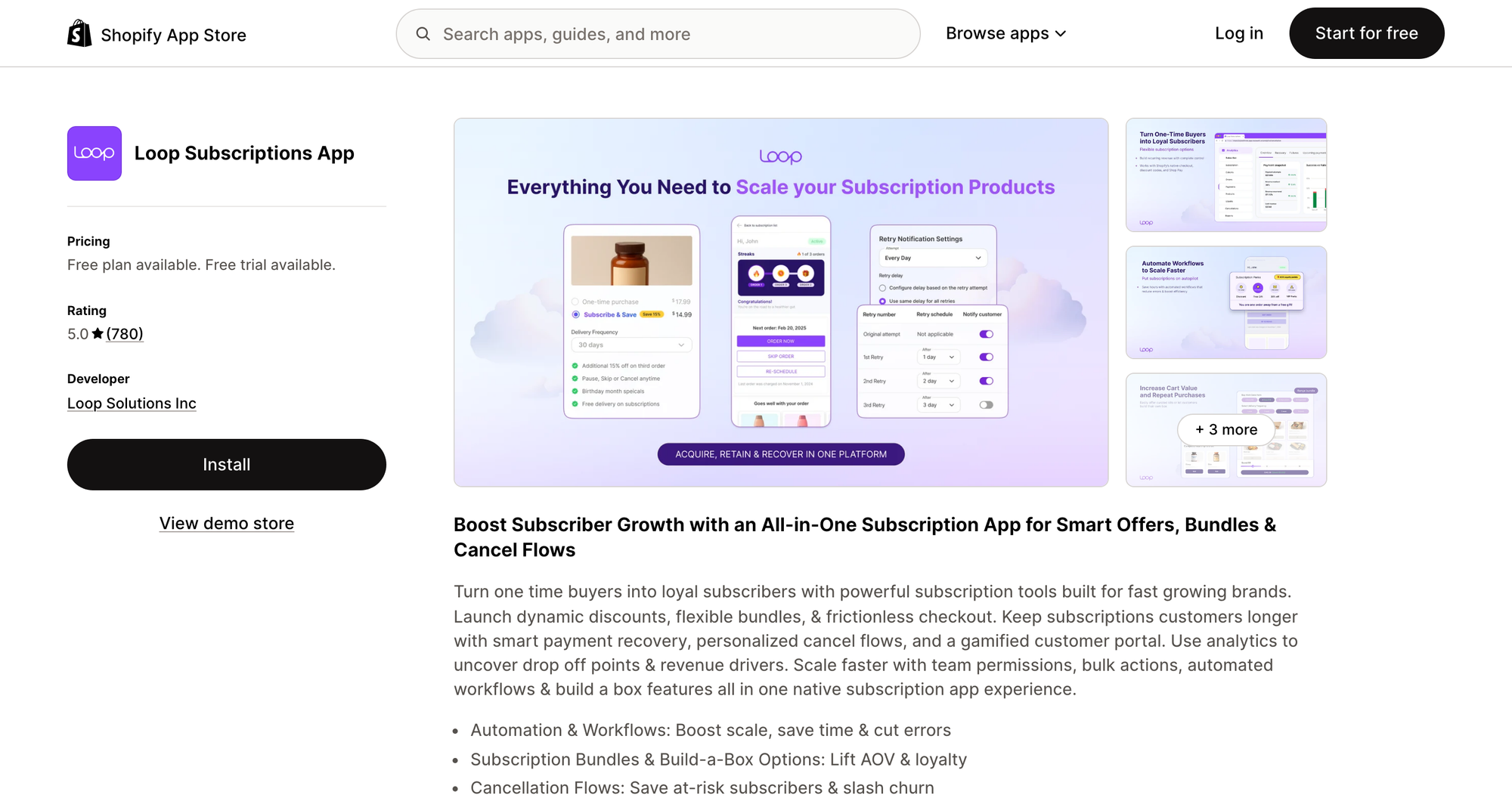
4,091 installs, 5.0 stars from 780 reviews.
What it actually does
- Loop supports fixed and build-your-own custom bundles, one-click checkout links with tracking, and ready-to-use product widget templates.
- Smart dunning with 15 retry attempts, and automatic price and shipping updates.
- Personalised cancellation flows with offers, and a branded customer portal with upsell.
- Gamified subscriber journeys and rewards on Pro, with a dedicated CSM and 24/7 Slack support.
What to check before you commit
Free Forever covers 50 active subscriptions. Starter is $99 plus 1.0%. Pro is $399 plus 0.75%. The crossover sits at about $120,000 a month; below that, Pro's $300 premium is not recovered by the 0.25% saving.
At $50,000 a month Loop costs about $599 against Seal's $24.95. The retention tooling is real, and so is the 24-fold difference — the question is whether you have someone to run it.
6. Recurpay — 0% fees at $9, unlimited subscriptions
Best for: stores that want a flat, cheap, zero-fee plan with no cap on subscription count or revenue. At $9 with unlimited subscriptions and no percentage, Recurpay is the only app here that combines all three, and it includes dunning and a self-serve portal at that price.
Not ideal for: stores that weight ecosystem and longevity. 8,062 installs is a sixth of Recharge's, and there is no free plan for a live store — development stores only — so evaluation happens inside a 14-day trial.
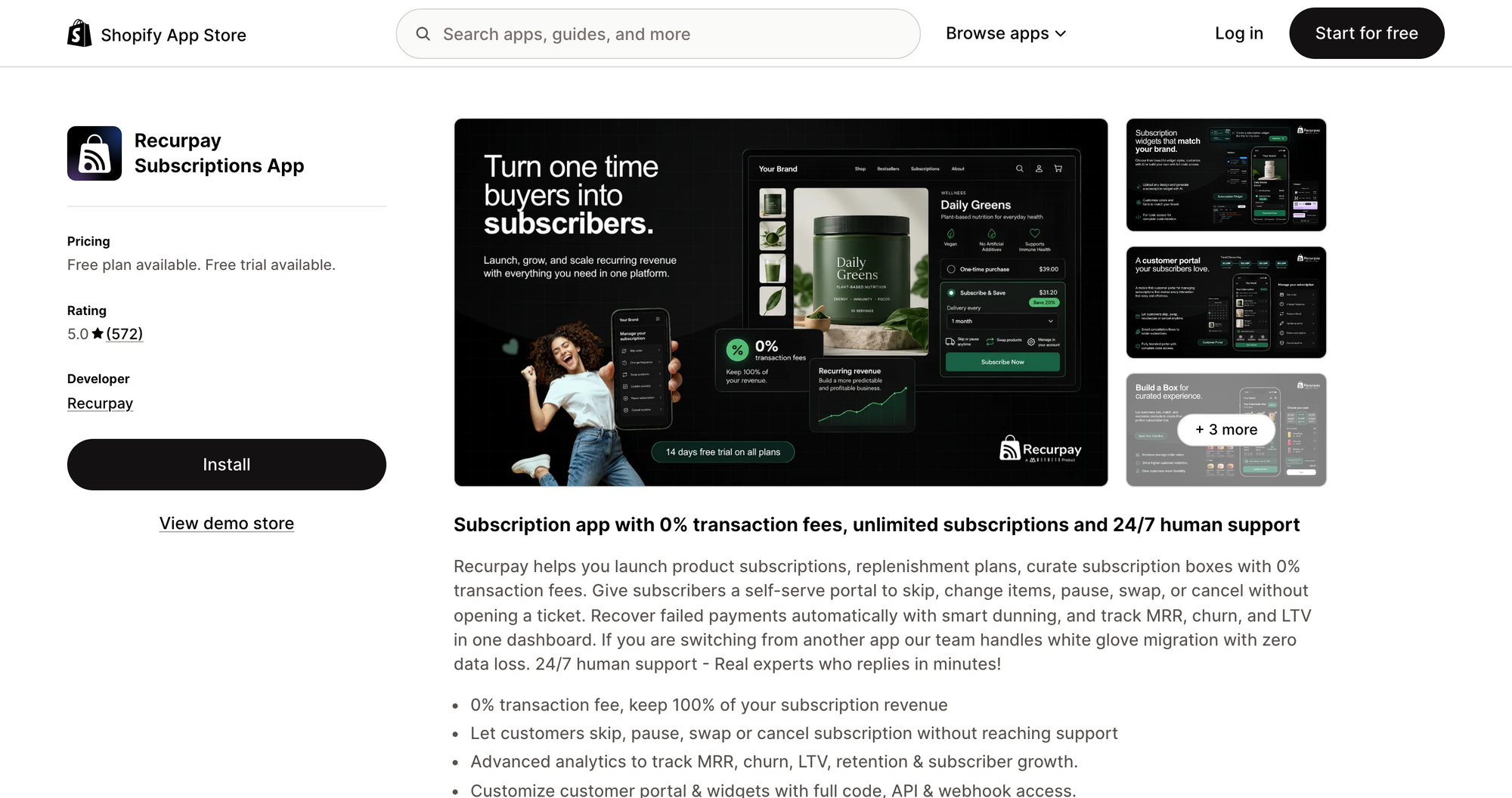
8,062 installs, 5.0 stars from 572 reviews.
What it actually does
- Recurpay charges 0% transaction fee with unlimited subscriptions on the $9 Launch plan.
- Pay-as-you-go and prepaid plans, a fully customisable subscription widget, cart upsell for subscriptions, subscription analytics, a self-serve customer portal, and dunning with automatic payment recovery — all present from the free development tier.
- Growth at $19 adds capability above Launch.
What to check before you commit
The free tier is development-stores-only, so there is no way to run Recurpay free on a live store. Plan the evaluation inside 14 days, and decide what you are testing before you start — with dunning, two weeks is barely one billing cycle.
7. PayWhirl — free to install, 3% until you pay to reduce it
Best for: stores under $5,000 a month in subscription revenue, where PayWhirl is genuinely free and includes expert installation, migration and cancellation prevention flows at no cost. For a first subscription offer that is a real head start.
Not ideal for: anyone who will pass $5,000 a month without moving plans. The 3% default is the highest fee in this comparison, and on $50,000 a month it is $1,500 — the most expensive outcome available here.
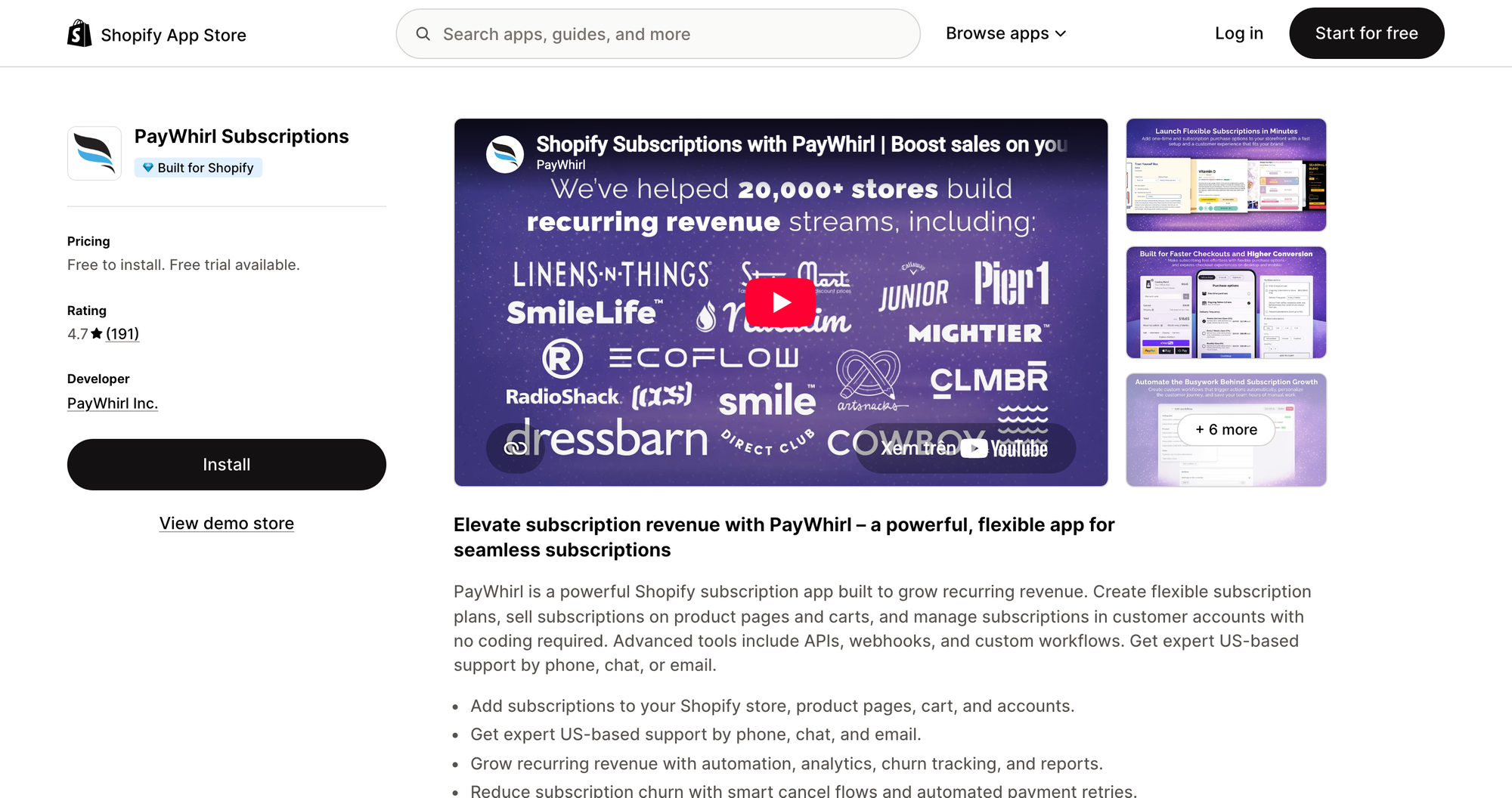
4,810 installs, 4.7 stars from 191 reviews.
What it actually does
- PayWhirl includes unlimited subscriptions and orders, expert installation, migration, analytics with data exports and cancellation prevention flows on the free plan.
- Pro at $9 drops the fee to 2% and adds customisable email templates and automatic address updating.
- Traction at $29 drops it to 1.5% and adds a workflow automation suite, failed payment actions and inventory management.
What to check before you commit
The free plan is 0% on your first $5,000 processed, then 3% with no monthly fee. The paid plans exist to buy that rate down, and the listing says rates go as low as 0.75% on tiers it does not show. Price your actual volume against the published tiers before installing, not after — the plan that looks free is the most expensive one at scale.
191 reviews is the thinnest public record in this group.
8. Bold Subscriptions — a percentage on every tier
Best for: stores already inside Bold's ecosystem running Bold Upsell or Memberships, where one vendor across several apps is worth something operationally.
Not ideal for: anyone who wants a zero-fee option at any price, and anyone who weights rating. At 4.0 from 381 reviews Bold is the second-lowest-rated app here, and there is no tier without a transaction fee.
6,322 installs, 4.0 stars from 381 reviews.
What it actually does
- Bold supports customisable frequencies, order-based and fixed-date schedules, prepaid subscriptions, dunning and unlimited subscribers on every plan.
- Subscription Maximizers on the entry tier.
- A 30-day free trial on all plans, second only to Recharge's 60 days.
What to check before you commit
Every Bold plan carries a transaction fee, and the plans exist mainly to reduce it: Launch $24.99 + 2%, Grow $49.99 + 1%, Scale $74.99 + 0.9%.
At $50,000 a month Scale costs $524.99 against Grow's $549.99 and Launch's $1,024.99, so the top tier is the cheapest once you are at volume — the reverse of Recharge and Loop, where the top tier only pays off much further up. Run the arithmetic for your own number; the answer is different for each of these three vendors.
How to choose
Validating whether subscriptions work: Shopify Subscriptions, free, and accept the 3.7 rating as the price of finding out.
Running it properly on a budget: Seal or Appstle. Both charge 0%. Count your subscriptions and your monthly subscription revenue, then pick whichever ladder your shape of business sits lower on. High-ticket and low-count favours Seal; low-ticket and high-count favours Appstle.
You want retention tooling and will staff it: Loop at $99 + 1.0%, or Recharge at $99 + 1.49% + 19¢ if you also want benchmarks and implementation support. Price both at your actual revenue, and check the crossover before upgrading either.
You are above $250,000 a month: Recharge Plus becomes defensible on arithmetic rather than on features.
Subscriptions and loyalty answer the same question from different angles, and they conflict more often than merchants expect — a subscriber already getting 15% off every order does not need a 5% loyalty discount on top. Whether subscription orders should earn loyalty points is the decision that trips up most stores running both, and paid membership versus subscription covers the case where the subscription *is* the loyalty programme.
Frequently asked questions
What is the cheapest Shopify subscription app? Shopify Subscriptions, which is free with no transaction fee, though it rates 3.7 from 844 reviews. Among third-party apps, Seal is free for 50 subscriptions and $5.95 for 100, and Appstle is free up to $500 a month in subscription revenue and $10 up to $5,000, both at 0% transaction fees.
Does Recharge charge transaction fees? Yes. Starter is $99 a month plus 1.49% and 19¢ per transaction. Plus is $499 plus 1.34% and 19¢. The $25 entry plan covers your first 50 subscribers with no transaction fee.
Which Shopify subscription app has no transaction fee? Seal, Appstle, Recurpay and Shopify Subscriptions all charge 0%. Seal and Appstle cap you instead — Seal by subscription count, Appstle by subscription revenue. Recurpay's $9 Launch plan has unlimited subscriptions and no cap.
Which subscription app do most Shopify stores use? Recharge, with 52,220 installs as of 7 October 2026. Seal is second with 34,158 and Appstle third with 32,512.
Is Shopify Subscriptions good enough? It is free, first-party, and rates 3.7 from 844 reviews with 19% one-star. Use it to validate demand; plan to move when you need dunning depth, cancellation flows or an API.
Do I need an app, or can Shopify do subscriptions natively? Shopify provides the subscription framework — selling plans, subscription contracts and recurring billing — but not a merchant-facing interface for building and managing offers. Every app here is a layer on top of that framework, which is why they compete on retention tooling and billing model rather than on the subscription mechanic itself.

Written by
Thomas Nguyen is the CEO & Co-founder of Joy, a loyalty solution for Shopify and eCommerce brands. With years of experience building high-performance Shopify apps, Thomas aims to help merchants grow through customizable and retention-focused tools.
Related reading
 Shopify apps
UpPromote Alternatives: The 300-Referral Cap Nobody Meters
UpPromote's Growth plan caps at 300 reviewed referrals a month, a unit no rival meters. Seven alternatives compared on cap mechanics.
 Thomas Nguyen
 Shopify apps
Best Free Shopify Loyalty Apps: 50 to 400 Orders Free
Free-tier caps run from 50 orders on CWILL to 400 on LoyaltyLion. The full table, plus what crossing each cap actually costs.
Thomas Nguyen Shopify apps
Best Shopify Membership Apps: Appstle $19, No Member Fee
Appstle charges $19 with no per-member fee. Inveterate publishes no price at all. Seven apps and what each pricing panel does not say.
Thomas Nguyen Shopify apps
Shopify Subscription Fees: Seal $89.95, Recharge $1,671
Total cost at 100, 500 and 2,000 subscribers across six apps. Recharge Starter passes Seal's top tier at 382 subscribers.
Thomas Nguyen Shopify apps
Skio vs Recharge: Recharge Now Owns Skio
The listing reads a Recharge Company. Skio is $599 a month plus 1% and 20 cents; Recharge Starter wins below 2,700 subscribers.
Thomas Nguyen Shopify apps
Loox Alternatives: The Paid Plan Includes Fewer Orders
Loox's free plan allows 500 monthly orders and its $49.99 plan includes 300. Six alternatives on caps, overage and real cost.
Thomas Nguyen