UpCart vs AfterSell: Both Apps Belong to Rokt
Merchants comparing them are choosing between two SKUs from one owner. UpCart meters orders, AfterSell prices by surface.
Summarize this post with AI
The vendor field on both listings reads Rokt. UpCart and AfterSell are two products from one owner, read from their live Shopify App Store listings on 8 October 2026, and merchants comparing them are choosing between SKUs rather than between companies.
The pricing shapes are genuinely different, which is the useful half of this comparison. UpCart is order-capped: $29.99 a month up to 200 monthly store orders, $34.99 up to 500, $54.99 up to 1,000, and no published price above that. AfterSell is scope-tiered with no order cap at any price: $34.99 for post-purchase, $59.99 for pre-purchase, $79.99 for both. At 1,000 monthly orders the two sit $5 apart, and only one of them stops there.
One more thing to file away before the detail. AfterSell's listing names UpCart among the apps it works with.
Key takeaways
- Both listings carry Rokt as the vendor. Rokt announced the AfterSell acquisition on 10 January 2024 and said in the same post that "The AfterSell product offering also includes UpCart, a fully featured cart drawer specifically designed to increase AOV and reduce cart abandonment."
- UpCart's three paid plans are feature-identical. The only difference between $29.99, $34.99 and $54.99 is the monthly order cap.
- AfterSell's three paid plans carry no order cap. The $34.99, $59.99 and $79.99 tiers buy different surfaces: post-purchase, pre-purchase, and both.
- At 501 to 1,000 monthly orders UpCart costs $54.99 and AfterSell Pre-Purchase costs $59.99, a $5 gap for overlapping cart functionality from the same vendor.
- Above 1,000 monthly store orders UpCart has no price on its listing. The panel renders the App Store maximum of four plan cards and links out with "See all pricing options".
- Neither app has a usable free plan. Both free cards are restricted to development and partner stores.
- Rokt publishes a third Shopify listing, Rokt Ecommerce, which monetises the confirmation page with third-party offers rather than selling your own products.
Both listings name the same vendor
Every rating, review count and price below was read from each app's live Shopify App Store listing on 8 October 2026, and each app name links to its listing so you can check the vendor field yourself in one click.
Rokt's own announcement is the primary record. Writing on 10 January 2024, Rokt said "we have agreed to acquire AfterSell, a Shopify and Shopify Plus partner that helps ecommerce merchants upsell and cross-sell", and that the deal would "expand our client portfolio to more than 20,000 SMB merchants" (Rokt). The same post places UpCart inside the AfterSell product line.
Nothing about that is hidden. It is also not visible on either App Store listing beyond the vendor name, which is a field few merchants read, and neither listing cross-references the other as a sister product. The practical consequence is narrow and worth knowing: a shortlist with UpCart and AfterSell on it is a shortlist of one supplier, which removes the usual reason for running two vendors at all, namely independence from a single roadmap.
1. UpCart, a cart drawer priced by your order count
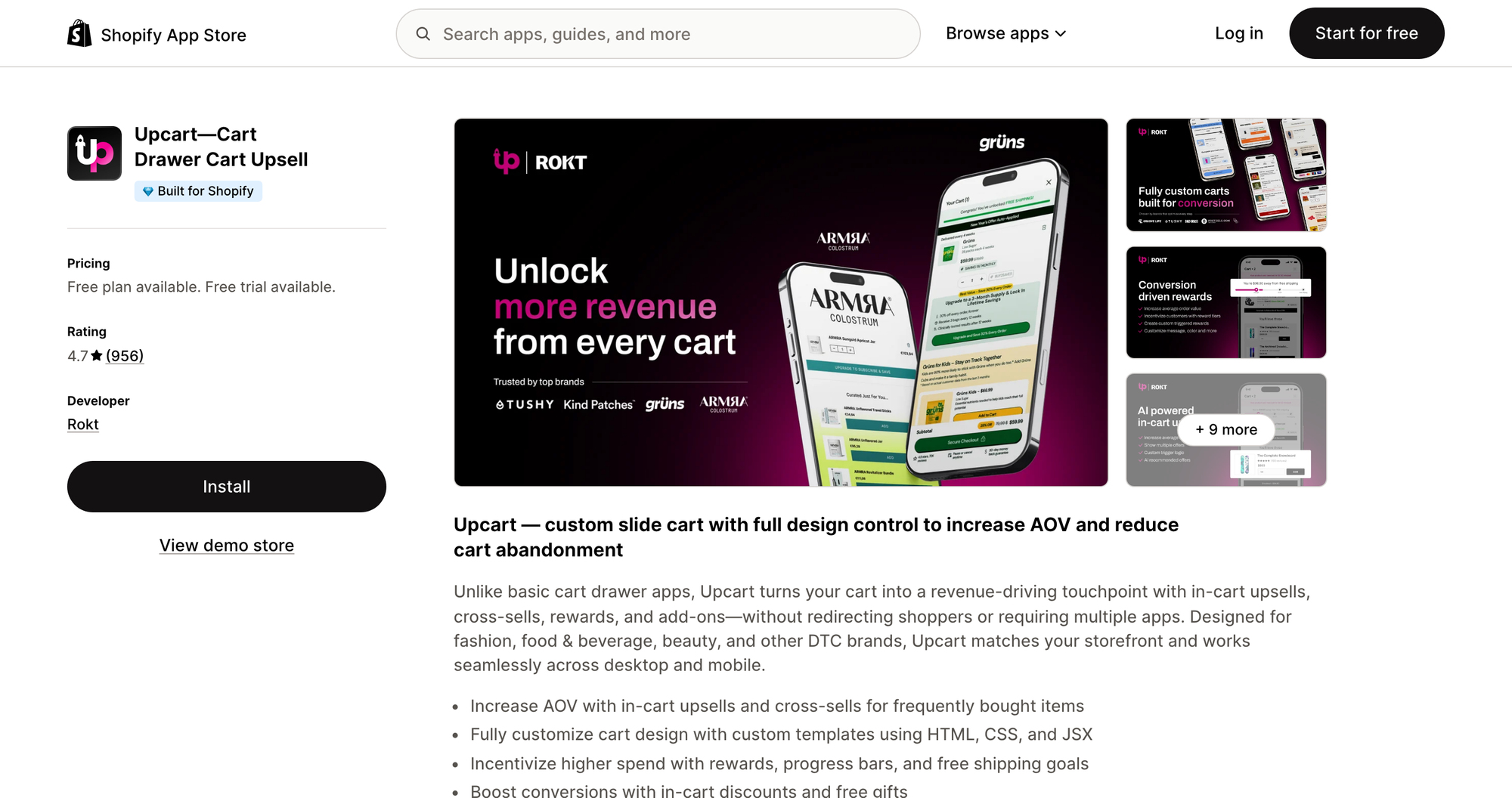
Best for: stores under 500 monthly orders that want a cart drawer with upsells, announcements, free-shipping progress and add-ons for the lowest price available from this vendor. At $29.99 up to 200 orders UpCart is the cheapest way into Rokt's cart tooling, and the feature set on that plan is identical to the $54.99 one, so a small store gives up nothing by paying least.
Not ideal for: any store above 1,000 monthly orders, because the listing stops pricing there and the next number comes from a conversation rather than a panel. It is also a poor fit for a store whose order count swings seasonally, since the meter counts store orders rather than orders the app influenced. A Black Friday spike moves you up a tier on volume the cart drawer had nothing to do with.
UpCart runs on 18,439 Shopify stores. Its live listing read 4.7 stars from 956 reviews on 8 October 2026, with 884 five-star and 38 one-star, and the Built for Shopify badge is present. Launched 19 July 2021.
What it actually does
- A cart drawer with six named modules: design settings, announcements, upsells, rewards including a free-shipping bar, add-ons, and custom HTML and CSS.
- Every one of those six appears on all three paid cards. The tiers do not gate features.
- The listing names only two surfaces it works with: Checkout and Shopify Admin. That is the shortest integration list of any app in this comparison.
What to check before you commit
The meter. "Up to 200 monthly store orders", "Up to 500 monthly store orders" and "Up to 1000 monthly store orders" are the verbatim charge lines on the three paid cards, and the phrase is store orders, not cart conversions. Work out your own worst month rather than your average.
Then check what sits above 1,000. The panel renders four cards, which is the App Store's maximum, and carries a "See all pricing options" link out to the vendor. Shopify's own App Store requirements state at 4.2.1 that apps must "Provide accurate and complete pricing information", and the four-card limit is a constraint on the surface rather than a vendor decision. Either way, a 2,000-order store cannot price UpCart from the listing.
2. AfterSell, an upsell suite priced by surface
Best for: stores that want post-purchase offers and nothing else, which AfterSell sells at $34.99 with no order cap at any volume. One-click post-purchase offers, thank-you page offers, checkout upsells, subscription upgrades and multivariate testing all sit on that entry tier, so a 5,000-order store pays the same as a 200-order one. It also carries the strongest rating in this comparison.
Not ideal for: a store that only wants a cart drawer, because the cart tooling lives on the $59.99 Pre-Purchase tier and the $34.99 plan does not include it. At UpCart's entry tier, buying Complete at $79.99 to get both surfaces costs more than running UpCart and AfterSell Post-Purchase side by side at $64.98, and the two products overlap on cart functionality once you do.
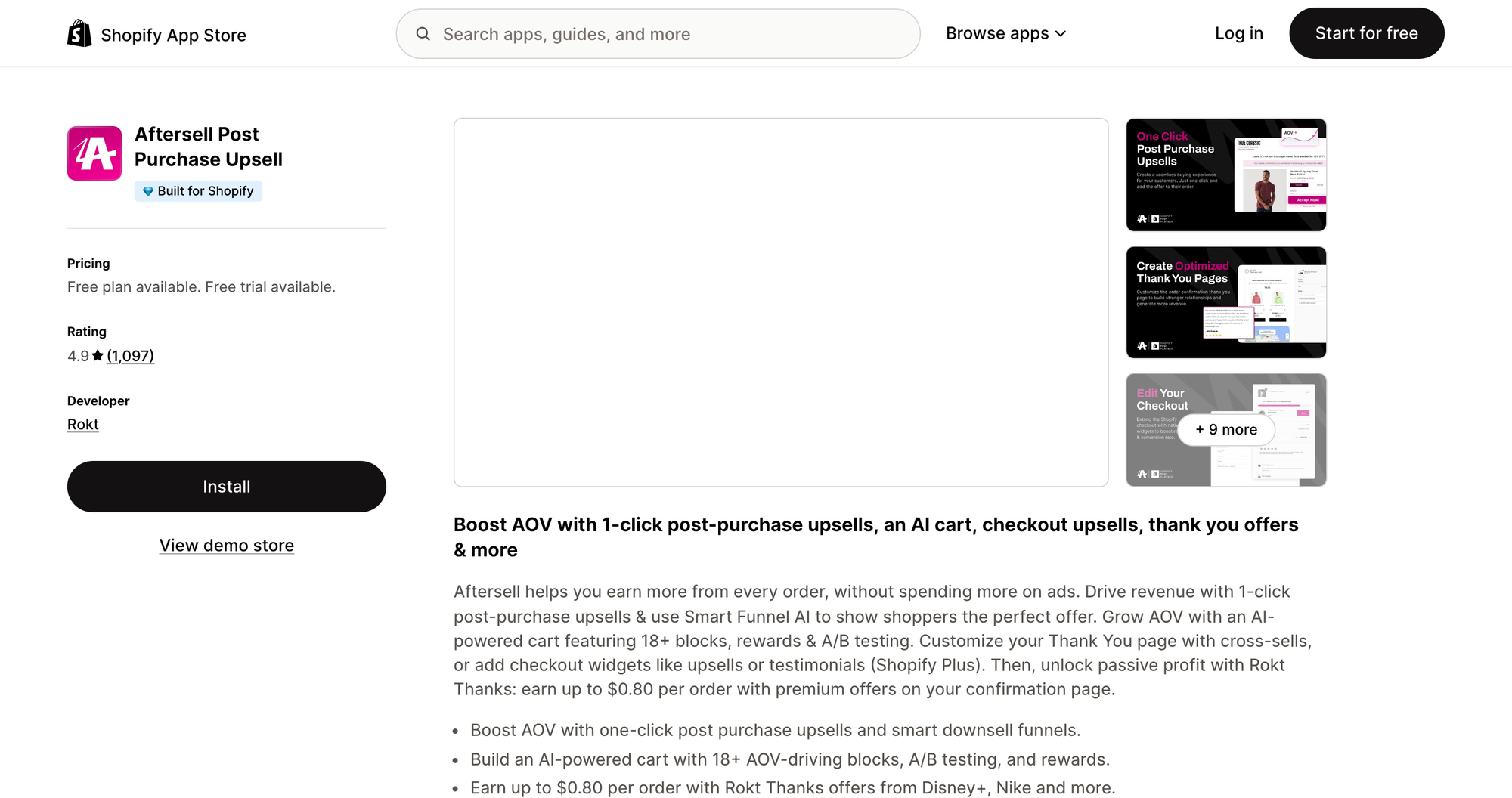
AfterSell runs on 12,569 Shopify stores. Its live listing read 4.9 stars from 1,097 reviews on 8 October 2026, with 1,036 five-star and 25 one-star, and the Built for Shopify badge is present. Launched 31 December 2019.
What it actually does
- Post-Purchase at $34.99: one-click post-purchase offers, subscription upgrades, smart funnels, checkout upsells and add-ons, thank-you page offers, multivariate testing.
- Pre-Purchase at $59.99: AI cart building, 18 or more drag-and-drop blocks, rewards bars, free gifts and upsells, product page upsells, advanced analytics and A/B testing, cart export and import.
- Complete at $79.99: both of the above plus a product recommendation engine.
- The listing names Klaviyo, Nosto, Recharge, Skio, Yotpo, Shopify Flow, customer accounts and UpCart among the surfaces it works with.
What to check before you commit
Which surface you are actually buying. The $25 step from Post-Purchase to Pre-Purchase does not add depth to post-purchase offers, it moves you to a different stage of the funnel, and the $20 step to Complete adds the first tier back. Merchants who read these as good, better, best will buy the wrong one.
Check the overlap too, especially if UpCart is already installed. Pre-Purchase's AI cart building, rewards bars and upsell blocks cover the same ground as UpCart's upsells and rewards modules, from the same vendor, at a $5 premium over UpCart's top published tier.
The panel also renders four cards and links out, so a tier above Complete is not visible on the listing.
Price them by order volume, because only one of them is
| Monthly store orders | UpCart | AfterSell Post-Purchase | AfterSell Pre-Purchase | AfterSell Complete |
|---|---|---|---|---|
| Up to 200 | $29.99 | $34.99 | $59.99 | $79.99 |
| 201 to 500 | $34.99 | $34.99 | $59.99 | $79.99 |
| 501 to 1,000 | $54.99 | $34.99 | $59.99 | $79.99 |
| Above 1,000 | Not published | $34.99 | $59.99 | $79.99 |
Three rows of that table are worth stopping on.
At 201 to 500 orders both entry products cost $34.99 and do different jobs. The identical price is a coincidence of two pricing models meeting, not a like-for-like comparison, so the decision at that volume is purely which surface you want to change.
At 501 to 1,000 orders the gap between UpCart and AfterSell Pre-Purchase is $5. For $54.99 you get a cart drawer with a cap. For $59.99 you get cart building plus product-page upsells and A/B testing with no cap. The cheaper option is the one that will ask you to upgrade.
Above 1,000 orders the comparison stops being a comparison. AfterSell's price does not move. UpCart's is not on the page.
The third Rokt listing
Rokt publishes a third Shopify app, Rokt Ecommerce, running on 814 Shopify stores. Its pricing panel was not read for this comparison, so treat its plans as unknown rather than absent.
What it does is a different business from the other two. Rokt's own documentation describes placing advertiser offers in the transaction moment, and states that "When customers engage with an advertiser offer, you earn revenue, all while maintaining a brand-safe and native experience" (Rokt docs). UpCart and AfterSell sell your products to your customer. Rokt Ecommerce rents your confirmation page to somebody else's.
Rokt documents that as a revenue line, and it is run deliberately by brands that want it. It is still a different decision from buying an upsell app, and it is worth knowing the same vendor sells both motions before a sales conversation offers you the second one.
What one owner changes, and what it does not
The shared ownership is not a reason to avoid either app, and the strongest evidence for that is in AfterSell's own integration list. An integration between two products from the same company is a supported path rather than a best-effort connector, which is more than a two-vendor stack can promise. That line in the Works with list, which reads like a partnership, is the only place either listing hints at the relationship.
What it does change is the diligence. Three things are worth asking before you buy both:
- Overlap. UpCart plus AfterSell Complete runs from $109.98 to $134.98 a month depending on your order count, for two products that both build carts. Ask which modules you would be paying for twice.
- Roadmap. One owner sets the priority order between a cart drawer and a post-purchase suite. A merchant depending on both is exposed to that ordering.
- Pricing coherence. One vendor currently meters one product on your order count and the other on nothing. That is a choice, and choices get revisited.
Neither app controls the surface it runs on. Post-purchase offers and checkout upsells depend on Shopify's checkout UI extensions, and when Shopify changes what those extensions can do, both apps change on Shopify's schedule rather than Rokt's. That is the one risk running two vendors would not have reduced either.
How to choose
You want a cart drawer and you do under 500 orders a month. UpCart at $29.99 or $34.99. Cheapest route into the tooling, same features as the top tier.
You want post-purchase offers at any volume. AfterSell Post-Purchase at $34.99. No order cap, strongest rating in this comparison, and it is the only tier that prices the same at 200 orders and 5,000.
You do more than 1,000 orders a month and want cart tooling. AfterSell Pre-Purchase at $59.99 is the only one of the two with a published price at that volume.
You want both surfaces. Price AfterSell Complete at $79.99 against UpCart plus AfterSell Post-Purchase at $64.98, then ask Rokt which combination it supports better.
Cart and checkout work is AOV work, and AOV work is cheaper than acquisition but shallower than retention. Baymard Institute puts the average documented cart abandonment rate at 70.22% across 50 studies, last updated 22 September 2025, which is the size of the problem a cart drawer addresses. The second order from the same customer is a different problem with different economics, covered in the comparison of acquisition cost against retention and the practical guide to Shopify customer retention.
Two related operational questions sit next to this choice. Measuring whether an upsell added margin rather than moved it needs the same discipline as measuring programme ROI, and post-purchase offers often create post-purchase order changes, which is what the order-editing app comparison covers.
Frequently asked questions
Are UpCart and AfterSell the same company? Yes. Both Shopify App Store listings carried Rokt as the vendor on 8 October 2026, and Rokt's own announcement of 10 January 2024 states that UpCart is part of the AfterSell product offering.
Which is cheaper, UpCart or AfterSell? UpCart below 500 monthly store orders, at $29.99 or $34.99. AfterSell Post-Purchase at $34.99 is cheaper from 501 orders upward, because UpCart's price rises to $54.99 and then off the panel while AfterSell's does not move.
Does UpCart have an order limit? Yes. Its three paid plans cap at 200, 500 and 1,000 monthly store orders, read verbatim from the charge lines on 8 October 2026. The panel publishes no plan above 1,000 orders.
Does AfterSell have an order limit? No order cap appears on any of its plan cards. The three paid tiers differ by which part of the funnel they cover rather than by volume.
Do UpCart and AfterSell do the same thing? They overlap. UpCart is a cart drawer with upsells and rewards modules; AfterSell's Pre-Purchase tier includes AI cart building, rewards bars and upsell blocks, and its Post-Purchase tier covers checkout and thank-you page offers that UpCart does not touch.
Is there a free plan for either app? Not a usable one. Both free cards are restricted to development and partner stores, so a live store starts at $29.99 on UpCart or $34.99 on AfterSell.
Pick the surface first, then read the meter
The ownership is the fact everyone misses and the pricing shape is the fact that costs money. Decide whether you are changing the cart, the checkout, or both, and only then compare the two numbers, because at every volume above 500 orders they are measuring different things.
Count last month's store orders. Above 1,000, UpCart has no published price and AfterSell Pre-Purchase has one: $59.99.

Written by
Thomas Nguyen is the CEO & Co-founder of Joy, a loyalty solution for Shopify and eCommerce brands. With years of experience building high-performance Shopify apps, Thomas aims to help merchants grow through customizable and retention-focused tools.
Related reading
 Shopify apps
Best Shopify Affiliate Apps: GoAffPro 0%, UpPromote 2%
GoAffPro charges no percentage at any tier. UpPromote takes 2% of referred sales on top of $29.99. Ten apps on cost and free-plan honesty.
 Thomas Nguyen
 Shopify apps
Shopify Loyalty App Pricing: $30 to $199 at 2,000 Orders
Appstle costs $30 at 2,000 monthly orders and Smile costs $199. Eight loyalty apps priced at 500, 2,000 and 10,000 orders.
Thomas Nguyen Shopify apps
EU Withdrawal Button Apps: Two Start Free, One Charges
EU Directive 2023/2673 became mandatory on 19 June 2026. Four withdrawal-button apps on price, scope and what each listing leaves out.
Thomas Nguyen Shopify apps
Skio vs Recharge: Recharge Now Owns Skio
The listing reads a Recharge Company. Skio is $599 a month plus 1% and 20 cents; Recharge Starter wins below 2,700 subscribers.
Thomas Nguyen Shopify apps
UpPromote vs GoAffPro: Only One Takes a Cut
UpPromote charges 2% of referred sales on top of its monthly fee. GoAffPro and BixGrow charge no percentage at any tier.
Thomas Nguyen Shopify apps
Best Shopify Order Editing Apps: Orderify Costs $8.99
Orderify prices by your Shopify plan, not your order volume, where OrderEditing.com charges $99. Seven apps and who each one suits.
Thomas Nguyen