Shopify Subscription Fees: Seal $89.95, Recharge $1,671
Total cost at 100, 500 and 2,000 subscribers across six apps. Recharge Starter passes Seal's top tier at 382 subscribers.
Summarize this post with AI
Three of the six subscription apps here charge 0% per transaction and three charge a percentage, and at 2,000 subscribers paying $40 a month the gap between the cheapest paid option and the most expensive is 18.6 times. Seal bills $89.95 for that book. Recharge bills about $1,671. Shopify Subscriptions bills nothing at all.
The crossover worth naming is smaller and sharper than most brands expect. At $40 per subscriber per month, Recharge Starter costs more than Seal's most expensive published plan from 382 subscribers upward, and Seal's most expensive published plan covers 150,000 subscriptions. All figures were read from the live Shopify App Store listings and from each vendor's own pricing page on 8 October 2026.
Key takeaways
- Seal charges 0% on every published tier, from the free plan to the $399 plan covering 150,000 subscriptions, and publishes all seven tiers on sealsubscriptions.com.
- Recharge Starter at $99 plus 1.49% plus 19¢ passes Seal's $399 top tier at 382 subscribers paying $40 each. Loop at $99 plus 1.0% passes it at 750 subscribers.
- Appstle prints "0% Transaction Fee" on Starter and above. The Free plan card does not carry that line, so treat the free tier's fee as undisclosed rather than zero.
- Appstle meters on subscription revenue and Seal meters on subscription count, which flips the cheaper option at 376 subscribers paying $40 each: Appstle jumps from $30 to $100 while Seal stays at $24.95.
- Shopify Subscriptions is free and takes 0%, and its listing read 3.7 stars from 848 reviews on 8 October 2026 with 160 at one star, the weakest distribution here by a wide margin.
- Every App Store panel in this comparison is truncated or links out, so the listing is a complete price list for none of them.
The fee is the price, and the plan card hides it
Every app here runs on the same platform primitives. Shopify's own subscriptions purchase option and selling plans framework supplies the recurring charge, the subscription contract and the stored payment method, so no app in this list can be meaningfully better at the subscription mechanic itself.
So the monthly fee is the smaller half of the decision. A percentage fee is an uncapped line that grows with the thing you are trying to grow, and it is charged on gross subscription revenue rather than on margin. On the unit economics most D2C brands run, a $10 order leaves $2 to $3 of profit after COGS, acquisition, ops and platform cost, so a 1.49% fee takes 15¢ of it every month, forever.
That is the case for reading the fee first and the plan price second.
Six apps, four pricing shapes
Every rating, review count and price below was read from each app's live Shopify App Store listing on 8 October 2026, and each app name links to its listing so you can check it in one click. Where a listing links out, the vendor's pricing page was read the same day.
| App | Metering axis | Entry plan | Transaction fee |
|---|---|---|---|
| Shopify Subscriptions | none published | free | 0% |
| Seal | subscription count | free, 50 subscriptions | 0% on every published tier |
| Appstle | monthly subscription revenue | free, up to $500/month | 0% stated on Starter and above |
| Loop | none published | free, 50 active subscriptions | 1.0% on Starter, 0.75% on Pro |
| Recharge | subscriber count on entry plan | $25, first 50 subscribers | 1.49% + 19¢, 1.34% + 19¢ on Plus |
| Skio | none published | $599 | 1% + 20¢ |
Total cost at 100, 500 and 2,000 subscribers
The arithmetic assumes $40 of subscription value per subscriber per month and one renewal order each. Every percentage row moves with your average subscription value, which is the whole problem with budgeting a percentage from a plan card.
| App | 100 subscribers ($4,000/mo) | 500 subscribers ($20,000/mo) | 2,000 subscribers ($80,000/mo) |
|---|---|---|---|
| Shopify Subscriptions | $0 | $0 | $0 |
| Seal | $5.95 | $24.95 | $89.95 |
| Appstle | $10.00 | $100.00 | $100.00 |
| Loop | $139.00 | $299.00 | $899.00 |
| Recharge | $177.60 | $492.00 | $1,671.00 |
| Skio | $659.00 | $899.00 | $1,799.00 |
Four crossovers come out of that table, and each one is arithmetic rather than opinion:
- 382 subscribers. Above that count at $40 each, Recharge Starter costs more per month than Seal's $399 SUPERSTAR plan, which covers 150,000 subscriptions.
- 750 subscribers. Above that count, Loop Starter at $99 plus 1.0% costs more than the same Seal plan.
- 376 subscribers. At $40 each that is $15,040 a month, which clears Appstle's $15,000 Business band. Appstle goes from $30 to $100 while Seal stays at $24.95 until 500 subscriptions.
- $266,000 a month. That is where Recharge Plus at $499 plus 1.34% finally costs less than Recharge Starter at $99 plus 1.49%, because a $400 base difference needs a 0.15% rate saving to clear it.
1. Shopify Subscriptions — 0% from Shopify, and the ratings say why it is free
Best for: brands running a simple replenishment offer with no bundles, no prepaid terms and no cancellation funnel, where the subscription is a convenience on an existing product rather than the business model. Shopify Subscriptions costs nothing and takes nothing, so a brand with 2,000 subscribers at $40 saves $1,671 a month against Recharge on identical subscription mechanics.
Not ideal for: brands whose subscription revenue is the business. Shopify Subscriptions publishes no dunning depth, no cancellation flow builder and no retention tooling, which is exactly where subscription churn is won. Its listing read 3.7 stars from 848 reviews on 8 October 2026, with 160 one-star and 70 two-star reviews, so 27% of public feedback sits at two stars or below.
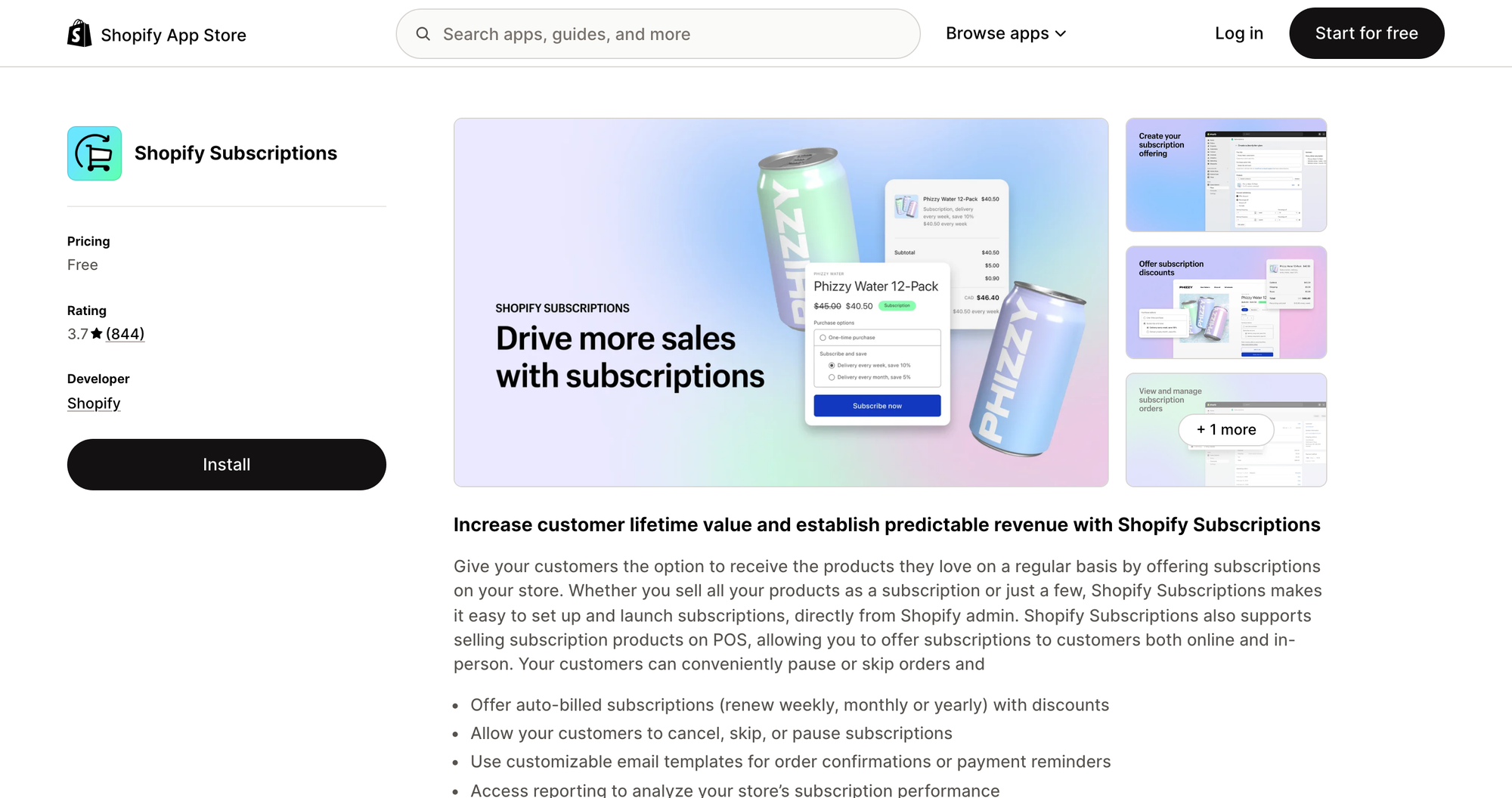
Shopify Subscriptions runs on 15,787 live Shopify stores.
What it actually does
- Native subscription contracts, customer portal and POS support, built by Shopify on Shopify's own framework.
- No pricing panel at all on the listing. The hero summary reads "Free", which is the entire published commercial term.
What to check before you commit
Read the one-star and two-star reviews first, because the distribution is the signal here. A 3.7 average on a first-party free app usually reflects functional gaps rather than support failures, and the gaps are what you hit in month three. Checkout-level control is a separate question: it depends on Shopify's checkout UI extensions, which are Plus-only.
2. Seal Subscriptions — 0% on all seven tiers, and all seven are published
Best for: brands with high average subscription value and a countable subscriber book. Seal meters on subscription count and never charges a percentage, so a brand with 300 subscribers at $200 each runs $60,000 a month of subscription revenue for $24.95. The same book costs roughly $1,042 a month on Recharge Starter, which is a 41-times difference on identical revenue.
Not ideal for: low-ticket, high-volume programmes. Seal counts heads, so 2,000 subscribers at $8 each is $16,000 of monthly revenue on an $89.95 plan, where Appstle charges $30. A trial cohort or a paused subscription also consumes a slot, so over-recruiting cheap subscribers means paying for subscribers who are not paying.
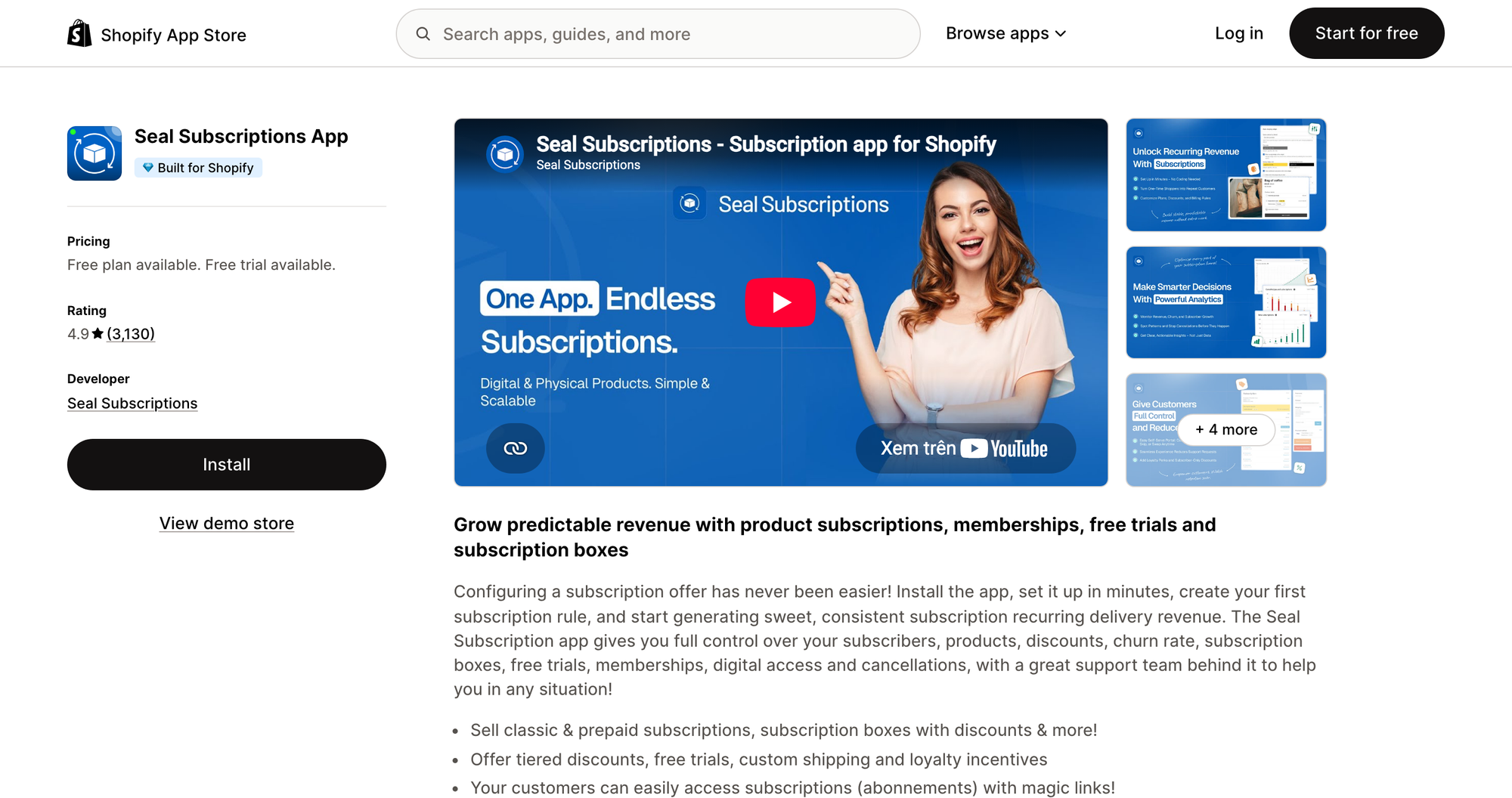
Seal runs on 34,158 live Shopify stores. Its listing read 4.9 stars from 3,135 reviews on 8 October 2026.
What it actually does
- Prints "0% transaction fee" on every published card, free plan included, and states on the pricing page at sealsubscriptions.com that "we don't charge any transaction fees".
- Publishes the full ladder the App Store cannot render: free at 50 subscriptions, $5.95 at 100, $9.95 at 250, $24.95 at 500, $89.95 at 2,000, $199 at 50,000 and $399 at 150,000.
- Lists full API and webhooks access on all four visible tiers, free plan included, which no other app in this comparison does.
What to check before you commit
Count what Seal counts. The cap is total subscriptions, not active subscribers and not orders, so cancelled-but-retained records and paused plans matter to the band you land in. Ask support how a paused subscription is counted before you size the plan. Note too that the App Store panel renders the maximum of four cards and stops at LEGEND, so a brand above 500 subscriptions has to price Seal from the vendor page, where the $89.95, $199 and $399 tiers live.
3. Appstle Subscriptions — 0% on paid tiers, metered on revenue
Best for: low-ticket, high-count subscription programmes. Appstle bands on monthly subscription revenue, so 1,000 subscribers at $12 each is $12,000 a month and costs $30, where Seal would charge $89.95 for the same revenue spread over 1,000 records. A coffee, supplement or consumable brand with a large cheap book is the exact shape Appstle prices well.
Not ideal for: high-AOV programmes with few subscribers. Forty subscribers at $400 each is $16,000 a month, which clears the $15,000 Business band and lands on the $100 plan, while the same 40 subscribers sit inside Seal's free tier at $0. A $400 monthly box pays for revenue rather than for complexity.
Appstle Subscriptions runs on 32,512 live Shopify stores. Its listing read 5.0 stars from 8,948 reviews on 8 October 2026, the largest public review base in the subscription category.
What it actually does
- Prints "0% Transaction Fee & No Hidden Charges" on the Starter, Business and Business Premium cards. The Free card does not carry that line. The listing states no transaction fee for the free tier either way, so the free plan's fee is undisclosed, not zero.
- Bands at up to $500 a month of subscription revenue on free, $5,000 on Starter at $10, $15,000 on Business at $30 and $100,000 on Business Premium at $100.
- Retention tools and cancellation control from $30, the cheapest published cancel-flow tooling in this comparison, plus Build-a-Box, bundling and action logs on the same tier.
What to check before you commit
The free plan is a trial. At $500 a month of subscription revenue it covers roughly 12 subscribers paying $40, and the 0% line is not printed on it. Budget from Starter. Then read what the fourth card says rather than what it costs: Business Premium's feature list ends by pointing merchants to sales for Enterprise, APIs and webhooks, so programmatic access sits on no published plan. If you need the API, Appstle's price for you is unpublished, which is the opposite of Seal's position.
4. Loop Subscriptions — 1.0% falling to 0.75%, and the cheaper rate costs more
Best for: brands that want gamified subscriber journeys, prepaid and gift subscriptions, and a dedicated CSM with 24x7 Slack support. Loop puts smart dunning with 15 retries and personalised cancellation flows on its $99 Starter plan, deeper retention tooling than any 0% app publishes at that price.
Not ideal for: mid-market brands with growing revenue. Loop's 1.0% is uncapped, so $80,000 a month in subscription revenue costs $899 where Seal charges $89.95 and Appstle charges $100. Loop's own Pro tier makes the trap explicit: dropping the rate to 0.75% costs $300 more per month, so Pro only beats Starter above $120,000 a month, which is 3,000 subscribers at $40.
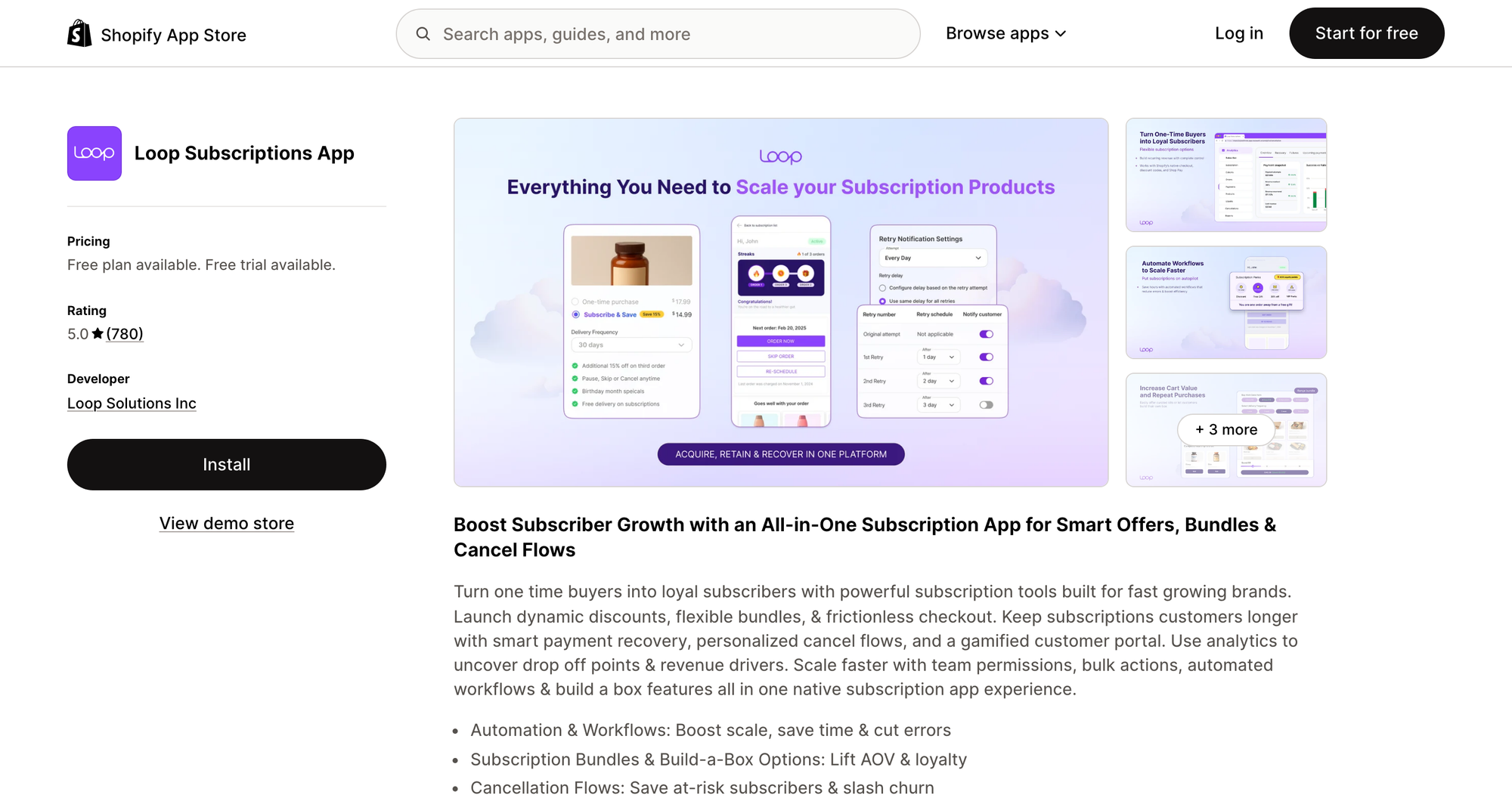
Loop runs on 4,091 live Shopify stores. Its listing read 5.0 stars from 781 reviews on 8 October 2026.
What it actually does
- Fifteen dunning retries named on the plan card, the most specific dunning commitment published in this comparison.
- Admin and storefront APIs with webhooks on the $399 Pro plan, not on Starter.
- Free Forever tier at 50 active subscriptions with the customer portal and revenue analytics, and no transaction fee stated on it.
What to check before you commit
Do the Pro arithmetic before upgrading. The 0.25% rate saving is worth $300 a month only at $120,000 of monthly subscription revenue, and below that Pro is the more expensive plan for the same percentage maths plus a CSM. The panel shows three cards and links out, so confirm whether a tier above Pro exists before you model a growth case.
5. Recharge — the broadest upgrade path, and the highest percentage
Best for: brands that want the cheapest credible start and will pay a percentage for retention depth later. Recharge's $25 plan covers the first 50 subscribers with no transaction fee, the lowest serious entry price in the category, and the 60-day trial is long enough to measure a second billing cycle rather than guess at it.
Not ideal for: brands whose subscription revenue is scaling faster than their margin. At 2,000 subscribers paying $40 the percentage alone is $1,192 a month before the 19¢ per transaction, and it is charged on gross revenue. The listing also warns that external charges may be billed separately from your Shopify invoice.
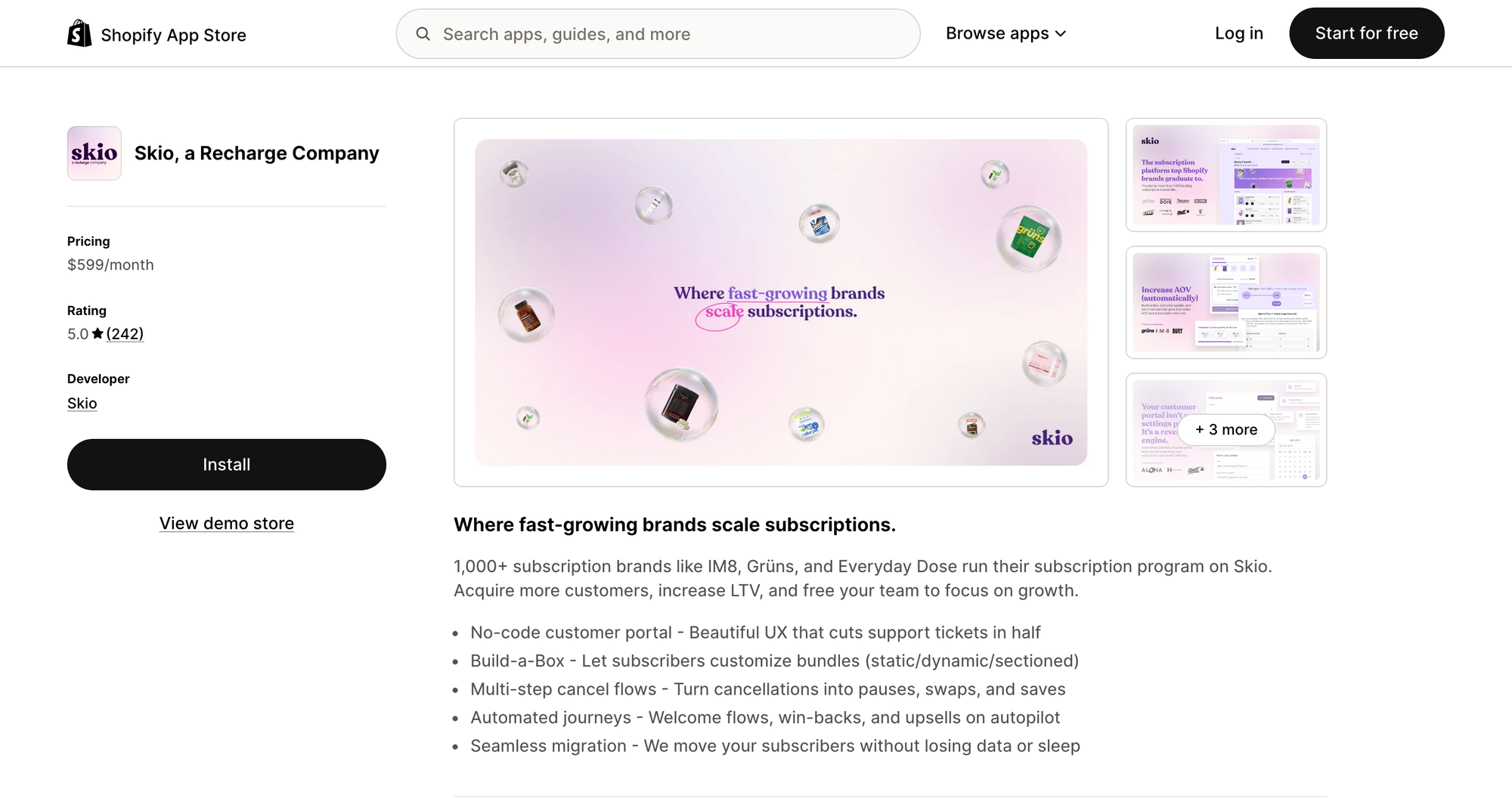
Recharge runs on 52,220 live Shopify stores. Its listing read 4.8 stars from 3,129 reviews on 8 October 2026, with 148 one-star reviews.
What it actually does
- Smart cancellation prevention and failed payment recovery on the $99 Starter plan.
- Analytics with industry benchmarks, which no other app in this comparison publishes.
- Plus at $499 adds bundles, tiered discounts, Concierge SMS, loyalty rewards, a referral programme and the JavaScript SDK with Storefront API.
What to check before you commit
Recharge's listing publishes a cheaper entry point than its own website does. The App Store panel carries the $25 plan; the pricing page on getrecharge.com starts at $99 and adds an unpriced Custom tier at volume-based rates. Install from the listing. And if a sales conversation offers Plus, ask what it changes other than the rate: the 0.15% saving is worth $400 a month only above roughly $266,000 of monthly subscription revenue.
6. Skio — $599 plus 1%, and the lowest percentage in the comparison
Best for: brands past roughly 2,700 subscribers migrating off a legacy platform, where zero-downtime migration and a multi-step cancel flow builder are the purchase. Skio's 1% is the lowest percentage here, so at 5,000 subscribers paying $40 it costs about $430 a month less than Recharge Starter on the same book.
Not ideal for: any brand below about 2,000 subscribers. There is no free plan and no entry tier, so 200 subscribers costs $599 a month plus 1% on a platform priced around a book 10 times larger. The $500 base premium over Recharge Starter is dead weight until subscription revenue clears roughly $107,500 a month.
Skio runs on 1,797 live Shopify stores. Its listing read 5.0 stars from 242 reviews on 8 October 2026.
What it actually does
- Multi-step cancel flow builder, Build-a-Box in static and dynamic form, and automated lifecycle journeys on the single published plan.
- Passwordless login and quick actions, so a subscriber can skip or swap from an email link.
What to check before you commit
The listing renders one card and links out. The pricing page on Skio's own website adds the annual rate of $499 a month and an unpriced Enterprise tier, and it scopes the fee to "orders involving a subscription", which makes a mixed cart with one subscription line a billable subscription order. Note the ownership too: the listing is titled "Skio, a Recharge Company" as of 8 October 2026, so the lowest-percentage option and the highest-percentage option here answer to the same vendor.
How to pick the fee shape, not the app
Three questions settle this before any demo:
Divide monthly subscription revenue by subscriber count. Above about $30 per subscriber per month, a count-metered app such as Seal is cheaper. Below about $15 with more than 500 subscribers, a revenue-metered app such as Appstle is. Between the two they land within a few dollars and the decision is features.
Decide whether you are buying retention tooling or billing. The percentage apps sell dunning depth, cancel flows and implementation. If nobody on your team owns subscriber retention as a job, you are paying for tooling nobody will operate.
Model the fee at three times your current revenue. A flat fee at 3x is still a flat fee. A percentage at 3x is the line that gets signed off once and never revisited.
For the full feature comparison behind these numbers, including Recurpay, Bold and PayWhirl, read the complete Shopify subscription app comparison. If the open question is what brings one-time buyers back, what a loyalty program costs at each order volume prices that side on the same basis and how points behave on bundles and subscriptions covers the overlap.
Run the arithmetic before the demo
The fee shape decides more of your subscription P&L than any feature on any plan card, and every number here can be checked in five minutes with a calculator. Divide monthly subscription revenue by subscriber count, then price all three shapes against the result: flat, count-metered and percentage. A brand that walks into a sales call knowing its own crossover point does not get sold the tier above the one it needs.
Frequently asked questions
Which Shopify subscription app has no transaction fee? Shopify Subscriptions, Seal and Appstle. Shopify Subscriptions is free and takes 0%, Seal prints 0% on all seven published tiers, and Appstle prints 0% on Starter and above but not on the Free card.
How much does Recharge charge per transaction? 1.49% plus 19¢ on the $99 Starter plan and 1.34% plus 19¢ on the $499 Plus plan, read from the listing on 8 October 2026. The $25 plan carries no transaction fee for the first 50 subscribers.
At what point does a transaction fee cost more than a flat plan? At $40 per subscriber per month, Recharge Starter passes Seal's $399 top tier at 382 subscribers and Loop Starter passes it at 750. That Seal tier covers 150,000 subscriptions.
Does Appstle charge a transaction fee on the free plan? The listing does not say. "0% Transaction Fee & No Hidden Charges" appears on Starter and above, and the Free card does not carry it. Treat the free tier's fee as undisclosed and budget from the $10 Starter plan.
Is Shopify Subscriptions good enough to replace a paid app? For a simple replenishment offer, yes, and it costs nothing. It publishes no dunning, cancel-flow or retention tooling, which is what the paid apps are actually selling, and 27% of its 848 reviews sit at two stars or below.
What is the cheapest way to start selling subscriptions on Shopify? Shopify Subscriptions at $0, or Seal's free plan at 50 subscriptions with 0% and full API access. For paid retention tooling from day one, Recharge's $25 plan covers the first 50 subscribers with no fee.

Written by
Thomas Nguyen is the CEO & Co-founder of Joy, a loyalty solution for Shopify and eCommerce brands. With years of experience building high-performance Shopify apps, Thomas aims to help merchants grow through customizable and retention-focused tools.
Related reading
 Shopify apps
Govalo Pricing: 2.9% of Gift Card Value on Every Plan
The percentage never goes away, not even on the $399 Enterprise tier. Six alternatives priced against a $20,000 gift-card month.
 Thomas Nguyen
 Shopify apps
Loox Alternatives: The Paid Plan Includes Fewer Orders
Loox's free plan allows 500 monthly orders and its $49.99 plan includes 300. Six alternatives on caps, overage and real cost.
Thomas Nguyen Shopify apps
Best Free Shopify Loyalty Apps: 50 to 400 Orders Free
Free-tier caps run from 50 orders on CWILL to 400 on LoyaltyLion. The full table, plus what crossing each cap actually costs.
Thomas Nguyen Shopify apps
Affiliate App Fees: ReferralCandy 10.5%, GoAffPro 0%
Total cost at $5,000, $25,000 and $100,000 of monthly affiliate revenue across seven apps and four different pricing shapes.
Thomas Nguyen Shopify apps
UpCart vs AfterSell: Both Apps Belong to Rokt
Merchants comparing them are choosing between two SKUs from one owner. UpCart meters orders, AfterSell prices by surface.
Thomas Nguyen Shopify apps
Best Shopify Membership Apps: Appstle $19, No Member Fee
Appstle charges $19 with no per-member fee. Inveterate publishes no price at all. Seven apps and what each pricing panel does not say.
Thomas Nguyen