Loox Alternatives: The Paid Plan Includes Fewer Orders
Loox's free plan allows 500 monthly orders and its $49.99 plan includes 300. Six alternatives on caps, overage and real cost.
Summarize this post with AI
Loox's own pricing panel contradicts itself. The free Beginner plan reads "Up to 500 orders" while Convert at $49.99 a month reads "300 orders included in base price + $50 per additional 300 orders", as read on the live listing on 8 October 2026. Upgrading from free therefore cuts your included order volume by 200. The alternatives that solve that problem outright are Judge.me at $0 with no order cap at all, Junip with unlimited orders on every plan including free, and AG Product Reviews at $0 with no paid tier to graduate into.
Below are six alternatives priced from their live listings, the arithmetic Loox's panel does not publish, and the one thing Loox still does better than anything here. Every rating, review count and price was read from each app's live listing on 8 October 2026, and each app name links to it. Install counts are the number of live Shopify stores running the app on the same date.
Key takeaways
- Loox's free plan allows up to 500 orders. Its first paid plan includes 300. That inversion is printed on one vendor's own pricing panel.
- Loox does not define a billable "order" in any documentation found, so the Convert overage cannot be totalled honestly. Treat $49.99 as a floor and the overage as undefined until Loox answers in writing.
- Judge.me is the only app here with no order cap on any plan, free or paid, which removes the metering problem rather than repricing it.
- Junip states unlimited orders and unlimited review request emails on its free plan, so order growth never triggers an upgrade.
- Loox is still the only app here bundling a referral programme with reviews, and the discount-for-photo mechanic is what it was built around.
- Most listings here render the App Store maximum of four plan cards or link out, so a higher tier may exist that the panel cannot show.
What Loox's pricing panel actually says
Three plan cards are visible, and the panel links out to Loox's own site, so this is not necessarily the whole ladder:
| Plan | Price | Order line, verbatim from the listing |
|---|---|---|
| Beginner | Free | "Up to 500 orders" |
| Convert | $49.99/month | "300 orders included in base price + $50 per additional 300 orders" |
| Unlimited | $299.99/month | No order line published |
Two things follow, and only one can be stated as a number.
The inversion is a fact. A store running 450 orders a month sits inside the free plan. The same store at 501 orders cannot, and the cheapest paid option includes 300. The upgrade buys real capability: video reviews, AI summaries and translations, reviews on bundles, referrals, Google, Meta and TikTok syndication, and API access. It does not buy headroom. It removes headroom.
The overage cannot be totalled. Loox does not define a billable order anywhere documented, and WiserReview's analysis of Loox pricing reports that support could not define it either. Nor does the panel say whether a partial block of 300 bills as a full $50 or prorates. So a store at 500 orders faces $49.99 plus somewhere between nothing and $50, and a single published figure for that bill is invented. Get the definition in writing before modelling it.
What can be said about the shape: Unlimited at $299.99 is the price of five extra blocks of 300 on Convert. Where the crossover lands depends on the order definition and the rounding rule, and the listing provides neither, so price Unlimited in the same conversation as Convert rather than after it.
129,584 live Shopify stores run Loox. The listing read 4.9 stars from 9,775 reviews on 8 October 2026, 162 of them one-star.
The six alternatives at a glance
| App | Live Shopify stores | Rating / reviews | Free plan | Entry paid plan |
|---|---|---|---|---|
| Judge.me | 592,507 | 5.0 / 48,164 | unlimited, no order cap | $15 |
| AG Product Reviews | 27,304 | 5.0 / 3,176 | fully free, no paid tier | none |
| Okendo | 19,344 | 4.8 / 1,427 | 50 orders a month | $19 |
| Fera | 8,654 | 4.8 / 2,031 | none | $9 |
| Junip | 8,142 | 4.8 / 1,160 | unlimited orders | $29 |
| Opinew | 4,874 | 4.7 / 622 | 50 email requests | $19 |
Read the free-plan column first. It is where the Loox decision is made, because the reason brands look for a Loox alternative is the 500-order ceiling and what sits immediately past it.
1. Judge.me — no order cap on any plan
Best for: stores whose order volume is growing and whose review programme must not get more expensive as a result. Judge.me's Forever Free plan carries unlimited product and store reviews with no order cap, so a brand going from 400 to 4,000 orders a month pays exactly what it paid before, and the Loox inversion problem disappears rather than moving up a tier.
Not ideal for: brands whose reviews are a merchandising surface rather than a trust signal. Judge.me's widgets are competent and unremarkable next to Loox's, and its referral programme sits behind a paid tier, so a fashion brand that built its product page around a photo wall and a refer-a-friend block is rebuilding two things, not one.
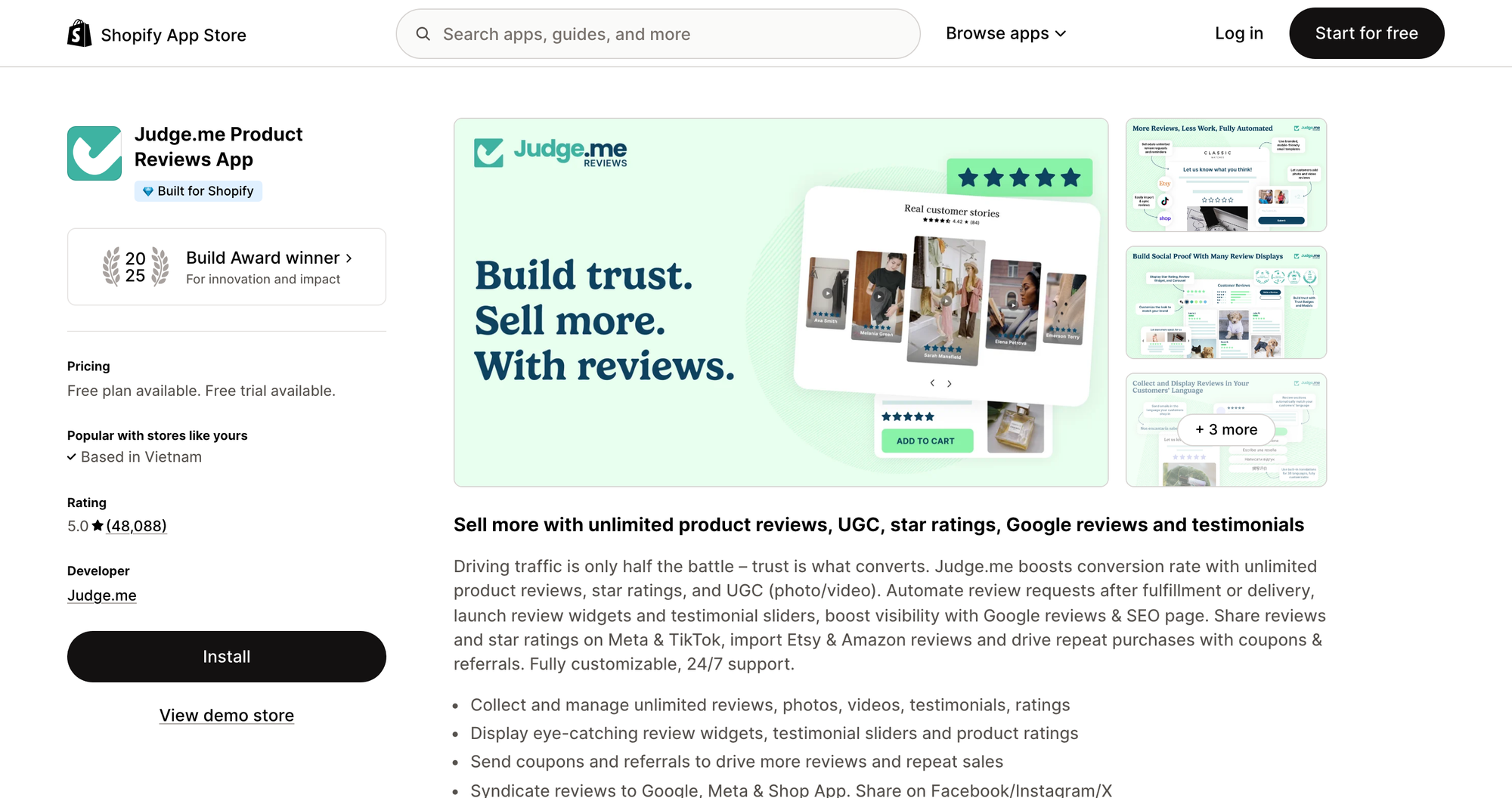
592,507 live Shopify stores run Judge.me. The listing read 5.0 stars from 48,164 reviews on 8 October 2026.
What it actually does
- Unlimited visual reviews including photos and videos on the free plan, with the review widget, star-rating badge and carousels.
- Google reviews sync and rich snippets, trust badges, syndication to the Shop app, Etsy and Amazon, and a reviews importer with AliExpress sync, all on free.
- AI replies, summaries and translations, 130-plus integrations, 16 widgets including Q&A, coupons and referrals, Meta and TikTok Shop sync, and CSS customisation, from Awesome at $15.
What to check before you commit
Coupons and referrals sit on Awesome at $15, not on free, so a brand switching from Loox to replicate the discount-for-photo mechanic pays $15 rather than nothing. The panel shows two plans and links out, so confirm nothing sits above $15 before you plan around it.
2. Junip — unlimited orders on every plan, including free
Best for: stores that want order volume out of the pricing conversation permanently and will pay for capability instead. Junip's listing states unlimited orders and unlimited review request emails on the free plan, so there is no cap to breach, no overage line, and no version of the Loox 300-versus-500 problem at any tier.
Not ideal for: brands whose whole collection plan is an incentive. Review incentives sit on Core at $29 rather than on free, so a store switching off Loox's discount-for-photo offer and expecting to rebuild it for nothing starts paying on day one.
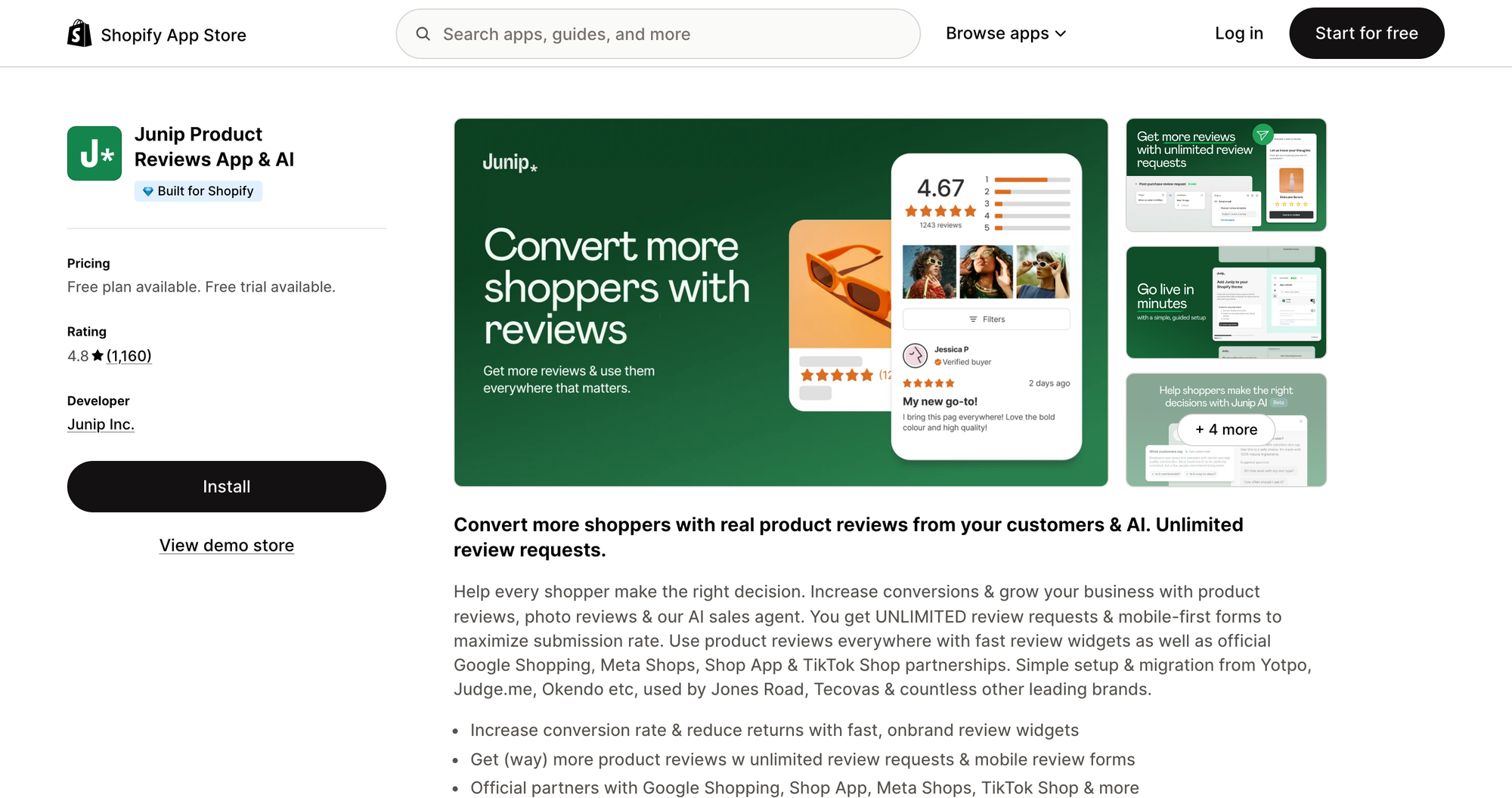
8,142 live Shopify stores run Junip. The listing read 4.8 stars from 1,160 reviews on 8 October 2026.
What it actually does
- Free covers unlimited orders, unlimited review request emails, mobile-first submission, product-page widgets and rich snippets.
- Core at $29 adds incentives, review replies, product grouping and media in review requests.
- Growth at $79 adds Google Shopping, TikTok Shop, Shop app syndication, Meta Shops, Klaviyo and Postscript integrations, and review search and filters; Premium at $299 adds Junip AI, multi-store management and API access.
What to check before you commit
Syndication is the decisive line and it sits on Growth at $79. If Google Shopping, TikTok Shop and the Shop app are why you are leaving Loox, compare $79 against Convert at $49.99 plus undefined overage, not against Junip's free plan. Junip's distribution is the cleanest here, 1,070 five-star out of 1,160 with four one-star reviews, and the panel renders four cards with a link out.
3. AG Product Reviews — free with no ladder at all
Best for: stores that want unlimited first-party review collection at zero cost and no plan to manage. AG Product Reviews renders no pricing panel on its listing and its pricing summary reads "Free", so there is no order cap, no overage and nothing to model, which is the shortest possible answer to the Loox arithmetic.
Not ideal for: brands that need a published upgrade path or a contractual support tier. There is no paid plan, which is both the appeal and the ceiling, and with no revenue signal behind the app the thing worth checking is how recently support replied to someone else.
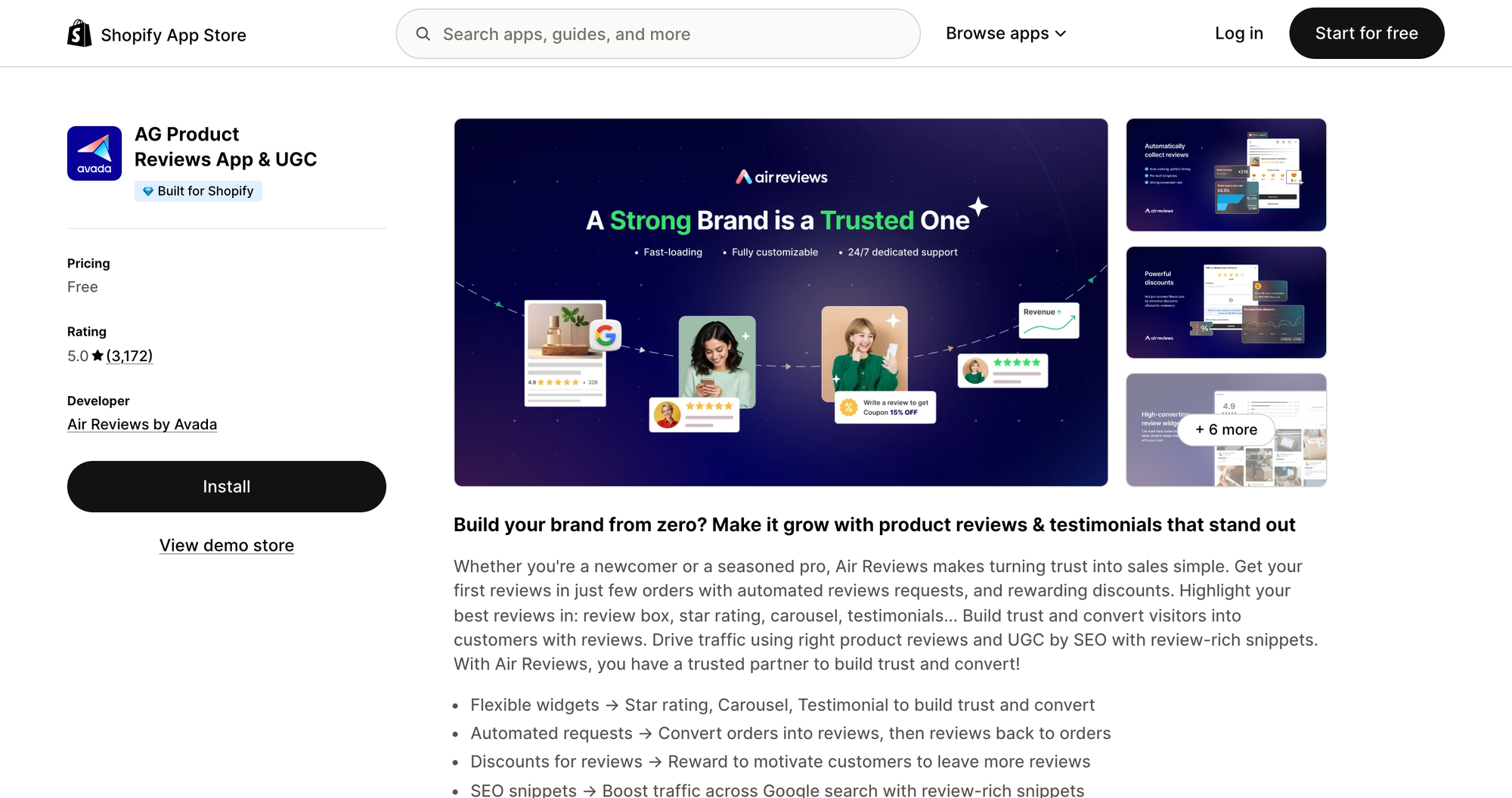
27,304 live Shopify stores run AG Product Reviews. The listing read 5.0 stars from 3,176 reviews on 8 October 2026. It is built by Avada, the same company that builds Joy, so treat this section as a disclosure rather than a recommendation.
What it actually does
- Unlimited product reviews with customisable widgets and automated collection, with no order metering.
- Works with Checkout, Shopify Flow and Shopify Admin, plus Klaviyo, PageFly, PushOwl and Transcy, and integrates with Joy Rewards and Loyalty Program, which is the disclosure half of this section.
What to check before you commit
Read the distribution rather than the average: 3,071 five-star, 80 four-star and 17 one-star out of 3,176. Then check the specific widget you need, because a free app with no tiers has nothing to upgrade into when a requirement appears.
4. Fera — metered on review requests, not orders
Best for: stores running review collection as a defined campaign, where the unit you control is how many requests go out. Fera meters requests directly, 100 a month on Startup at $9 and 1,000 on Small at $29, so a brand sending 200 requests pays for the activity rather than the sales.
Not ideal for: stores that want to prove the app before paying, and stores that assume one cap. Fera has no free plan, and every tier carries both a request limit and an order limit, so a 2,500-order store sending 400 requests lands on Medium at $99 because of the order line, not the request line.
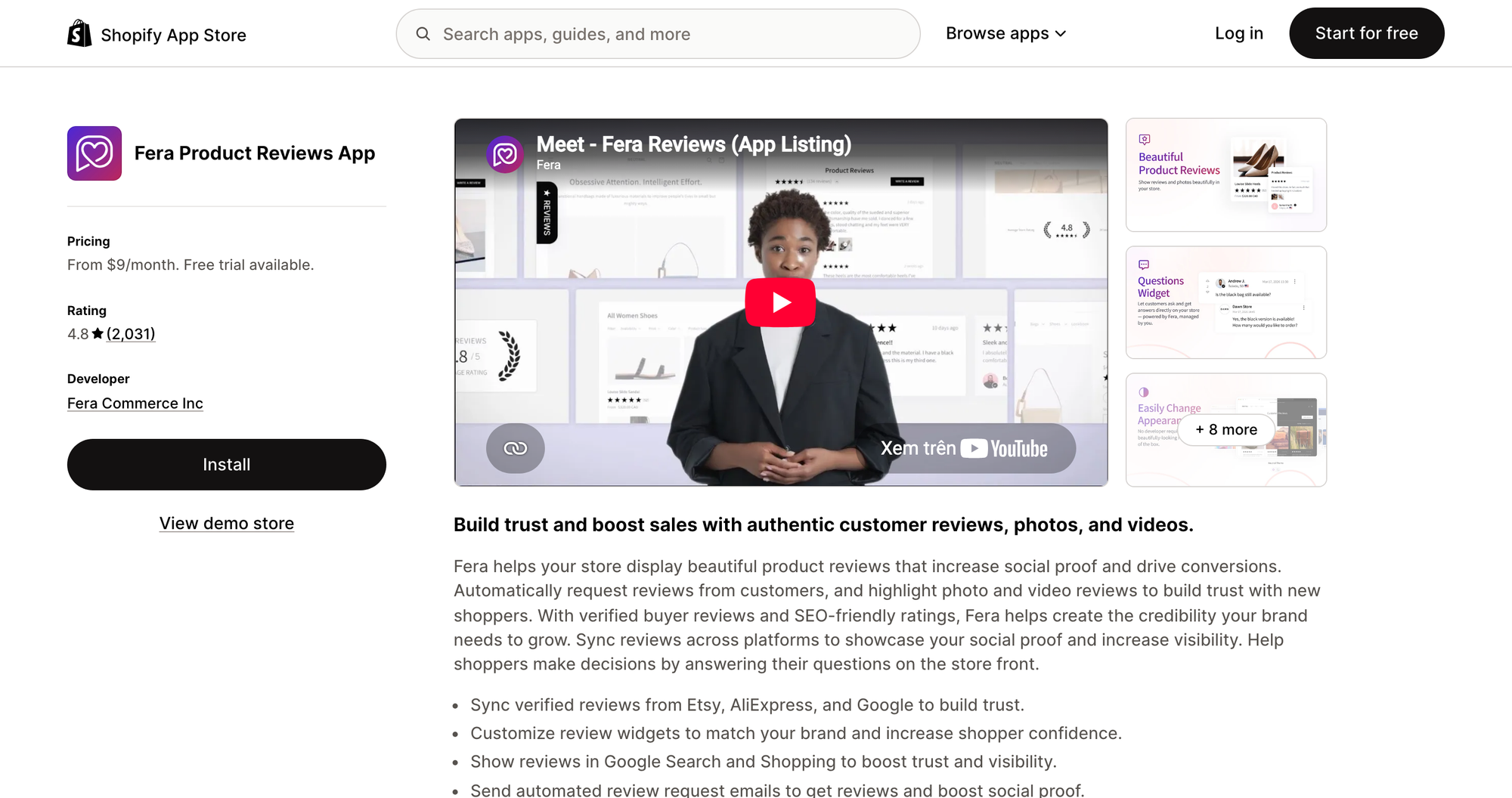
8,654 live Shopify stores run Fera. The listing read 4.8 stars from 2,031 reviews on 8 October 2026.
What it actually does
- Startup at $9 covers 100 review requests, up to 200 orders, two users, 100MB of photo and video storage, a questions-and-answers widget and unlimited integrations.
- Small at $29 raises that to 1,000 requests and 2,000 orders, with custom email domains and product groups.
- Medium at $99 reaches 10,000 requests and 20,000 orders with multi-store sync; Semi-Large at $199 covers 25,000 requests and 50,000 orders. Named integrations include Google, Facebook, Etsy, Klaviyo and Smile.io.
What to check before you commit
Photo and video storage is capped at 100MB on Startup and 1GB on Small, a limit no other app here publishes. For a brand leaving Loox precisely because photo reviews are the product, storage is the line to model before price. The panel renders four cards, the App Store maximum, so a tier above Semi-Large may exist.
5. Okendo — attribute filtering rather than photo walls
Best for: beauty, apparel and supplement brands where the buying question is whether a product suits someone with a particular skin type, hair type or fit. Okendo captures those attributes at review time and converts them into on-site filters, a different job from displaying photographs attractively and the one capability nothing else here offers.
Not ideal for: stores above 3,500 monthly orders, where the ladder stops, and brands whose products do not vary by customer type. Okendo's caps escalate steeply, from 200 orders at $19 to 1,500 at $119, so a store at 1,600 orders a month pays $299 where Judge.me charges $15.
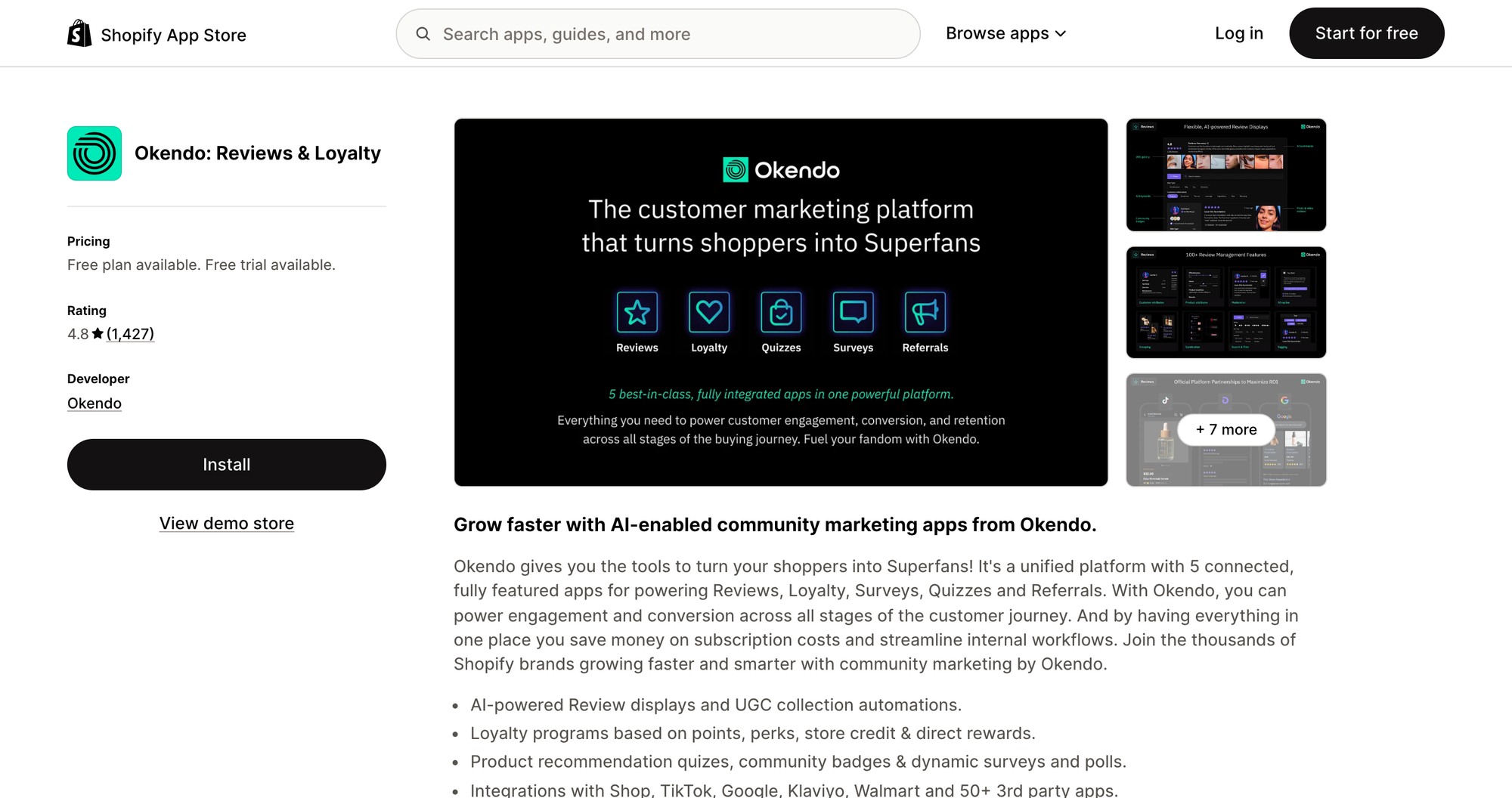
19,344 live Shopify stores run Okendo. The listing read 4.8 stars from 1,427 reviews on 8 October 2026.
What it actually does
- A smart review form capturing structured customer attributes, with review grouping across variants and review moderation on the free plan.
- A Review Rewards Engine on the free plan, the closest thing here to Loox's incentive mechanic without paying for it.
- AI review summaries and keywords, a Q&A widget and TikTok Shop integration from Growth at $119; review campaigns, an advanced CSS editor, email and SMS integrations and managed onboarding from Power at $299.
What to check before you commit
Okendo bundles loyalty into the same app, which changes the comparison if loyalty is also on your list. The caps are the risk: free to 50 orders, $19 to 200, $119 to 1,500 and $299 to 3,500, with four cards rendered and a link out. Then open five product pages and write down the question a hesitant shopper is asking. If the answer is an attribute, Okendo earns the premium. If it is "is this real", a verified-buyer badge on a free app answers it for nothing.
6. Opinew — for importing reviews you own
Best for: brands already selling on Amazon or eBay under their own account who want those reviews on their Shopify pages. Opinew's recurring imports keep the two in sync rather than copying once, a job Loox does not do at all.
Not ideal for: stores collecting first-party reviews by email alone. The step from Starter at $19 to Growth at $89 buys import volume and recurring imports, so a brand importing nothing pays for the half of the product it will not switch on.
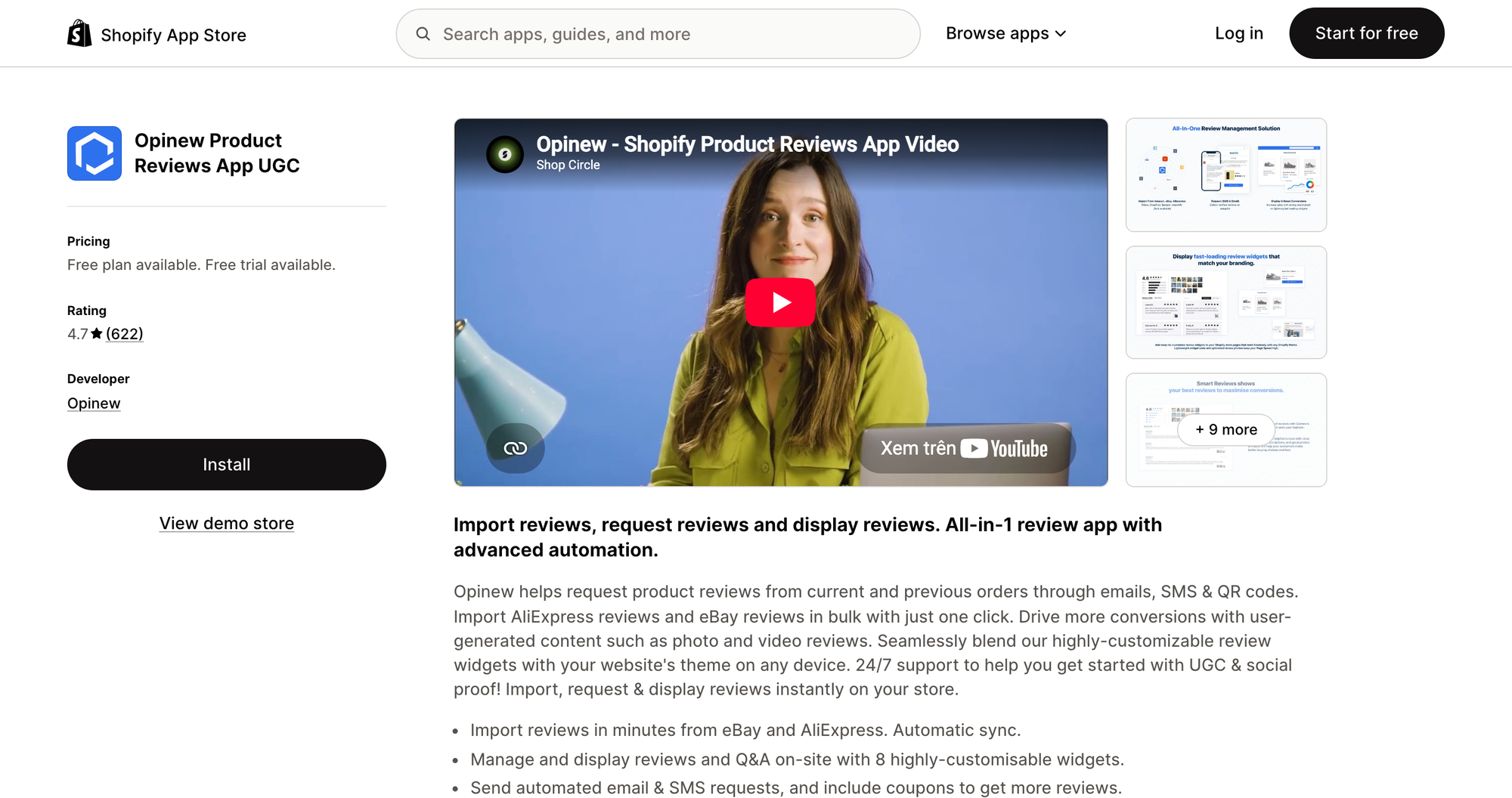
4,874 live Shopify stores run Opinew. The listing read 4.7 stars from 622 reviews on 8 October 2026.
What it actually does
- Free allows 50 review requests by email and 100 imports from eBay and AliExpress, one-off only.
- Starter at $19 gives 500 imports and 100 email requests, unlimited AliExpress imports, photo and video reviews and coupon incentives.
- Growth at $89 adds recurring imports, SMS collection and Google Shopping at 5,000 imports; Advanced at $199 reaches 50,000 imports with headless support.
What to check before you commit
A Smart Reviews add-on is advertised from $9 a month on Starter, Growth and Advanced alike, so it sits outside every tier and appears in no plan price. The email request limit is tighter than it looks: 100 a month on Starter, a fraction of what a 500-order store needs.
Why reviews earn the budget at all
Reviews are not decoration, and the research sets a target that changes which app you need. In a report on how online reviews influence sales, Northwestern University's Spiegel Research Center found purchase likelihood for a product with five reviews is 270% greater than for the same product with none, that displaying reviews lifted conversion 190% for lower-priced items and 380% for higher-priced ones, and that a verified-buyer badge improves the odds of purchase by 15%.
Two findings in the same research should govern the choice. The marginal benefit of additional reviews drops off rapidly after the first five, so an app that gets every product in a long catalogue to five beats one that gets a few products to fifty. And purchase likelihood peaks between 4.0 and 4.7 stars and falls as ratings approach 5.0, so a programme engineered for perfect scores works against you.
Together those argue for breadth, and for an app that does not charge more as the catalogue starts working. Which is the argument against metering by orders.
Which one to pick
Stay on Loox if the discount-for-photo mechanic and the referral programme are both running and both earning. Nothing in this list bundles reviews and referrals, and the photo wall is genuinely better. Stay on Beginner until you pass 500 orders.
Move to Judge.me if the decision is about reviews and nothing else: unlimited reviews, no order cap, $0, the widest free syndication in the category, and $15 for coupons and referrals if you want the Loox mechanic back. Move to Junip if you want order volume permanently out of the pricing conversation and can carry $79 for syndication. Move to AG Product Reviews if free with no ladder is the whole requirement.
Choose Okendo when the shopper's real question is a customer attribute, Fera when your programme is a campaign measured in requests and you have modelled the storage caps, and Opinew when the reviews you want are reviews of your own products.
Reviews answer the first-purchase question. The second purchase is a different system, and the two connect through the earning rule: how loyalty points work covers the mechanics, what a loyalty point actually costs covers the maths of giving points away, and rewarding reviews with loyalty points covers the join between them. For the paid field beyond this list, Judge.me alternatives and Judge.me, Okendo and Yotpo compared go deeper.
Frequently asked questions
How much does Loox cost? The live listing shows three plans: Beginner free with "Up to 500 orders", Convert at $49.99 a month with "300 orders included in base price + $50 per additional 300 orders", and Unlimited at $299.99. The panel carries a "See all pricing options" link, so a tier outside those three may exist.
Why is Loox's paid plan cheaper on orders than its free plan? Because the free plan is capped at 500 orders while the first paid plan includes 300. Loox publishes no explanation. The practical reading is that Convert is sold on capability, including video reviews, AI features, referrals and API access, rather than on volume.
What does Loox count as an order? Loox does not define it in any documentation found, and WiserReview reports that support could not define it either. That matters because the overage is $50 per additional 300 orders, so the definition sets the bill.
What is the best free alternative to Loox? Judge.me, whose Forever Free plan carries unlimited product and store reviews with no order cap, Google sync, rich snippets and Shop app syndication. AG Product Reviews is the other fully free option, and Junip's free plan states unlimited orders.
Which Loox alternative handles photo and video reviews best? Fera sells photo and video collection from $9 a month and is the only app here publishing explicit media storage limits, 100MB on Startup and 1GB on Small. Loox remains the strongest at displaying them, which is why the switch is a trade rather than an upgrade.
Does any Loox alternative include a referral programme? Judge.me bundles coupons and referrals on its $15 Awesome plan, which is the cheapest route to both. Loox itself includes referrals, post-purchase and on-site, from Convert at $49.99.

Written by
Thomas Nguyen is the CEO & Co-founder of Joy, a loyalty solution for Shopify and eCommerce brands. With years of experience building high-performance Shopify apps, Thomas aims to help merchants grow through customizable and retention-focused tools.
Related reading
 Shopify apps
Affiliate App Fees: ReferralCandy 10.5%, GoAffPro 0%
Total cost at $5,000, $25,000 and $100,000 of monthly affiliate revenue across seven apps and four different pricing shapes.
 Thomas Nguyen
 Shopify apps
UpCart vs AfterSell: Both Apps Belong to Rokt
Merchants comparing them are choosing between two SKUs from one owner. UpCart meters orders, AfterSell prices by surface.
Thomas Nguyen Shopify apps
Shopify Subscription Fees: Seal $89.95, Recharge $1,671
Total cost at 100, 500 and 2,000 subscribers across six apps. Recharge Starter passes Seal's top tier at 382 subscribers.
Thomas Nguyen Shopify apps
Smile.io Pricing: The $999 Plan Is Not on the App Store
The listing stops at Growth $199. smile.io adds Plus at $999 billed annually, and the crossover sits near 6,500 monthly orders.
Thomas Nguyen Shopify apps
What Free to Install Really Means on Shopify
Free to install and Free plan available are different billing settings. What the label costs on six apps, quoted from each panel.
Thomas Nguyen Shopify apps
Best Free Shopify Loyalty Apps: 50 to 400 Orders Free
Free-tier caps run from 50 orders on CWILL to 400 on LoyaltyLion. The full table, plus what crossing each cap actually costs.
Thomas Nguyen