
Should Customers Earn Loyalty Points on Bundles and Subscription Orders?
A policy framework for points, VIP spend, redemptions, refunds, and multipliers on bundle and subscription orders.

Summarize this post with AI
Yes, in most programs customers should earn on bundle and subscription orders, but not automatically on every dollar shown at retail price. The defensible default is to award points on eligible net merchandise paid, exclude taxes, shipping, gift-card tender and canceled value, then reverse points when value is refunded.
The harder question is not whether these orders “count.” It is whether the same order can receive a bundle markdown, a subscription discount, a redeemed reward, VIP progress and a subscriber multiplier without exceeding its economic role. A senior operator needs one policy across checkout, subscriptions, loyalty, finance and customer service.
Key takeaways
- Use eligible net merchandise paid as the normal earning base, not list price and not the pre-discount subtotal.
- Treat points, VIP qualification and promotional multipliers as three separate ledgers or policy decisions.
- Decide discount combination rules before launch. Do not discover them when a bundle code and loyalty coupon collide at checkout.
- Reverse earn and VIP progress proportionally on partial refunds, with an auditable order reference.
- Reward subscription commitment deliberately. A subscriber multiplier should fund lower churn or better cadence, not simply stack on top of an already aggressive discount.
Start with the economic event, not the order label
“Bundle order” can mean a fixed bundle SKU, a mix-and-match group, a quantity break or several ordinary items receiving an automatic discount. “Subscription order” can mean the first checkout, a recurring renewal, a prepaid plan or a mixed cart containing one-time and recurring items.
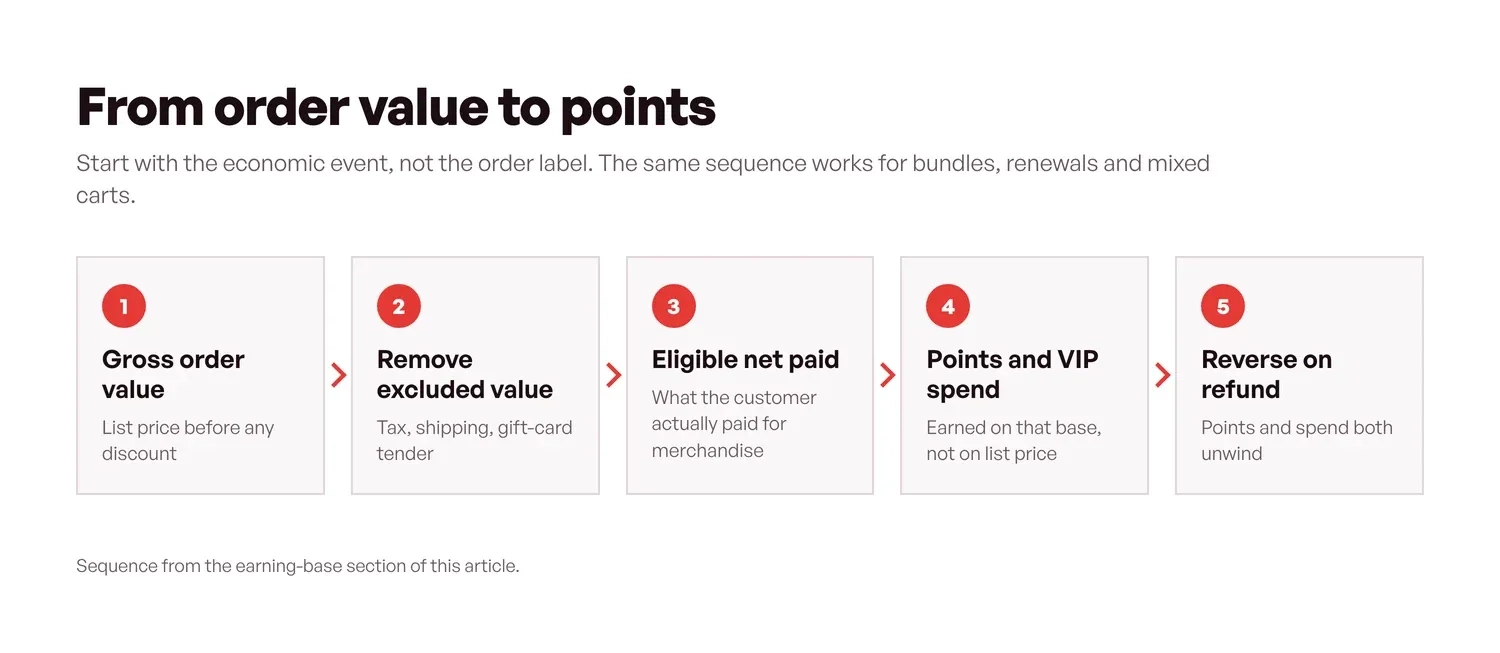
Those labels do not tell you what value the merchant collected. The loyalty calculation should begin with order economics:
eligible earning base = eligible merchandise subtotal − allocated discounts − refunded eligible value
Taxes usually do not represent merchandise value. Shipping is often a pass-through cost or a separate service. Gift-card tender represents value purchased earlier, so awarding on both gift-card purchase and gift-card redemption can double count. Each merchant can choose differently, but the exclusions should be explicit and consistent.
Shopify’s bundle documentation explains that bundles can be represented and managed in different ways. That is one reason not to rely only on a “bundle” tag. Calculate from line items, discount allocations and eligibility rules that survive changes in merchandising setup.
Choose the earning base
Three policies appear simple, but they produce very different costs.
| Earning policy | What receives points | Advantage | Main risk |
|---|---|---|---|
| Gross merchandise value | List-price value before discounts | Generous and easy to message | Rewards value the customer did not pay |
| Net merchandise paid | Eligible product value after allocated discounts | Aligns points with collected merchandise revenue | Requires reliable discount allocation |
| Net contribution proxy | Net paid minus selected variable costs | Closest to economics | Too complex to explain at shopper level |
For most Plus brands, net merchandise paid is the best operating default. Keep the shopper message simple, such as “earn points on eligible purchases,” while the terms define exclusions.
Do not attempt to calculate true contribution margin inside customer-facing points logic. COGS, fulfillment and return provisions belong in program analysis, not in a balance a shopper must predict. Instead, exclude structurally low-margin products or create category-specific rates if the economics require it.
Allocate discounts at line level
A cart-level discount must be allocated across eligible lines before points are calculated. Otherwise, an excluded gift card or non-earning service can absorb discount value while eligible merchandise earns as if it were full price.
The same principle applies to bundles. If a bundle is represented by component lines, allocate the bundle markdown across those components. If it is represented by a single parent line, preserve a mapping to the underlying items for returns and reporting.
Shopify lets merchants configure which discounts can combine. Its discount combination guidance also makes clear that combinations depend on discount classes and configuration. Loyalty policy should mirror the actual checkout behavior, not a marketing promise that every offer “stacks.”
Separate points, VIP spend and promotion logic
A common implementation mistake is to use one amount for everything. These are different instruments:
| Instrument | Job | Recommended base for bundles/subscriptions |
|---|---|---|
| Redeemable points | Fund a future reward | Eligible net merchandise paid |
| VIP qualifying spend | Recognize commercial relationship | Net paid, with refunded value reversed |
| Subscriber status | Recognize an active commitment | Subscription status, not spend alone |
| Promotional multiplier | Change behavior for a period | Base points on specifically eligible value |
A customer may keep subscriber status while their VIP spend changes with orders and refunds. That is cleaner than forcing subscription into a spend tier. It also allows non-subscribers to progress through normal VIP tiers without being disadvantaged by a status they cannot access.
If your system cannot hold regular VIP progression and subscriber status independently, document precedence. For example, an exclusive subscriber tier may temporarily replace the displayed spend tier, while historical qualifying spend continues to be retained for reassessment after cancellation.
Decide whether redemption can stack with bundle or subscription pricing
There is no universal correct answer. The policy should reflect margin, customer expectation and checkout constraints.
| Policy | Best fit | Caveat |
|---|---|---|
| No reward redemption on discounted bundles | Thin-margin curated sets | Can surprise members if hidden until checkout |
| Fixed-value reward allowed, percentage reward blocked | Wide order values and capped risk | Needs clear eligibility copy |
| Rewards combine with subscription discount | Mature subscription economics | Can create persistent double discounting |
| Points earn on the post-redemption amount | Strict cost control | Makes earning feel lower on reward orders |
| Points earn before loyalty redemption, after commercial discounts | Programs that treat redemption as tender-like value | Creates higher loyalty cost and needs finance approval |
The distinction between a commercial markdown and a loyalty redemption matters. A bundle discount changes the selling price. A loyalty reward settles part of the order in exchange for previously earned value. Some brands therefore calculate earn after bundle and subscription discounts but before a loyalty fixed-value redemption. Others calculate on cash paid. Either can work if it is consistently implemented and modeled.
A safer first policy is: commercial discounts reduce the earning base; loyalty redemptions do not combine with other order discounts unless explicitly tested; and customers can see incompatibility before converting points into a coupon.
Use a subscriber multiplier only when it buys a behavior
A multiplier should answer a specific question: what behavior is the additional reward meant to reinforce?
- Initial subscription: reward the commitment once, but avoid issuing a large bonus before the return or cancellation window closes.
- Successful renewals: award on each paid cycle, based on net eligible value.
- Consecutive cycles: use a milestone after a defined number of successful payments rather than a permanent high multiplier.
- Cross-category purchase: use a targeted multiplier on non-subscription items if the goal is to expand the relationship.
- Prepaid plans: define whether points issue when cash is collected or as each fulfillment occurs. Finance, returns and customer expectations must align.
Do not grant a subscriber multiplier merely because the integration supports it. Subscription pricing may already include a standing discount. The incremental reward must be compared with contribution after product cost, payment fees, fulfillment, shipping support and expected returns.
Shopify’s subscription guidance is useful for understanding the customer and order lifecycle, but the loyalty layer still needs its own rules for renewals, failed payments, pauses and cancellations.
Build refund and reversal behavior before launch
Refund handling is not an edge case. It is part of the points ledger.
For a full refund, reverse the points earned and the VIP spend credited to that order. For a partial refund, reverse the portion attached to the returned lines, including their allocated discounts. Do not reverse unrelated lines just because the original purchase was a bundle.
Bundle returns need an explicit policy when a customer keeps part of a set. Options include repricing retained items, disallowing partial returns for the bundle, or reversing only the returned components. Loyalty should consume the outcome produced by the commerce and returns system, not invent a separate price.
The ledger should store:
- source order and line identifiers;
- event type, such as earn, pending, release or reversal;
- eligible amount and currency;
- rule and multiplier version;
- original event reference for every reversal;
- idempotency key so a retried webhook cannot award twice.
Pending points can reduce negative-balance risk by delaying availability until a return window has passed. They do not replace reversals because late refunds and chargebacks still happen.
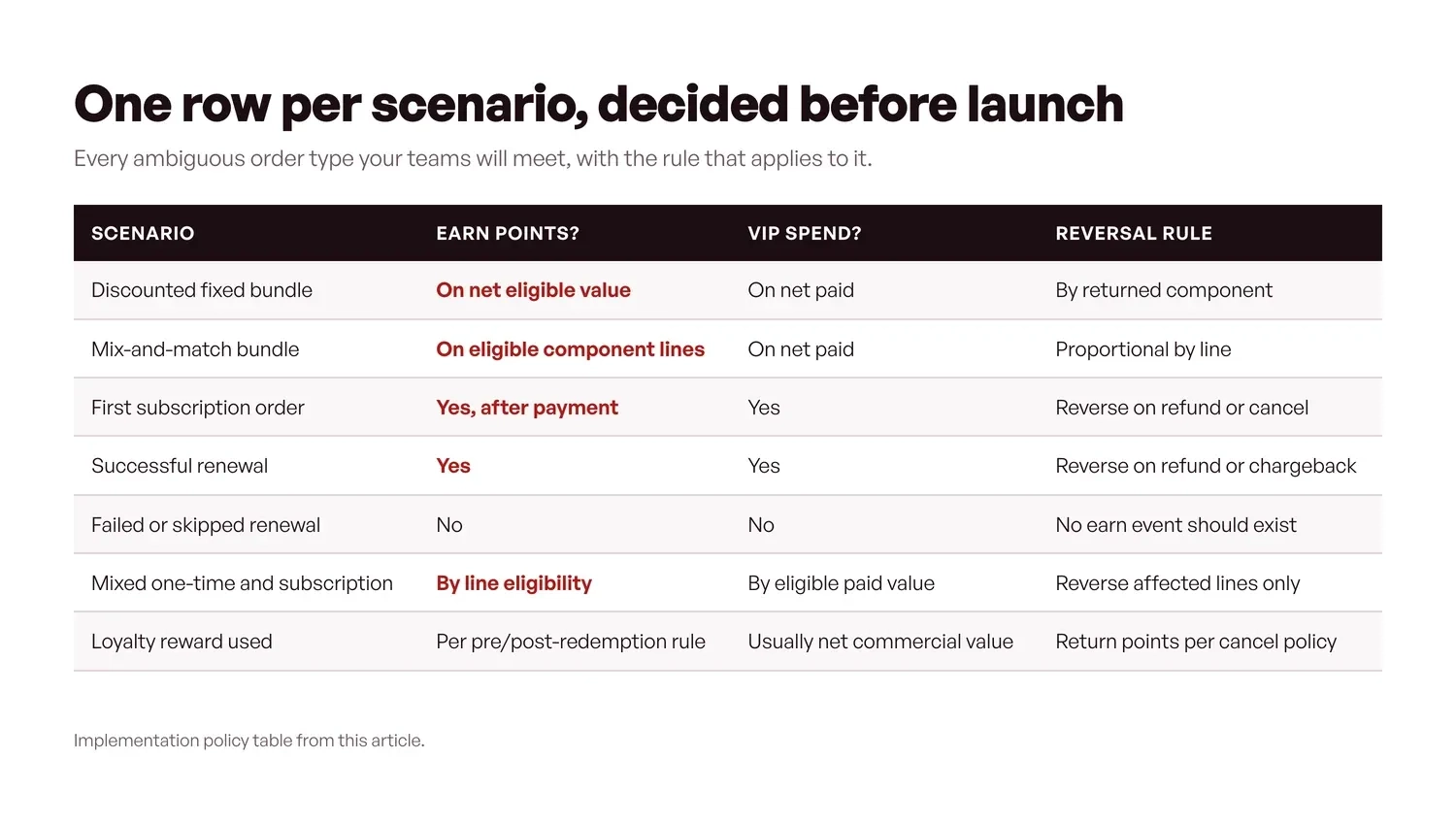
An implementation policy your teams can sign off
Use a written matrix before configuring rules.
| Scenario | Earn points? | VIP spend? | Redemption? | Reversal rule |
|---|---|---|---|---|
| Discounted fixed bundle | On net eligible value | On net paid | Per combination policy | By returned component or repriced outcome |
| Mix-and-match bundle | On eligible component lines | On net paid | Test conflicts | Proportional by line |
| First subscription order | Yes, after payment | Yes | Usually same as renewal | Reverse on refund/cancel |
| Successful renewal | Yes | Yes | Rarely relevant at renewal | Reverse on refund/chargeback |
| Failed or skipped renewal | No | No | No | No earn event should exist |
| Mixed one-time/subscription cart | By line eligibility | By eligible paid value | Respect checkout classes | Reverse affected lines only |
| Loyalty reward used | Per chosen pre/post-redemption rule | Usually net commercial value | Already redeemed | Return used points according to cancellation policy |
Have ecommerce, retention, finance and support approve the same matrix. Then test it with real checkout scenarios, including Markets currencies, tax-inclusive pricing, stacked automatic discounts, partial fulfillment and a subscription renewal created without a storefront session.
Make the generous rule the controlled rule
Customers should not be penalized because a product is sold as a bundle or on subscription. They should earn on the value of eligible merchandise they actually buy. Generosity becomes expensive when undefined stacking, gross-price earning and missing refund reversals all compound on the same order.
The durable policy is easy to state: earn on eligible net merchandise, recognize commitment separately from spend, combine discounts only by design, and reverse value when the commercial event reverses. That gives customers a predictable program and gives finance an auditable liability.
Sources

Written by
Thomas Nguyen is the CEO & Co-founder of Joy, a loyalty solution for Shopify and eCommerce brands. With years of experience building high-performance Shopify apps, Thomas aims to help merchants grow through customizable and retention-focused tools.
Related reading
 How-to Guide
BFCM Readiness: Shopify Tests Checkout, Nobody Tests Your Widget
Shopify scale-tests checkout at 80,000 a minute. The risk you own is the storefront, measured on the signed-in path.
 Thomas Nguyen
 How-to Guide
Shopify BFCM Guide: Black Friday 2026 Is 27 November
Black Friday 2026 is 27 November and Cyber Monday is 30 November. Shopify changed how it counts BFCM customers, so 81M is not growth.
Thomas Nguyen How-to Guide
Shopify Referral Program Basics: Everything You Need To Know To Get Started
Referral programs are an effective ways to grow your Shopify store. This article will explain the basics of setting up a Shopify referral program and how to make it work.
Thomas Nguyen Program design
VIP Early Access on Shopify: Three Ways to Gate a Sale Before It Opens
Shopify can limit an automatic discount to a customer segment. Three ways to gate a VIP sale, and where each one leaks.
Thomas Nguyen How-to Guide
Shopify Discount Combinations: Why Your Loyalty Reward Will Not Stack
Shopify does not combine discounts by default, and the setting only reaches reward codes issued after you change it.
Thomas Nguyen How-to Guide
An Expert Guide to Shopify POS Loyalty Programs
This guide provide everything you need to know about Shopify POS loyalty programs, best apps to use, different program types, and even setup steps.
Thomas Nguyen