
Online + POS Loyalty: Identity, Receipts, and Reconciliation
Design one loyalty ledger across ecommerce, POS, and retail receipts with identity controls, idempotency, refunds, and reconciliation.

Summarize this post with AI
Omnichannel loyalty works only when every eligible purchase reaches one customer ledger once. The storefront, POS, subscription platform, and receipt flow can have different interfaces, but they cannot maintain competing truths about the same balance.
The difficult parts are identity, event timing, duplicate prevention, and reversals. A loyalty tile at checkout is useful, but it is the visible edge of a system that must survive shared phone numbers, late webhooks, partial refunds, offline retail receipts, and staff mistakes.
Design the ledger first. Then design the cashier and customer experience around it.
Key takeaways
- Use a stable customer identity and an explicit cross-system identity map.
- Give every earning event a unique idempotency key.
- Separate pending, available, redeemed, reversed, and expired value.
- Treat receipt submission as a controlled claims process.
- Reconcile channel totals and exceptions every operating cycle.
- Make post-purchase balance changes visible to staff and customers.
One ledger does not mean one interface
A customer may interact through an online account, a Shopify POS cart, a subscription order, a mobile wallet, or a receipt form. Each surface can show different context, but they should read and write the same underlying member state.
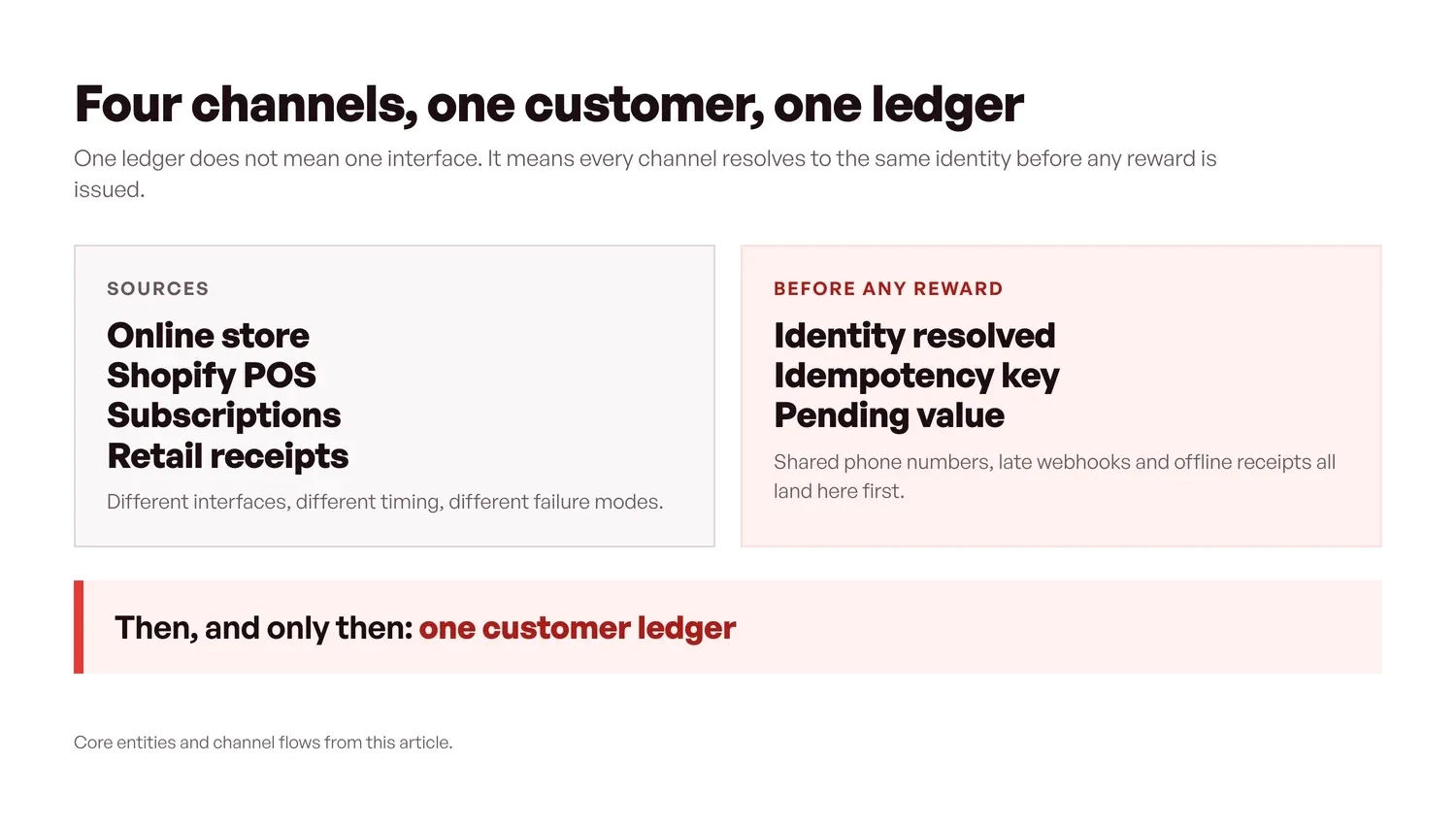
The core entities are:
| Entity | Required role |
|---|---|
| Customer | Canonical loyalty identity plus linked channel identities |
| Order | Commercial transaction and channel context |
| Event | Earn, redeem, adjust, expire, reverse, or tier change |
| Reward | Issued value and redemption conditions |
| Balance | Derived or controlled total by state |
| Audit record | Source, actor, timestamp, reason, and correlation IDs |
Avoid making the balance the only record. A number without an event history cannot explain why a refund removed value, why a receipt was rejected, or whether a delayed POS event was processed twice.
Identity must be resolved before rewards are issued
At POS, staff often find a customer by email or phone. That is convenient, but email and phone are mutable identifiers. Families may share a number. A customer may use one email online and another in-store. Formatting differences can create a second record.
Use an identity hierarchy:
- Platform customer ID within the commerce system
- Verified account or membership ID
- Linked external IDs from subscription or retail systems
- Normalized, verified email or phone as lookup attributes
- Manual merge under controlled support permissions
The POS workflow should encourage staff to assign an existing customer to the cart before checkout. If a new record is necessary, collect enough information to prevent an obvious duplicate and disclose any enrollment or communication consent separately.
Do not treat loyalty participation as marketing permission. A cashier can identify a customer for earning without silently creating email or SMS consent.
When records must be merged, preserve both event histories and create a merge audit record. Define which profile fields win and how open rewards, referrals, birthdays, tiers, and paid entitlements combine. A simple balance addition may duplicate value if the two records already contain mirrored events.
Every award needs an idempotency key
POS and ecommerce systems retry requests. Networks fail after the source sends an order but before it receives confirmation. Webhooks can arrive out of order. Staff can reopen orders. Without duplicate protection, “retry” becomes “award again.”
Create a unique key for each economic action, such as:
source_system + store + order_id + event_type + order_version
The exact format matters less than uniqueness and persistence. The destination must store the key and reject a second event with the same economic meaning.
Do not rely only on timestamp or cart total. Two valid orders can share both. Do not generate a fresh random key on every retry, because the destination cannot recognize the duplicate.
For adjustments, include a reason and reference to the original event where possible. A reversal should not erase history. It should create a linked negative event that preserves the audit trail.
Pending value protects against timing uncertainty
Online and POS orders do not always settle at the same speed. POS purchases are often paid and fulfilled immediately. Online orders may remain unfulfilled, be edited, or be canceled. Subscription renewals can fail after an initial event. Receipt claims need validation.
Use explicit states:
- Pending: recorded but not spendable
- Available: eligible to redeem
- Redeemed: consumed by a reward
- Reversed: removed because the source transaction changed
- Expired: no longer spendable under policy
The release rule should match the source risk. A paid POS order may become available quickly. A receipt claim may remain pending until validation. An online order may wait through a configured period.
Show customers and staff the state, not just the total. “200 pending, 800 available” is clearer than a single 1,000-point number that fails at redemption.
POS requires explicit channel configuration and staff context
A POS extension should answer four questions during checkout:
- Is the correct customer attached?
- What is available now?
- What will this cart earn?
- Which rewards can be applied to this cart?
In Joy’s current Shopify POS flow, merchants must explicitly enable eligible earning and redemption programs for the POS channel. The extension can show member status, balance, an estimated earn amount, and redeemable rewards. Post-purchase and order-detail loyalty summaries are configured separately in Shopify POS.[1]
That implementation detail illustrates a broader rule: channel eligibility should be explicit. An online program should not silently apply in-store, and a cashier should not promise value from an estimate that excludes tax, shipping, discounts, or product exclusions.
Staff permissions also matter. If a staff account cannot access the loyalty app, a zero balance can be mistaken for a customer-state problem. Monitor permission errors separately from genuine zero balances, and give store teams a short diagnostic path.
Receipt earning is a claims system
Receipt submission can connect purchases made through wholesale or third-party retailers. Rivo’s vendor-published Neuro and Kitsch cases describe receipt-based earning as a bridge between retail purchases and online loyalty identity.[2][3]
The pattern expands channel coverage, but it creates a new fraud surface. A receipt can be submitted more than once, shared across accounts, edited, returned after approval, or lack enough detail to apply product rules.
A controlled receipt workflow should capture:
- Retailer and location
- Transaction ID
- Purchase timestamp
- Product, quantity, and eligible value
- Currency and market
- Customer identity
- Receipt image and file fingerprint
- Review status and reviewer
- Linked award event
Use duplicate checks on transaction identifiers, image hashes, amount and time combinations, and account relationships. Add velocity limits and a manual-review path for ambiguous claims. Define whether a later retail return can be detected and reversed. If not, include that exposure in the economic model.
Receipt approval should create the same event structure as any other earn action. It should not use an untraceable manual balance edit.
Refunds and cancellations must reference the original award
A refund policy needs to answer three questions:
- Which original earning event is affected?
- How much value should be reversed for a partial refund?
- What happens if the customer already spent the value?
For partial refunds, reverse the portion tied to refunded eligible value, not an arbitrary fraction of the current balance. Consider discounts, excluded products, tax, shipping, and currency conversion under the same calculation base used for earning.
If the customer has already redeemed the points, policy choices include allowing a negative balance, reducing future earnings, canceling an unfulfilled reward, or writing off the amount. Each has customer and accounting consequences. Choose the policy before launch and make exceptions auditable.
Redemption refunds are separate. If an order using a reward is canceled, decide whether the reward is restored, reissued with the original expiry, or replaced with a new expiry. Prevent both restoring the reward and retaining the original discount.
Reconciliation turns channel data into trust
Reconciliation compares what source systems say happened with what the loyalty ledger recorded.
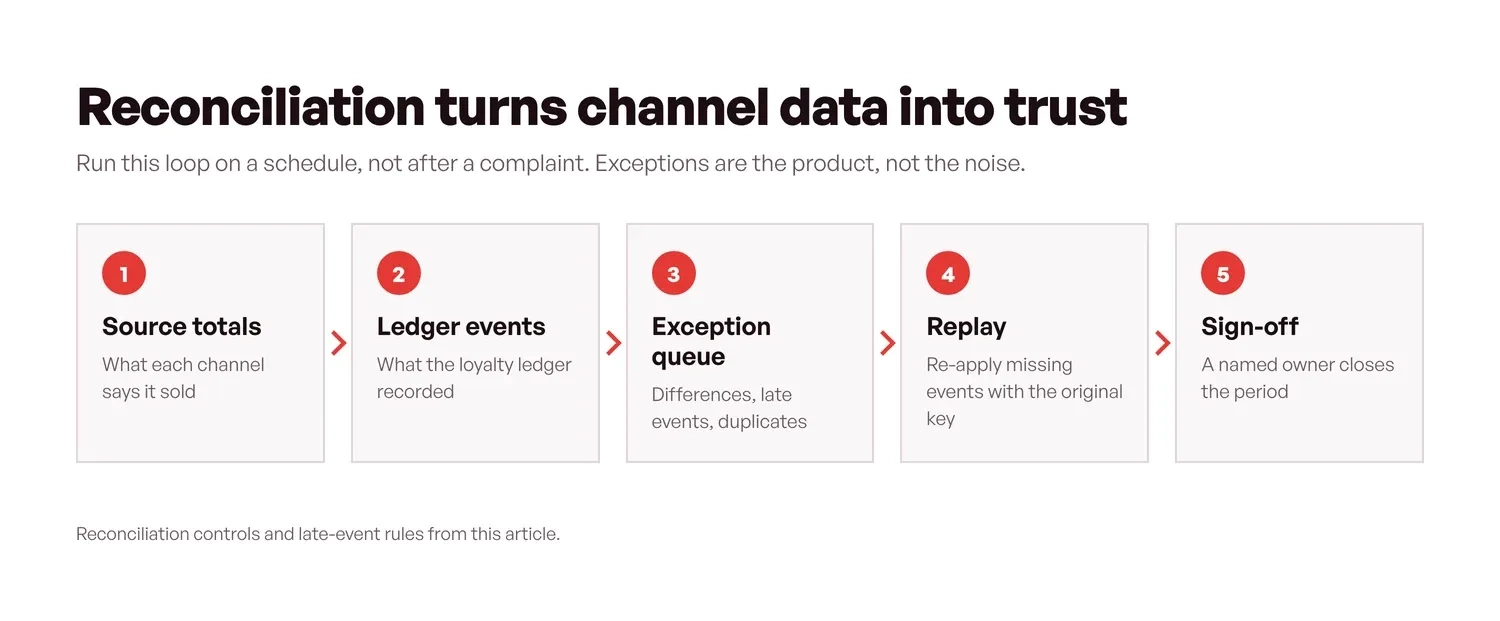
Run a channel-level control table:
| Control | Source total | Ledger total | Exception action |
|---|---|---|---|
| Eligible paid orders | Count and value | Earn events | Investigate missing or extra events |
| Refunds | Count and value | Reversal events | Replay or correct unmatched refunds |
| Redemptions | Applied discounts | Redeem events | Resolve orphan discounts or rewards |
| Receipt approvals | Approved claims | Receipt earn events | Find manual edits or duplicate awards |
| Customer merges | Merge records | Identity audit events | Review value moved or duplicated |
Counts alone are insufficient. Reconcile eligible value, awarded value, redeemed value, and reversed value. Break exceptions down by store, channel, integration, and event age.
Late events need an aging queue. A delayed event should still be processed once, against the rules valid at the correct economic time. Decide whether that means event time, order-paid time, or processing time, and apply the rule consistently.
Test the failures, not only the happy path
Before rollout, test:
- Existing customer found by email and phone
- Duplicate customer creation and merge
- POS order retried after a network interruption
- Online webhook delivered twice
- Event delivered after refund
- Partial refund after points were spent
- Reward applied, then order canceled
- Receipt submitted twice by one account
- Same receipt submitted by two accounts
- Subscription renewal failed after initial notification
- Staff account without app permission
- Market or currency mismatch
- Offline or delayed POS synchronization
For each test, verify the customer-facing balance, event ledger, source reference, channel attribution, and audit record. Also verify that support can diagnose the result without engineering access.
Build the customer experience on a controlled ledger
Omnichannel loyalty is not achieved by showing the same widget in more places. It requires one explainable identity, one event model, duplicate-safe processing, linked reversals, and routine reconciliation.
Once those controls exist, the interfaces can be helpful and immediate. Staff can quote a trustworthy balance. Customers can understand pending value. Finance can reconcile reward liability. Support can trace a disputed transaction from receipt or order to the exact ledger event.
Sources
- Product help center, Shopify POS loyalty setup and redemption documentation; current behavior verified against the POS feature wiki.
- Rivo case study: Neuro, vendor-published receipt-earning example and outcomes.
- Rivo case study: Kitsch, vendor-published omnichannel and receipt-earning example and outcomes.
- Shopify Help Center, general Shopify POS operations and customer workflows.

Written by
Thomas Nguyen is the CEO & Co-founder of Joy, a loyalty solution for Shopify and eCommerce brands. With years of experience building high-performance Shopify apps, Thomas aims to help merchants grow through customizable and retention-focused tools.
Related reading
 How-to Guide
Shopify Discount Combinations: Why Your Loyalty Reward Will Not Stack
Shopify does not combine discounts by default, and the setting only reaches reward codes issued after you change it.
 Thomas Nguyen
 How-to Guide
Shopify Referral Program Basics: Everything You Need To Know To Get Started
Referral programs are an effective ways to grow your Shopify store. This article will explain the basics of setting up a Shopify referral program and how to make it work.
Thomas Nguyen Program design
Free Shipping Rewards: The One Loyalty Reward Every Shopify Store Can Stack
Every Shopify store can stack a free shipping reward on a sale. Three published rules decide whether yours actually will.
Thomas Nguyen Program design
VIP Early Access on Shopify: Three Ways to Gate a Sale Before It Opens
Shopify can limit an automatic discount to a customer segment. Three ways to gate a VIP sale, and where each one leaks.
Thomas Nguyen How-to Guide
Should Customers Earn Loyalty Points on Bundles and Subscription Orders?
A policy framework for points, VIP spend, redemptions, refunds, and multipliers on bundle and subscription orders.
Thomas Nguyen How-to Guide
BFCM Readiness: Shopify Tests Checkout, Nobody Tests Your Widget
Shopify scale-tests checkout at 80,000 a minute. The risk you own is the storefront, measured on the signed-in path.
Thomas Nguyen