
Referral Partner Program: A 6-Step Guide to Real Revenue
A practical guide to building a referral partner program: how it differs from customer referrals, a 6-step setup, commission models, the metrics that matter, and why most stall.
-4b0e2f.webp&w=3840&q=95)
Summarize this post with AI
Some of your best customers never come from an ad. They come from a person who already trusts you telling someone else, "you should talk to these people." A consultant points a client your way. An agency recommends you to the brand they're rebuilding. A complementary app suggests you in a support reply. None of it cost you anything, and almost none of it is tracked.
A referral partner program turns those introductions into something you can count on. Instead of hoping the right people mention you, you build a small group of partners who actively send business your way, give them a simple way to do it, and pay them when an introduction becomes a real customer.
This guide is for ecommerce brands, agencies, and software companies that want a repeatable referral channel run by partners rather than one-off customers. We'll cover what a referral partner program actually is, how it differs from a customer referral program, the six steps to build one, and the commission models you can choose from.
What Is a Referral Partner Program?
A referral partner program is a formal arrangement where another business or individual agrees to send you qualified leads, and you reward them when those leads convert. The partner doesn't sell or service your product. They make the introduction, and you take it from there.
The "formal" part is what separates it from word of mouth. A real program has four moving pieces: an agreement that sets expectations, a unique link or trackable form for each partner, an easy way for them to refer, and an automatic way to attribute and pay the reward once a referred customer makes a purchase.
Partners come in a few common shapes:
- Adjacent service providers: agencies, consultants, or freelancers whose clients need what you sell.
- Complementary products: non-competing tools that share your audience, where each side recommends the other.
- Industry voices: advisors, community leaders, or creators whose audience trusts their recommendations.
- Happy power users: existing customers with a strong professional network who'd refer regularly, given a reason to.
That last group is where a referral partner program starts to overlap with a customer referral program, and the difference matters enough to spell out.
Referral Partner Program vs Customer Referral Program
These two get used interchangeably, but they behave differently and need different tooling.
| Who refers | Other businesses or professionals | Your existing customers |
|---|---|---|
| Relationship | Formal, contract-based | Casual, no agreement |
| Volume | A few dozen high-value partners | Thousands of low-touch referrers |
| Reward | Commission, often per closed deal | Store credit, points, discount |
| Best for | Higher-priced or considered purchases | Repeat-purchase, consumer products |
| Management | Hands-on, relationship-led | Mostly automated |
Neither is better. They solve different problems. If you sell a $40 consumer product, a customer referral program running quietly in the background will outperform any partner program. If you sell a service, a B2B product, or anything with a longer decision, a partner program's fewer-but-warmer introductions are worth the hands-on effort.
And if you sell business-to-business specifically, there's a related setup worth reading next to this one: our guide to building a B2B referral program covers the version where your own customers do the referring, rather than outside partners.
Referral Partner vs Affiliate vs Reseller
One more set of terms to untangle, because the rewards and effort differ at each step:
| Referral partner | Introduce a lead, then step back | Commission on the deal |
|---|---|---|
| Affiliate | Drive traffic at volume, usually via content or ads | Percentage per sale, high volume |
| Reseller | Sell and often support your product themselves | Margin or wholesale discount |
A referral partner is the lightest touch of the three. They're not running campaigns like an affiliate or carrying a quota like a reseller. They vouch, they introduce, and the depth of that trust is exactly why their leads tend to close.
Why Most Referral Partner Programs Stall
Most of these programs don't fail loudly. They launch, sign a handful of partners, generate two or three referrals, and then go quiet. Nobody cancels them. They just stop producing. Almost always, it traces back to one of these five causes.
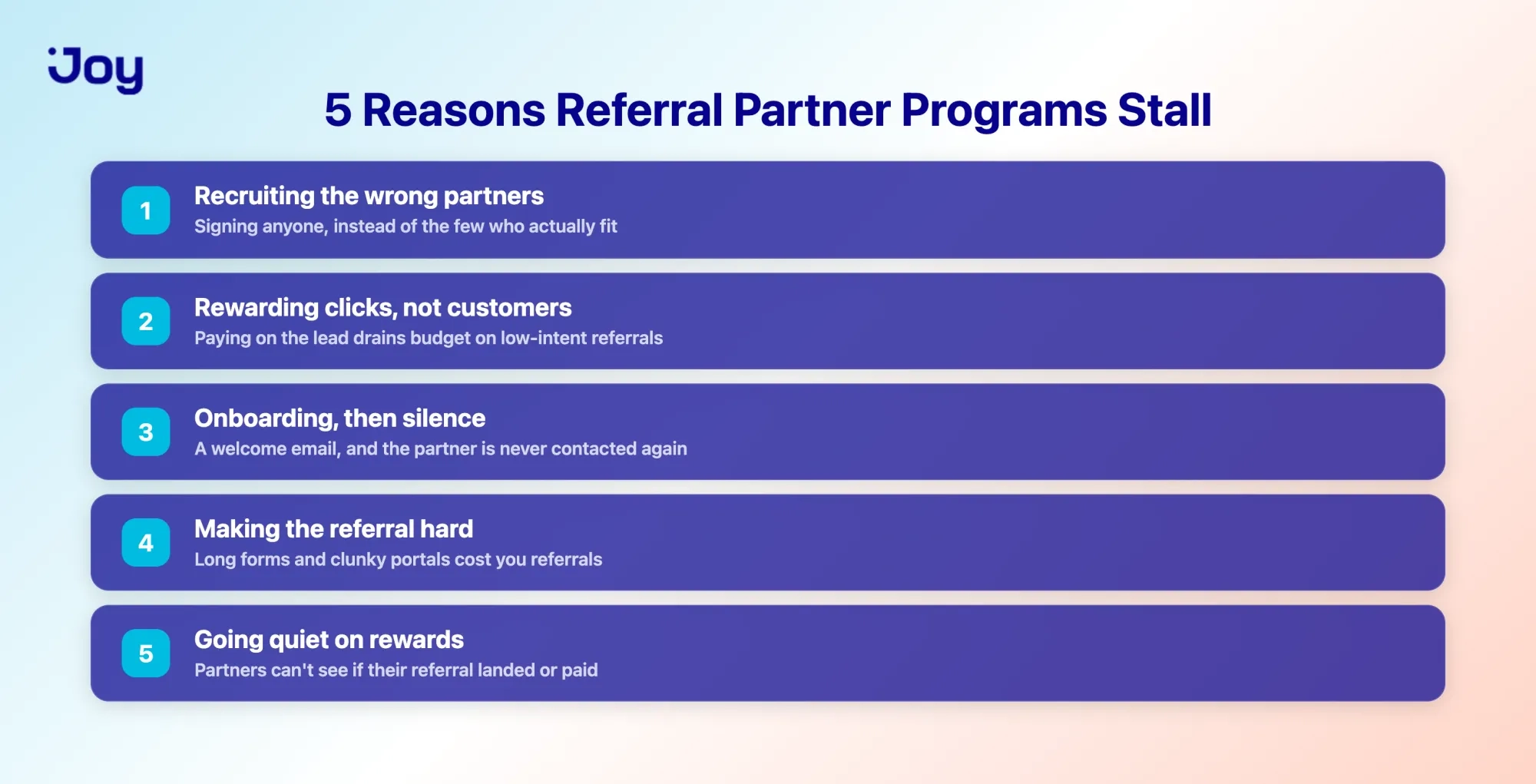
1. Recruiting anyone instead of the right someone. It's tempting to open the program to every customer and contact you have. But a hundred loosely-matched partners who never refer is worse than five who refer monthly. Volume isn't the goal here. Fit is.
2. Rewarding clicks instead of customers. If you pay on the lead rather than the closed deal, you get a flood of low-intent introductions and a budget that drains fast. The strongest programs reward outcomes (a referral that becomes a paying customer), which keeps partners focused on quality.
3. Treating onboarding as a finish line. A partner signs up, gets a welcome email, and is never contacted again. They forget you exist within a month. Enablement isn't a one-time event. It's the ongoing work of keeping partners equipped and reminded.
4. Making the referral hard. If referring means filling out a long form, logging into a clunky portal, or emailing you manually, partners won't bother. Every extra step costs you referrals. The act of referring should take under a minute.
5. Going silent on rewards. A partner refers someone, hears nothing for weeks, and has no idea whether it counted. Trust evaporates. Partners need to see their referral land, track its status, and know exactly when they'll be paid.
Notice that four of these five are relationship problems, not technology problems. A referral partner program is a set of relationships you maintain, with software to track them. Get that order backward, and it stalls.
How to Build a Referral Partner Program in 6 Steps
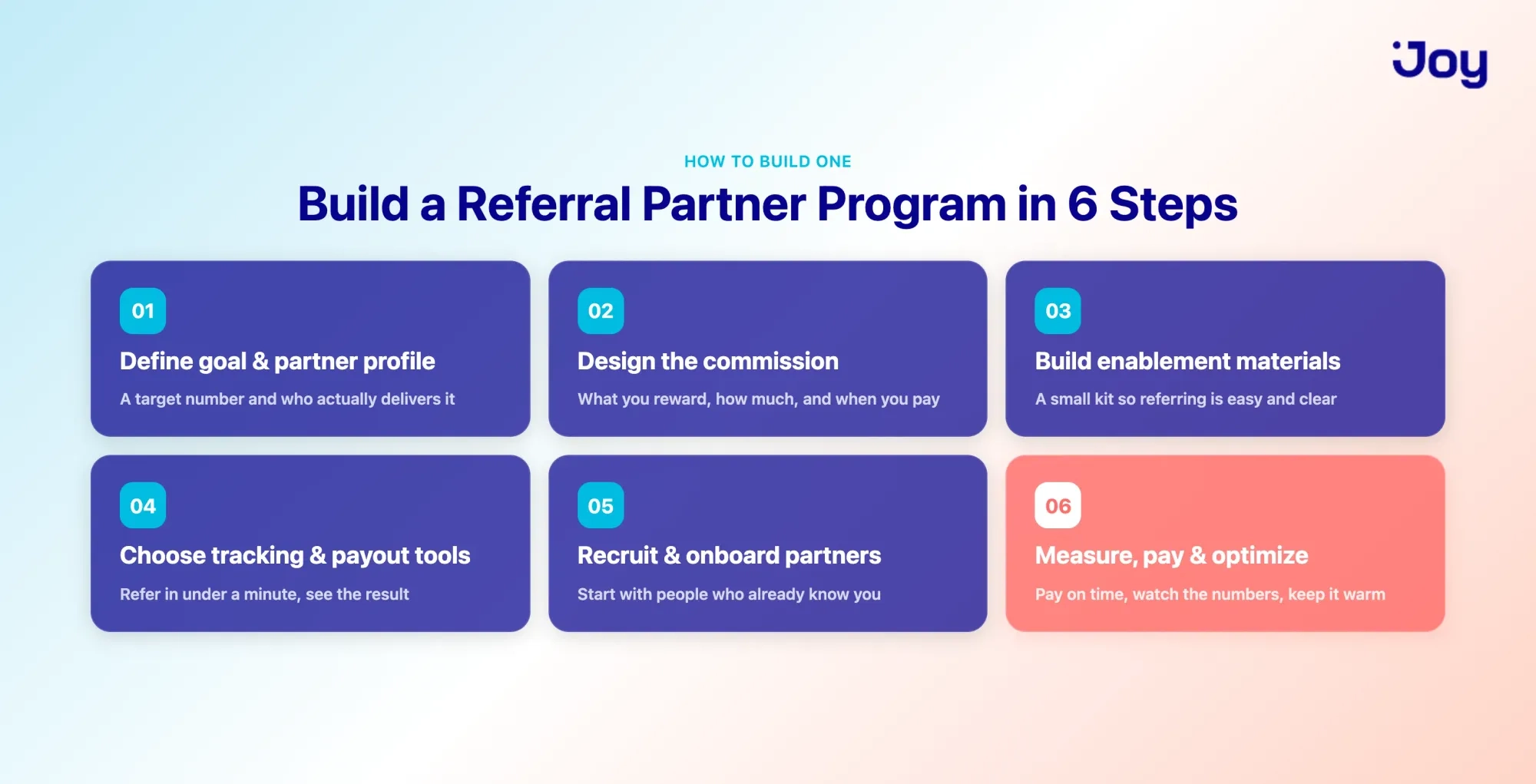
Step 1: Define Your Goal and Ideal Partner Profile
Start with a number, not a vibe. "Five qualified referrals a month" or "ten active partners by the end of the quarter" gives you something to design against and measure later.
Then describe the partner who'd actually deliver that. The useful question isn't "who likes us?" It's "whose clients or audience need what we sell, right when they're talking to them?" An agency mid-project with a client who'll soon need your product is worth more than a fan with no relevant network.
Write down two or three traits of your ideal partner: the industry they work in, the audience they reach, and the moment their people need you. That profile is your filter for every step that follows.
Step 2: Design the Commission Structure
This is where most programs either click or quietly break: decide what you reward (flat fee, a percentage of the order, or a recurring share), how much, and when you pay. Tie the reward to a real outcome, make it generous enough to be worth a partner's reputation, and pay it promptly. The full breakdown is in the next section.
Step 3: Build the Enablement Materials
A partner can only refer well if referring is easy and they know what to say. Give them a small kit:
- A one-page explainer of who you're a fit for, so they refer the right people.
- Their unique referral link or a short form, ready to share.
- A few lines of copy they can paste into an email or message.
- A simple answer to "what's in it for me and my contact?"
Keep it light. A partner shouldn't have to study your product. They need just enough to make a confident introduction.
Step 4: Choose Your Tracking and Payout Tools
You need to know which partner sent which lead, whether it converted, and what you owe. For a handful of partners, a shared spreadsheet and unique discount codes can genuinely work at the start. Don't overbuild before you have partners.
As you grow, look for software that gives each partner a unique link, automatically attributes conversions, and shows them their own dashboard. If your partners are essentially happy customers referring peers, Joy's referral program handles tracking and rewards natively on Shopify, so referrals tie back to a real order, and rewards are issued automatically rather than living in a spreadsheet you reconcile by hand.
For a pure B2B partner or affiliate setup, dedicated partner-management software is usually the better fit. Whatever you choose, the test is the same: can a partner refer in under a minute, and can both of you see the result without asking each other?
Step 5: Recruit and Onboard Partners
Now go get the partners that match your Step 1 profile. Start with people who already know you: past clients, complementary tools you integrate with, and customers who've referred before without being asked. A warm, specific invitation beats a mass blast every time.
When a partner says yes, onboard them properly: walk through how referrals work, hand over the enablement kit, and set expectations for how often you'll be in touch. First impressions set the tone for whether they ever refer.
Step 6: Measure, Pay, and Optimize
Once referrals start, your job shifts to keeping the program healthy. Pay rewards on time, every time. Nothing kills a partner program faster than a slow or unclear payout. Watch which partners actually refer, and focus there. And review the numbers monthly against the goal you set in Step 1. The metrics worth watching get their own section below.
Commission Models: What to Reward, How Much, and When
The commission structure is the engine of the program. Get it right, and partners stay motivated. Get it wrong, and you either overpay for weak leads or underpay and lose interest. Three decisions shape it.
What you reward. You have a few common models:
- Flat fee per closed deal: simple, predictable, easy to explain. Best when your deal sizes are fairly consistent.
- Percentage of the first order: scales the reward with the value the partner brought in. Best when order values vary a lot.
- Recurring share: a percentage of revenue for as long as the referred customer stays. Best for subscriptions, where a single good referral pays off for months.
- Tiered: the reward per referral grows as a partner sends more. Best for rewarding your most active partners and pulling occasional referrers into the habit.
How much. There's no universal right number, and chasing a "standard" rate from a blog will lead you astray. Work it backward instead: take what you can comfortably afford to spend acquiring a customer, and make sure the partner's cut sits well inside that while still feeling worth their time. A referral asks a partner to spend their reputation, not just their effort. Price it like you respect that.
When you pay. Pay on the closed deal, not the click. The exception is a two-part structure some programs use: a small thank-you when a qualified lead comes in, plus a larger reward when it closes. That can encourage volume without losing the focus on quality. Just keep the lead portion small enough that nobody games it.
The Metrics That Tell You It's Working
"Track your results" is useless advice without knowing what to track. Five numbers tell you whether a referral partner program is healthy, and they catch problems a single revenue figure hides.
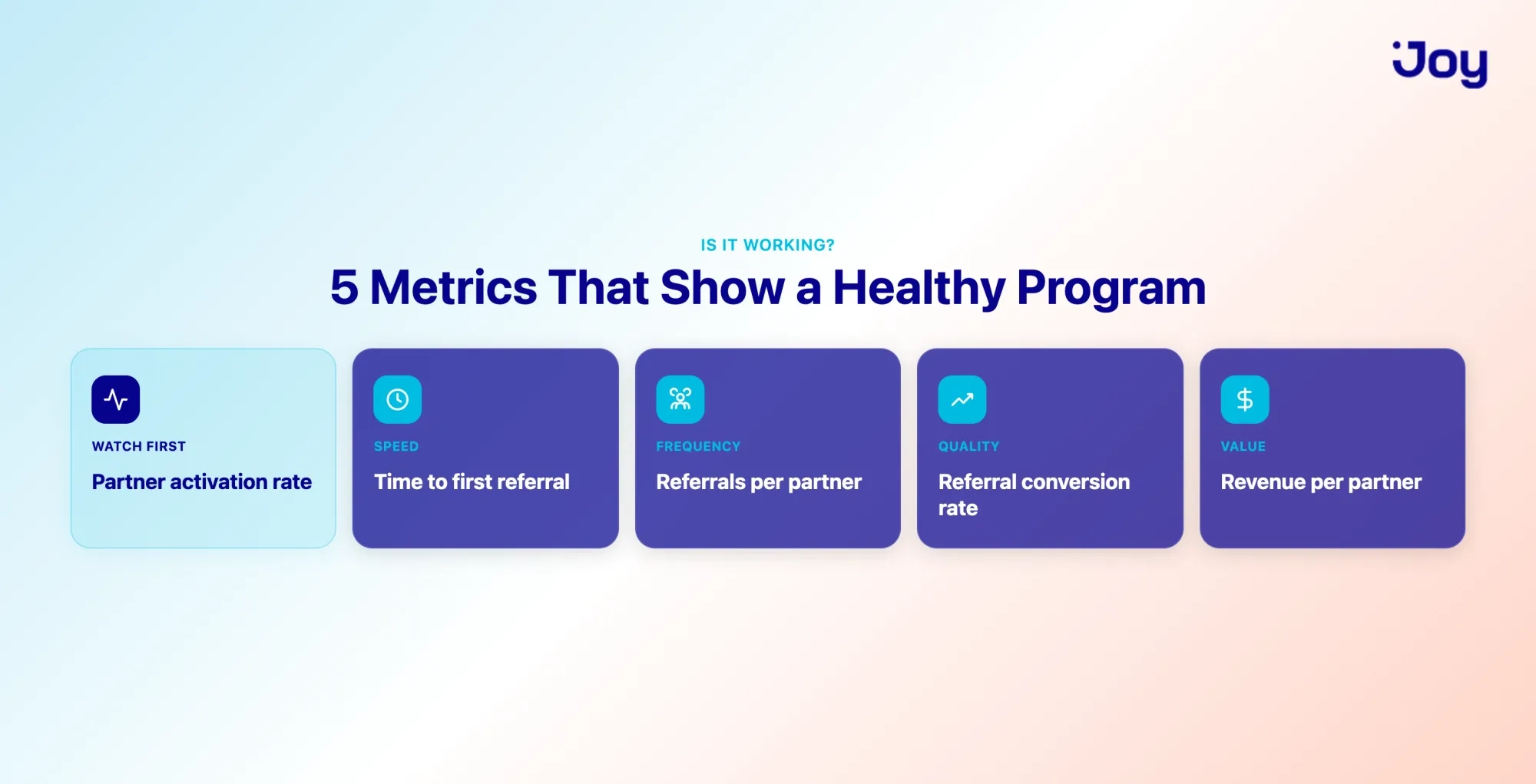
- Partner activation rate: the share of signed-up partners who've actually sent at least one referral. A low number is the clearest early sign that recruiting or enablement is off.
- Time to first referral: how long after onboarding a partner sends their first lead. The longer this drags, the more your onboarding needs work.
- Referrals per active partner: among partners who do refer, how often. This tells you whether the program is a habit or a one-time favor.
- Referral conversion rate: the share of referred leads that become customers. Referred leads should convert better than your average channel; if they don't, your partners may be sending the wrong people.
- Revenue per partner: what each partner relationship is actually worth, so you know where to spend your attention.
Watch the activation rate first. A program can look fine on total referrals, while 90% of partners have never sent one, which means the whole channel rests on two or three people and is one bad month from going quiet.
Start Small, and Keep It Warm
A referral partner program isn't a growth hack you switch on. It's a small set of relationships you build and maintain, with software underneath to keep it honest and trackable.
So start small. Pick five partners whose people genuinely need what you sell, give them a reward worth their reputation and a way to refer in under a minute, and pay them promptly when it works. Then do the unglamorous part: stay in touch, keep them equipped, and watch your activation rate. That's the whole game.
If your referrals come from happy customers, you can see how Joy runs referrals alongside your loyalty program on Shopify, so every referred order is automatically tracked and rewarded.
Frequently Asked Questions
What's the difference between a referral partner and an affiliate?
A referral partner makes warm, personal introductions to people they know, usually at low volume and high trust. An affiliate drives traffic at scale, often through content or ads, and is rewarded per sale. Partners vouch; affiliates promote.
How much commission should I offer referral partners?
There's no fixed rate worth copying. Start with what you can afford to spend to acquire a customer, and set the partner's reward comfortably within that. The number should feel worth a partner's time and reputation, not just their effort.
Do I need special software to run one?
Not at the start. A handful of partners can be tracked with unique discount codes and a shared sheet. As you add partners and the manual tracking gets error-prone, referral software that handles unique links, attribution, and automatic rewards saves the headache.
How many partners should I aim for?
Fewer than you'd think. Five to ten well-matched, active partners will usually out-produce fifty loosely-matched ones. Optimize for fit and activity, not the list's size.
How long before it produces results?
Plan in quarters, not weeks, especially for higher-priced or considered purchases where the referred customer takes time to decide. The first referrals often come within a month or two; a steady rhythm takes longer and depends on how well you keep partners engaged.

Written by
Thomas Nguyen is the CEO & Co-founder of Joy, a loyalty solution for Shopify and eCommerce brands. With years of experience building high-performance Shopify apps, Thomas aims to help merchants grow through customizable and retention-focused tools.
Related reading
 How-to Guide
Online + POS Loyalty: Identity, Receipts, and Reconciliation
Design one loyalty ledger across ecommerce, POS, and retail receipts with identity controls, idempotency, refunds, and reconciliation.
 Thomas Nguyen
 How-to Guide
How to Measure Brand Loyalty: 6 Critical Metrics for 2026
Likes don't equal loyalty - and neither do single-purchase sales. This guide breaks down how to measure brand loyalty with 6 critical metrics: LTV, repeat purchase rate, retention rate, point redemption, NPS, and UGC. Plus benchmarks for 2026 - when acquisition costs are 4× higher.
Thomas Nguyen How-to Guide
Should Customers Earn Loyalty Points on Bundles and Subscription Orders?
A policy framework for points, VIP spend, redemptions, refunds, and multipliers on bundle and subscription orders.
Thomas Nguyen How-to Guide
Corporate Loyalty Programs: How to Build One That Actually Works
Most guides treat employee recognition and customer loyalty as separate topics. They shouldn't.
Thomas Nguyen How-to Guide
Brand Loyalty Statistics: The 2026 Profitability Guide
Facebook CAC jumped 295% in a year. Allbirds got 1700% ROI from loyalty. This 2026 brand loyalty statistics guide unpacks the benchmarks that separate profitable retention from expensive acquisition — plus the redemption rates, LTV math, and Gen Z data behind today's top programs.
Thomas Nguyen How-to Guide
How to Set Up a Referral Program on Shopify: Loyalty Expert Guide
To set up a referral program on Shopify: Preparing, understanding customers, defining incentives, installing app, configuring, promoting, and analyzing
Thomas Nguyen