
EU Withdrawal Button Apps: Two Start Free, One Charges
EU Directive 2023/2673 became mandatory on 19 June 2026. Four withdrawal-button apps on price, scope and what each listing leaves out.
Summarize this post with AI
The EU withdrawal-button requirement took effect on 19 June 2026, and Shopify's own help centre states the penalties for ignoring it: legal warnings, fines of up to 4% of annual turnover in some EU member states, and an extended withdrawal period where the 14-day cooling-off window stretches to 12 months and 14 days. Four Shopify apps now cover the requirement, and the two purpose-built ones are free at entry: Revoq at $0 rising to $9 and $25, and 401layers' EU Withdrawal Button & Form at $0 rising to $9.99 and $29.99. The two returns platforms that also cover it, 247APPS and PostCo, price for the returns job rather than the compliance job, and 247APPS' $19 STARTER tier adds $0.29 per return after the first 30.
The compliance explainers ranking for this topic do not compare the apps. Below is what each listing publishes, what the requirement demands, and the one retention decision buried inside a forced-refund flow. Every rating, review count and price was read from each app's live listing on 8 October 2026, and each app name links to it. Install counts are the number of live Shopify stores running the app on the same date.
Key takeaways
- The requirement applies to any business selling goods, services or digital content online to consumers in the EU, regardless of where the business is located, according to Shopify's help centre.
- Shopify's own documentation names three mechanics: an easy-to-find button or link, a two-step confirmation capturing the customer's name and order details, and automatic confirmation sent on a durable medium such as email.
- You do not have to use Shopify's native flow. A Shopify staff reply on the developer forums dated 2 July 2026 states merchants may use return and cancellation rules, a third-party app, or their own withdrawal form.
- Revoq and 401layers both ship a free tier with unlimited withdrawals and translations into all EU languages, so the compliance floor costs nothing on either.
- Revoq is the only one of the four publishing a PDF evidence pack per withdrawal and a full audit log, both on Professional at $25.
- If you sell into the EU through Managed Markets, Shopify's help centre states compliant cancellation and return policies are applied automatically.
What the requirement actually demands
Start with the primary source rather than a law firm's summary. Shopify's help centre page on the EU right of withdrawal sets out the requirement introduced by EU Directive 2023/2673, and names four things, read on 8 October 2026:
- An easy-to-find withdrawal function, described as "a clearly labeled button or link that customers can easily find and use to exercise their withdrawal right, such as from their account or order status page".
- Two-step confirmation: after clicking, the customer confirms the withdrawal and provides their name and the details of the contract or order being cancelled.
- Automatic confirmation of the request sent to the customer "on a durable medium, such as email".
- Scope, which is broad: the directive "applies to any business that sells goods, services, or digital content online to consumers in the EU, regardless of where the business is located".
The 14-day cooling-off period itself is older. What changed on 19 June 2026 is that the exit has to be a button rather than a policy page, and the confirmation has to be automatic.
Two practical points sit outside the help centre and inside the Shopify Dev Community thread on the requirement. First, a Shopify staff member replying on 2 July 2026 confirms merchants "aren't required to use Shopify's native setup specifically", and may instead use "Shopify's return/cancellation rules, a third-party app, or their own withdrawal form/process". Second, the same reply describes the native verification step as confirming order access using the identifier tied to the order, by email verification code or through the order status page link, rather than a password login. Whether a given implementation satisfies a given member state's reading is a question for your own counsel, which Shopify says explicitly.
That is the gap the apps fill. The native flow routes through the orders area; the apps put a standalone form in front of it.
The four apps at a glance
| App | Live Shopify stores | Rating / reviews | Free tier | Paid tiers |
|---|---|---|---|---|
| Revoq | 13,236 | 4.8 / 565 | yes, unlimited withdrawals | $9, $25 |
| 401layers EU Withdrawal Button & Form | 2,020 | 4.9 / 2,314 | yes, unlimited withdrawals | $9.99, $29.99 |
| 247APPS Returns & EU Withdrawal-Button | 836 | 4.5 / 85 | portal only | $19, $39, $59 |
| PostCo Returns & Exchanges | 432 | 4.9 / 101 | free to install | $179, $289 |
Two of these are compliance tools and two are returns platforms that cover compliance on the way past. That distinction decides the price you pay, because a returns platform is sold on return volume and a compliance tool is sold on features around a free unlimited core.
The launch dates explain the shape of the category. Revoq published on 11 March 2026 and 401layers' app on 9 January 2026, both inside six months of the deadline, and Revoq now runs on more live Shopify stores than the other three combined. 247APPS and PostCo have been listed since 2021 and 2020, selling returns long before withdrawal buttons were mandatory.
1. Revoq — the audit trail, and the only PDF evidence pack
Best for: EU-facing stores that want the withdrawal flow to produce defensible records rather than just satisfy a checkbox. Revoq's Professional tier at $25 a month is the only plan among these four publishing a full audit log of every action and a PDF evidence pack per withdrawal, which is what turns a customer dispute from an argument into a document.
Not ideal for: stores wanting one app for both withdrawals and the wider returns operation. Revoq is built around the withdrawal flow and its listing names no carrier integrations or return-label generation, so a brand already running a returns platform ends up with two systems touching the same order and has to decide which one owns the refund.
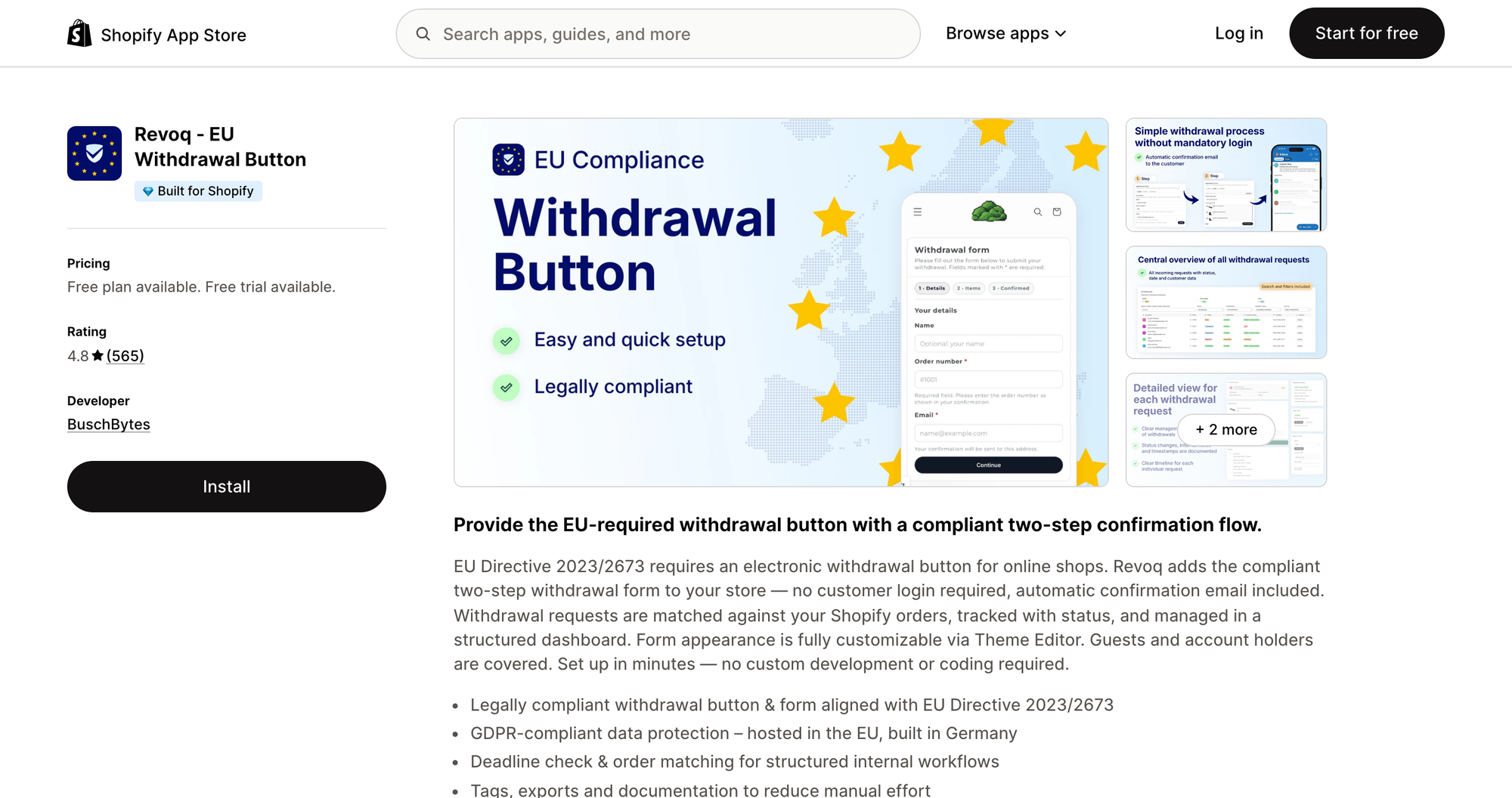
13,236 live Shopify stores run Revoq. The listing read 4.8 stars from 565 reviews on 8 October 2026, and the app launched on 11 March 2026.
What it actually does
- The free tier covers an EU-compliant withdrawal button and form, translations into all EU languages, automatic order matching, an automatic deadline check per withdrawal, an auto confirmation email, unlimited withdrawals, and a dashboard with an inbox and status workflow.
- Essential at $9 removes the "Powered by Revoq" branding, auto-cancels unfulfilled orders, tags orders automatically, enables partial returns down to specific items, and allows custom withdrawal reasons, sender name, reply-to address and confirmation email templates.
- Professional at $25 adds a custom SMTP sending domain, blocks withdrawals without a verified order, auto-blocks submissions past the deadline, creates Shopify Returns automatically, excludes specific items, and produces the audit log and PDF evidence pack.
What to check before you commit
The branding line matters more than it looks. "Powered by Revoq" sits on the free tier, which means the free compliance floor puts a vendor's name inside a legal flow on your storefront. Budget $9 if that is unacceptable. Then look at where the enforcement features sit: blocking withdrawals without a verified order and auto-blocking late submissions are both on Professional at $25, so the free tier accepts submissions your policy would reject and leaves the filtering to a human.
2. 401layers EU Withdrawal Button & Form — the DPA is the paid feature
Best for: EU-facing stores, particularly German ones, that need a data processing agreement in place for the withdrawal flow. 401layers puts a DPA covering GDPR on Basic at $9.99 a month, which is the single clearest reason to leave its free tier and is a document a compliance review will ask for by name.
Not ideal for: stores that want the Shopify Returns sync at the entry price. Syncing with Shopify Returns, adjustable withdrawal terms, a configurable maximum withdrawal period and hiding the form from non-EU customers all sit on Grow at $29.99, so a store on Basic is reconciling withdrawals into its returns flow by hand.
2,020 live Shopify stores run 401layers' app. The listing read 4.9 stars from 2,314 reviews on 8 October 2026, which is the deepest feedback base of the four by a wide margin, and the app launched on 9 January 2026.
What it actually does
- The free tier covers the EU withdrawal button and form, unlimited withdrawals, automatic confirmation emails, template integration, a management dashboard, translations in all EU languages, merchant email notifications and an evaluation mode.
- Basic at $9.99 adds the DPA and GDPR documentation, custom email templates, custom branding and merchant notifications.
- Grow at $29.99 adds the Shopify Returns sync, adjustable withdrawal terms, a maximum withdrawal period setting and the ability to hide the form from non-EU customers.
What to check before you commit
Hiding the form from non-EU customers sits on Grow at $29.99, and that is a conversion decision rather than a compliance one: a US-only visitor shown a withdrawal button is being offered an exit the law never required you to show them. Price that against Grow rather than treating it as a nice extra. Note also that the review count here runs ahead of the install count in this comparison, which is unusual and worth reading the distribution of: 2,181 five-star, 102 four-star and 11 one-star.
3. 247APPS Returns & EU Withdrawal-Button — a per-return fee on the entry plan
Best for: German-language stores already running a return portal who want the withdrawal portal in the same app and whose monthly return count is predictable and low. 247APPS publishes both a public return portal and a public withdrawal portal on its free tier, which is the only free plan here that bundles the two jobs.
Not ideal for: stores with return volume above about 30 a month on the entry plan. The $19 STARTER tier's additional-charges line reads "After the first 30 returns, this plan charges $0.29 per return", so a store processing 300 returns a month pays $19 plus roughly $78, and the flat Shopify Basic and Grow tiers at $39 and $59 exist precisely to escape that.
836 live Shopify stores run 247APPS' app. The listing read 4.5 stars from 85 reviews on 8 October 2026, the lowest rating of the four, and the listing does not carry the Built for Shopify badge.
What it actually does
- The free tier gives a public return portal and a public withdrawal portal, and nothing else is listed.
- STARTER at $19 unlocks full functionality for all Shopify plans from Basic to Plus, with the per-return charge above 30.
- Shopify Basic at $39 and Shopify Grow at $59 both give full functionality "without additional inApp fees", and each is scoped to the named Shopify plan.
What to check before you commit
The tier names are Shopify plan names, not capability names, so read them as eligibility rather than as a ladder: the $39 tier is for Shopify Basic stores and the $59 tier for Shopify Grow stores. Work out your flat-versus-metered crossover before choosing, because at 30 returns a month STARTER is cheapest and at 100 returns a month the flat tier is. The panel renders four cards, the App Store maximum, so a tier above Shopify Grow may exist that the listing cannot show.
4. PostCo Returns & Exchanges — compliance as a by-product of a returns platform
Best for: brands whose real problem is returns economics rather than the withdrawal button, and who want order editing and post-purchase upsell in the same vendor. PostCo's Checkout+ tier is free to install with unlimited returns, unlimited order edits and unlimited upsells, with the revenue coming from checkout and package protection instead of a subscription.
Not ideal for: any store buying a withdrawal button and nothing else. PostCo's listing does not name the EU withdrawal function among its features at all, its paid Platform tiers cap returns at 100 and 200 a month for $179 and $289, and it does not carry the Built for Shopify badge. A compliance requirement that costs $0 at Revoq should not be the reason you take on a $179 platform.
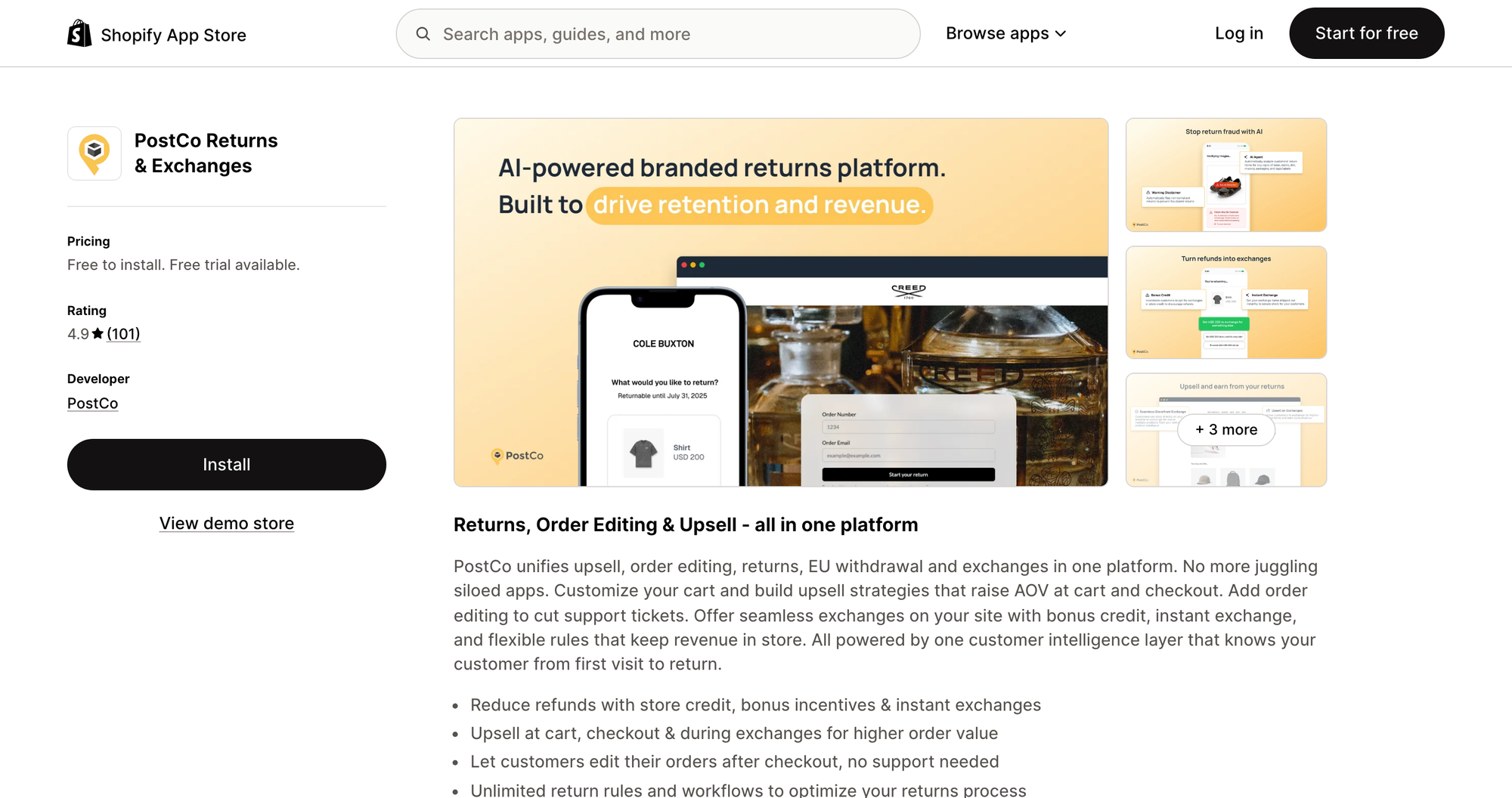
432 live Shopify stores run PostCo. The listing read 4.9 stars from 101 reviews on 8 October 2026.
What it actually does
- Checkout+ is free to install with unlimited returns, order edits and upsells, bundling checkout and package protection with returns and exchanges.
- Platform at $179 a month covers up to 100 returns with unlimited order edits and upsells; a second Platform card at $289 covers up to 200 returns.
- Named capabilities include multi-item and instant exchange, address changes, adding products to an order, and upsells at cart, checkout and post-purchase, plus AI fraud flagging.
- Carrier and tooling integrations named on the listing include Australia Post, Royal Mail, USPS, Stripe, Klaviyo and Gorgias.
What to check before you commit
The two Platform cards carry the same name at different prices, which is a listing quirk worth reading carefully before you pick one. More important, confirm in writing that PostCo covers the 19 June 2026 withdrawal mechanics, because the listing does not say so and this comparison includes it on the strength of its returns coverage rather than a published compliance claim. The panel renders three cards and links out via "See all pricing options".
The retention decision inside a forced refund
A withdrawal request is the one moment in the customer lifecycle where the law removes your ability to negotiate. The customer clicks, the clock starts, the money goes back. What the directive does not remove is the choice of what goes back.
Store credit is the only retention lever that survives inside that flow, and it has to be offered as a genuine alternative rather than imposed, because the refund right is the customer's. Offered properly, a credit plus a bonus converts a refund into a second visit, and the arithmetic favours it: acquiring a new customer is "anywhere from five to 25 times more expensive than retaining an existing one", according to Harvard Business Review, and the same piece cites Bain's Frederick Reichheld finding that increasing retention rates by 5% increases profits by 25% to 95%.
Three things make this work rather than annoy people. Offer the credit as an option alongside the cash refund, never instead of it. Add a premium to the credit so choosing it is a better deal than cash. And do it in the confirmation email the directive already requires you to send, which is the one message in the flow a withdrawing customer definitely opens.
Store credit as a reward mechanic covers how the premium is structured, and Shopify store credit covers the native primitive behind it. For whether the attempt is worth the effort at your scale, customer retention benchmarks and Shopify customer retention set the baseline.
Which one to pick
Install Revoq if the withdrawal button is the whole requirement. The free tier covers the compliance floor with unlimited withdrawals and all EU languages, $9 removes the vendor branding from a legal flow on your storefront, and $25 buys the audit log and the per-withdrawal PDF evidence pack that nothing else here publishes.
Install 401layers' EU Withdrawal Button & Form if a DPA is on your compliance checklist, because that document sits on its $9.99 tier, and budget $29.99 if you need the Shopify Returns sync or want the form hidden from non-EU shoppers.
Choose 247APPS only if you want the return portal and the withdrawal portal from one vendor in German, and only after doing the per-return arithmetic: $0.29 above 30 returns on the $19 tier, against flat pricing at $39 and $59. Choose PostCo when returns economics is the actual project and the withdrawal button is incidental, and get its compliance coverage confirmed in writing first.
Then do the thing none of the four apps does for you. Decide what the confirmation email offers, because the law dictates that you send it and says nothing about what it contains.
Frequently asked questions
When did the EU withdrawal button become mandatory? 19 June 2026. Shopify's help centre describes the electronic withdrawal function as a requirement that "took effect on June 19, 2026", introduced by EU Directive 2023/2673.
Does the EU withdrawal requirement apply to a US or UK store? Yes, if you sell to consumers in the EU. Shopify's help centre states the directive "applies to any business that sells goods, services, or digital content online to consumers in the EU, regardless of where the business is located". Ask your own counsel how it applies to your markets.
What are the penalties for not having a withdrawal button? Shopify's help centre lists legal warnings, fines of up to 4% of annual turnover in some EU member states, and an extended withdrawal period in which the 14-day cooling-off window can stretch to 12 months and 14 days.
Do I need an app, or can Shopify do this natively? Both routes exist. A Shopify staff reply in the developer forums dated 2 July 2026 states merchants "aren't required to use Shopify's native setup specifically" and may use return and cancellation rules, a third-party app, or their own form. If you sell through Managed Markets, Shopify's help centre states compliant cancellation and return policies are applied automatically.
What is the cheapest EU withdrawal button app? Both purpose-built apps are free at entry. Revoq's free tier and 401layers' free tier each cover an EU-compliant button and form with unlimited withdrawals and translations into all EU languages. Revoq's free tier carries "Powered by Revoq" branding, removed on its $9 Essential plan.
Which withdrawal app has the most reviews? 401layers' EU Withdrawal Button & Form, whose listing read 4.9 stars from 2,314 reviews on 8 October 2026, against 565 for Revoq, 101 for PostCo and 85 for 247APPS. Both purpose-built apps launched in 2026, so judge them on the recency of the reviews as much as the count.

Written by
Thomas Nguyen is the CEO & Co-founder of Joy, a loyalty solution for Shopify and eCommerce brands. With years of experience building high-performance Shopify apps, Thomas aims to help merchants grow through customizable and retention-focused tools.
Related reading
 Shopify apps
Loloyal Alternatives: Loloyal Is Now CWILL Loyalty
Same install base and review history under a new name. Its $69 Growth plan jumps to $599 for API access, and five alternatives priced.
 Thomas Nguyen
 Shopify apps
Review Importer Alternatives: Judge.me and AG Cost $0
Six AliExpress and Amazon importers are shrinking. Judge.me and AG Product Reviews collect unlimited first-party reviews at no cost.
Thomas Nguyen Shopify apps
Shopify Loyalty App Pricing: $30 to $199 at 2,000 Orders
Appstle costs $30 at 2,000 monthly orders and Smile costs $199. Eight loyalty apps priced at 500, 2,000 and 10,000 orders.
Thomas Nguyen Shopify apps
Best Shopify Affiliate Apps: GoAffPro 0%, UpPromote 2%
GoAffPro charges no percentage at any tier. UpPromote takes 2% of referred sales on top of $29.99. Ten apps on cost and free-plan honesty.
Thomas Nguyen Shopify apps
Talon.One Alternatives: Adyen Owns Talon.One Now
Adyen closed its 750 million euro acquisition on 1 July 2026. Of six alternatives, only Voucherify publishes a price.
Thomas Nguyen Shopify apps
Best Shopify Order Editing Apps: Orderify Costs $8.99
Orderify prices by your Shopify plan, not your order volume, where OrderEditing.com charges $99. Seven apps and who each one suits.
Thomas Nguyen