Skip to content
Product update

Shopify Store Credit: How to Use It to Drive Repeat Orders

Shopify store credit explained: what it is, five use cases that drive repeat orders, how to set it up in Joy, and the operational rules that keep it clean.

Thomas NguyenThomas NguyenUpdated
Joy loyalty widget showing a $12 store credit balance applied at checkout
9 min read

Summarize this post with AI

Store credit is the most underused reward currency on Shopify. It spends like cash, it applies at checkout with no math, and unlike points, it doesn't sit unredeemed on your books. Roughly 27% of loyalty points go unused, according to Antavo's 2026 loyalty report. A store-credit balance is much harder to ignore, because it reads as real money the customer already has.

This guide is about putting store credit to work. What it is, the use cases that actually drive repeat orders, how to run it inside Joy, and the operational rules, expiry, refunds, and multi-currency that keep it clean. Whether you're adding store credit for the first time or trying to get more out of what you already run, the goal is the same: fewer dead rewards, more repeat orders.

What Store Credit Actually Is

Store credit is a cash-value balance tied to a customer's account and applied directly at checkout. A $10 balance spends like $10. There's no conversion, no "what's this worth" step.

That's the core reason it works. Points are a currency the customer has to decode ("500 points" means nothing until they learn it's worth $5). Store credit is already money. That single trait, which feels real, is what makes customers come back to spend it.

It also gets confused with three things it isn't:

  • Cashback isn't a separate thing. It's one way to earn store credit, a percentage of spend returned as a balance.
  • A gift card is usually bought and transferable. Store credit is earned and tied to one account.
  • A coupon shrinks one order's margin and expires as a code. Store credit is a balance the customer owns and comes back to spend.

Why Store Credit Works for Shopify Stores

Three advantages make store credit worth building around.

The money stays in your store. A percentage discount hands a margin away, and it leaves for good. Store credit keeps that value inside your business until the customer spends it again, and some of it never gets redeemed. You're not cutting prices. You're funding the next order. Say you'd normally run a 10% off code. On a $100 order, that's $10 gone the moment it's used. Swap it for $10 in-store credit, and that value only leaves your business when the customer returns to redeem it.

It's simpler to operate. One balance, no conversion rules, fewer questions. The Game Collection, a Joy store, cut support tickets 40% while running a 61% redemption rate. A currency that customers understand at a glance is one that generates fewer "where's my reward" tickets.

Redemption drives revenue. The whole point of a reward is that it gets used. Top-performing programs pull 15% to 25% more revenue from customers who redeem, per McKinsey. Because store credit is simple to spend, it tends to get redeemed, and redemption is what brings the customer back.

Points still have their place for engagement, referrals, and tiers. But when the goal is a fast, clean repeat purchase, store credit is the sharper tool.

Five Ways to Use Store Credit

Store credit isn't one tactic. It's a flexible balance you can attach to different moments in the customer relationship. Here are five use cases that move repeat orders, each mapped to how you'd run it in Joy.

Five store credit use cases: cashback, milestones, referrals, refunds, and migration

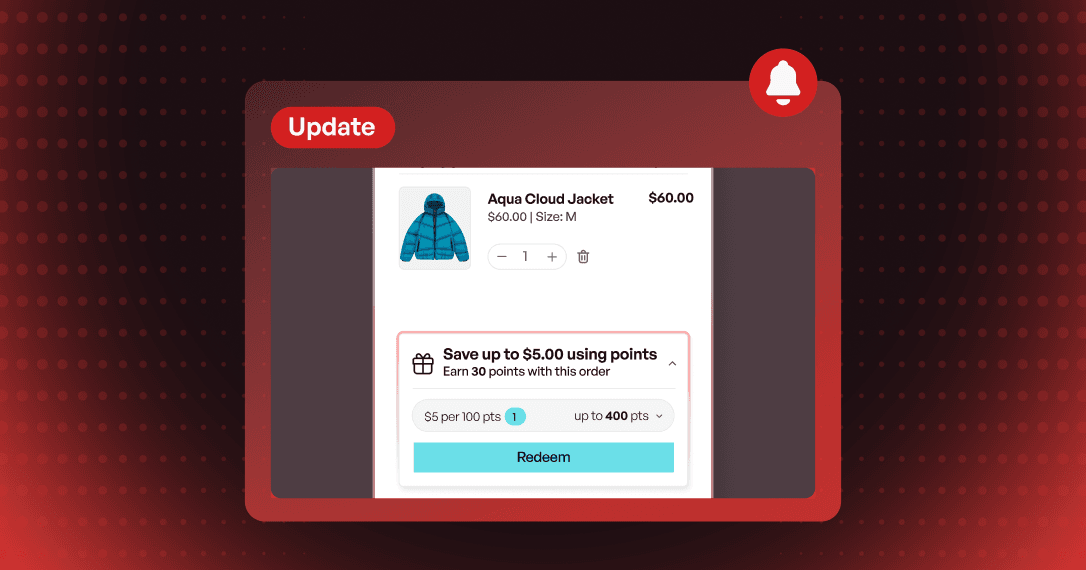
1. Cashback on every order. Return a percentage of each purchase as store credit. A customer spends $120, and 5% drops $6 into their account. That $6 pulls them back for the next order while they still remember you. Compare it to a 5% discount: the discount saves them money once, and then it's gone, while credit only has value if they return. In Joy, this runs as a store-credit reward on Place Order. It's the single best lever for turning a first-time buyer into a repeat one, and the metric to watch is your first-to-second-order rate.

2. Milestone rewards. Give credit when a customer hits a spending or order milestone. Reach $500 in lifetime spend, earn $25 in credit. This rewards your best customers and gives mid-tier buyers a reason to reach the next level, which lifts average order value and lifetime spend. In Joy, you set this with a store-credit reward on Milestones. It works as a lightweight VIP mechanic without the overhead of building full tiers.

3. Referral rewards as credit. Pay both sides of a referral in store credit instead of cash or a plain code. The referrer earns a balance they'll spend with you, and the new customer arrives with credit that pulls their first order. Your acquisition cost stays inside your store instead of leaving as a cash payout, and it lands at a fraction of paid ad CAC. Joy supports store credit on Referrals, including across markets and currencies.

4. Refund-to-credit. Turn a return into retained revenue. Instead of refunding cash out of your business, offer store credit, often with a small bonus to make it the obvious choice. The customer keeps shopping, and the money that would have left your store stays in it. For stores with meaningful return rates, this is one of the highest-impact uses of store credit, because it converts a loss into a future order. And when an order paid with store credit is refunded, Joy puts the credit that was used back in the customer's balance and logs the change.

5. Migrating balances when you switch apps. If you're moving from another loyalty or gift-card app, you can bring existing balances over as store credit so customers don't lose value in the transition. That protects the trust you've already built, which is the thing most at risk during a platform switch. In Joy, you bring those balances over with a CSV import, so nobody logs in to find their rewards gone.

You don't have to pick just one. The strongest setups stack them: cashback to drive the repeat, milestones to reward loyalty, referral credit to grow, and refund-to-credit to hold onto revenue. Each one feeds the same balance the customer sees at checkout.

How to Set Up Store Credit in Joy

The concept is simple. The setup is quick once you've decided which use cases to run. Here's the shape of it in Joy.

You create a store-credit reward and attach it to the trigger you want: Place Order for cashback, Milestones for spending goals, Referrals for advocacy. Customers see their balance right on your storefront through the widget, so the reward stays visible instead of hidden in an email. Visibility is what drives redemption.

Customers can also see the expiry date on their credit in their activity history. A $12 balance with a date on it is a strong reason to open a new order before it expires.

From there, you set the rules that protect your margin: an expiry window, refund behavior, and multi-market handling for referral rewards. More on those next.

A simple first setup looks like this:

  • Turn on 5% cashback on Place Order
  • Add a milestone reward near your average repeat-customer spend
  • Decide whether returns are refunded as store credit
  • Set a six to twelve-month expiry

Start there, watch your redemption and repeat rate, then layer in referrals once it's running.

The results are there when it's built well. Allbirds, a Joy store, runs a 45% reward redemption rate at 1,700% ROI on its program. For the step-by-step, set up store credit in Joy.

Operational Realities You Can't Skip

This is the part most guides leave out, and it's exactly where store credit either works or turns into a liability.

The operational rules for store credit: expiration, refunds, multi-currency, and liability

Expiration. Outstanding credit is money you owe. Set an expiry so it doesn't pile up as permanent liability, and use it to nudge customers back before they lose the balance. Joy lets you set a global expiry with per-program overrides, so a referral reward and a cashback reward can expire on different clocks.

Refunds. Decide your refund-to-credit behavior up front. When an order is returned, does the balance adjust, or does the credit stay? Settle this before launch so returns don't break a customer's balance or open a support ticket.

Multi-currency and multi-market. If you sell across markets, credit and referral rewards need to behave correctly in each one. Confirm how your setup handles currency before you turn it on for international customers.

Accounting and liability. Treat outstanding store credit as a liability on your books, and track breakage against it. It's real money, so it belongs in your numbers, not just your marketing. For example, if you've issued $8,000 in credit and $2,000 sits unspent past a reasonable window, that $2,000 is breakage, and the $6,000 spent is revenue you drove. Knowing the split keeps your P&L honest.

How to Measure Store Credit

Four metrics tell you whether store credit is doing its job:

  • Redemption rate. The percentage of issued credit that gets spent. Higher is better; it means the reward is changing behavior, not sitting idle.
  • Breakage and liability. The unredeemed balance. Some breakage is normal, but rising breakage signals customers who've disengaged.
  • Repeat purchase rate. The real goal. Store credit should move this, not just get redeemed.
  • Assisted Orders. Orders influenced by loyalty rewards. This is Joy's north-star metric because it ties the program to actual revenue, not vanity signups.

Read them together. A high redemption rate next to a flat repeat rate means credit is being spent by customers who would have come back anyway. To put the program's return in numbers, see loyalty ROI.

When Store Credit Isn't the Right Call

Store credit isn't a fix for everything, and pretending otherwise costs you credibility.

It's a weak fit for rewarding non-purchase behavior. Handing someone a cash balance for writing a review or having a birthday feels off, like paying for attention. Points do that job better, because a point balance can grow from engagement without implying you bought it.

It also doesn't gamify the way points do. The "I'm 200 points from a reward" pull that keeps customers checking their balance is a points strength, not a store-credit one. If your growth leans on tiers, streaks, and progress mechanics, points belong in the mix.

The honest answer for most stores is to run both: store credit for the fast repeat purchase, points for engagement and advocacy. This guide focuses on store credit because it's the underused half, but the two work best side by side.

The Bottom Line

Store credit earns its place because it does one thing better than any other reward: it gets spent. It reads as real money, keeps that money inside your store, and drives the repeat orders that fund your growth.

Start with the use case that fits your economics. Cashback to win the repeat, milestones to reward your best customers, referral credit to grow without paying for ads, and refund-to-credit to hold onto revenue you'd otherwise hand back. Motherswork, a Joy store, drives 43% of its revenue through loyalty built on this kind of thinking.

Frequently Asked Questions

What is store credit on Shopify?

Store credit is a cash-value balance tied to a customer's account and applied at checkout. It spends like money, with no point conversion. On Shopify, apps like Joy let you issue it as a reward for purchases, milestones, and referrals.

How do I add store credit to my Shopify store?

Shopify doesn't issue store credit as a standalone loyalty reward on its own, so most stores use an app. In Joy, you create a store-credit reward, attach it to a trigger such as Place Order or Referrals, and customers see their balance in the loyalty widget. It takes minutes once you've chosen your use cases.

Does store credit expire?

It can, and it usually should. Setting an expiry keeps outstanding credit from becoming a permanent liability and encourages customers to return before they lose the balance. In Joy, you can set a global expiry with per-program overrides.

What happens to store credit when an order is refunded?

When an order paid with store credit is refunded, Joy returns the credit that was used to the customer's balance, accounts for tax and shipping, and records the change in their Activity log.

Is store credit the same as a gift card or a coupon?

No. A gift card is bought and transferable. A coupon shrinks one order and expires as a code. Store credit is an earned, account-tied cash balance that the customer comes back to spend.

Is store credit better than points?

For a fast, simple repeat purchase, yes. Store credit reads as real money and gets redeemed more easily. Points win on engagement and non-purchase rewards like referrals and reviews. Many stores run both.

Does store credit work across multiple currencies?

It needs to be configured for it. Multi-market and multi-currency handling, including referral rewards, is a setup detail worth confirming before you launch internationally.

Thomas Nguyen

Written by

Thomas Nguyen

Thomas Nguyen is the CEO & Co-founder of Joy, a loyalty solution for Shopify and eCommerce brands. With years of experience building high-performance Shopify apps, Thomas aims to help merchants grow through customizable and retention-focused tools.

Stop being ordinary. Start leading

20,000+

Brands run loyalty on Joy

4.9★

Shopify App Store rating

1,689

Merchant reviews