
Best Western Rewards Program: What Business Owners Actually Need to Know
Best Western Rewards program breakdown: tier mechanics, the B2B Business Advantage program, and loyalty psychology lessons for e-commerce store owners.
Summarize this post with AI
Best Western Rewards stands out for its dedicated business program for small and medium-sized companies. Called Business Advantage, it gives companies access to member rates, rewards, and elite status for business travelers.
That makes Best Western worth studying if you're building or improving a loyalty program for your own store.
The core rewards program is simple. Members earn 10 points for every $1 spent on eligible room rates, and their points never expire.
For business owners, the bigger lesson is how Best Western connects individual rewards with company-level benefits. In this article, we will discover how it works, what makes it smart, and what you can steal for your Shopify store.
Key Takeaways
- Best Western Rewards runs on a flat 10-points-per-dollar rate with points that never expire. Simple earning rules reduce friction and increase participation.
- The Business Advantage program grants automatic Diamond status to business owners and Gold to their employees, creating built-in B2B loyalty.
- Instant elite status removes the earning curve and drives immediate spending, a strategy any ecommerce brand can replicate with paid VIP tiers.
- Best Western's brand inconsistency (SureStay earns only 5 points/dollar) shows why universal earning rules matter for customer trust.
- The program's combination of no-expiry points, flexible redemption, and B2B tiers offers a blueprint for loyalty programs targeting both consumers and businesses.
How the Program Works: The Design Decisions That Matter
Best Western keeps the program simple, but a few design choices are worth copying in your own loyalty program.
1. Flat earning rate: 10 points per dollar
Members earn 10 points for every $1 spent on eligible stays. The rule is simple, so customers know what they will earn without doing extra math. The main exception is SureStay, which earns 5 points per $1.
Why it matters: Simple rules reduce friction. Customers are more likely to understand and use a program when they don't have to remember different earning rates.
For your store: rate whenever possible. If you need different rates, make the reason clear. Too many exceptions can make a loyalty program harder to understand.
2. Points never expire
Best Western Rewards points do not expire, and the program has no blackout dates.
Why it matters: Customers don't have to worry about losing points because they waited too long to use them. That removes one common reason to disengage from a loyalty program.
For your store: Give customers enough time to use their rewards. Expiration dates can create urgency, but aggressive deadlines can also make customers feel punished. A loyalty program should encourage repeat purchases, not create frustration.
3. Four elite tiers
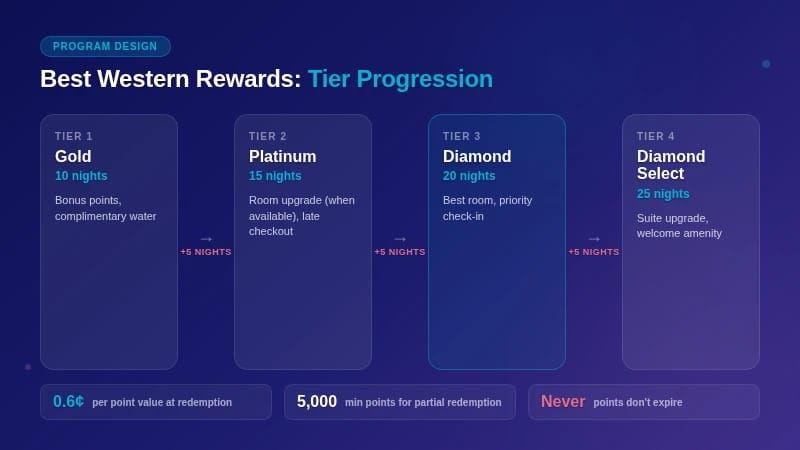
Best Western Rewards has four elite status levels: Gold, Platinum, Diamond, and Diamond Select. Each level gives customers a clear next goal, with benefits such as bonus points and potential room upgrades.
Why it matters: Tiered programs work best when the next level feels achievable. Customers need a clear reason to keep spending, but the gap cannot feel insurmountable.
Best Western also shows the limits of benefit promises. Room upgrades at higher tiers are subject to availability, so the benefit is not guaranteed.
For your store: Make tier benefits as concrete as possible. "Free shipping on every order" is stronger than "priority shipping when available." Customers should know exactly what they get when they reach the next tier.
4. Partial redemption starts at 5,000 points
Best Western's Pay with Points option lets members apply points toward a stay, even when they don't have enough for a full free night.
Why it matters: This gives customers a way to use their points before reaching a large reward threshold. Without partial redemption, customers can end up with points they cannot use, which weakens the perceived value of the program.
For your store: Give customers smaller ways to redeem points. Discounts, free products, or shipping rewards can help customers see value sooner and keep the program active.
5. Point value: roughly 0.6 cents each
Best Western Rewards points are worth roughly 0.6 cents each based on typical redemption value. Buying points directly costs 1 cent per point.
Why it matters: There is a clear difference between the cost of buying points and their typical redemption value. That makes earning points through actual stays more attractive than simply purchasing them.
For your store: Don't focus only on how many points customers earn. Focus on what those points are worth when redeemed. A large points balance means little if customers feel the rewards are difficult to reach or not valuable enough.
The bigger lesson is that a strong loyalty program does not need complicated mechanics. Simple earning rules, flexible redemption, clear tiers, and benefits that customers can understand can do more to drive engagement than a long list of features.
The Business Advantage Program: Best Western's B2B Loyalty Play
Most hotel loyalty guides skip this part. Only one out of three top-ranking articles even mentions it. But for ecommerce owners studying loyalty design, the Business Advantage program is the most interesting thing Best Western does.
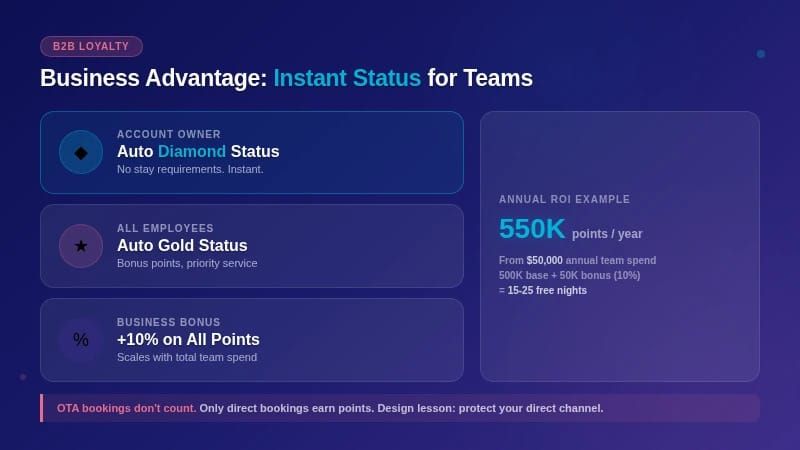
1. The account owner gets automatic Diamond status
The account owner receives Diamond status when they enroll. They do not need to complete stays first or wait to qualify.
Why it matters: Best Western puts a high-value benefit in front of the person making the buying decision. That can make the program more attractive from the start.
It also creates a switching cost. Moving business travel to another hotel program means giving up that status.
For your store: Consider giving the account owner a strong benefit when they join. VIP status, better discounts, or early access can make the first commitment feel more valuable.
2. Registered employees get automatic Gold status
The business owner is not the only person who benefits. Registered employees also receive Gold status.
Why it matters: This turns loyalty from an individual benefit into a team benefit. Employees have their own reasons for using the program, which can make it easier for the business to keep travel bookings in the same system.
For your store: If you sell to businesses, don't reward only the account owner. Give employees or team members useful benefits too. The more people who benefit from the program, the more reasons the business has to stay.
3. The business earns a 10% bonus on team travel points
Business Advantage members receive a 10% bonus on the points earned from eligible employee stays.
For example, if a team earns 500,000 base points from business travel, the company receives another 50,000 points as a bonus.
Why it matters: The reward grows with business spending. A company that books more stays earns more rewards, giving it a financial reason to keep using the program.
For your store: Percentage-based rewards can work well for B2B loyalty because the benefit scales with customer value. A small business gets a modest reward, while a larger account can earn significantly more.
4. Direct bookings are required to earn points
Business Advantage rewards eligible bookings made directly with Best Western. Reservations made through online travel agencies such as Expedia or Booking.com do not qualify for points.
Why it matters: The loyalty program does more than reward customers. It also encourages them to use Best Western's own booking channels instead of third-party platforms.
That is an important loyalty design principle: use rewards to influence the behavior that matters most to your business.
For your store: If you sell through both your own website and marketplaces, consider giving customers a stronger reward for buying directly. The goal is not simply to give away more points. It is about using rewards to move valuable behavior into your preferred channel.
Why the B2B model is worth studying
Business Advantage shows how a loyalty program can create value at multiple levels.
The business owner gets premium status. Employees get their own benefits. The company earns additional rewards as its spending grows.
That creates several reasons to stay with the same program.
For an ecommerce brand that sells to both consumers and businesses, the bigger lesson is this: B2B loyalty does not have to be a simple discount program. You can build a separate loyalty track in which the account owner gets VIP benefits, employees receive useful perks, and the business earns rewards based on the team's total spending.
That structure can create stronger organizational loyalty than rewarding a single buyer.
Related: How to build a loyalty program for small business
The Psychology Behind the Design (And What to Steal for Your Store)
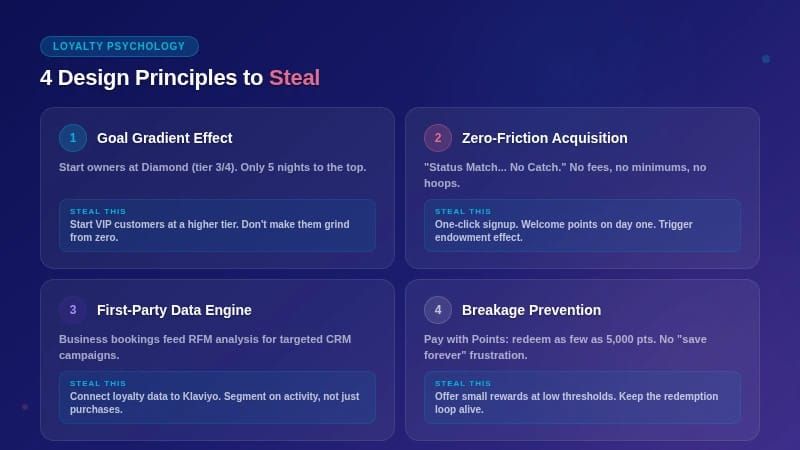
Best Western's program isn't flashy. But the behavioral psychology baked into its design is sharp. Here are four principles worth stealing.
1. Goal Gradient Effect
Business Advantage starts the account owner at Diamond, the third of four elite tiers. That puts the customer just one level away from Diamond Select.
The idea is simple: a goal can feel more motivating when it looks close. Starting at a higher tier makes the next milestone feel easier to reach than starting from zero.
Steal this: Don't make your best customers start at the bottom. Use customer value or past spending to assign a starting tier. This can make high-value customers feel recognized from day one.
For example, Joy's VIP tier feature lets merchants assign customers to different starting tiers.
2. Zero-Friction Acquisition
Best Western's "Status Match... No Catch" program removes most of the barriers to joining. Eligible members can show proof of status from another hotel program and receive a matching status without a fee or minimum stay requirement.
Why it matters: The easier it is to join, the less reason customers have to stop before they start.
Steal this: Make your sign-up process as simple as possible. Give new members a small reward right away, such as welcome points or a first-purchase discount.
The goal is to create value from the first interaction, rather than making customers wait before they see a benefit.
3. First-Party Data Engine
A loyalty program can tell you much more than how many points a customer has. It can show how often they buy, how recently they purchased, and how much they spend.
That gives you useful first-party data for customer segmentation. For example, you can identify high-value customers, inactive members, or customers who are close to reaching a new tier.
Steal this: Connect your loyalty data with your marketing tools, such as Klaviyo or Omnisend. Build segments around loyalty behavior, not just purchase history.
A customer who is 100 points away from a reward may need a very different message from a customer who has not purchased in six months.
4. Breakage Prevention
Pay with Points lets members use fewer points toward a stay, starting at 5,000 points.
Why it matters: Customers don't have to wait until they have enough points for a full reward. They can see value in a smaller balance.
This keeps the connection between earning and redeeming active. Customers can see that their points are useful, even before they reach a major reward.
Steal this: Don't make your first useful reward too difficult to reach. Add smaller redemption options at lower point levels.
A small reward, such as a free sample or shipping benefit, can give customers a reason to keep earning while they work toward a larger reward.
Related: How Customer Engagement Loyalty Programs Drive Repeat Business
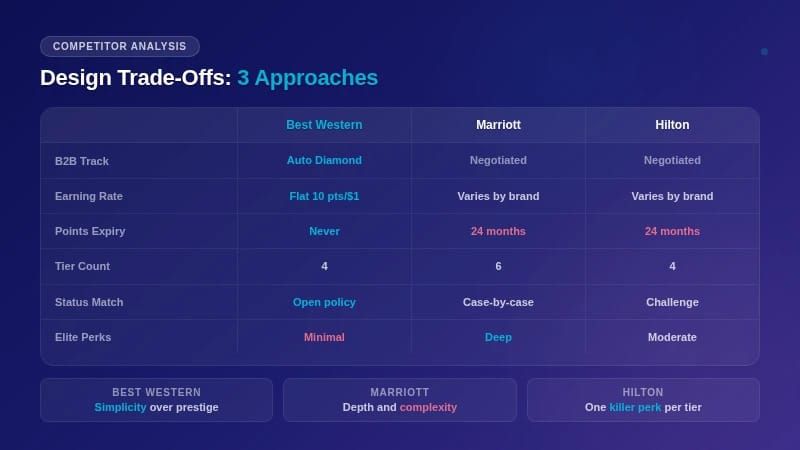
Best Western vs. Marriott vs. Hilton: Design Trade-Offs
Three chains, three different bets on what makes a loyalty program work.
1. Best Western bet on simplicity
Flat earning rate. No expiration. Open status matching. A dedicated B2B track that doesn't require corporate negotiations. The trade-off? Elite perks are the weakest of the three. Industry sources call them "minimal." If your brand competes on value rather than luxury, this is the playbook: make the program easy to understand and generous enough to keep people coming back.
2. Marriott bet on depth
Six tiers, brand-specific earning rates, extensive elite benefits including suite upgrades and lounge access. It works because their portfolio supports it, from budget to luxury. The trade-off? Complexity. New members need a guide just to understand the program. For ecommerce, complex tier structures only make sense if you have enough differentiated rewards to fill each level. Don't add tiers just to have tiers.
3. Hilton bet on one killer perk per tier
Four tiers, like Best Western, but with sharper benefits. Free breakfast at Gold status is genuinely valuable and easy to understand. No fine print, no "subject to availability." The trade-off? Less differentiation at the top. For ecommerce: one standout benefit per tier (free shipping, early access, exclusive products) beats a long list of mediocre perks. Pick the thing customers actually care about and make it real.
The honest takeaway: Best Western won't win a feature-by-feature comparison against Marriott or Hilton. But for B2B accounts and budget-conscious segments, simplicity and accessibility take precedence over prestige. The same logic applies to your store.
Conclusion
Best Western Rewards won't win on luxury perks. The upgrades are modest, the elite benefits are thin, and the property portfolio skews the budget.
But the design choices behind it are worth studying. Flat earnings. No expiration. Tight tier gaps. A B2B track that gives instant status without negotiation. These aren't hotel-specific ideas. They're loyalty architecture principles that work for any e-commerce store.
Building a loyalty program for your Shopify store? Joy Loyalty offers tiered rewards, VIP memberships, and a flexible point system built on the same principles. Start free.

Written by
Thomas Nguyen is the CEO & Co-founder of Joy, a loyalty solution for Shopify and eCommerce brands. With years of experience building high-performance Shopify apps, Thomas aims to help merchants grow through customizable and retention-focused tools.
Related reading
 Examples & Inspiration
Avis Preferred 2026 Guide: Skip the Line & Earn Free Days
The Avis loyalty program (Avis Preferred) lets you skip the counter and earn free rental days. See how the tiers, points math, and status shortcuts work in 2026.
 Thomas Nguyen
-be8365.webp&w=3840&q=75) Examples & Inspiration
Examples & Inspiration15 Loyalty Program Email Examples (With Copy-Paste Templates)
15 loyalty program emails your store should send, each with a copy-paste template, subject line ideas, and the exact trigger that sends it. Plus a metrics cheat sheet and how to automate the whole thing with Shopify Flow.
Thomas Nguyen Examples & Inspiration
American Airlines Loyalty program: $30B secret + Retention tricks
The American Airlines loyalty program is a $30B engine, not a perk. See how AAdvantage turns points into status, partners, and a retention flywheel you can copy.
Thomas Nguyen-68d473.webp&w=3840&q=75) Examples & Inspiration
Examples & Inspiration23 Best Referral Program Examples by Industry (And How to Build Your Own)
Most referral roundups stop at the reward. We checked 23 programs against each brand's own page to show what actually makes them work - and how to build your own.
Thomas Nguyen Examples & Inspiration
Hilton Honors 2026 Review: The Easiest Path to VIP Status?
The Hilton loyalty scheme just made elite status far easier to reach. See how Hilton Honors tiers, points sweet spots, and perks stack up for 2026 travelers.
Thomas Nguyen Examples & Inspiration
Referral Programs for Small Businesses: 12 Ideas & Examples (2026)
Twelve referral program ideas for small businesses, real examples broken down by how they actually work, a five-step setup with copy-paste scripts, and a simple way to measure ROI.
Thomas Nguyen