
Double Points: The Three Settings That Decide What the Weekend Pays
Three settings decide which BFCM orders receive double points, and Joy, LoyaltyLion and Smile each handle them differently.
Summarize this post with AI
On Thursday 3 December a customer writes in. She ordered on Cyber Monday, a few minutes before midnight, with a banner on the page promising double points. Her parcel has just shipped and her account shows the ordinary amount.
On the same morning another account shows the opposite problem. A guest who joined the program on Saturday has been credited double points for three years of past orders. Nobody on your team did anything wrong in either case. Each is a documented behaviour of a setting that was left where it was.
Key Takeaways
- A double-points event has three settings that decide which orders receive it: when points are calculated, what the multiplier stacks with, and how the event starts and stops.
- On a store that calculates points at fulfilment, an order placed inside the event and shipped after it ends is exposed to whatever the rules are on the day it ships. Joy documents a setting that locks the rules at order time.
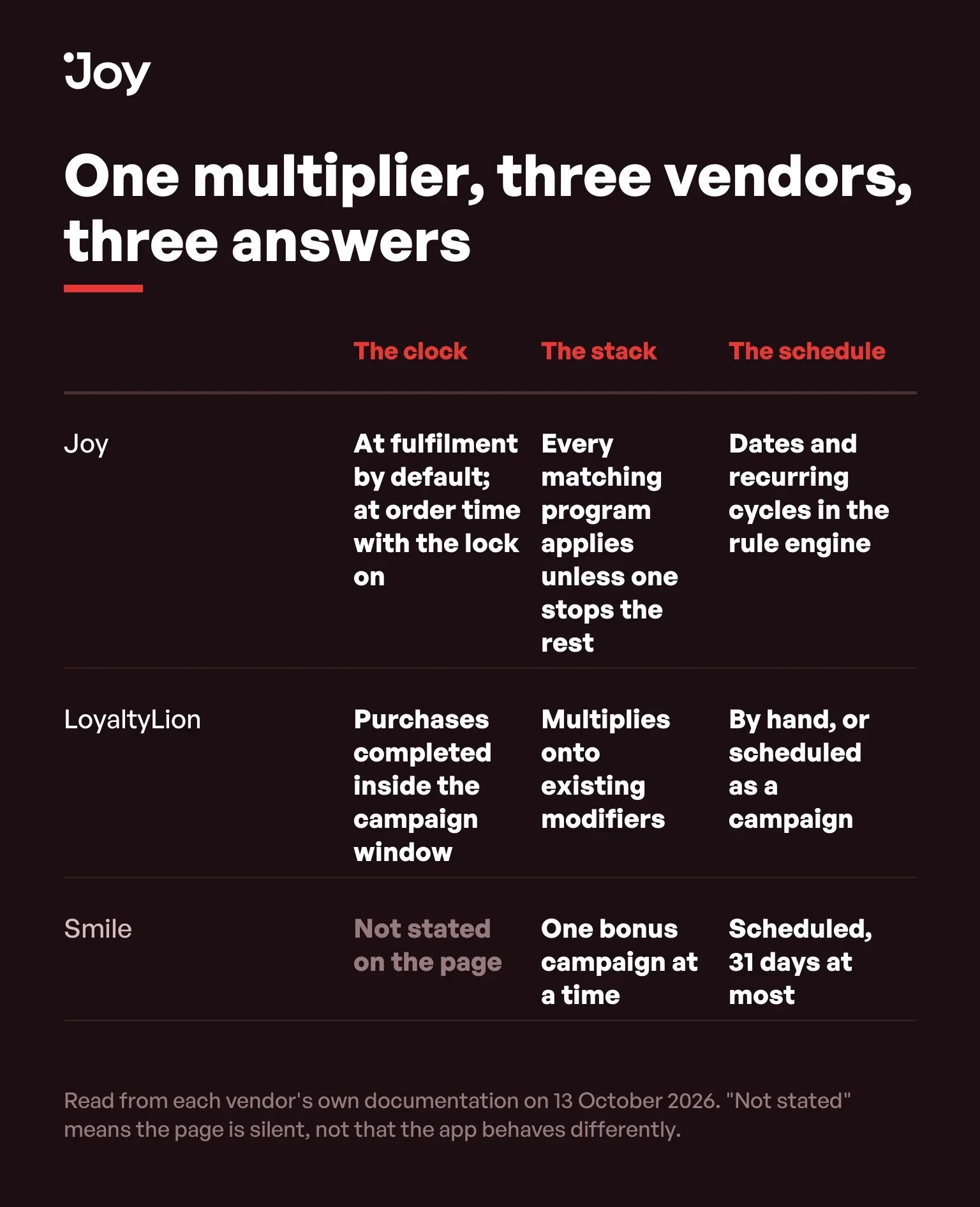
- Multipliers stack differently by vendor. Joy applies every earning program that matches unless one is set to stop the rest, LoyaltyLion multiplies a campaign onto existing modifiers, and Smile runs one bonus campaign at a time.
- LoyaltyLion's manual promotion cannot be scheduled, and with its historic purchases option on, a guest who joins during the event earns double on earlier orders too.
- Smile's page does not say whether a boosted order is fixed when it is placed or later. Where a page is silent, a test order is the only source.
Published 22 October 2026. Vendor behaviour was read from Joy's, LoyaltyLion's and Smile's own documentation on 13 October 2026 and is linked. Rivo and Yotpo were not read for this page. The two customers above are illustrations built from those documents.
The advice stops at "run a double-points weekend"
Vendor guidance on BFCM multipliers covers the idea. It rarely prices it, and it leaves out which orders qualify. That is decided by three settings, and Joy, LoyaltyLion and Smile each document them differently.
Setting one: the clock
A multiplier applies to an order at one moment, and the first question is which. Joy gives the merchant the choice, set out in its guide to rewarding by order status, between rewarding when an order is Paid and when it is Fulfilled. On the second route its article on locking earning conditions at order creation is candid about the consequence: "By default, Joy calculates loyalty points when an order is fulfilled. However, if reward rules change between the time a customer places an order and the time it's fulfilled, the actual points awarded may differ from what the customer expected".
An event that ends at midnight on Monday is a reward rule changing. An order that ships on Thursday is an order fulfilled after the change. That is the Cyber Monday customer from the top of this page.
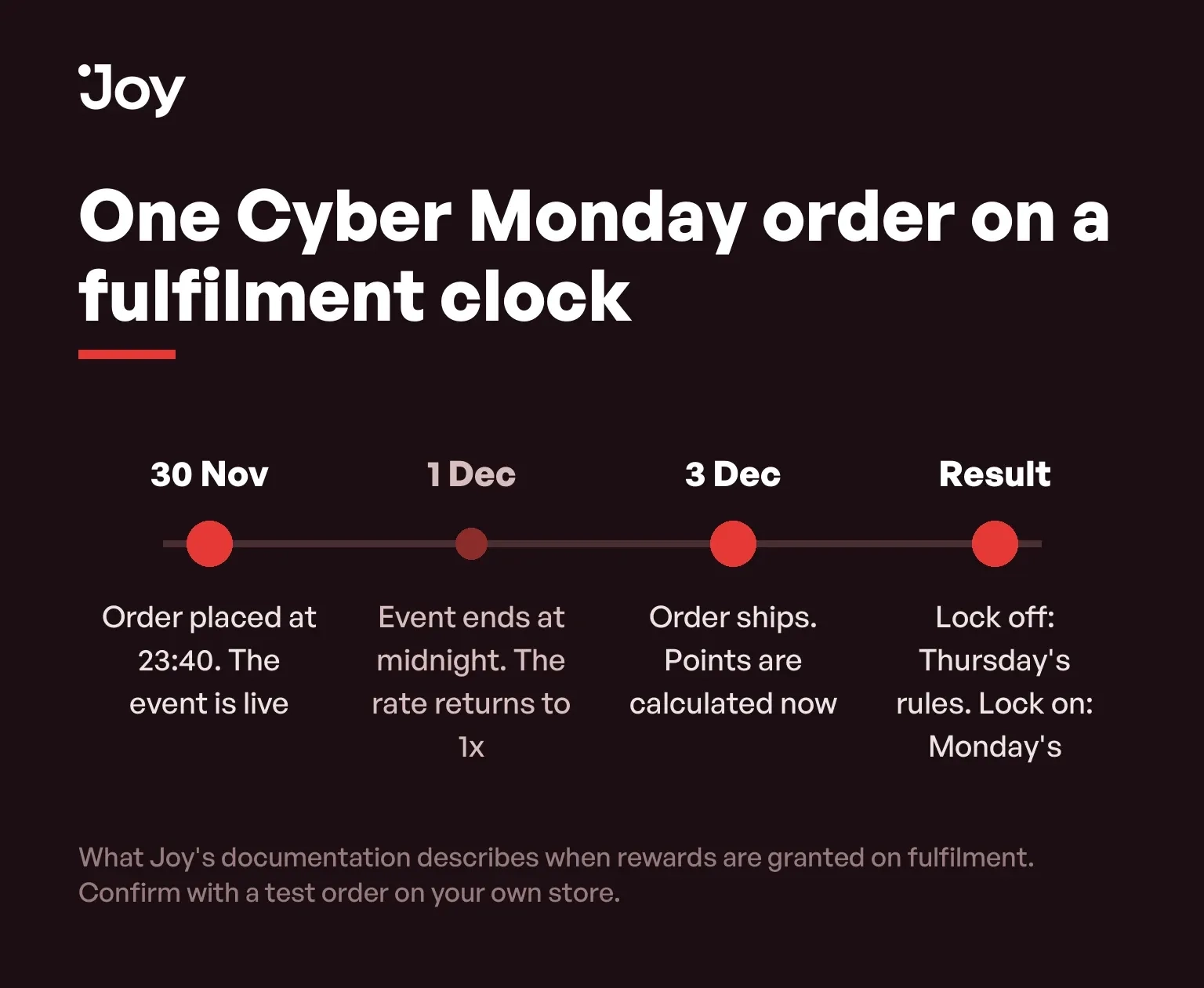
The fix is a toggle called Lock earning conditions at order creation. With it on, "points calculation is based on order creation time, not fulfillment". Two conditions come with it. The toggle only appears when Fulfilled is the selected status, and Joy's documentation for the toggle says it "only applies to orders placed after the setting is enabled", so switching it on during the weekend does nothing for the orders already in the queue.
LoyaltyLion's scheduled campaign is written around the purchase, as its article on the Points multiplier event shows: "Members who complete purchases during the scheduled campaign window will receive their points multiplier". Smile's guide to managing a bonus points campaign gives the schedule and the timezone and does not say whether a boosted order is fixed when it is placed or at a later status. If you run Smile, place a test order across the end of a short test campaign and look.
How long your orders wait between payment and dispatch over that weekend is set by the warehouse and the carrier. On a fulfilment clock, that wait decides who gets the multiplier.
Setting two: the stack
The second question is what a 2x event is multiplied onto. Here the vendors diverge further, and two of the three will pay more than the headline if the event is built carelessly.
Joy's rule engine treats every earning rule as its own program and applies all that match, which its guide to the multiple program system states plainly: "Rules do not replace each other - they stack unless conditions prevent overlap". A BFCM program worth two points per dollar, added beside an always-on program worth one, pays three. Joy's own FAQ on earning rates for special occasions says to tick "Stop further rules processing" on the special-occasion program, which makes the event replace the base rate for the orders it covers.
LoyaltyLion multiplies. "Campaign multipliers are applied on top of existing multipliers", says its documentation for the multiplier campaign, and its example is that a 2x campaign on a 0.5x modifier results in 1x. By the same arithmetic a 2x campaign on a collection that already carries a 2x modifier is 4x.
Smile takes the opposite line in its article on bonus points campaigns: "Only one bonus campaign can run at a time", and campaigns "cannot overlap". Where each tier has its own Place an order rule, the merchant chooses which tiers the campaign lifts.
On a $60 order, at one point per dollar and 100 points to the dollar, the three outcomes look like this.
| How the event was built | Effective rate | Points on a $60 order | Reward value issued |
|---|---|---|---|
| An event that doubles the base rate | 2x | 120 | $1.20 |
| An extra 2-points-per-$1 program on top of the base program | 3x | 180 | $1.80 |
| A 2x campaign on a collection that already earns 2x | 4x | 240 | $2.40 |
The figures are small per order. They are also 50% and 100% above what was budgeted, on every order of the busiest weekend of the year.
Setting three: the schedule
The third question is who switches the event on and off. LoyaltyLion's page on running a promotion by editing the purchase rule is direct: "You cannot schedule a promotion. Make the change yourself when the promotion starts, and remember to change it back when it ends". Its scheduled alternative, the Points Multiplier Event, is included on the Advanced plan and above, and once that campaign is live the multiplier, scope and schedule are locked, as LoyaltyLion's article on the campaign explains.
Smile schedules with a start and an end date, in the store's local timezone, for at most 31 days. Joy's rule engine supports "exact dates, date ranges, recurring schedules, and weekly cycles", and Joy's guide to setting a special-occasion rate notes that a seasonal rate needs the Advanced plan with rule engine mode on.
The schedule also decides who is inside the event, and this is where the second customer comes from. LoyaltyLion's manual route carries a warning in its article on running promotions: if the purchase rule uses Reward historic purchases, "any guest who joins your program during the promotion also earns double points on their earlier purchases". The campaign route behaves the same way: historic orders are credited at account creation, at the campaign's rate.
A BFCM weekend brings past guest buyers back, and some of them create an account while they are there. With that option on, each of those is paid double for a history they built at single.
When none of this needs your attention
A store that rewards on payment has no clock problem. A store with one earning rule and no collection modifiers has nothing to stack. If both describe you, set the multiplier, set the dates, and spend the hour on something else.
The questions to answer before the banner goes up
- Which order status triggers points on your store, and if it is fulfilment, is the lock on? It has to be on before the first event order is placed.
- How many earning rules can match one BFCM order? List them, including collection and tier rules.
- Is the event a replacement for the base rate or an addition to it? Decide, then configure it to match.
- Who ends the event, and at what time in which timezone?
- What does a guest who joins during the event receive for earlier orders?
Then run one order through. Shorten the event to an hour on a test product, place an order inside it, let it end, fulfil the order, and read the customer's activity log. The cost of a point, which is the other half of this decision, is worked through in the real cost of a loyalty point; the rest of the weekend's mechanics are in our BFCM loyalty strategies guide and the order of work in the Black Friday checklist.
Start with the status
Both customers from 3 December trace back to a setting that sat unread in October. In your loyalty app, open the order settings and look at which status your store rewards on.
FAQs
When are double points actually awarded?
It depends on the app and on a setting. Joy's Reward by order status setting lets a store reward orders when they are Paid or when they are Fulfilled, and on the Fulfilled route the rules in force at fulfilment are the ones that apply unless the lock is switched on. LoyaltyLion ties its scheduled multiplier to purchases completed inside the campaign window.
Why did a customer get triple points during a double-points event?
Usually because two earning rules both applied. Joy's documentation for its rule engine says "customers earn points from every program whose conditions they meet", so a 2x event added as a separate program pays on top of the base program unless it is set to stop further rules.
Can a double-points event be scheduled in advance?
In Joy's rule engine and in Smile's bonus campaigns, yes. In LoyaltyLion it depends on the route, and its guide to running promotions covers both: the manual promotion cannot be scheduled, and the Points Multiplier Event campaign can.
Does a points multiplier apply to guests who sign up during the event?
On LoyaltyLion, with Reward historic purchases switched on, a guest who joins during the promotion "also earns double points on their earlier purchases", as LoyaltyLion's own article on promotions warns. Check the equivalent setting in your own app before the weekend.
How long can a bonus points campaign run?
Smile caps a campaign at 31 days and allows one at a time, as its documentation on bonus campaigns sets out; a longer promotion has to be two campaigns scheduled back to back.
Should the multiplier lock at order time or at fulfilment?
At order time, if the event is something you advertised. The customer decided to buy on the promise that was on the page when she paid, and a warehouse delay is not a reason to pay her less than that.

Written by
Thomas Nguyen is the CEO & Co-founder of Joy, a loyalty solution for Shopify and eCommerce brands. With years of experience building high-performance Shopify apps, Thomas aims to help merchants grow through customizable and retention-focused tools.
Related reading
 Program design
VIP Early Access on Shopify: Three Ways to Gate a Sale Before It Opens
Shopify can limit an automatic discount to a customer segment. Three ways to gate a VIP sale, and where each one leaks.
 Thomas Nguyen
 How-to Guide
Shopify Discount Combinations: Why Your Loyalty Reward Will Not Stack
Shopify does not combine discounts by default, and the setting only reaches reward codes issued after you change it.
Thomas Nguyen Program design
Free Shipping Rewards: The One Loyalty Reward Every Shopify Store Can Stack
Every Shopify store can stack a free shipping reward on a sale. Three published rules decide whether yours actually will.
Thomas Nguyen Loyalty Strategy
Channel Loyalty Platform: The Complete Guide to Building Partner Programs That Drive Revenue
Most B2B brands lose channel partners not to better products — but to better incentives. A channel loyalty platform is the system that makes your brand the easy choice for distributors, dealers, and resellers. Inside: 5 incentive models, implementation, and ROI.
Thomas Nguyen Loyalty Strategy
Building Customer Loyalty: The Framework That Actually Works
Stable revenue can mask something uncomfortable: customers returning out of habit, not preference. When they find a better option, they leave without warning — and you pay full CAC to replace them. Here's how to build the loyalty they actually feel, not the one you assume.
Thomas Nguyen How-to Guide
BFCM Readiness: Shopify Tests Checkout, Nobody Tests Your Widget
Shopify scale-tests checkout at 80,000 a minute. The risk you own is the storefront, measured on the signed-in path.
Thomas Nguyen