
Store Credit or a Discount: The BFCM Reward That Returns in January
Store credit is a payment method, not a discount. That one fact decides where it stacks, what it costs and when you pay.
Summarize this post with AI
Two rewards, same headline value. Ten percent off the next order, or $10 of store credit. They read the same to a customer and they behave nothing alike in your business: one cuts the price of a sale you were going to make, the other moves money into January and brings the customer with it.
During BFCM that difference is sharper than at any other point in the year, because November margin is the thinnest you will trade on and January margin is the healthiest. This page is what Shopify's own documentation says about the instrument, the trap in it that nobody writes about, and when a plain discount is still the better choice.
Key Takeaways
- Shopify treats store credit as a payment method, not a discount. It consumes none of the five discount-code slots on an order, needs no combination settings, and works on a store that cannot stack order discounts at all.
- Issued in November and spent in January, store credit moves the cost out of the weekend where margin is thinnest and into the month where the denominator is large again.
- The trap: store credit is never excluded from the points-earning base, because Shopify classes it as a payment method. A customer paying with credit you funded still earns points on the full order.
- Only the full balance can be applied, there is no store-wide default expiry, and issuance is capped below $15,000 per customer account.
- For stores created on or after 12 May 2025, orders paid partly with store credit carry third-party transaction fees on that portion.
Published 27 October 2026. Every limit below was read from Shopify's own store credit documentation on 13 October 2026 and is linked. Shopify changes these pages without notice.
A payment method, not a discount
Shopify displays store credit as a payment method at checkout, and that classification is the whole argument. A discount is an object the platform has to reconcile with every other discount in the cart. A payment method is not.
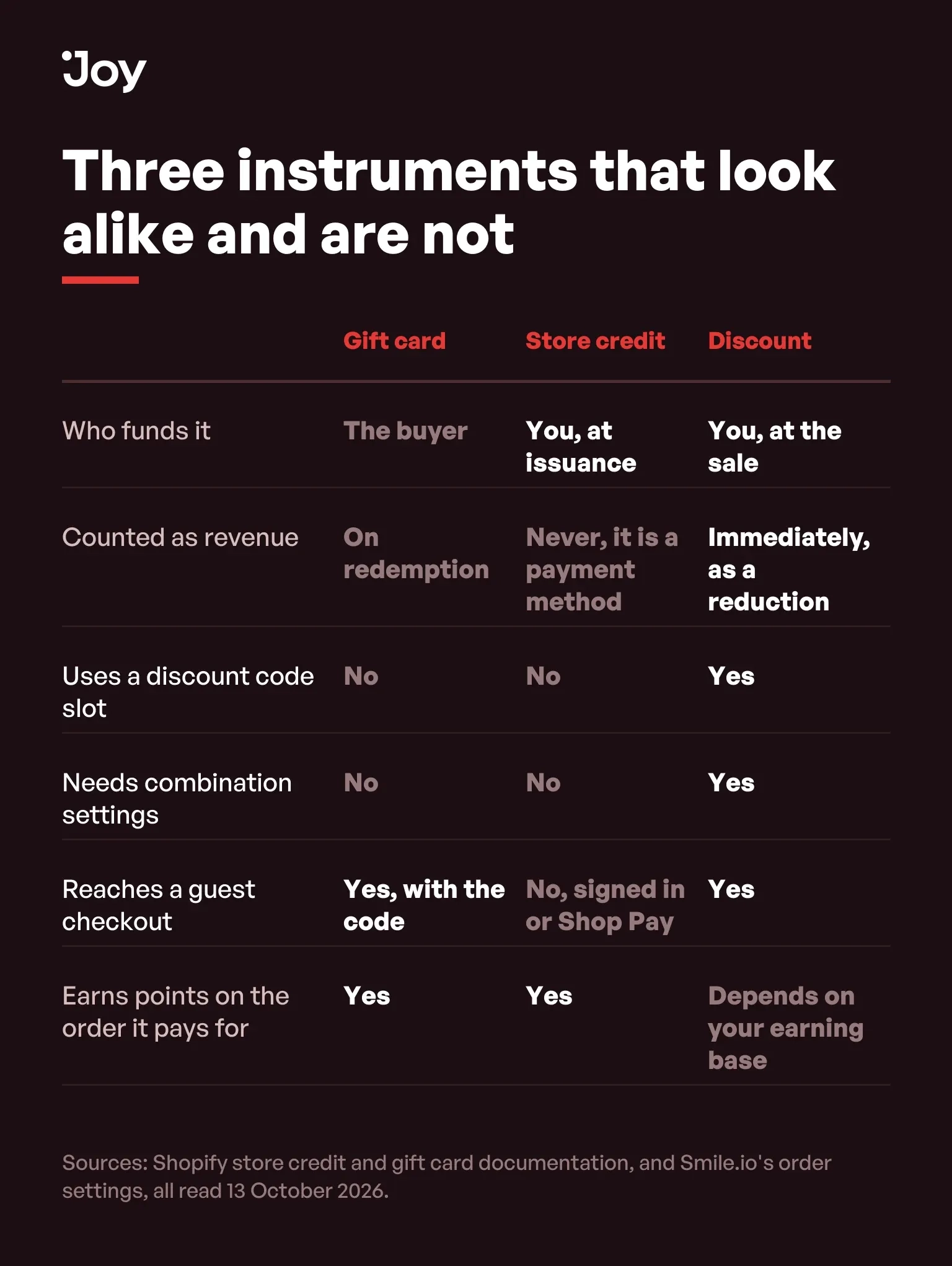
Follow the consequences. Store credit consumes none of the five product or order discount codes Shopify allows on one order. It needs no combination setting on either side. It is unaffected by the eligibility rules, set out in Shopify's guide to combining discounts, that decide whether a store may stack an order discount with another order discount. A store running checkout.liquid customisations, which cannot stack a money-off reward with a sitewide sale at all, can hand a customer store credit and watch it work.
That makes credit the one loyalty instrument whose behaviour does not depend on how your promotion was built. In a November cart full of discounts competing for slots and permissions, it simply pays.
The limits, from Shopify's own page
| Property | What Shopify documents | What it means for a reward |
|---|---|---|
| Classification | A payment method, not a discount | No combination settings, no code slots, no eligibility rules |
| Who can use it | Customers signed in through customer accounts, or Shop Pay | The loyalty path is the authenticated path, as always |
| Issuance cap | Less than $15,000 USD on a single customer account | Not a constraint for a loyalty reward; it is one for a goodwill gesture. B2B is separate: less than $10,000 USD on a company location account |
| Partial use | Only the full store credit amount can be applied | A $50 balance cannot be split across two orders |
| Expiry | Set per issuance; no store-wide default, unlike gift cards | Expires at the end of the day in your store's timezone, and the earliest-expiring balance is used first |
| Where it works | Online store, Point of Sale and Shop | Not on draft orders or edited orders |
| Subscriptions | The initial purchase only | It cannot pay recurring subscription bills |
| Currency | The currency of your checkout | A customer holding credit in another currency sees nothing at checkout |
| Fees | Stores created on or after 12 May 2025 pay third-party transaction fees on the amount paid with store credit | A real cost of the instrument, and easy to miss |
Two rows carry more weight than the rest. Only the full balance can be applied, so a reward denomination larger than a typical basket will sit unused while the customer waits for an order big enough to justify it. And there is no store-wide default expiry, which means expiry is a decision you make at issuance, every time, rather than a policy you set once.
And a different cap if you sell B2B
The $15,000 ceiling is the direct-to-consumer one, per customer account. B2B has its own and it is lower, as Shopify's guide to setting up business-to-business store credit states: "You can only issue store credit amounting to less than $10,000 USD on a company location account". The two are separate limits on separate pages, and they are routinely quoted as one number.
The structure differs as well as the number. B2B credit attaches to a company location and every B2B customer assigned to that location can spend it, while Shopify's store credit documentation says credit added to a customer profile "can be used only in a D2C online store and can't be used in a B2B online store". If you run both channels, a reward issued in the wrong place is a reward the customer cannot see.
The trap: credit still earns points
Here is the mechanism nobody writes down, and it follows directly from the classification. Because Shopify treats store credit as a payment method rather than a discount, Smile's article on Shopify order settings documents that gift cards and store credits "are never excluded from the rewardable order total".
So the January order arrives, the customer pays $25 of it with credit you issued in November, and earns points on the full $100. You funded the credit. You then fund points on the order the credit paid for. Neither cost is wrong on its own and nothing in any report puts them side by side.
The fix is not to abandon the instrument. It is to decide, deliberately, whether an order settled with store credit should earn at the full rate, and to check what your own app does rather than assume. If it earns, price the reward with that second cost included.
Dating the liability is the point
A discount is spent the moment it is used, inside the weekend, against the worst margin of the year. Store credit is issued in November and redeemed whenever the customer comes back, which for a well-timed expiry is January: a month with no competing promotion, full prices, and a return rate that is already pulling customers back into contact with you.
The structure is the same one that makes points cheaper than discounts in principle: a discount reduces the price of every sale it touches, including the sales that would have happened anyway, while credit costs you only on the orders where it is actually used. Store credit adds a date to that structure, and the date is the part you control.
There is an honest caveat. Credit that is never redeemed looks free and is not: it is a reward that failed to bring anyone back. The measure of this instrument is redemption, not issuance, and a programme reporting large outstanding balances is reporting a problem rather than a saving.
The same $10, worked through both ways
Take a $100 order with $40 of cost of goods, and a reward worth $10 either way. The arithmetic is less interesting than the timing, and the timing is the entire case.
| 10% off this order | $10 of store credit issued | |
|---|---|---|
| What the first order yields | $90 revenue, $50 gross margin | $100 revenue, $60 gross margin |
| If the customer never comes back | You gave away $10 and have one order | You gave away nothing and have one order at full price |
| If the customer does come back | The second order is at full price; total margin across both is $110 | The second order yields $90 received against $40 of cost; total margin across both is $110 |
| When the cost lands | In the November weekend, against the thinnest margin of the year | Whenever the credit is redeemed, against a full-price order |
| How certain the cost is | Exact, and known on the day | Unknown until it is redeemed, and zero if it never is |
Notice the third row. If the customer returns, the two instruments cost the same across the pair of orders: $110 of gross margin either way. That is worth saying plainly, because most vendor writing on this topic implies the credit is structurally cheaper and it is not.
What differs is the risk. The discount is paid on the spot whether or not it ever produces a second order. The credit is paid only in the event that it works, and against a full-price order when it does. You are trading a certain cost today for a conditional cost later, at a better margin — and giving up some conversion on the first order to do it.
Which means the real question is not which instrument is cheaper. It is how much first-order conversion you lose by withholding the discount, and no published source answers that for a BFCM cohort. It is, however, exactly the sort of thing one weekend of a split test will tell you about your own brand.
It only works for customers who sign in
One operational detail decides whether any of this reaches a customer. Store credit can be applied only when the customer is signed in through customer accounts, or through Shop Pay, as Shopify's page on store credit makes clear. A guest checkout cannot see a balance, let alone spend one.
So the ceiling on this instrument is your account rate, not your issuance. A brand where most January buyers check out as guests will issue credit in November, watch redemption stay low, and conclude the instrument does not work — when what did not work was the sign-in.
The practical sequence, then, is the reverse of how most merchants do it. Get the account created during the November order, while the customer has a reason to care. Put the balance in it. Then the January email has somewhere to point, and the customer arrives at a checkout that already knows who they are.
When a discount is still the better instrument
| If this is your situation | Choose | Why |
|---|---|---|
| You want the order now, at any cost | Discount | A price cut converts today. Nothing else does it as reliably. |
| You want the second order | Store credit | A balance is a reason to come back that survives an unsubscribe. |
| Your store cannot stack order discounts | Store credit | It is a payment method, so there is nothing to combine and nothing to qualify for. |
| Margin is already thin on the discounted SKU | Store credit, dated | The cost lands in January, against a full-price order. |
| The customer pays with credit and earns points | Watch it | You fund the credit and then fund points on the order it pays for. |
| You need the cost to be certain | Discount | A discount costs exactly what it says. Credit costs what is redeemed, which you will not know for months. |
The first row is the one merchants forget during a season built on urgency. If the job is to win an order against a competitor in the next four hours, a price cut does it and a future balance does not. Store credit is the instrument for the order after this one.
What to decide before November
Three things, in one sitting. The denomination, which has to be smaller than a typical basket because only the full balance can be applied. The expiry date, chosen per issuance, which is what turns a vague balance into a January reason to return. And whether an order paid with credit earns points at the full rate, which you find out with one test order rather than from any help page.
The eight mechanics that work on a loyalty base during the weekend, and which of them cost margin rather than cash, are in our BFCM loyalty strategies guide. The order of work for the weeks before the weekend is in our Black Friday checklist.
The reward that survives an unsubscribe
A third of the people who join a list during a sale are there for the sale, and email is a fragile way to hold them. A store credit balance is not a message; it is money with their name on it, sitting in an account they have to sign into. It costs you nothing until it works, it lands in the month you most need an order, and it is the one instrument in this category that Shopify's own plumbing treats as real.
FAQs
Is store credit a discount?
No, and that single fact drives everything else. Shopify presents store credit as a payment method at checkout, so it is invisible to the discount combination engine: it consumes none of the five product-or-order code slots, needs no combination opt-in, and is unaffected by the eligibility rules that decide whether two discounts can stack.
Can a customer use part of their balance?
No. Shopify applies the full store credit amount; a customer cannot choose a partial amount. Plan reward denominations with that in mind, because a balance larger than a typical basket does not behave the way customers expect.
Does store credit expire?
Only if you set an expiry when you issue it. There is no store-wide default, unlike gift cards. Credit expires at the end of the day in your store's timezone, and when a customer holds several balances the earliest-expiring one is used first.
Does a customer earn points on an order paid with store credit?
On Smile, yes, and the reason is documented: Shopify treats gift cards and store credits as payment methods rather than discounts, so they are never excluded from the rewardable order total. Check your own app, because this is the case where the same order costs you twice.
Are there fees?
For stores created on or after 12 May 2025, orders that include store credit as a payment method are charged third-party transaction fees on the amount paid with the credit. On an older store this does not apply, which means two merchants running the identical programme can have different unit costs.
Store credit or a gift card?
A gift card is bought, usually by someone else, and carries its own expiry rules. Store credit is issued by you and expires only if you say so. For a loyalty reward the control over expiry is the deciding difference.

Written by
Thomas Nguyen is the CEO & Co-founder of Joy, a loyalty solution for Shopify and eCommerce brands. With years of experience building high-performance Shopify apps, Thomas aims to help merchants grow through customizable and retention-focused tools.
Related reading
 Loyalty Strategy
BFCM Loyalty Strategies: Eight Mechanics That Are Not a Discount
Eight loyalty mechanics for the BFCM weekend, with the cheapest instrument named for each and the costly one priced.
 Thomas Nguyen
 Program design
Double Points: The Three Settings That Decide What the Weekend Pays
Three settings decide which BFCM orders receive double points, and Joy, LoyaltyLion and Smile each handle them differently.
Thomas Nguyen Loyalty Strategy
How to Retain Customer Loyalty: 7 Proven Strategies
Acquiring a customer costs 5 to 25x more than keeping one — yet most brands keep pouring budget into acquisition. Here are seven proven strategies to retain customer loyalty, each with action steps and real metrics, plus a Day 0 to 60 playbook you can run immediately.
Thomas Nguyen Loyalty Strategy
Double Points at BFCM: What a 2x Weekend Costs in Margin
A 2x weekend on a discounted order can take 10% of its gross margin. The full arithmetic, with every assumption printed.
Thomas Nguyen Loyalty Strategy
Building Customer Loyalty: The Framework That Actually Works
Stable revenue can mask something uncomfortable: customers returning out of habit, not preference. When they find a better option, they leave without warning — and you pay full CAC to replace them. Here's how to build the loyalty they actually feel, not the one you assume.
Thomas Nguyen Loyalty Strategy
Customer Loyalty Management: Your Guide to Maximizing Repeat Revenue
Customer loyalty management is the system that turns one-time buyers into repeat revenue. This guide covers segmentation, reward design, omnichannel sync, and how to measure ROI — with frameworks you can put to work this quarter.
Thomas Nguyen