
The 2026 Holiday Forecasts, With the Population Attached to Every Number
Adobe says $275.1 billion and Deloitte says $316.1 billion. Both are right. What each 2026 holiday forecast measures.
Summarize this post with AI
In September two forecasters put a number on American holiday e-commerce for 2026. Adobe said $275.1 billion. Deloitte said at least $316.1 billion. Both figures are being quoted this month as the holiday e-commerce forecast, and they are $41 billion apart.
Neither is wrong. They are answers to different questions, and the questions are printed in the releases for anyone who reads past the headline. This page sets out what each forecast covers. The number that matters most to a loyalty program is in none of the headlines, and it comes last.
Key Takeaways
- Adobe forecasts $275.1 billion of US online holiday spending. Deloitte forecasts US holiday e-commerce of $316.1 billion to $318.9 billion. The two are $41 billion apart because Adobe's season is two months and Deloitte's is three, and because they are built from different data.
- Salesforce's widely quoted 2026 figures are predictions about traffic and costs, published in July and global in scope. None of them is a sales forecast.
- On 13 October 2026 NRF had not published a 2026 holiday forecast. Its forecasts page listed the 2026 annual outlook and the 2025 holiday one.
- For a loyalty program the most useful lines are further down Adobe's release: Cyber Week is 17.3% of the season, and the deepest discounts Adobe expects in apparel peak at 23% off list.
- Every figure here describes the United States or the world. None describes your store, and none is a result.
Published 4 November 2026; written 13 October 2026. Every figure was read on the publisher's own page and is linked. These are forecasts and predictions made before the season. Mastercard and Bain have also published 2026 outlooks; neither primary page would load while this was written, so neither is quoted.
The forecasts, side by side
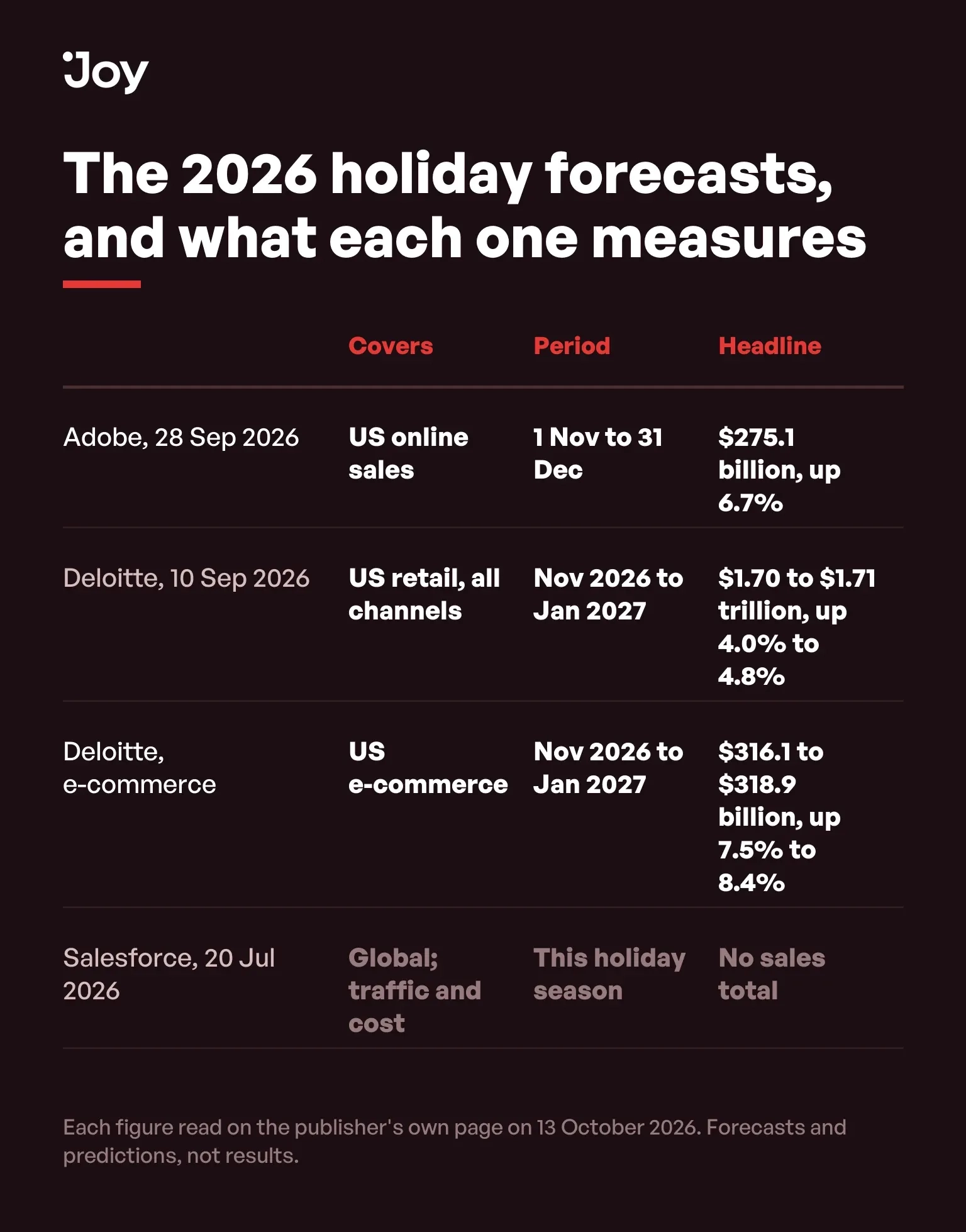
| Publisher | Published | What it covers | Period | Headline |
|---|---|---|---|---|
| Adobe | 28 September 2026 | US online sales, from Adobe Analytics transaction data | 1 November to 31 December 2026 | $275.1 billion, up 6.7% |
| Deloitte | 10 September 2026 | US retail sales, all channels, excluding automotive and gasoline | November 2026 to January 2027 | $1.70 to $1.71 trillion, up 4.0% to 4.8% |
| Deloitte | 10 September 2026 | US e-commerce sales | November 2026 to January 2027 | $316.1 to $318.9 billion, up 7.5% to 8.4% |
| Salesforce | 20 July 2026 | Global. Predictions about traffic and cost, with no sales total | "This holiday season" | 20% of holiday ecommerce traffic from AI chat agents; $3 billion more spent subsidizing free shipping |
| NRF | Not published by 13 October 2026 | US retail sales | November and December | None yet. Its 2025 forecast was 3.7% to 4.2% |
Why $275.1 billion and $316.1 billion are both right
Adobe's figure is for "the period from Nov. 1 to Dec. 31, 2026" and is built from what Adobe Analytics observes: the press release announcing that figure cites more than one trillion visits to US retail sites and 100 million SKUs. It is online only and US only.
Deloitte's season, in its press release forecasting holiday retail sales, is "the November 2026 through January 2027 period". Its e-commerce range of $316.1 billion to $318.9 billion therefore includes a month Adobe leaves out, and its comparison base is the $294 billion it reports for last season from US Census Bureau data.
Two definitions of a season and two sources of data produce two totals. A third forecaster with a third definition will produce a third, and none of that is in a merchant's hands. What a merchant controls is whether the label travels with the number when it is pasted into a planning deck.
What Salesforce published is something else
Salesforce's 2026 holiday piece is titled as predictions and dated 20 July. Its lines are of this kind: "20% of all 2026 holiday ecommerce traffic will originate from AI chat agents", and "Retailers will spend an additional $3 billion globally to subsidize free shipping this holiday season".
Those are statements about traffic and cost, at global scale, made four months before Black Friday. They are worth reading. They are not interchangeable with a sales forecast, and the 20% in particular counts traffic that Salesforce itself describes as including "competitor scrapers" alongside shoppers.
NRF, as of 13 October
The National Retail Federation's holiday forecast is the one this table is missing. When this page was written NRF's own forecasts page carried two items: the 2026 annual outlook, in which "retail sales in 2026 will grow by 4.4% over 2025 to $5.6 trillion", and last year's holiday forecast, which predicted that "retail sales in November and December will grow between 3.7% to 4.2% over 2024".
That gives the shape to expect. NRF defines the season as November and December, the same two months as Adobe, across retail and not only online. If its 2026 figure has appeared by the time you read this, that is where it belongs in the table above.
The lines a loyalty program should read
Below the headline, Adobe's release has four details that bear on how a retention program should spend the season.
Cyber Week is 17.3% of the season
Adobe's holiday forecast expects Cyber Week, the five days from Thanksgiving to Cyber Monday, to bring in $47.5 billion, "representing 17.3% of the full holiday season spend". The other $227.6 billion is spent on the 56 days around it.
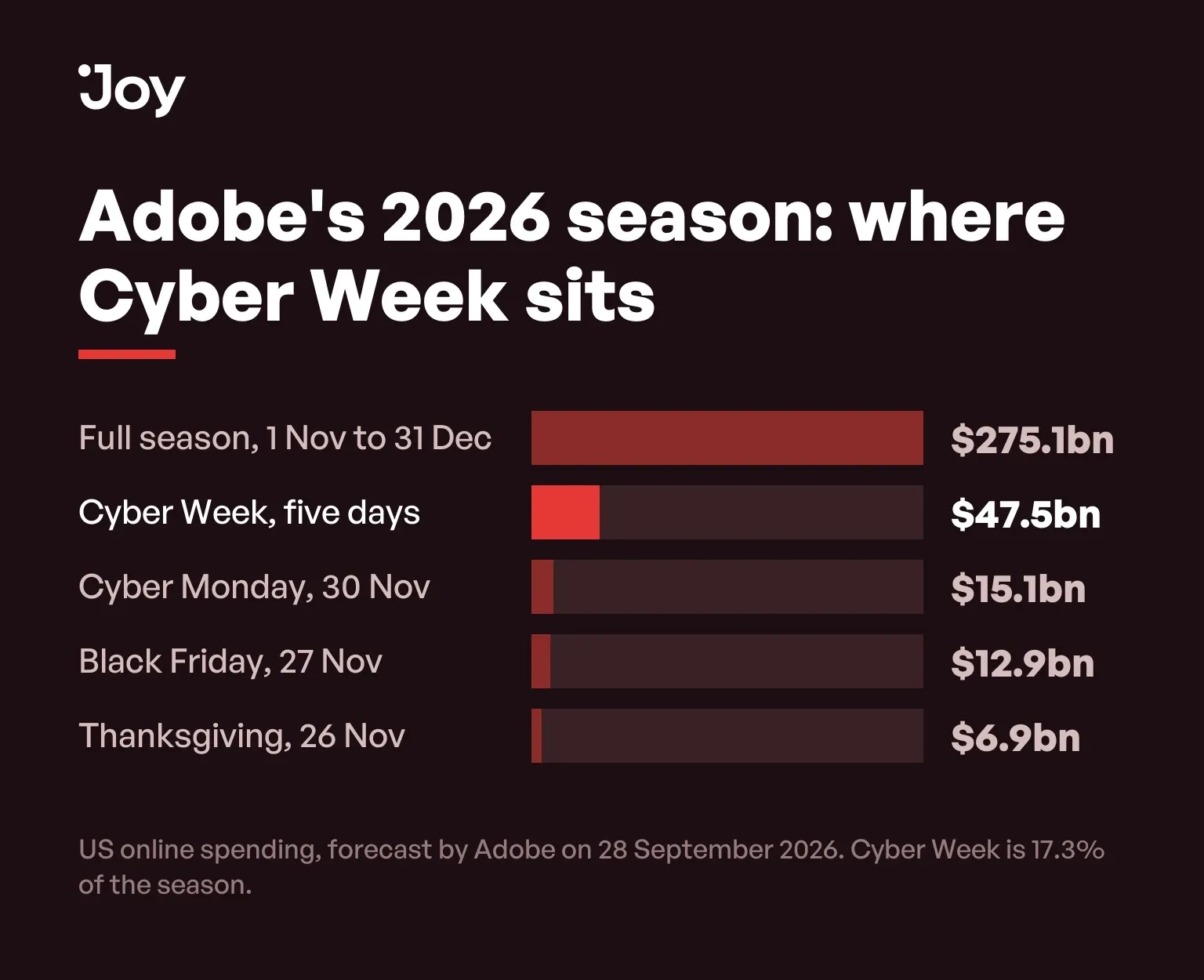
A loyalty calendar that runs a multiplier from Thursday to Monday and then goes quiet is built for a sixth of the money. The same release puts October at $95.8 billion, up 8%, before the season it defines has started.
Discounts peak lower than the headline suggests
The "up to 30%" in the summary of Adobe's forecast release is the peak for one category. By category, it expects discounts to peak at 30% off listed price in electronics, 29% in toys, 23% in TVs, computers and apparel, 19% in sporting goods, and 18% in appliances and furniture.
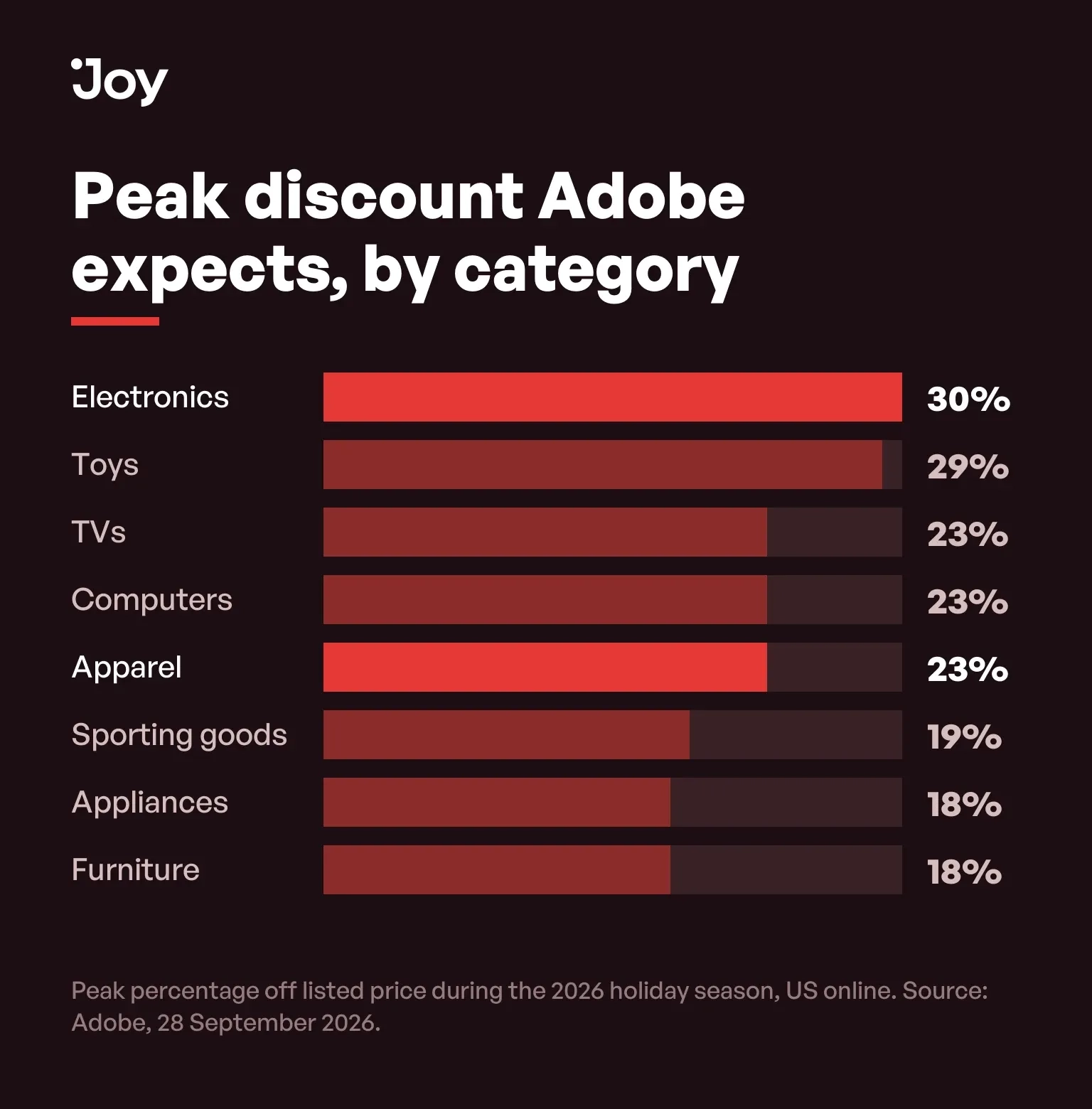
Those are peaks across large US retailers, and a smaller brand may have reasons to go deeper. But a store planning 40% off is 17 points deeper than the apparel peak, and every loyalty cost that is calculated on a discounted order grows with the depth of the discount.
Rewards sites are an acquisition channel for somebody else
Adobe reports that within affiliates and partners, "cashback and rewards partners leads in affiliate traffic with a 36% share". A shopper who arrives through one of those is collecting a reward from the partner, on top of anything your own program offers her.
AI traffic is growing from a small base
Adobe "expects AI traffic to U.S. retail sites this holiday season (measured by shoppers clicking on a link) to rise 130% YoY". That is a growth rate for visits. The release gives no share of sales for it.
What none of this tells you
Not one of these numbers forecasts your store. A US total says nothing about a brand doing two million dollars in skincare, and a forecast that turns out right for the country can be wrong for every individual merchant in it. Treat the totals as weather.
How to carry a forecast
- Publisher and date of publication.
- Geography: US, or global.
- Channel: online only, or all retail.
- Period: two months, three months, or five days.
- Kind: a forecast of sales, a prediction about something else, or a survey of intentions.
If any of the five is missing, the number is not ready to be repeated. Two copying errors were already in circulation when this page was written, one giving Cyber Monday as $15.2 billion and one giving Deloitte's e-commerce floor as $361.1 billion. The releases say $15.1 billion and $316.1 billion.
How the two big days differ in practice is covered in Cyber Monday vs Black Friday; the loyalty mechanics for the weekend are in our BFCM loyalty strategies guide, and the wider plan in the Shopify BFCM guide.
The number that comes last
It is 23%, or whichever of Adobe's category peaks is closest to what you sell. Write your planned BFCM discount next to it. If yours is the deeper of the two, find out what it does to the cost of every point you issue that weekend before the sale goes live.
FAQs
What is the 2026 holiday sales forecast?
It depends whose, and for what. Adobe forecasts $275.1 billion of US online sales for 1 November to 31 December, up 6.7%. Deloitte forecasts $1.70 trillion to $1.71 trillion of US retail sales for November through January, up 4.0% to 4.8%.
Why are Adobe's and Deloitte's e-commerce numbers so different?
Adobe counts two months and Deloitte counts three, so Deloitte's figure includes January. They also start from different data: Adobe from transactions it observes on US retail sites, Deloitte from a baseline it attributes to the US Census Bureau. Neither contradicts the other.
How much is Cyber Monday 2026 expected to be worth?
Adobe expects $15.1 billion of US online spending on Cyber Monday, 30 November, up 6.2%, and $12.9 billion on Black Friday, up 9.2%.
Has NRF published its 2026 holiday forecast?
Not when this page was written on 13 October 2026. NRF's forecasts page then listed its 2026 annual forecast and its 2025 holiday forecast. Check that page for anything newer.
Is the average holiday discount 30%?
No. Adobe's 30% is the peak it expects for the deepest category, electronics, during Cyber Week. Its expected peaks for apparel, sporting goods, appliances and furniture are between 18% and 23%.
Should I set my own BFCM target from these forecasts?
No. They describe national and global totals. Use them for the shape of the season and for discount norms in your category, and set the target from your own last three years.

Written by
Thomas Nguyen is the CEO & Co-founder of Joy, a loyalty solution for Shopify and eCommerce brands. With years of experience building high-performance Shopify apps, Thomas aims to help merchants grow through customizable and retention-focused tools.
Related reading
 Program design
Where a Member Can Actually Spend Points at BFCM: Cart, Checkout, or Nowhere
Five screens sit between a product page and a paid order. Shopify decides which of them can carry a redeem button.
 Thomas Nguyen
 Loyalty Strategy
Store Credit or a Discount: The BFCM Reward That Returns in January
Store credit is a payment method, not a discount. That one fact decides where it stacks, what it costs and when you pay.
Thomas Nguyen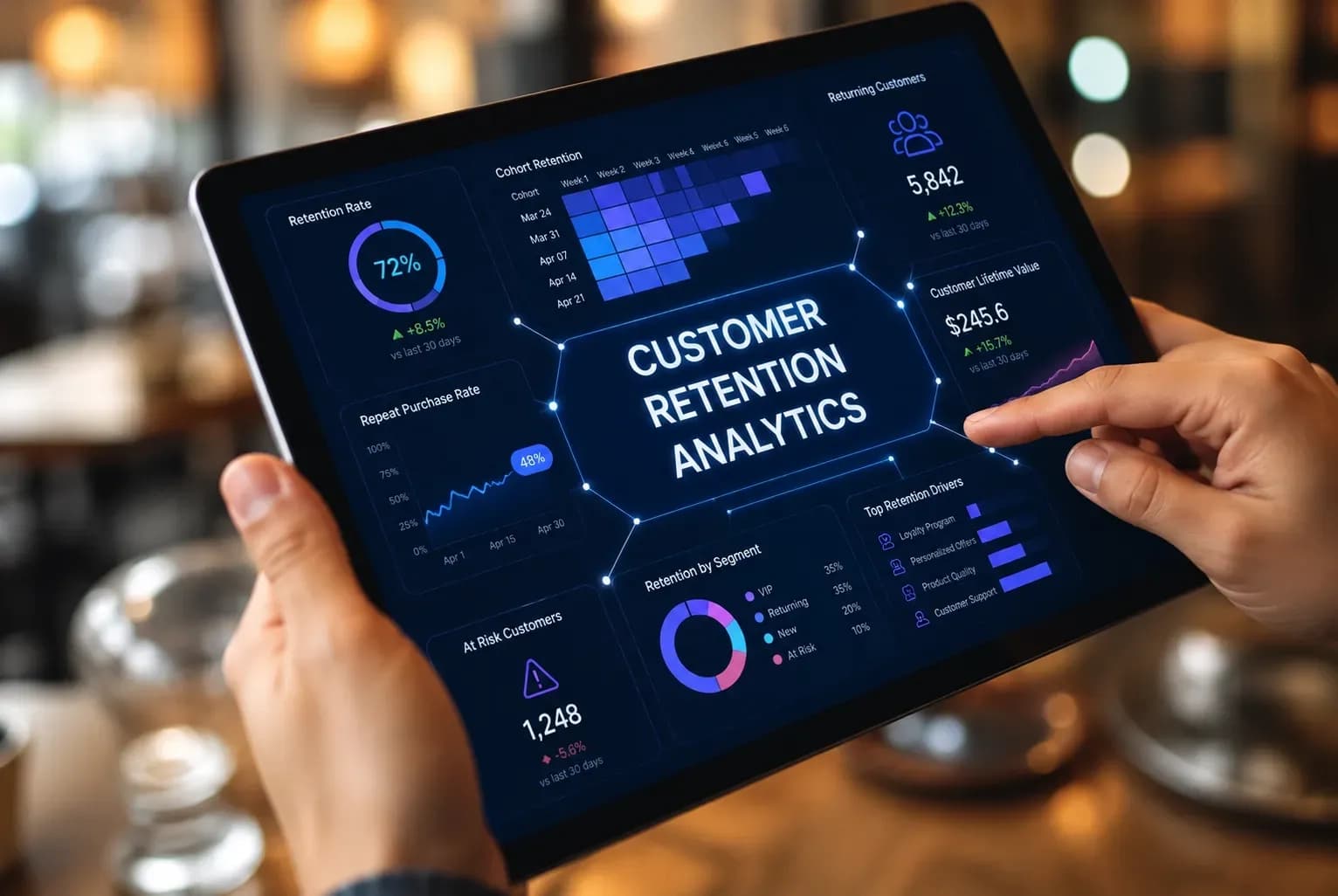 Loyalty Strategy
Customer Retention Analytics: Turn Your Data Into Retention Action
Most retention guides stop at the numbers. This one shows how to read your retention data and turn each metric into a concrete loyalty play for your Shopify store.
Thomas Nguyen Loyalty Strategy
Customer Retention Goals: 5 Targets to Set (and How to Hit Them)
A goal-first guide to customer retention: the five targets worth setting, how to make each one SMART, and the strategy that hits it.
Thomas Nguyen Loyalty Strategy
Customer Engagement and Loyalty: Strategies and How to Measure Them
Customer engagement and loyalty aren’t the same thing. Here’s how they differ, seven strategies that build both, and the metrics that tell you it’s working.
Thomas Nguyen Loyalty Strategy
Gift Cards and Loyalty: The December Revenue That Is Not Revenue Yet
Shopify does not count a gift card sale as a sale. That one rule moves part of December's revenue into January.
Thomas Nguyen