
Where a Member Can Actually Spend Points at BFCM: Cart, Checkout, or Nowhere
Five screens sit between a product page and a paid order. Shopify decides which of them can carry a redeem button.
Summarize this post with AI
On the Tuesday after Cyber Monday your loyalty dashboard will show two numbers: how many members ordered over the weekend, and how many of them spent points. The distance between the two was fixed weeks earlier, by a decision almost nobody makes on purpose, which is how many of the screens between a product page and a paid order have a redeem button on them.
Count them on your own store before reading further. If the answer is one, it is the widget in the corner.
Key Takeaways
- In Deloitte's 2025 holiday survey, 26% of consumers planned to use loyalty points, up from 20% a year earlier. In a separate Deloitte survey of loyalty members, 40% admitted to sometimes forgetting to redeem. Both describe what people said.
- A purchase passes through up to five screens where points can be spent, and a store does not control all of them. Redemption inside the checkout steps is limited by Shopify to stores on Shopify Plus.
- For every other store the cart is the last screen with a redeem button on it, and a shopper who uses an express checkout button never sees the cart.
- Apps differ on what an abandoned redemption costs the member. Smile deducts points when the code is generated; Joy's cart block deducts them only when the purchase completes.
- Songmont recorded a 5x redemption rate on Black Friday against its previous platform after redemption moved into checkout. That is one merchant, and the program changed in other ways at the same time.
Published 28 October 2026. Platform behaviour was read from Shopify's developer documentation and from Joy's and Smile's own documentation on 13 October 2026. Both Deloitte figures are survey responses, and the populations are given where they are used.
Intent is rising and memory is not
Deloitte's 2025 Holiday Retail Survey, of 4,270 consumers, found that "One-quarter (26%) of consumers surveyed plan to use loyalty points (versus 20% in 2024)" to stretch their holiday budgets, as Deloitte's press release on the survey reports. That is a statement of intention, collected between late August and early September.
A second Deloitte study asked 5,564 US adults who belong to loyalty programs about the one they like most, and the Deloitte Insights article on reshaping loyalty programs reported that "40% of all respondents admit to sometimes forgetting to redeem". Its methodology note says the findings reflect favourite programs and "should not be generalized across all loyalty memberships". Read plainly, that is the rate of forgetting in the program a person cares about most.
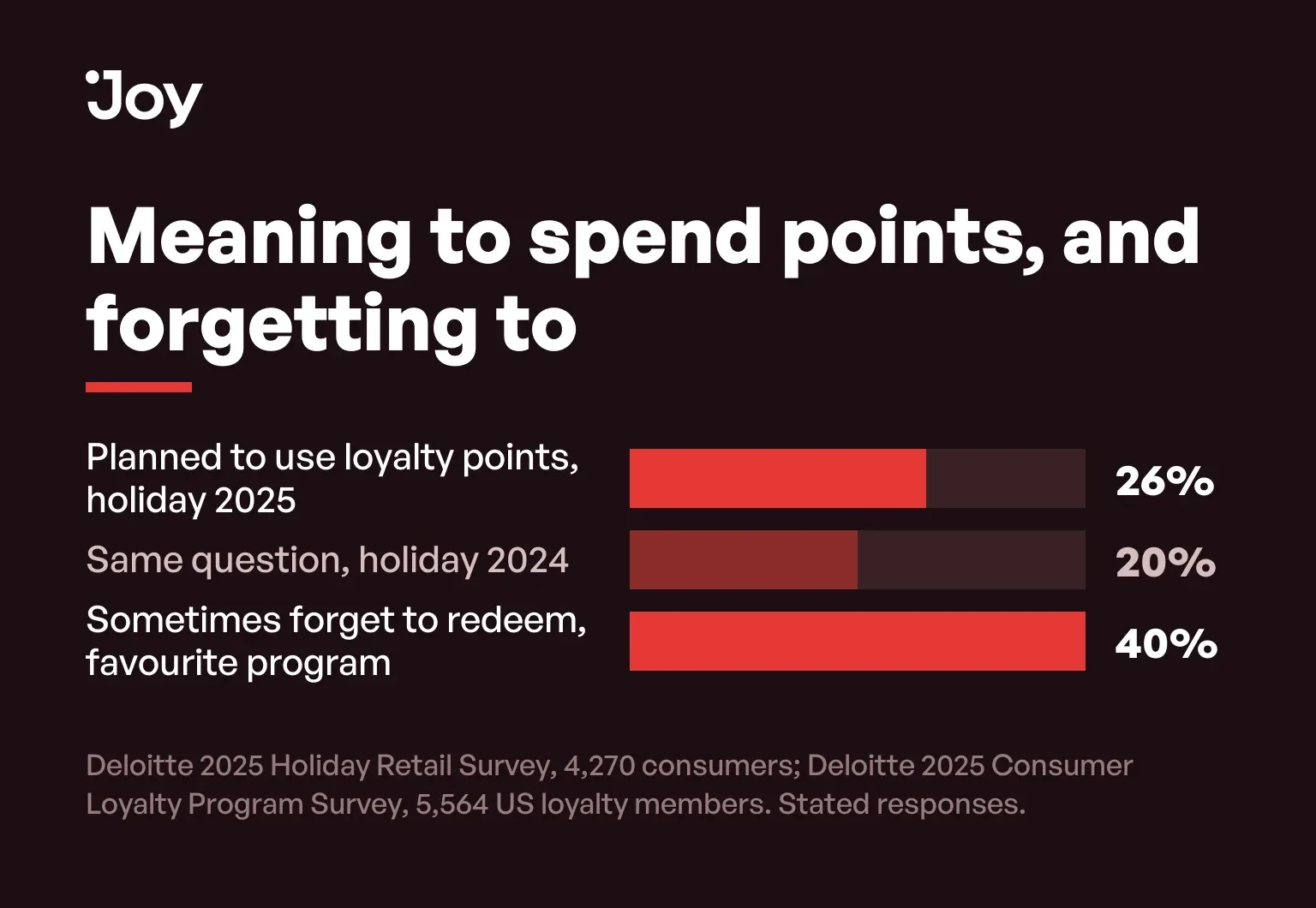
Put together, more shoppers arrive meaning to spend points, and a large share of members lose track of them even where they are most engaged. What a store can change is how often the balance is put in front of the member while she is buying.
The five screens
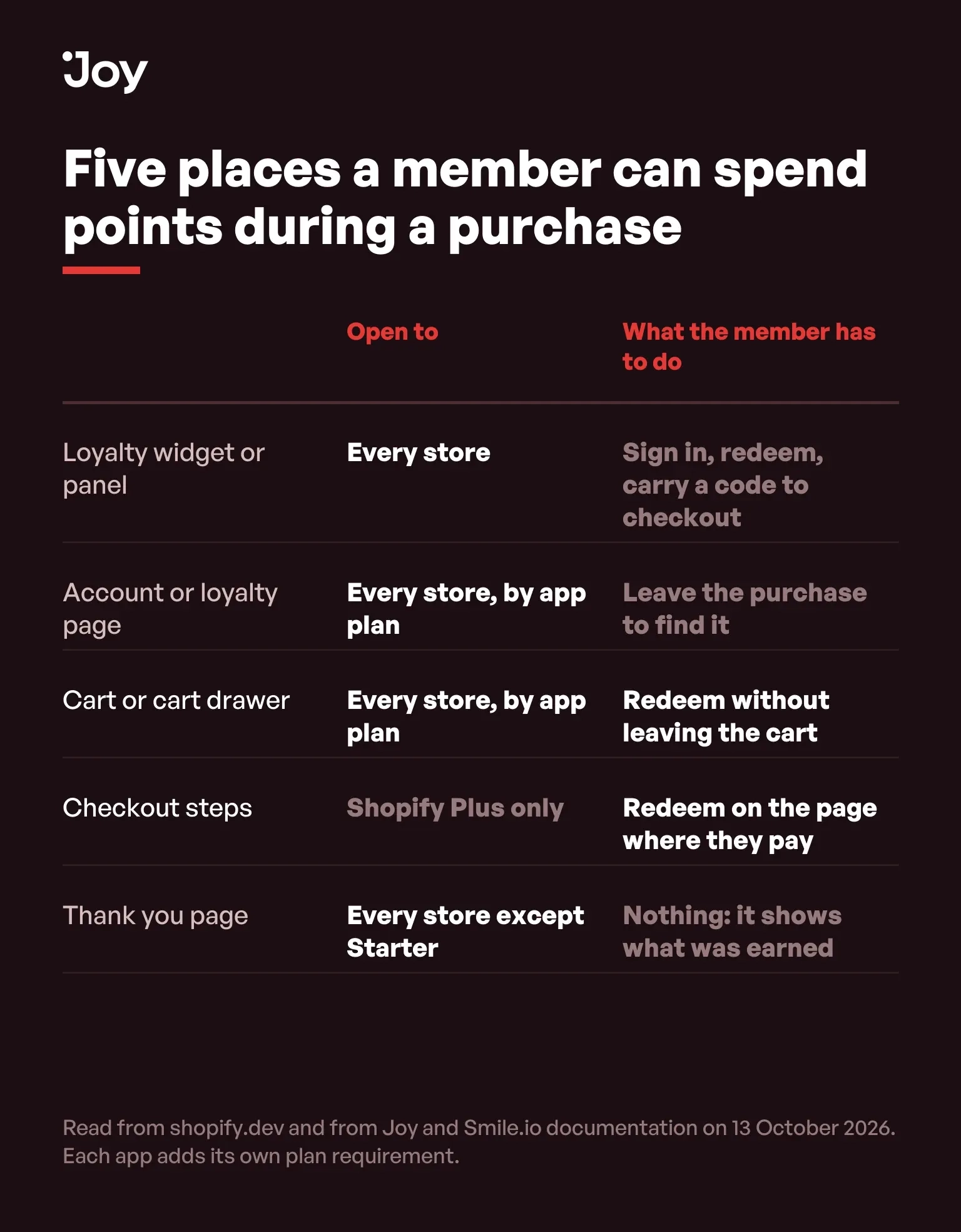
A purchase on Shopify can offer redemption in five places. They are not equally available, and the order below is the order a shopper meets them.
The widget or panel
This is the default everywhere. Smile, in its guide to how customers redeem points, describes redeeming through its panel as available on all of its plans, and sets out the steps: log in to a store account, open the panel, choose a reward, then apply or copy the code. It works, and it asks the member to stop shopping, remember she has points, and go and fetch them.
The account or loyalty page
Both vendors now place the program inside Shopify's customer account. Smile's Loyalty Hub is on its Growth plan and above; Joy offers a Loyalty Hub page and separate account blocks, set out in its guide to the account page. It is the right home for a balance, and by Joy's own description it is where customers land after a purchase, which is the wrong side of the order for spending points.
The cart
Here the balance meets the basket. As Joy's guide to Redeem in Cart describes, the feature works in the cart drawer and on the cart page, applies a reward without reloading the page, and opens on the reward that saves the most on the current cart. It is available on Essential, Advanced and Ultimate. The background to that rebuild is in our note on the member in the cart with unspent points.
The checkout steps
This is the screen where the customer has already decided to pay, and it is the one a store may not be allowed to use. Shopify's rule, in its developer documentation on checkout app extensions, is that app blocks on "the information and shipping and payment steps in checkout are available only to stores on a Shopify Plus plan". Joy says the same of its checkout blocks, and its guide to the checkout page is careful about whose rule it is: "This is a Shopify platform restriction, not a Joy limitation".
The apps then add a gate of their own. Joy's Quick Redeem needs its Ultimate plan as well as Shopify Plus. Smile's checkout redemption needs Growth or above, again on Shopify Plus.
After the order
The Thank you page can show what an order earned. By then there is nothing left to spend points on. In a physical shop the equivalent screen is the point of sale, where Joy's extension lets staff redeem for an identified customer on its Advanced and Ultimate plans, as Joy's guide to redeeming at POS checkout sets out.
What an abandoned redemption costs the member
A cart built on Thursday night and finished on Friday morning is ordinary during a sale, so it matters what happens to points redeemed for an order that did not complete the first time. The vendors differ.
Smile deducts at the moment of redemption, and its article on customer redemptions is explicit: "their points are deducted as soon as the discount code is generated", and if the code is not used "the redeemed points aren't automatically returned to their balance". The code stays in the account for later.
Joy's cart block works the other way, as Joy's Redeem in Cart documentation states: "Points are only permanently deducted when a customer completes their purchase". Its checkout block, documented in Joy's guide to Quick Redeem, converts points into a temporary code and refunds them at once if the customer cancels. Neither design is wrong. They produce different support tickets in the first week of December.
The nowhere cases
Four kinds of member reach a paid order without ever being offered the chance to redeem.
- The member who is signed out. Every surface above needs to know who she is, and Smile's panel steps begin with logging in.
- The member who taps an express button on the product page. Buy it now and wallet buttons go straight to checkout and skip the cart, which on a store below Plus was the last screen with a redeem block. On Plus, Smile notes that its checkout block can also be shown in Shop Pay.
- The member whose reward code will not combine with the sale. She was offered redemption and checkout refused it.
- The guest, who has no balance yet and is shown either nothing or an invitation to join.
The second of those is the hardest to see from the admin. A cart block does its work only for shoppers who pass through the cart, and a product page built around a one-tap purchase sends a share of them around it.
What moving the button did for one brand
Songmont, which runs a paid membership on Joy, moved redemption into checkout so that points apply without the customer leaving the page. Songmont's case study on Joy reports a "5x redemption rate during Black Friday compared to their previous platform".
Treat that as a single observation. It is one brand, the comparison spans a change of platform, and the program itself was rebuilt at the same time, so the placement of the button cannot be separated from everything else that changed. It does show the size of what is at stake.
If you are not on Plus
You cannot put redemption in checkout, and no app setting changes that. The cart is where your program ends, and a shopper who goes around the cart goes around your program. Upgrading a Shopify plan to fix a redemption rate is rarely the right trade.
Walk the path
- Sign in as a test member with enough points for a reward.
- Add a product to the cart the ordinary way and note every screen that shows your balance or a redeem control.
- Start again and use the express button on the product page. Note the screens again.
- Redeem in the cart, then abandon the checkout, and look at the member's balance and rewards afterwards.
- Repeat the first two steps signed out.
Four short runs, and you will have your own version of the table above. The mechanics worth pointing those points at over the weekend are in our BFCM loyalty strategies guide.
Count the screens
The number you were asked for at the top of this page is the one to write down. Sign in as a member, tap the fastest route to payment your product page offers, and count how many times the store shows you your points before it takes your money.
FAQs
Can customers redeem loyalty points at Shopify checkout?
Inside the checkout steps, only on Shopify Plus. Shopify limits app blocks on the information, shipping and payment steps to Plus stores, as its overview of checkout app extensions states, and loyalty apps add their own plan requirement on top.
Where can a store that is not on Plus let members redeem?
In the loyalty widget, on the loyalty or account page, and in the cart. Joy's Redeem in Cart works in the cart drawer and on the cart page on its Essential plan and above.
Do points come back if the customer does not finish the order?
That depends on the app and the surface. Smile's documentation on redeeming points states that redeemed points "aren't automatically returned" if the code goes unused. Joy's documentation for the cart block says points "are only permanently deducted when a customer completes their purchase".
Does a guest see the redeem block?
A guest has no balance to spend, so the useful question is what the block shows them instead. Joy's cart block can be hidden for guests or left visible as a prompt; decide which before the weekend, because a BFCM sale is built to bring in people who have never signed in.
How many rewards can be applied to one cart?
Joy's cart block supports one active redemption per cart session. Smile allows a second reward where discount combinations are enabled, with the second code pasted in by hand.
Is a higher redemption rate a cost or a result?
Both. Redeemed points are a cost you have already promised, and a member who redeems is one who came back. The measures are set out in our guide to loyalty program redemption rates.

Written by
Thomas Nguyen is the CEO & Co-founder of Joy, a loyalty solution for Shopify and eCommerce brands. With years of experience building high-performance Shopify apps, Thomas aims to help merchants grow through customizable and retention-focused tools.
Related reading
 Loyalty Strategy
BFCM Loyalty Strategies: Eight Mechanics That Are Not a Discount
Eight loyalty mechanics for the BFCM weekend, with the cheapest instrument named for each and the costly one priced.
 Thomas Nguyen
 Program design
Free Shipping Rewards: The One Loyalty Reward Every Shopify Store Can Stack
Every Shopify store can stack a free shipping reward on a sale. Three published rules decide whether yours actually will.
Thomas Nguyen Loyalty Strategy
Gift Cards and Loyalty: The December Revenue That Is Not Revenue Yet
Shopify does not count a gift card sale as a sale. That one rule moves part of December's revenue into January.
Thomas Nguyen Loyalty Strategy
Double Points at BFCM: What a 2x Weekend Costs in Margin
A 2x weekend on a discounted order can take 10% of its gross margin. The full arithmetic, with every assumption printed.
Thomas Nguyen Loyalty Strategy
Gamified Loyalty Program: Turning Rewards into Fun Experiences
From spinning wheels and earning badges to completing challenges and unlocking tiers, this guide explores how brands use gamification to boost loyalty—and how you can do the same.
Thomas Nguyen How-to Guide
What Does a Discounted Order Earn? Four Apps, Four Answers
A $100 jacket at 40% off: does it earn 100 points or 60? Four loyalty apps, four answers, and one test that settles it.
Thomas Nguyen