
AI-Referred Shoppers Arrive Signed Out
Adobe expects AI traffic to retail sites to rise 130% this season. A click from an assistant lands signed out.
Summarize this post with AI
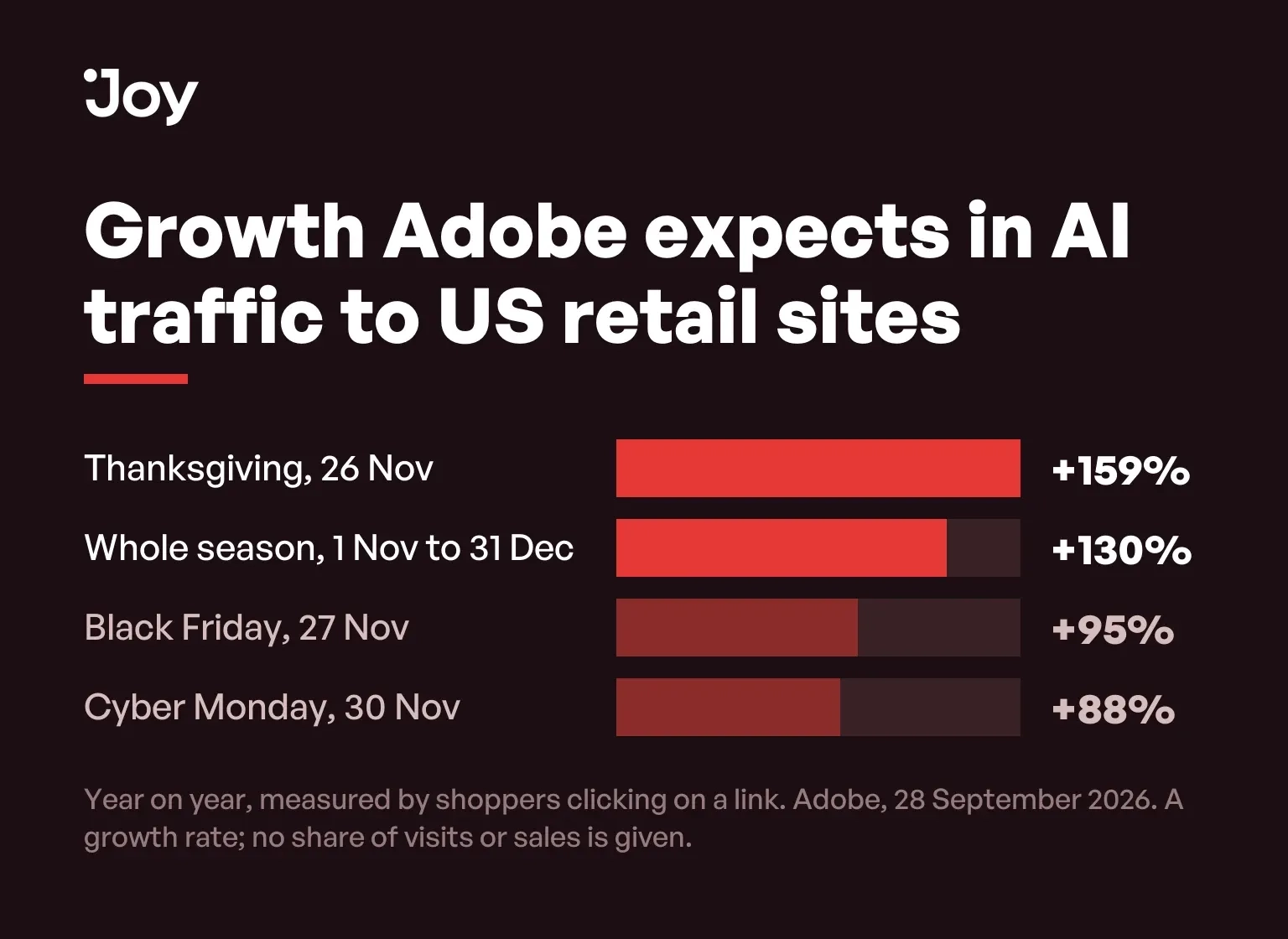
Adobe's holiday forecast contains a number that has been repeated more than it has been read: AI traffic to US retail sites is expected to rise 130% year on year. The part in brackets is the part that matters. Adobe says the traffic is "measured by shoppers clicking on a link".
A click on a link is a landing on a page, and for a loyalty program the trouble starts with which page and in what state.
Key Takeaways
- Adobe expects AI traffic to US retail sites to rise 130% this holiday season, measured by shoppers clicking a link. It publishes a growth rate and no share of visits or sales.
- A click from an assistant is a visit that starts on a page deep in the store, in a session with no login. A member arriving that way looks like a stranger.
- Most of what a loyalty program shows is shown to members who are signed in: the balance, the tier price, the reward in the cart.
- Shopify now describes agents that discover products and approve purchases through Shop. Whether loyalty earning and redemption carry through such a purchase is not documented in anything read for this page.
- The practical step is small: look at one product page as a signed-out visitor and see whether it mentions the program at all.
Published 11 November 2026; written 13 October 2026. This is the thinnest-evidenced page in our BFCM series, and it is written to stay inside what Adobe, Salesforce and Shopify have published. Adobe measures traffic and does not report orders. Where something is not known, the page says so.
What has been published
Adobe expects the increase to be sharpest on Thanksgiving, at 159% year on year, followed by Black Friday at 95% and Cyber Monday at 88%. The release gives no base for those percentages and no share of total visits, so a store cannot read off how much of its own traffic this represents.
Salesforce goes further and predicts that "20% of all 2026 holiday ecommerce traffic will originate from AI chat agents". The same sentence in its holiday predictions post says that traffic "will be a mix of consumer-facing bots handling live queries, autonomous agents executing backend tasks, and competitor scrapers". Part of that fifth is software reading your prices.
Shopify, for its part, has built for the channel. Its Spring '26 Edition states that "Shopify gets your products in AI channels automatically", and describes shoppers using AI agents who "can discover products across Shopify and approve purchases through Shop". A merchant did not choose to be listed there and does not choose which product an assistant links to.
The visit a click produces
Take the simplest case, which is the one Adobe is counting. Somebody asks an assistant for a recommendation, is shown a product, and taps through. The page that opens is a product page. The browser it opens in may be one the shopper has never used with your store, so there is no session and no login.
If that shopper is a member with 900 points and Gold status, your store has no way of knowing. She sees the public price and the public page.
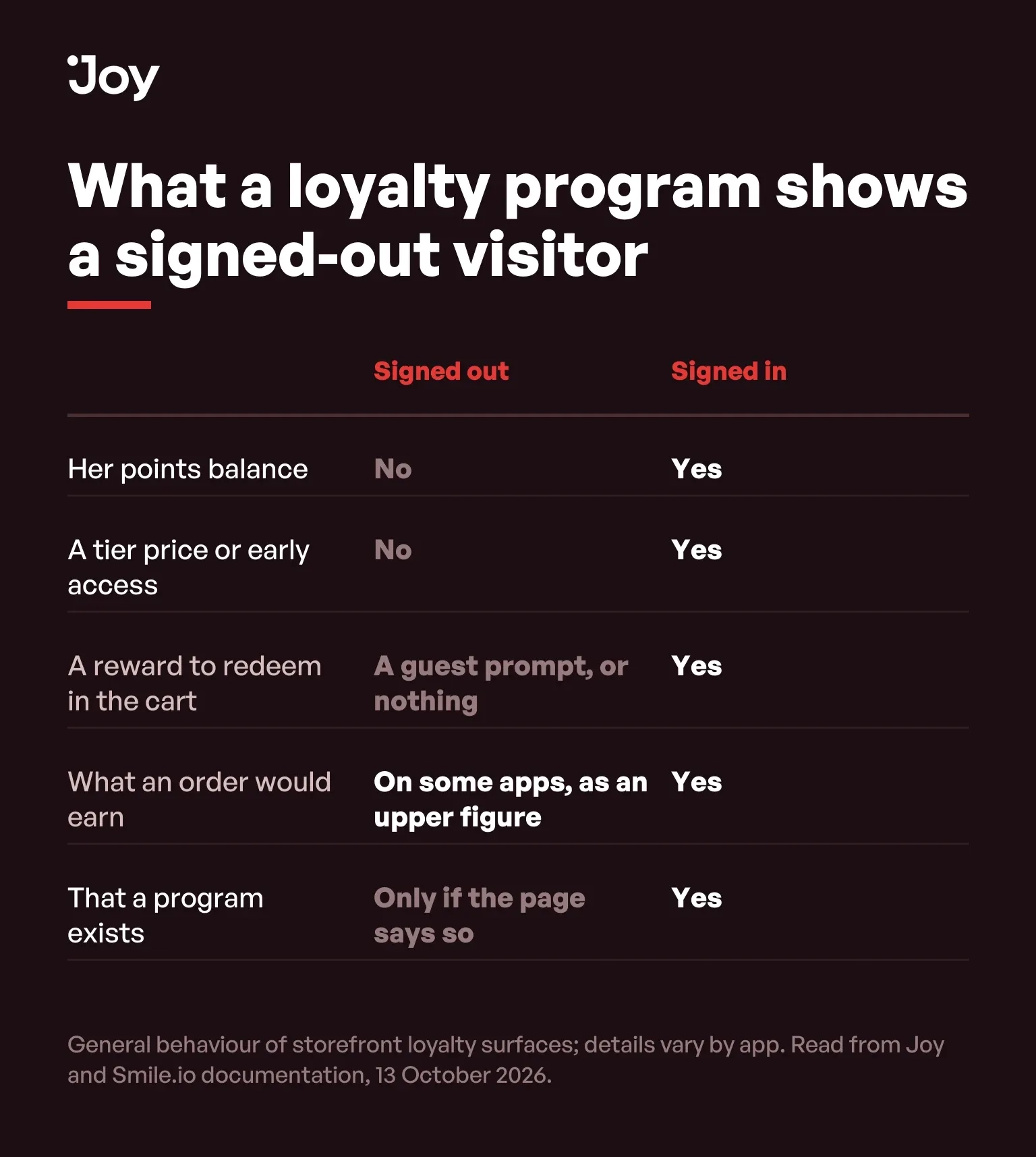
Nearly everything a program does on the storefront waits for recognition. The balance is hers alone. A tier price applies once Shopify knows her tier. The redeem block in the cart has a state for guests and a different one for members; Joy's editor previews both, and offers a setting to hide the block from guests altogether, as the Redeem in Cart guide shows.
What can be shown to a stranger
Some surfaces are designed for the signed-out case, and they are the ones to check before the weekend.
Smile's guide to bonus points campaigns states that "Customers who aren't signed in see the highest amount they could earn, starting with 'up to'". Joy's Member exclusive deal sits on the product page and, for non-members, "encourages them to join the loyalty program to unlock these perks". Both put the program in front of somebody the store has not identified.
The other half is making sign-in short enough to do mid-purchase. Joy's widget offers Sign in with Shop on all plans, which, as Joy's guide to customer login in the widget describes, signs a Shop user in without reloading the page. Shopify is extending the same identity outward: the same Spring '26 Edition notes that developers can "add Shop sign-in to experiences built with Catalog API, so shoppers can connect their Shop account".
What is not known
Three things, and they are the important ones.
- How large this traffic is for a store of your size. Adobe publishes growth across US retail and Salesforce predicts a global share that includes bots.
- Whether these visits convert. Adobe's survey reports that 77% of respondents who had used AI for shopping felt more confident in their purchase. Confidence is what they were asked about.
- Whether a purchase approved through an agent earns points, accepts a reward code, or recognises a tier. Nothing read for this page documents it, and the secondary reports contradict one another.
The third is the one a loyalty team should chase with its vendor. If an order placed that way reaches Shopify as an ordinary order against a known customer, earning is probably unaffected and redemption is the gap. That is a guess, and it is labelled as one.
When to leave this alone
Open your analytics and filter sessions by referrer for the assistants your customers use. If the share is a fraction of a percent, this is not a November project. A growth rate of 130% on a very small base is still a small number, and your time before Black Friday has better uses.
One check that is worth ten minutes
- Open a private window and go straight to a product page by its URL, the way a link from an assistant would.
- Read the page top to bottom. Note the first place the loyalty program is mentioned, if it is.
- Add the product to the cart. Note what the redeem block shows a guest.
- Find the shortest route to signing in from where you are, and count the steps.
For how Joy itself is approaching agents on the merchant side, see Joy AI Agents; the loyalty mechanics for the weekend are in our BFCM loyalty strategies guide.
Back to the brackets
"Measured by shoppers clicking on a link" describes a person arriving at one page of your store with no history attached. Paste the URL of your best-selling product into a private window and read the page as she would.
FAQs
How much holiday traffic comes from AI assistants?
Nobody has published a share for it that this page was able to verify. Adobe gives growth of 130% year on year for US retail sites. Salesforce predicts 20% of holiday ecommerce traffic will come from AI chat agents, a figure that by its own description includes backend agents and competitor scrapers.
Do AI-referred shoppers buy?
Adobe's release does not say. It measures traffic. The release does report a survey of 5,000 consumers in which 77% of those who had used AI for online shopping said they felt more confident in their purchase, which is a statement about confidence.
Can a customer use loyalty points when buying through an AI agent?
This page found no primary documentation that settles it, and secondary reports disagree with one another. Ask your loyalty vendor, and place a test order if you have access to such a channel.
What does a signed-out visitor see of a loyalty program?
It depends on the app and the surface. Smile, for one, shows customers who are not signed in the highest amount they would earn in a bonus campaign, prefixed with "up to", according to its article on managing a bonus points campaign.
Should this change my BFCM plan?
Only at the edges. Check your own referral data first. If assistants send you a fraction of a percent of sessions, note it and return to it in January.

Written by
Thomas Nguyen is the CEO & Co-founder of Joy, a loyalty solution for Shopify and eCommerce brands. With years of experience building high-performance Shopify apps, Thomas aims to help merchants grow through customizable and retention-focused tools.
Related reading
 Loyalty Strategy
Black Friday Marketing Strategies 2025 for Brand-Led Growth
Innovate how you reach customers to lift your BFCM AOV
 Thomas Nguyen
 Loyalty Strategy
How to set up customer retention automation (without a big team)
A step-by-step guide to automating customer retention across the customer lifecycle, from onboarding to win-back.
Thomas Nguyen Loyalty Strategy
Gift Cards and Loyalty: The December Revenue That Is Not Revenue Yet
Shopify does not count a gift card sale as a sale. That one rule moves part of December's revenue into January.
Thomas Nguyen Loyalty Strategy
Cyber Monday vs Black Friday 2026: Which Deserves Your Margin
Black Friday and Cyber Monday 2026 are four days apart and reward different levers. Which one deserves your margin.
Thomas Nguyen Loyalty Strategy
The 2026 Holiday Forecasts, With the Population Attached to Every Number
Adobe says $275.1 billion and Deloitte says $316.1 billion. Both are right. What each 2026 holiday forecast measures.
Thomas Nguyen Loyalty Strategy
Store Credit or a Discount: The BFCM Reward That Returns in January
Store credit is a payment method, not a discount. That one fact decides where it stacks, what it costs and when you pay.
Thomas Nguyen