
ReferralCandy Pricing: The $9 Plan Is the Expensive One
Four feature-identical tiers differing only by success fee. The first upgrade is due at $1,000 in monthly referred sales.

Summarize this post with AI
ReferralCandy sells four plans and every one of them carries the same feature set. The only line that changes as you climb is the success fee: 10.5% of referral sales on Basic at $9 a month, 3.5% on Grow at $79, 1.5% on Scale at $249, and 0.25% on Enterprise at $799, read from the live ReferralCandy listing on 8 October 2026.
That makes the ladder solvable with one multiplication, and the answer runs backwards from how plan ladders usually work. Above roughly $7,700 a month in referred sales the $799 Enterprise plan costs less than the $9 Basic plan. At $10,000 a month in referred sales, Basic bills $1,059 and Enterprise bills $824.
Each plan card carries the bullet "All features on every plan", so nothing is gated. The price you are choosing is a rate, and the rate is the whole product decision.
Key takeaways
- ReferralCandy's four tiers are feature-identical. The plan cards read "All features on every plan" on Basic, Grow, Scale and Enterprise, so the only variable is the success fee.
- Three crossovers govern the ladder: Grow beats Basic above $1,000 a month in referred sales, Scale beats Grow above $8,500, and Enterprise beats Scale above $44,000.
- At a 10% referral reward, Basic's 10.5% success fee costs more than the reward you pay the referrer.
- Shopify's own Collabs app charges 2.9% of each commission payment rather than a percentage of the sale, which on a 10% commission works out at 0.29% of referred sales. Basic's rate is 36 times heavier.
- The pricing panel stops at four cards, which is the App Store maximum, and carries a "See all pricing options" link. Any tier above Enterprise is not visible on the listing.
- ReferralCandy launched on 28 September 2010 and is the oldest app in its category. The success-fee model it still runs is the one the category abandoned.
The four plans, and the one line that changes
Every rating, review count and price below was read from ReferralCandy's live Shopify App Store listing on 8 October 2026, and the app name links to that listing so you can check it in one click.
| Plan | Monthly | Success fee on referral sales | What the card says it is for |
|---|---|---|---|
| Basic | $9 | 10.5% | "For brands getting started" |
| Grow | $79 | 3.5% | "For brands scaling referral revenue" |
| Scale | $249 | 1.5% | "For high-volume where margins matter" |
| Enterprise | $799 | 0.25% | "Dedicated onboarding & account manager" |
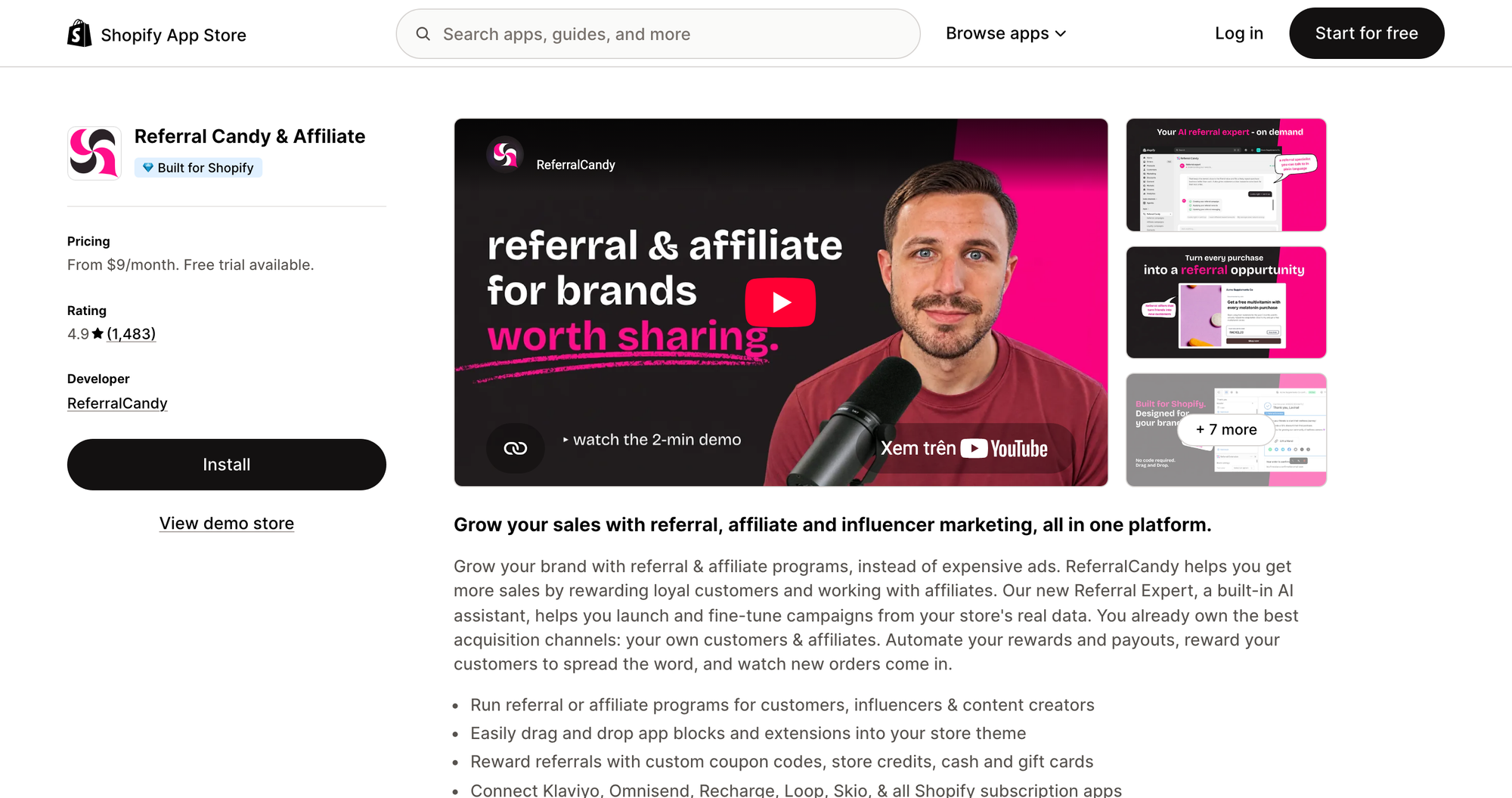
The one differentiator the panel admits to above the fee is on Enterprise: a dedicated onboarding and account manager. Everything a merchant would normally pay to unlock, the referral widget, the email sequences, the affiliate side, the integrations, sits on the $9 plan already. ReferralCandy's listing names Klaviyo, Omnisend, Recharge, Appstle, Loop, Skio and Shopify POS among the surfaces it works with, and the panel does not restrict any of them by tier.
Keep that in mind, because the plan labels are doing work the arithmetic does not support. "For brands getting started" describes your revenue, and your revenue is exactly what the fee is charged on.
What each plan costs at six volumes of referred sales
The monthly fee is trivial next to the fee on sales at any serious volume. Here is the full bill at six levels of monthly referred sales, using the rates published on 8 October 2026.
| Monthly referred sales | Basic $9 + 10.5% | Grow $79 + 3.5% | Scale $249 + 1.5% | Enterprise $799 + 0.25% |
|---|---|---|---|---|
| $1,000 | $114 | $114 | $264 | $801.50 |
| $5,000 | $534 | $254 | $324 | $811.50 |
| $10,000 | $1,059 | $429 | $399 | $824 |
| $25,000 | $2,634 | $954 | $624 | $861.50 |
| $50,000 | $5,259 | $1,829 | $999 | $924 |
| $100,000 | $10,509 | $3,579 | $1,749 | $1,049 |
Read the top row and the bottom row together. At $1,000 a month in referred sales the cheapest plan costs $114 and the dearest costs $801.50, a spread of seven times. At $100,000 a month the cheapest plan costs $1,049 and the dearest costs $10,509, a spread of ten times, and the two plans have swapped places.
A merchant who picks Basic because it is the $9 plan and then succeeds is the one this table is about. Growing from $5,000 to $50,000 in monthly referred sales takes the Basic bill from $534 to $5,259 a month. That is $63,108 a year on a plan whose features are identical to the $799 one, which would have billed $11,088.
The three crossovers that decide your plan
Four plans produce three adjacent break-evens, and all three land on round enough numbers to memorise.
Basic to Grow at $1,000 a month. Set $9 + 10.5% against $79 + 3.5% and the two bills meet at exactly $1,000 in monthly referred sales, where both cost $114. Below that, Basic. Above it, Grow, immediately.
Grow to Scale at $8,500 a month. The $170 step from Grow to Scale buys a two-point fee reduction, which pays for itself at $8,500 in monthly referred sales. Both plans bill $376.50 at that point.
Scale to Enterprise at $44,000 a month. The $550 step buys 1.25 points, so the break-even sits higher: $44,000 in monthly referred sales, where both bill $909.
Stack those and the correct plan at any volume is readable off one line. Basic below $1,000. Grow from $1,000 to $8,500. Scale from $8,500 to $44,000. Enterprise above $44,000.
The headline inversion, Enterprise beating Basic at $7,707 a month, sits inside the Grow band, which is why it is a curiosity rather than a recommendation. The useful version is simpler: the first upgrade is due at $1,000 a month in referred sales, which is a volume most programmes reach in their first quarter.
The fee is charged on the sale, not on the reward
Charging the fee on the sale rather than on the reward is the mechanic that separates ReferralCandy from everything else in its category, and the listing states it plainly: the success fee applies to referral sales.
Run a typical programme on it. You offer a 10% discount to the referred friend, they spend $100, and you pay $10 in reward value. ReferralCandy Basic then charges 10.5% of that $100 sale, or $10.50. The app's fee is larger than the reward that caused the sale. On Grow the same order costs $3.50 in fees, on Scale $1.50, on Enterprise 25 cents.
Compare the shape against the platform's own tool. Shopify states on its Shopify Help Center that "There's a 2.9% processing fee applied to every automatic commission payment, which is reflected in your Shopify bill", and gives the worked example: "if your affiliate product sale total is $100 USD and commission earned by the creator is 10%, then the 2.9% processing fee will be 29 cents." That is 2.9% of the commission, which is 0.29% of the sale. ReferralCandy Basic's 10.5% of the sale is 36 times heavier on the same order.
Neither number is the full cost of either app, and Collabs is scoped to creator partnerships rather than customer referrals. The point is narrower and it matters when you model: two apps can both advertise a percentage and levy it on bases that differ by a factor of ten.
ReferralCandy as an app, not as a price list
Best for: brands with high-ticket, low-frequency products that want the referral and affiliate motions in one tool and can place themselves correctly on the fee ladder from day one. A store doing $40,000 a month in referred sales on Scale pays $849, which is defensible for a 2010-vintage product with a dedicated account manager one tier up and integrations into Klaviyo, Recharge, Appstle, Loop and Skio already on the entry plan. The feature parity across tiers is a real advantage here: you never discover that the thing you need is two plans away.
Not ideal for: any store whose referred revenue is growing faster than its ability to revisit its plan. The fee is levied on referral sales rather than on orders or affiliates, so there is no volume cap to warn you and no notification when the rate stops making sense. A merchant who sets Basic and forgets it pays $5,259 a month at $50,000 in referred sales where Enterprise would bill $924, and nothing in the product surfaces that gap. It is also the wrong fit for a programme built on a percentage reward, because at a 10% referral discount Basic's fee exceeds the reward on every order.
ReferralCandy runs on 1,694 Shopify stores. The live listing read 4.9 stars from 1,483 reviews on 8 October 2026, with 1,341 five-star and 12 one-star, and the Built for Shopify badge is present on the page.
What it actually does
- Referral and affiliate programmes in one app, with automated reward delivery, performance tracking and post-purchase referral capture.
- Integrations named on the listing for Klaviyo, Omnisend, Recharge, Appstle, Loop and Skio, which covers the subscription stack better than most apps in the category, plus Shopify POS and customer accounts.
- Every feature on every tier, including the $9 one. No app in the affiliate category gates less.
What to check before you commit
The pricing panel renders four cards, which is the App Store's maximum, and carries a "See all pricing options" link to ReferralCandy's own site. A fifth tier above Enterprise would not be visible on the listing even if it exists, so confirm against ReferralCandy's own pricing page before you assume $799 is the ceiling. Shopify's own App Store requirements say at 4.2.1 to "Provide accurate and complete pricing information", and the four-card rendering limit is a surface constraint rather than a vendor choice.
Second thing: the footnote under the panel reads "All charges are billed in USD. Recurring and usage-based charges are billed every 30 days." Your success fee is a usage charge, which means it lands on a Shopify invoice a cycle after the sales that generated it. Shopify's own billing documentation describes usage charges as fees that "vary based on how much you use the app or its services", and notes that apps charging on usage "can include a spending limit that prevents app charges from exceeding a maximum threshold over the duration of the billing period". Find out whether ReferralCandy sets one on your plan, because a 10.5% rate on an unexpectedly good month is the exact scenario a spending limit exists for.
Third: 1,694 stores is a small base for a product this old, and the apps that overtook it did so on flat pricing. That is context for the fee structure, not an argument against the app, but it tells you the market's verdict on success fees.
How ReferralCandy's shape compares with the rest of the category
Four pricing shapes compete in Shopify's referral and affiliate category, and ReferralCandy occupies the only one built around buying down a rate. The alternatives price on a flat fee, on a percentage that falls by tier, or on nothing at all at the entry level. The full fee comparison across the category sets the flat-priced apps against the percentage ones at named revenue levels, and the three-way comparison of UpPromote, GoAffPro and BixGrow covers the apps that took the installs.
If what you want is customers recommending you to friends rather than partners selling for commission, the mechanic is different and so is the right tool. The referral app comparison covers that side, and the choice between a referral programme and a points programme is the decision that comes before either.
Frequently asked questions
How much does ReferralCandy cost per month? Basic is $9 a month plus 10.5% of referral sales, Grow is $79 plus 3.5%, Scale is $249 plus 1.5%, and Enterprise is $799 plus 0.25%, as read on 8 October 2026. The monthly fee is the smaller half of the bill at any volume above about $1,000 in monthly referred sales.
Does ReferralCandy have a free plan? No. The listing's pricing summary reads "From $9/month. Free trial available." A trial is available, and the cheapest standing plan is Basic at $9 plus the 10.5% success fee.
What is a success fee on referral sales? It is a percentage of the revenue the app attributes to your referral programme, billed as a usage charge on top of the monthly subscription. It is levied on the sale rather than on the reward you pay out, so a 10.5% success fee on a programme offering a 10% referral discount costs more than the discount.
Which ReferralCandy plan is cheapest for my store? Take last month's referred sales total. Below $1,000, Basic. From $1,000 to $8,500, Grow. From $8,500 to $44,000, Scale. Above $44,000, Enterprise.
Do all ReferralCandy plans have the same features? Every plan card read on 8 October 2026 carries the bullet "All features on every plan". The only difference the panel names beyond the fee is dedicated onboarding and an account manager on Enterprise.
Is there a plan above Enterprise? The listing does not say. The pricing panel renders four cards, which is the App Store maximum, and links out with "See all pricing options", so any higher tier sits on ReferralCandy's own site rather than on the listing.
Run the multiplication before you pick the plan
ReferralCandy is the rare app where the pricing decision is arithmetic rather than judgement, because the features do not move. That is worth more than it sounds: you can get this right in thirty seconds and never revisit it until your volume doubles.
Open your referral report and read last month's referred sales total. If it cleared $1,000, you have been overpaying on Basic since the month it did.

Written by
Thomas Nguyen is the CEO & Co-founder of Joy, a loyalty solution for Shopify and eCommerce brands. With years of experience building high-performance Shopify apps, Thomas aims to help merchants grow through customizable and retention-focused tools.
Related reading
 Shopify apps
Shopify Loyalty App Pricing: $30 to $199 at 2,000 Orders
Appstle costs $30 at 2,000 monthly orders and Smile costs $199. Eight loyalty apps priced at 500, 2,000 and 10,000 orders.
 Thomas Nguyen
 Shopify apps
UpPromote vs GoAffPro: Only One Takes a Cut
UpPromote charges 2% of referred sales on top of its monthly fee. GoAffPro and BixGrow charge no percentage at any tier.
Thomas Nguyen Shopify apps
Best Shopify Affiliate Apps: GoAffPro 0%, UpPromote 2%
GoAffPro charges no percentage at any tier. UpPromote takes 2% of referred sales on top of $29.99. Ten apps on cost and free-plan honesty.
Thomas Nguyen Shopify apps
Enterprise Loyalty Pricing: Only Voucherify Publishes One
Seven enterprise loyalty platforms, one published price: Voucherify at 600 euro a month. What contact sales is standing in for.
Thomas Nguyen Shopify apps
11 Best Shopify Loyalty Apps to Boost Customer Retention in 2026
We compared 11 Shopify loyalty apps on real pricing, ratings, and reviews, so you can pick with confidence instead of guessing.
Thomas Nguyen Shopify apps
Appstle Loyalty Review: VIP Tiers for $30, Not $199
Appstle puts VIP tiers on a $30 plan where Smile.io charges $199. The full pricing ladder, and where the published plans run out.
Thomas Nguyen