
What Free to Install Really Means on Shopify
Free to install and Free plan available are different billing settings. What the label costs on six apps, quoted from each panel.
Summarize this post with AI
"Free to install" is the most-read phrase on the Shopify App Store and it carries no fixed meaning. On Postscript's Starter plan it means a $49 monthly minimum spend. On Appstle Memberships it means genuinely free up to 25 members a month with the card stating "No per member fee or hidden fees!". On Inveterate it means a single plan card whose entire charges line reads "See our website for full pricing details!". All three were read from their live listings on 8 October 2026.
Across the listings read that day, fourteen carried "Free to install" in the line beside the Install button, and they resolve to at least seven different charge structures: a spend floor, a usage rate, an order cap, a member cap, an order-or-revenue trigger, a percentage of value, and nothing published at all.
Postscript's charge line ends with three words that are not priced anywhere on its listing: "+ Carrier fees." Those come back later.
Key takeaways
- "Free to install" and "Free plan available" are two different settings a developer picks when submitting a listing, and Shopify documents them as such. Merchants read them as the same promise.
- Postscript's Starter plan is free to install with a $49 monthly minimum spend, then $0.009 per SMS and $0.045 per MMS. Below roughly 5,440 messages a month you pay the $49 regardless of what you send.
- Upsell.com's free tier caps at "Up to 50 orders or $50 upsell revenue", so a single accepted $50 upsell ends it with 49 free orders unused.
- Appstle Memberships is the honest case: free to install, 25 members a month, and a charges line that says explicitly that nothing else is charged.
- UpCart's free plan is labelled "DEVELOPMENT STORES" and its only feature bullet reads "ONLY For Development & Partner Stores". A live store starts at $29.99.
- Rebuy's free tier claims to pay the merchant, with the bullet "Earn $0.20–0.35+ per order", while its paid tier reads "Starts as low as" $25 a month with the ladder unpublished.
- Shopify's App Store panel renders at most four plan cards, which is why so many listings carry a "See all pricing options" link.
Shopify documents two labels, and merchants read one
Every price, cap and charge line quoted below was read from the app's live Shopify App Store listing on 8 October 2026, and each app name links to its listing.
The phrase is not marketing language. It is a field. Shopify's own best-practices guidance for App Store listings tells developers to "Choose your primary billing method (Free to install, Recurring charge, or One-time payment) and provide clear pricing information in the designated section only." The same page adds the instruction that produces the other label merchants see: "For apps with free and paid plans, select Recurring charge and mark one plan as Free, this shows 'Free plan available' in search results."
So the two labels say different things about the app. "Free to install" means the developer's primary billing method is not a recurring charge. "Free plan available" means it is, and one tier within it is free. Neither tells you there is no cost, and the difference between them is invisible to a merchant reading quickly.
Shopify also requires the detail underneath to be complete. App Store requirement 4.2.1 states: "Provide accurate and complete pricing information. Ensure your pricing information includes all pricing options such as, free trial time and charge details." Requirements 4.2.2 and 4.2.3 then confine that information to the pricing section and keep it out of images and the rest of the listing.
That is a strong rule with a surface constraint sitting on top of it. The panel renders at most four plan cards, so an app with five tiers satisfies 4.2.1 by linking out, and every truncated panel carries "See all pricing options". Seven of the nine listings quoted below do.
What Shopify means by a charge
Three charge types sit behind every one of these labels, and Shopify defines them on its own billing help page.
Subscription charges are "for the recurring use of an app, such as a monthly subscription payment." That is the $29.99 or the $79 on a plan card.
Usage charges "vary based on how much you use the app or its services. For example, if an app charges based on the number of customer interactions, then your fee will change accordingly." Every percentage and every per-message rate quoted below is one of these, and they land on the invoice after the cycle in which the usage happened.
One-time charges are "payments for specific services or features provided by an app, such as transferring data from one platform to another."
Two mechanics in that page matter more than the definitions. Usage charges can be bounded: "Apps that charge based on usage can include a spending limit that prevents app charges from exceeding a maximum threshold over the duration of the billing period." And some apps sit outside the system entirely, charging the merchant directly rather than through Shopify billing, in which case the charge never appears on a Shopify invoice at all.
Seven things "free to install" turned out to mean
1. A monthly spend floor: Postscript
The Starter card is priced "Free to install". Its charges line, verbatim, reads: "$49 monthly minimum spend. $100 credit for your first 30 days. Then $0.009/SMS, $0.045/MMS + Carrier fees."
What that costs. The $49 is a floor rather than a ceiling. Divide it by the SMS rate and the floor binds until you send about 5,440 messages a month; past that you are paying usage rather than the minimum. A store sending 50,000 SMS a month pays roughly $450 on the same "free to install" plan. Postscript's Growth tier at $100 a month lowers the rate to $0.008 per SMS and Professional at $500 lowers it to $0.007, so the paid tiers are rate buy-downs rather than feature unlocks.
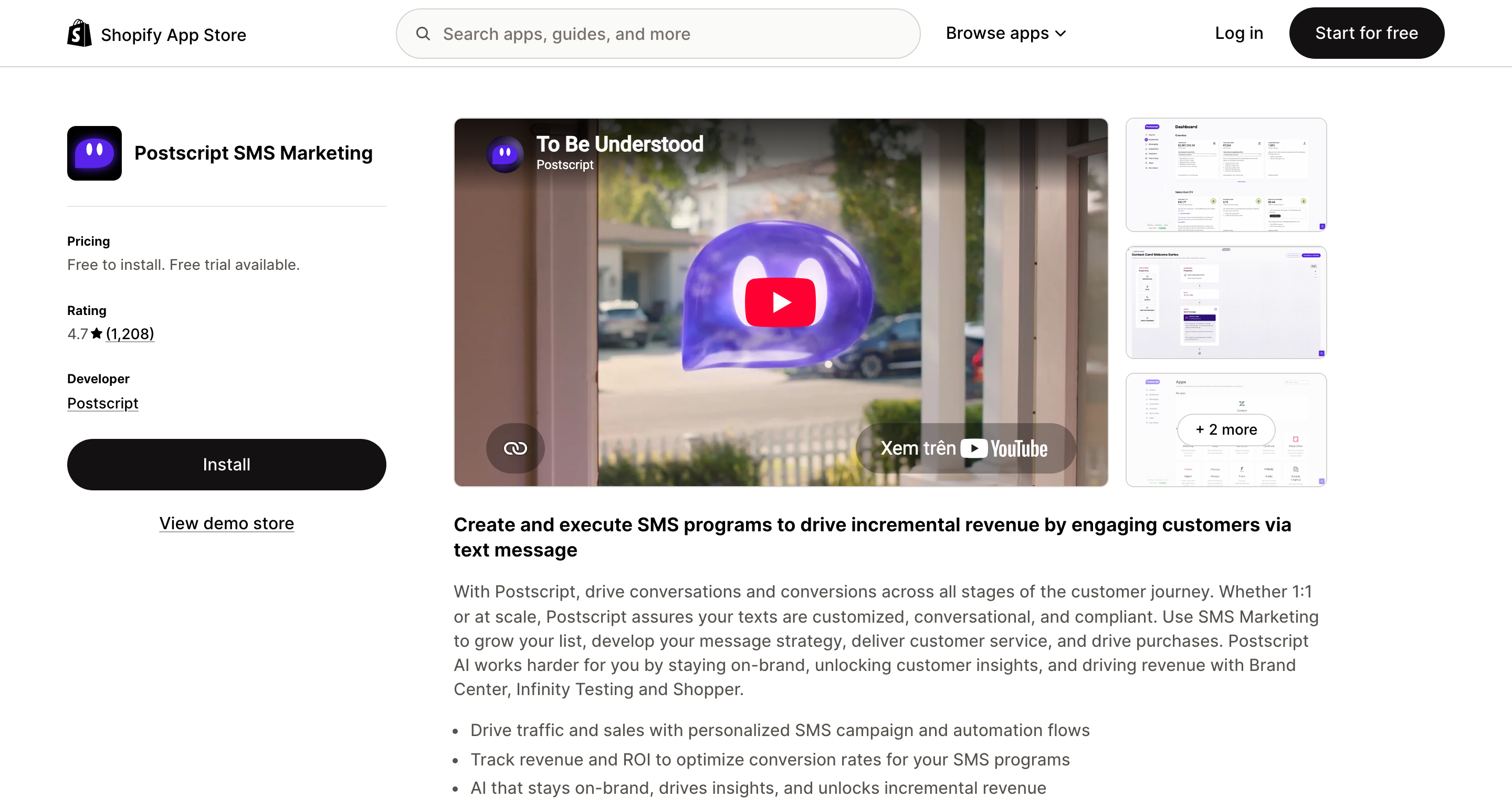
Postscript runs on 22,945 Shopify stores. Its live listing read 4.7 stars from 1,208 reviews on 8 October 2026, with 34 one-star, and the Built for Shopify badge is absent. Three plan cards are shown and the panel links out.
2. An order-or-revenue trigger, whichever trips first: Upsell.com
The listing's summary reads "Free plan available" rather than "Free to install", which is the distinction from Shopify's own guidance above. Its FREE card carries two meters in one line, verbatim: "Up to 50 orders or $50 upsell revenue".
What that costs. The word doing the work is "or". A store with a $300 average order value that sells one $50 add-on has used its entire revenue allowance on order one, with 49 orders still unspent. The paid cards restate the ambiguity with a slash instead of a conjunction: "51-100 store orders / upsell revenue" at $9.99, "101-200" at $19.99, "201-500" at $39.99. Which of the two numbers governs is not stated on any card, and the tier above 500 is not rendered.
Upsell.com runs on 10,087 Shopify stores. Its live listing read 4.8 stars from 3,098 reviews on 8 October 2026, with 68 one-star.
3. A count cap and nothing else: Appstle Memberships
Appstle Memberships is the version of the phrase that means what a merchant assumes. The FREE card is priced "Free to install", its cap reads "- Includes up to 25 Members per Month!", and its charges line reads "No per member fee or hidden fees! [Best free plan compared to others]".
What that costs. Nothing, up to 25 members a month, and the charges line says so rather than leaving it to inference. Past that: $19 for 100 members, $39 for 500, $79 for 750. The Business Premium card adds "*PING US FOR ENTERPRISE, APIs & WEBHOOK*", so API and webhook access carries no published price.
Worth noting what the same vendor family does one listing over. Appstle Subscriptions is labelled "Free plan available", its free card is priced simply "Free", and its cap is not on the charges line at all but inside a feature bullet: "*Upto $500 in subscriptions per month*". One vendor, two labels, two different places to look for the limit.
Appstle Memberships runs on 2,947 Shopify stores. Its live listing read 5.0 stars from 919 reviews on 8 October 2026.
4. Nothing at all: Inveterate
The pricing summary reads "Free to install. Additional charges may apply." The panel renders one card, named "Free" and priced "Free to install", with an empty feature list and a charges line that reads, in full: "See our website for full pricing details!"
What that costs. Unknown from the listing. No tier, no cap, no unit and no percentage appears anywhere on the page, and the panel carries a "See all pricing options" link. This is the limiting case of the phrase: a listing that satisfies the format and transfers the entire pricing question to a sales conversation.
Inveterate runs on 178 Shopify stores. Its live listing read 4.9 stars from 12 reviews on 8 October 2026, the thinnest evidence base among the listings here. That is not an argument against the app. A twelve-review listing with no published price is a deliberate enterprise motion, and a brand that wants a scoped implementation rather than a self-serve plan is exactly who buys that way.
5. Free for stores that are not yours: UpCart
The summary reads "Free plan available. Free trial available." The free card is named "DEVELOPMENT STORES" and its only feature bullet reads "ONLY For Development & Partner Stores".
What that costs. A live store cannot use the free plan, so UpCart's real entry price is $29.99 a month. The three paid cards are feature-identical and differ only by meter: "Up to 200 monthly store orders" at $29.99, "Up to 500" at $34.99, "Up to 1000" at $54.99. Note the unit is store orders rather than orders the app influenced, so a seasonal spike raises the bill on volume the cart drawer did not touch. Nothing above 1,000 orders is priced on the panel.
UpCart runs on 18,439 Shopify stores. Its live listing read 4.7 stars from 956 reviews on 8 October 2026, with 38 one-star.
6. Free, with the vendor paying you: Rebuy
Rebuy's panel carries two free cards. One is "Dev stores". The other is "Rebuy Monetize", whose bullets read "Make money from your thank you page", "Earn $0.20–0.35+ per order" and "Zero risk to CVR, just 100% pure profit", with a fourth stating that the app costs nothing because Rebuy pays the merchant.
What that costs. Nothing, and it is a different product from the one merchants usually install Rebuy for. The personalisation engine sits on a third card headed "Starts as low as" at $25 a month, whose charges line reads "Pricing scales based on orders per month" with no ladder printed and no order bands named. So one listing carries a free tier that pays you, a paid tier whose price is a starting point, and no published scale between them.
Rebuy runs on 15,104 Shopify stores. Its live listing read 4.7 stars from 854 reviews on 8 October 2026, with 19 one-star.
7. A percentage of value, bounded or not
Two apps read the same day attach a percentage to the phrase, and only one of them bounds it.
Unbounded. Shopify Collabs is "Free to install. Additional charges may apply", and its charges line reads "+ 2.9% commission processing fee on automatic payments may apply". Shopify quantifies that in its own article on paying creators through Collabs: "There's a 2.9% processing fee applied to every automatic commission payment, which is reflected in your Shopify bill", with the worked example that a $100 sale at a 10% commission attracts a 29-cent fee. The percentage applies to the commission rather than the sale, which is the single most misread figure in the affiliate category.
Bounded. Gift Card Hero is also priced "Free to install", and its charges line reads "2% total gift card value (min. $9.99/month, max. $49.99)". That is the only charge line in this set bounded on both sides: a floor of $9.99 and a ceiling of $49.99, so the worst case is knowable before you install.
Collabs runs on 11,365 Shopify stores and Gift Card Hero on 1,072. Collabs' live listing read 4.2 stars from 434 reviews on 8 October 2026, with 90 one-star. Gift Card Hero's read 4.9 stars from 153 reviews the same day.
The carrier fees nobody publishes
Back to Postscript's three words. Every one of its three plan cards ends with "+ Carrier fees", and no card, no footnote and no pricing summary on the listing puts a number on them.
That gap is real and it is not Postscript's to close. Carrier fees are pass-through charges set by mobile network operators, and they vary by carrier, by message type and by country. A vendor cannot publish a single figure for a cost somebody else sets per message per network. What a merchant can do is treat the published $0.009 per SMS as an incomplete unit price and ask Postscript for its current carrier pass-through schedule in writing before committing a budget.
Anyone quoting you a total monthly cost for Postscript that includes carrier fees is estimating. The honest version of that line is that the listing names three charges and prices two of them.
Four questions to ask any pricing panel
Run these in order before you install anything labelled free.
- What is the meter, and in what unit. Orders, revenue, members, contacts, messages, payouts or nothing. Six of the seven cases above meter something different, and the unit is what makes two apps incomparable.
- Is there a floor. A minimum spend converts "free to install" into a subscription at a different name. Postscript's is $49.
- Is there a ceiling. Gift Card Hero's $49.99 maximum is rare. Shopify's billing documentation notes that apps charging on usage can set a spending limit, so ask whether yours does.
- Does the panel end, or does it link out. "See all pricing options" means the tier you will eventually be on is not on the page you are reading.
A fifth question applies to anything with a percentage: what the percentage multiplies. Collabs' 2.9% of a commission and a competitor's 2.9% of a sale differ by the commission rate, which on a 10% programme is a factor of ten.
Frequently asked questions
What does "free to install" mean on the Shopify App Store? It means the developer selected "Free to install" as the app's primary billing method rather than a recurring charge. It says nothing about usage charges, minimum spends, percentages or caps, all of which appear in the separate charges line under each plan card.
What is the difference between "free to install" and "free plan available"? They are different listing settings. Shopify's guidance tells developers that an app with free and paid plans should select "Recurring charge" and mark one plan as free, which produces "Free plan available" in search results. "Free to install" signals a non-recurring primary billing method instead.
Can a free-to-install app still charge me? Yes, through usage charges, a minimum spend, a percentage of value, or by billing you directly outside Shopify. Postscript's free-to-install Starter plan carries a $49 monthly minimum, and Shopify Collabs' free-to-install plan carries a 2.9% processing fee on automatic commission payments.
Why do some app listings only show four plans? The App Store pricing panel renders a maximum of four plan cards. Apps with more tiers satisfy Shopify's completeness requirement by adding a "See all pricing options" link to their own pricing page.
How do I cap what an app can charge me? Shopify's billing documentation states that apps charging on usage "can include a spending limit that prevents app charges from exceeding a maximum threshold over the duration of the billing period". Whether a given app sets one is a question for the vendor, and it is the right question to ask of anything metered per message or per sale.
Which free Shopify apps are actually free? The ones whose charges line says so. Appstle Memberships states "No per member fee or hidden fees!" alongside a 25-member monthly cap, and Rebuy Monetize claims to pay the merchant rather than charge them. Both are bounded, published and checkable, which is the standard worth holding every other listing to.
Read the charges line, not the price
The price on a plan card is the smallest number in the deal on five of the seven listings above. The charges line underneath it carries the meter, the floor, the percentage and the link out, and it is the line that decides what you actually pay.
That matters most where the cost compounds with success. What a loyalty or rewards programme really costs to run breaks the software fee out from the reward budget, and what a single loyalty point costs prices the liability a free-to-install app creates on your balance sheet rather than your invoice. For the two categories where the free label hides most, subscription app pricing and affiliate app fees do the arithmetic app by app, and paid membership programmes covers the model Appstle Memberships and Inveterate both sell.
Open the listing of whatever you are about to install, find the small grey line under the price, and read it before the price. If it ends in a plus sign or a link, you have not seen the price yet.

Written by
Thomas Nguyen is the CEO & Co-founder of Joy, a loyalty solution for Shopify and eCommerce brands. With years of experience building high-performance Shopify apps, Thomas aims to help merchants grow through customizable and retention-focused tools.
Related reading
 Shopify apps
Best Free Shopify Loyalty Apps: 50 to 400 Orders Free
Free-tier caps run from 50 orders on CWILL to 400 on LoyaltyLion. The full table, plus what crossing each cap actually costs.
 Thomas Nguyen
 Shopify apps
Govalo Pricing: 2.9% of Gift Card Value on Every Plan
The percentage never goes away, not even on the $399 Enterprise tier. Six alternatives priced against a $20,000 gift-card month.
Thomas Nguyen Shopify apps
Smile.io Pricing: The $999 Plan Is Not on the App Store
The listing stops at Growth $199. smile.io adds Plus at $999 billed annually, and the crossover sits near 6,500 monthly orders.
Thomas Nguyen Shopify apps
Affiliate App Fees: ReferralCandy 10.5%, GoAffPro 0%
Total cost at $5,000, $25,000 and $100,000 of monthly affiliate revenue across seven apps and four different pricing shapes.
Thomas Nguyen Shopify apps
Loox Alternatives: The Paid Plan Includes Fewer Orders
Loox's free plan allows 500 monthly orders and its $49.99 plan includes 300. Six alternatives on caps, overage and real cost.
Thomas Nguyen Shopify apps
Social Snowball Pricing: The $899 Plan Can Cost Less
Entry is $249 a month plus 3% of affiliate revenue. Above $21,667 a month the $899 no-usage-charge tier is the cheaper one.
Thomas Nguyen