
Rise.ai Pricing: Spending Store Credit Costs $199.99
The button that lets a shopper apply store credit sits on the $199.99 Pro plan, and the order cap counts every order, not gift-card ones.

Summarize this post with AI
Rise.ai publishes three plans on the Shopify App Store, and the feature that lets a shopper actually spend their store credit sits on the most expensive one. On 8 October 2026 the listing read Starter at $19.99 including 100 monthly store orders with 20 cents per order above that, Small-Business at $59.99 including 400 orders at 15 cents, and Pro at $199.99 including 2,000 orders at 10 cents. The plan card that names the "Apply Store Credit Button" is Pro.
The second thing the listing says plainly and nobody quotes is what the meter counts. The cards read "400 Monthly Total Store Orders Included" and "2000 Monthly Total Store Orders Included". That is every order your brand takes, not the orders involving a gift card or a store credit. A brand doing 1,200 orders a month of which 30 touch store credit is billed on 1,200, and on the Starter plan that means $19.99 plus 1,100 overage orders at 20 cents, which is $239.99. Pro costs $199.99 and includes 2,000 orders. The overage alone on the entry plan exceeds the full price of the top one.
Below is the cost at named order volumes, the two crossovers inside the ladder, what each plan gates, and what Shopify's native store credit already does without an app.
Key takeaways
- Rise.ai's published plans on 8 October 2026 were Starter $19.99 for 100 orders, Small-Business $59.99 for 400 orders and Pro $199.99 for 2,000 orders, with per-order overage of 20, 15 and 10 cents.
- The order allowance counts total store orders, not gift-card or store-credit orders, which the plan cards state verbatim as "Monthly Total Store Orders Included".
- The Starter plan stops being Rise.ai's cheapest plan at 300 monthly orders, where Starter and Small-Business both cost $59.99. Above 300 orders Starter is never the cheapest option again.
- Pro overtakes Small-Business at about 1,333 monthly orders. At 1,200 orders Small-Business costs $179.99 against Pro's $199.99 and Starter's $239.99.
- The "Apply Store Credit Button" appears only on the Pro plan at $199.99, so the two cheaper plans sell credit issuance without naming a storefront control for spending it.
- Shopify's own store credit has hard limits an app sits on top of: less than $15,000 per customer account, no store-wide default expiry, and only the full balance can be applied at checkout.
The three published plans
Rise.ai launched on 17 December 2014, carries the Built for Shopify badge, and the Rise.ai listing read 4.7 stars from 759 reviews on 8 October 2026, with 23 one-star reviews inside that total.
Best for: brands under about 400 total monthly orders that want gift cards and store credit without surrendering a percentage of card value. Rise.ai charges no fee on gift-card value at any tier, so a brand selling $50,000 of gift cards on 400 orders pays $59.99 where a percentage-based vendor would charge four figures. Its returns and support integration list, naming Loop Returns, Gorgias, AfterShip, Attentive, Klaviyo and Tapcart, is also the widest in the category and the reason Rise.ai keeps appearing in refund-to-credit workflows.
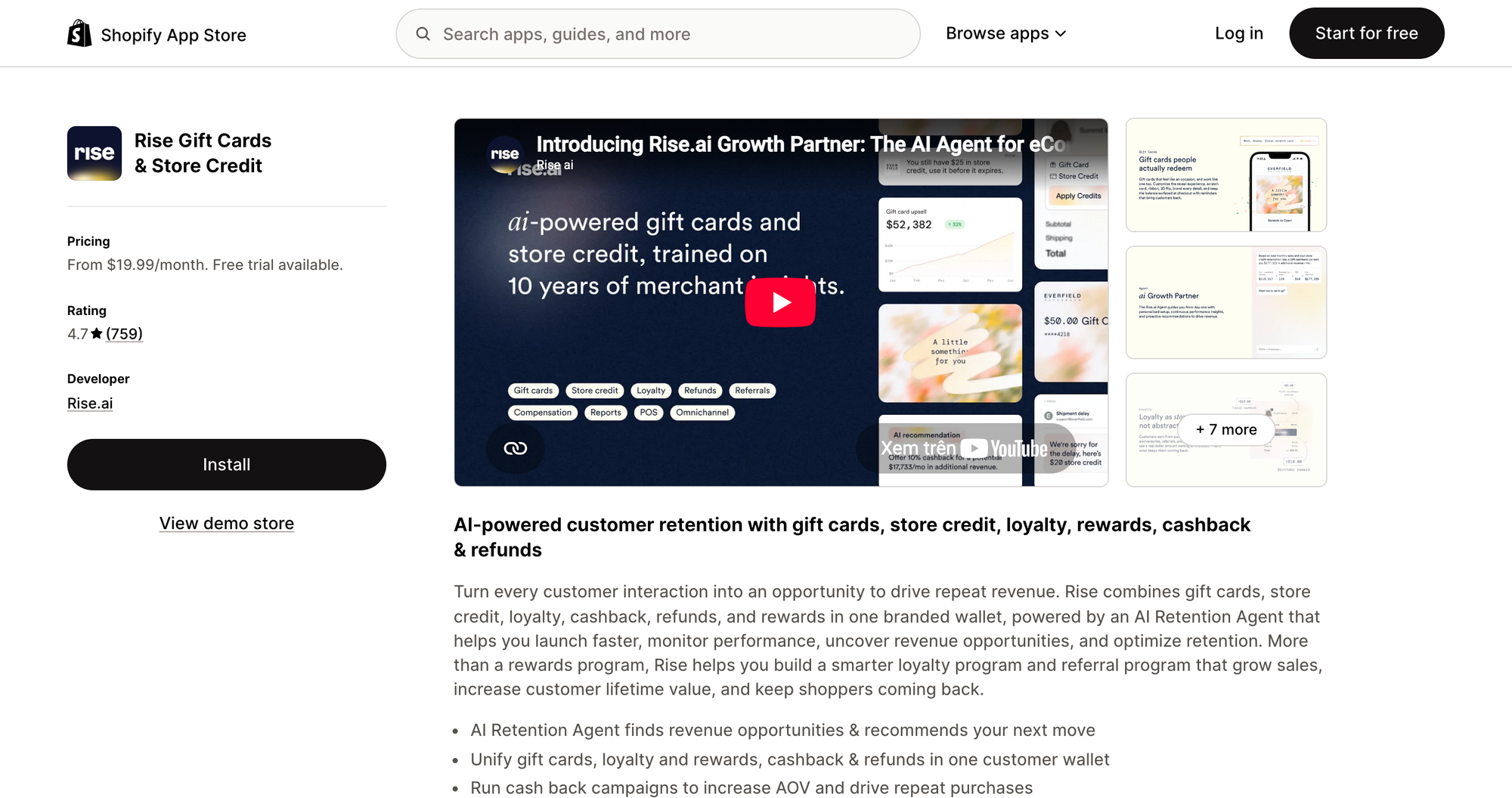
Not ideal for: high-order brands with modest gift-card activity, because the allowance counts every store order rather than every gift-card order. A 10,000-order brand pays $999.99 on Pro whether it issued 50 credits or 5,000, and no cheaper plan exists that meters usage instead of volume. The storefront control for applying a credit balance sits on that same $199.99 plan, so the two cheaper tiers sell issuance without naming the mechanism for spending.
| Plan | Monthly | Annual | Included orders | Overage per order | What it adds |
|---|---|---|---|---|---|
| Starter | $19.99 | $203.88, save 15% | 100 | 20 cents | advanced gift card programme, manual store credit, referrals |
| Small-Business | $59.99 | $575.88, save 20% | 400 | 15 cents | claim page customisation, check balance page |
| Pro | $199.99 | $1,919.88, save 20% | 2,000 | 10 cents | Apply Store Credit Button, bulk gift card creation |
The panel shows three cards and carries a "See all pricing options" link. Rivo publishes a Rise.ai range of "$19.99-$599.99/month", so a tier above Pro exists that the listing does not render, and no allowance or overage rate for it is published anywhere a buyer can read.
What the three cards share is the shape: a flat fee, an order allowance, and a per-order rate that falls as you climb. What they do not share is the thing most buyers assume, which is that the allowance relates to the product they are buying.
The meter counts every order, not every gift card
What the meter counts is the single most consequential line on the Rise.ai listing, and it is stated in plain language on two of the three cards.
Small-Business includes "400 Monthly Total Store Orders Included". Pro includes "2000 Monthly Total Store Orders Included". Starter includes "100 Monthly Store Orders Included". The word doing the work is "store". The meter is your whole order volume.
For most brands that inverts the economics. A gift-card and store-credit app is usually bought because a slice of revenue runs through credit: refunds issued as credit instead of cash, a gift-card programme at Christmas, a loyalty reward paid as balance. That slice is often 2% to 10% of orders. Rise.ai bills on all of them.
A worked example. A brand doing 1,200 orders a month issues 40 store credits and sells 60 gift cards, so 100 orders touch the app. On the Starter plan the bill is $19.99 plus 1,100 orders of overage at 20 cents, which is $239.99 a month, or $2.40 for each order that actually used the product. Pro costs $199.99 and covers 2,000 orders. The cheap plan costs more than the expensive one, and the reason is a meter that has nothing to do with usage.
The practical rule is short. Price Rise.ai from your total monthly order count, treat the gift-card volume as irrelevant to the bill, and run all three plans before choosing.
What Rise.ai costs at named order volumes
Every figure calculated from the plan cards read on the live listing on 8 October 2026. The cheapest plan at each volume is in bold.
| Total monthly store orders | Starter $19.99 | Small-Business $59.99 | Pro $199.99 |
|---|---|---|---|
| 100 | $19.99 | $59.99 | $199.99 |
| 300 | $59.99 | $59.99 | $199.99 |
| 500 | $99.99 | $74.99 | $199.99 |
| 1,200 | $239.99 | $179.99 | $199.99 |
| 1,500 | $299.99 | $224.99 | $199.99 |
| 2,000 | $399.99 | $299.99 | $199.99 |
| 5,000 | $999.99 | $749.99 | $499.99 |
| 10,000 | $1,999.99 | $1,499.99 | $999.99 |
Two crossovers fall out, and neither is published.
Starter stops being the cheapest plan at 300 monthly orders. At 300 orders Starter costs $19.99 plus 200 overage orders at 20 cents, which is $59.99, exactly what Small-Business costs with 400 orders included. Above 300 orders Small-Business is cheaper at every single volume, because 15 cents beats 20 cents on every marginal order and the $40 base difference has already been paid off. The headline "From $19.99/month" is therefore accurate for brands under 300 orders a month and misleading for everyone else.
Pro overtakes Small-Business at about 1,333 monthly orders. Small-Business reaches $199.99 when its overage hits $140, which is 933 orders past its 400-order allowance. Below that, the $59.99 plan is cheaper despite the smaller allowance. Above it, Pro is cheaper and the gap widens: $100 a month at 2,000 orders, $250 at 5,000, $500 at 10,000.
The combined effect is that Rise.ai's entry plan is right for a narrow band of brands, its middle plan is right for a wide one, and its top plan is right above roughly 1,333 orders. That is a reasonable ladder. It is just not the ladder the price list implies, and the published figure most brands budget from is the one that applies least often.
The Apply Store Credit Button sits on Pro
Read the three feature lists in order and a pattern appears. Starter sells issuance: an advanced gift-card programme, manual store-credit issuance, referrals. Small-Business adds presentation: claim page customisation, a check-balance page. Pro adds the "Apply Store Credit Button" and bulk gift-card creation.
So the storefront control named for applying a credit balance is a Pro feature, and the two cheaper plans name no equivalent. For a brand whose plan is "issue store credit instead of refunds and let customers spend it", that places the completing half of the workflow at $199.99 a month regardless of order volume. A 200-order brand that wants the button pays the 2,000-order price.
This also changes how to read the crossovers above. If the button is a requirement, the arithmetic is irrelevant and the answer is Pro. If it is not, the arithmetic decides and Small-Business wins across most of the range. Establishing which of those two brands you are is a ten-minute job and it determines everything.
What Shopify's native store credit already does
Rise.ai sits on top of a Shopify primitive, and the primitive has published limits worth knowing before you price an app against it. All of the following was read on help.shopify.com on 8 October 2026.
There is a hard ceiling per customer. Shopify's store credit documentation states "You can only issue store credit amounting to less than $15,000 USD on a single customer account". A separate, lower limit applies to B2B: "less than $10,000 USD on a company location account". Note the wording is less than, not up to.
There is no store-wide expiry. Verbatim: "Store credit expiration is set per issuance. You choose an expiry date or no expiry date each time you issue store credit or refund to store credit. Unlike gift cards, store credit doesn't have a store-wide default expiry setting, and there's no built-in automation that applies a standard expiry to all store credit." A brand that wants a consistent expiry policy is buying automation, which is a legitimate reason to pay for an app.
A balance cannot be part-spent. Verbatim: "Only the full store credit amount can be applied as a payment method." That is a real constraint on how a credit-led programme behaves at checkout.
Multi-currency balances hide from the shopper. Verbatim: "If a customer has store credit issued to their account in multiple currencies, then only the store credit balance that matches the currency of your checkout displays to the customer at checkout."
Store age can add a transaction fee. Also verbatim: "For Shopify stores created on or after May 12, 2025, orders that include store credit as a payment method are charged third-party transaction fees on the order amount paid for using store credit." That is a cost of running store credit that sits outside any app's pricing, and it depends on when the store was created rather than on which plan it is on.
One frequently repeated claim is worth correcting. Store credit itself is not plan-gated: neither the help page nor the Admin API documentation states a plan requirement. What is plan-scaled is throughput. Shopify's GraphQL Admin API rate limits run 100 points per second on standard plans, 200 on Advanced, 1,000 on Shopify Plus and 2,000 on enterprise, so a Plus store can issue credit through the API an order of magnitude faster than a standard store. That constrains bulk issuance speed, not access.
What to check before you commit
Count total orders, then price all three plans. The answer changes at 300 and again at about 1,333 monthly orders, and the published entry price applies only below 300.
Decide whether you need the Pro button. If the storefront control for applying credit is part of the workflow you are buying, your price is $199.99 and nothing else in the ladder matters.
Take the annual discount if the volume is stable. Annual billing saves 15% on Starter and 20% on both Small-Business and Pro, which is $1,919.88 a year for Pro against $2,399.88 billed monthly. The saving is real; the commitment is a year at a volume that may cross a crossover.
Get a figure for the tier above Pro before you need it. The panel ends at Pro and Rivo publishes a range topping out at $599.99 a month, so brands heading past 10,000 orders should ask what sits above $199.99 while they are still comparing.
Check what you are replacing rather than what you are adding. Several of the capabilities on the Starter and Small-Business cards are presentation layers on a Shopify primitive that already works. The ones worth paying for are the automations Shopify explicitly does not provide, starting with a store-wide expiry policy, and bulk issuance at a scale the Admin API rate limit makes awkward by hand.
For how Shopify's own store credit behaves in practice, see Shopify store credit explained and rewarding customers with store credit. For the cost side of a credit-led or points-led programme, what a loyalty programme actually costs and how loyalty points work cover the arithmetic that sits underneath the software bill.
Frequently asked questions
How much does Rise.ai cost? Starter is $19.99 a month including 100 monthly store orders, Small-Business is $59.99 including 400, and Pro is $199.99 including 2,000. Overage runs 20, 15 and 10 cents per order respectively. Annual billing saves 15% on Starter and 20% on the other two. Figures read 8 October 2026.
What counts towards Rise.ai's order limit? Every order your store takes. The plan cards read "400 Monthly Total Store Orders Included" and "2000 Monthly Total Store Orders Included", so the meter is total store volume rather than gift-card or store-credit orders. A brand doing 1,200 orders a month is billed on 1,200 even if only 100 touched the app.
Which Rise.ai plan includes the Apply Store Credit Button? Pro, at $199.99 a month. Starter sells gift-card and manual store-credit issuance plus referrals, Small-Business adds claim page customisation and a balance-check page, and the Apply Store Credit Button appears only on the Pro card alongside bulk gift-card creation.
Is Rise.ai's $19.99 plan the cheapest option? Only below 300 monthly orders. At 300 orders Starter and Small-Business both cost $59.99, and above 300 Small-Business is cheaper at every volume because its overage is 15 cents against Starter's 20. At 1,200 orders Starter costs $239.99 and Small-Business costs $179.99.
Does Shopify charge for store credit on its own? Issuing store credit is a native Shopify feature with no plan requirement stated in its documentation. There is one published cost: for stores created on or after 12 May 2025, orders paid for with store credit are charged third-party transaction fees on the amount paid with credit. Shopify also caps issuance at less than $15,000 per customer account.
What are the limits of Shopify's native store credit? Four published ones, all read 8 October 2026: less than $15,000 per customer account and less than $10,000 per B2B company location, no store-wide default expiry setting, only the full balance can be applied at checkout, and only the balance matching the checkout currency is shown to the customer.

Written by
Thomas Nguyen is the CEO & Co-founder of Joy, a loyalty solution for Shopify and eCommerce brands. With years of experience building high-performance Shopify apps, Thomas aims to help merchants grow through customizable and retention-focused tools.
Related reading
 Shopify apps
11 Best Shopify Loyalty Apps to Boost Customer Retention in 2026
We compared 11 Shopify loyalty apps on real pricing, ratings, and reviews, so you can pick with confidence instead of guessing.
 Thomas Nguyen
 Shopify apps
Talon.One Alternatives: Adyen Owns Talon.One Now
Adyen closed its 750 million euro acquisition on 1 July 2026. Of six alternatives, only Voucherify publishes a price.
Thomas Nguyen Shopify apps
Loloyal Alternatives: Loloyal Is Now CWILL Loyalty
Same install base and review history under a new name. Its $69 Growth plan jumps to $599 for API access, and five alternatives priced.
Thomas Nguyen Shopify apps
Social Snowball Pricing: The $899 Plan Can Cost Less
Entry is $249 a month plus 3% of affiliate revenue. Above $21,667 a month the $899 no-usage-charge tier is the cheaper one.
Thomas Nguyen Shopify apps
Enterprise Loyalty Pricing: Only Voucherify Publishes One
Seven enterprise loyalty platforms, one published price: Voucherify at 600 euro a month. What contact sales is standing in for.
Thomas Nguyen Shopify apps
Appstle Loyalty Review: VIP Tiers for $30, Not $199
Appstle puts VIP tiers on a $30 plan where Smile.io charges $199. The full pricing ladder, and where the published plans run out.
Thomas Nguyen