Enterprise Loyalty Pricing: Only Voucherify Publishes One
Seven enterprise loyalty platforms, one published price: Voucherify at 600 euro a month. What contact sales is standing in for.
Summarize this post with AI
Seven enterprise loyalty and incentives platforms were read at primary source on 8 October 2026. One publishes a price. Voucherify lists €600 a month for Business and €1,200 for Organization, shown as $650 and $1,300 when the page is switched to USD, with Enterprise custom. The other six route to a demo, a quote or a call.
That is the whole state of the category, and nobody says it plainly. Talon.One, Open Loyalty, Antavo, Uniqodo, Annex Cloud and TrueLoyal publish between them three tier names, two fee-component labels, one coupon floor and zero figures. The platform that used to publish a starting price, Zinrelo, stopped publishing one when it was acquired and rebranded. This article is the audit itself: who discloses, who does not, and exactly what "contact sales" is standing in for.
Key takeaways
- Voucherify is the only platform of the seven with list prices on its own site: €600 a month for Business and €1,200 for Organization, metered at 100,000 and 300,000 API calls a month respectively.
- Annex Cloud is the only platform publishing commitment terms, and they appear on its Shopify App Store listing rather than its own site: free to install, annual contract required, onboarding services required to activate.
- Talon.One's only published quantity anywhere is its Starter tier's "Individual pricing scheme with at least 500k coupons", and its pricing page states that "all of our customers get individualized offers".
- Open Loyalty is not open-source software. Its own pricing FAQ states it is Software as a Service, and the "open" refers to an open API.
- Four of the seven have changed hands, three of them inside 16 months: Talon.One to Adyen on 1 July 2026, Zinrelo to Scaleworks in August 2025, Annex Cloud to Edited Capital on 24 June 2025.
- Voucherify, Antavo and Annex Cloud each hold a live Shopify App Store listing with zero reviews, launched in 2022, 2024 and 2021. The listings exist. Nobody installs them.
The audit
Every row was read at the vendor's own domain on 8 October 2026, or at its live Shopify App Store listing where one exists.
| Platform | Publishes a price | What the pricing page gives instead | Shopify App Store listing | Owner |
|---|---|---|---|---|
| Voucherify | Yes | €600 Business, €1,200 Organization, Enterprise custom | live, zero reviews since 12 Sep 2022 | independent, founder-owned |
| Talon.One | No | Starter / Professional / Enterprise, unpriced; "at least 500k coupons" | none | Adyen, closed 1 Jul 2026 |
| Open Loyalty | No | "Platform Fee and Allowance Fee" on monthly Active Members | none | OEX SA capital group |
| Antavo | No | Start / Grow / Enterprise, unpriced; charges on customer activity | live, zero reviews since 10 Jun 2024 | independent, €10M Series A |
| Uniqodo | No | no plan names, no figures, no terms | none | independent |
| Annex Cloud | No | routes to a demo; terms published on its listing | live, zero reviews since 19 Mar 2021 | Edited Capital, 24 Jun 2025 |
| TrueLoyal (ex-Zinrelo) | No | "no one-size-fits-all tiers" | withdrawn | Scaleworks, Aug 2025 |
Read the second column rather than the first. The absence of a price is not the interesting part. The interesting part is that six vendors each substitute a *different kind* of non-answer, and the kind tells you what the invoice will be built from.
The one platform that publishes numbers
Voucherify's own pricing page gives €600 a month for Business and €1,200 for Organization, with longer commitments discounted and shown as savings of up to €54 over six months and up to €100 over twelve. The discounted totals themselves are not printed.
The more useful disclosure sits on its Shopify App Store listing, which publishes the same ladder with the metering made explicit: Business at $650 a month for 100 API calls a minute and 100,000 a month, Organization at $1,300 a month for 200 a minute and 300,000 a month, with a 60-day free trial and all charges billed in USD.
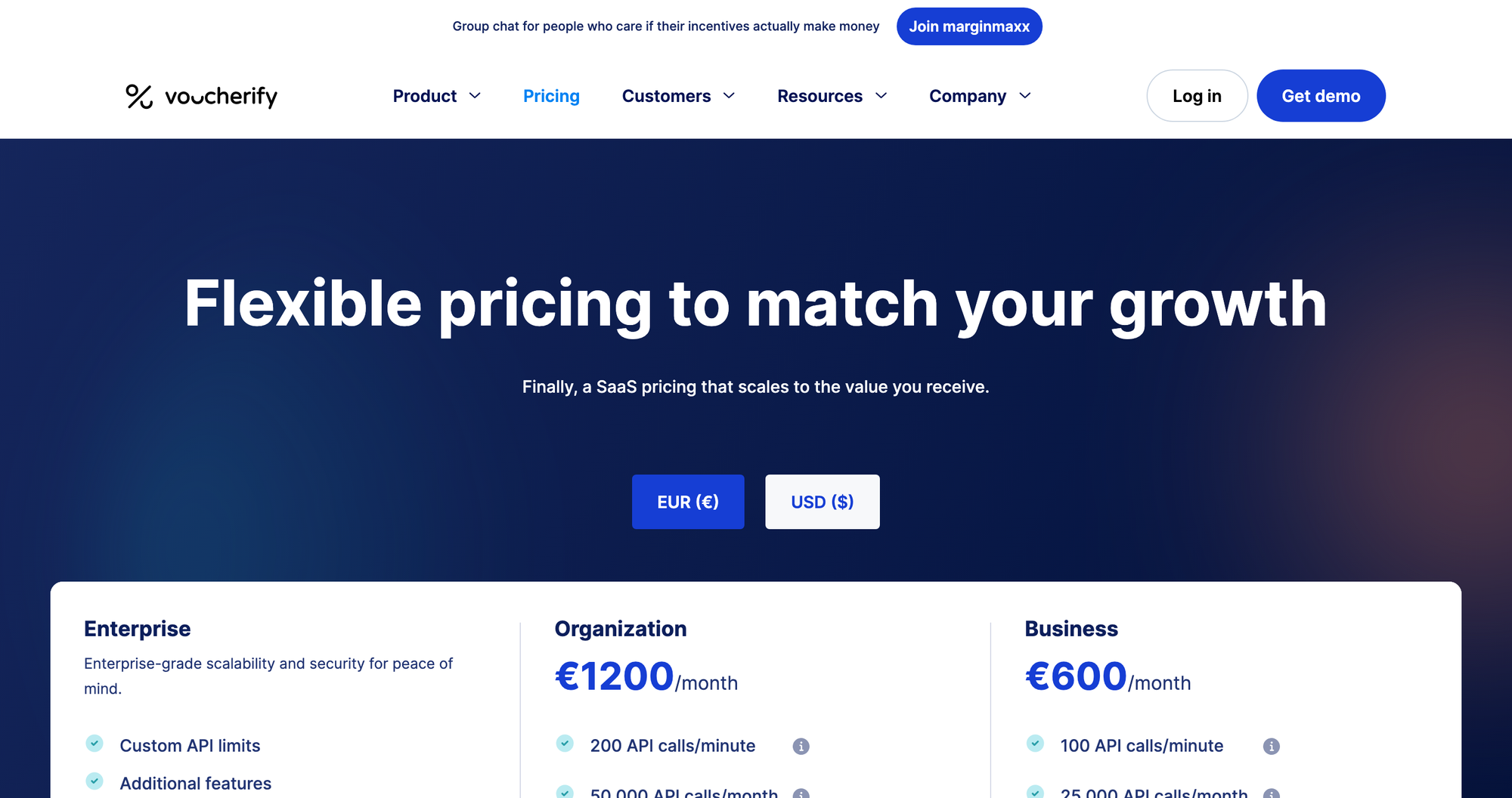
That is the only place in this entire category where a buyer can read the price and the unit it is charged on in the same panel. API calls per minute and per month are measurable before signing, which means a technical team can size the plan from its own logs rather than from a discovery call.
Voucherify's about page also states what the company is: "We've skipped the VC track. Still founder-led, still independent", and "Profitable from day one". Those are claims rather than filings, but they are claims on the record, and in a category where four of seven vendors have changed hands they are worth noting.
What "contact sales" is standing in for
Four things get hidden behind the demo-booking button, and they are hidden in different proportions by each vendor.
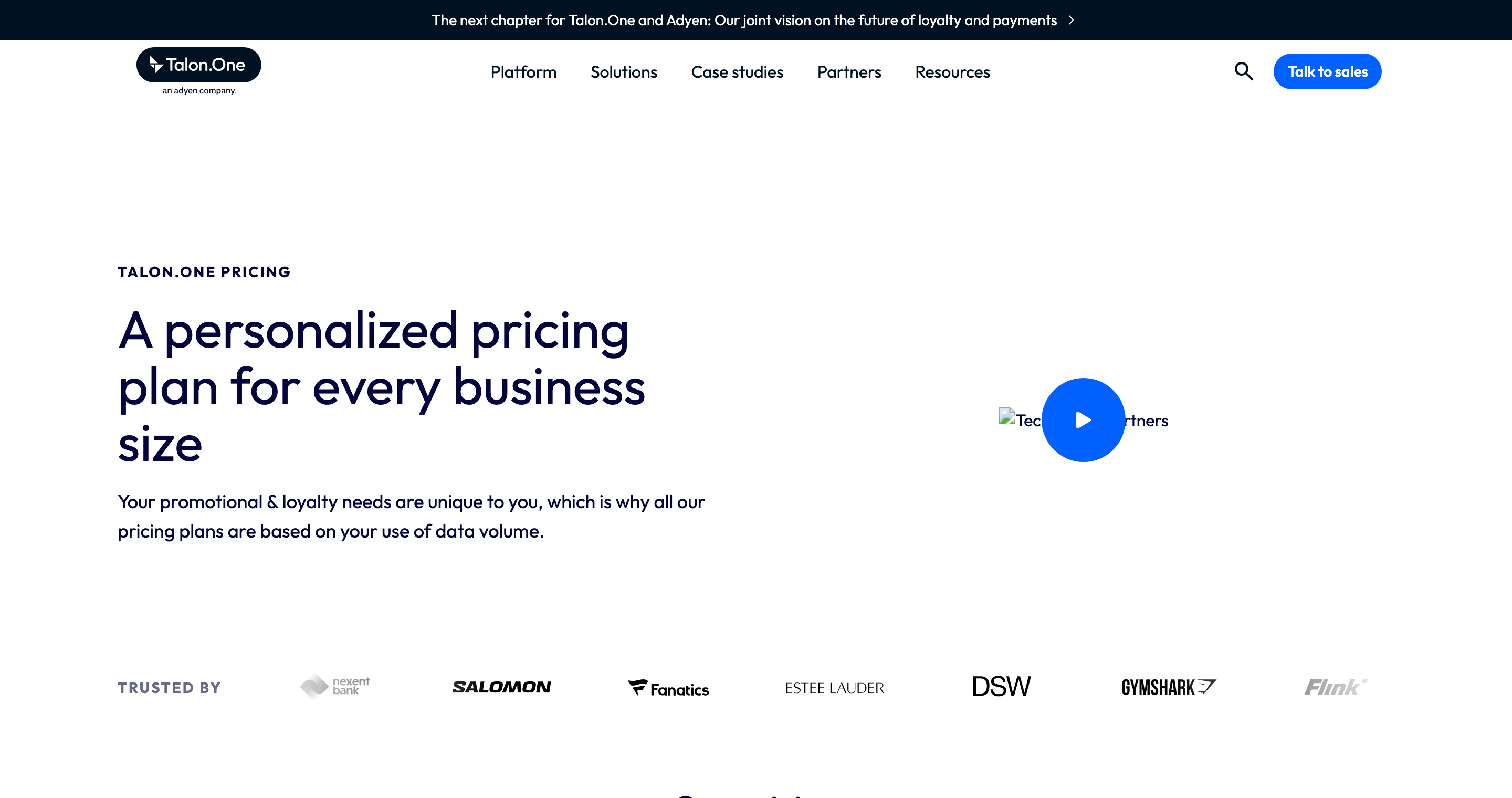
The metering unit. This is the largest omission, because it decides the shape of the bill rather than its size. Open Loyalty names two components, a "Platform Fee and Allowance Fee, determined based on the number of monthly Active Members", without pricing either. Antavo states its principle as "We want your success to be our success, so we charge based on customer activity. You won't be paying for customers that are not engaging with your stores", without defining a billable activity. Talon.One gives one quantity across its whole page, "Individual pricing scheme with at least 500k coupons". TrueLoyal states that pricing "is tailored to your specific program goals, scale, and integrations; no one-size-fits-all tiers". Four vendors, four units, none priced.
The commitment term. Exactly one platform publishes one, and not where you would look for it. Annex Cloud's Shopify listing states the app is free to install, that an annual contract is required, that pricing is "based on modules and loyalty program size", and that onboarding services are required to activate it. No figures are attached. But the existence of a mandatory annual term and mandatory paid onboarding is published, which is more than any of the other six disclose about commitment.
The implementation fee. None of the seven publishes a figure for onboarding, migration or integration work. Annex Cloud at least publishes that the work is compulsory. For the rest, a buyer discovers the second invoice during the sales cycle, after the licence has anchored the budget.
The negotiating asymmetry. Talon.One's pricing page closes with the statement that "all of our customers get individualized offers". Read as a buyer: the vendor knows every price it has agreed with every comparable brand, and you know none of them. That is the actual function of a blank pricing page, and it is a reason to ask for a reference price range in writing before any technical evaluation begins.
Four of seven have changed hands
Ownership is not usually a pricing question. In this category it is, because a price negotiated with one owner is a price the next owner did not set.
- Talon.One to Adyen. Adyen agreed to acquire 100% for a total consideration of €750 million on 23 April 2026 and announced the successful closing on 1 July 2026. Talon.One's release notes of 23 September 2026 state that "Talon.One is now an Adyen company". Neither company has published anything about pricing or contracts for existing customers.
- Zinrelo to Scaleworks. Acquired in August 2025 and merged with TINT under the TrueLoyal brand, which launched on 10 March 2026, per TrueLoyal's own explainer.
- Annex Cloud to Edited Capital. The Denver private equity firm acquired the company on 24 June 2025, terms undisclosed, with Steve Scribner named as CFO and Interim CEO and the customer base described as "over 60 enterprise clients across retail, consumer goods, and healthcare sectors".
- Open Loyalty is not acquired but is a member of the OEX SA capital group, a Polish holding company that was publicly listed on the Warsaw Stock Exchange from 2005 to 2024.
Antavo, Uniqodo and Voucherify remain independent. Antavo closed a €10 million Series A on 9 November 2022 led by Euroventures, published on its own newsroom.
The practical consequence is a single clause. If you are signing a multi-year contract with an unpriced vendor, ask what happens to your rate on a change of control, and get the answer in the agreement rather than in a call.
Three live App Store listings, zero reviews between them
The common framing is that enterprise loyalty platforms are not on the Shopify App Store. That is only half right, and the accurate version is more revealing.
Voucherify, Antavo and Annex Cloud all hold live listings. Voucherify's launched on 12 September 2022, Antavo's on 10 June 2024, Annex Cloud's on 19 March 2021. All three showed zero reviews when read on 8 October 2026. Antavo's listing shows a single Free plan at $0 a month, which is a front door rather than a tier.
Talon.One, Open Loyalty and Uniqodo have no listing at all. TrueLoyal's handle still resolves, now titled TrueLoyal, with the page stating the app is "not currently available on the Shopify App Store". A listing that was pulled is a different fact from a listing that never existed.
So the sharper claim is not that these platforms are absent from the App Store. It is that three of them are present and nobody installs them. An enterprise sale closes through a demo and a contract, so no install flow starts, no review flow starts, and the listing never accumulates the one signal a Shopify merchant uses to judge software. That is precisely why these platforms never appear in the loyalty category rankings, and why a merchant evaluating them has no peer evidence to draw on.
Zinrelo used to publish a starting price
A platform that once published a starting price and no longer does is the detail that makes the transparency trend legible rather than anecdotal.
Zinrelo was widely reported to have published a starting monthly price. That claim cannot be verified at primary source any more, because zinrelo.com/pricing now returns a permanent redirect to trueloyal.com/pricing, and the page it lands on publishes no plan names and no figures. What is verifiable is the present state: the one platform in this set with a reputation for disclosure stopped disclosing when it changed hands.
On customer impact TrueLoyal is unusually direct, and the sentence is worth reading if you were a Zinrelo customer: "Existing Zinrelo customers are TrueLoyal customers and the platform continues to operate." Nothing was discontinued. Zinrelo became TrueLoyal Rewards and TINT became TrueLoyal Fan Club.
If a comparison page quotes you a current Zinrelo monthly price, it is quoting a figure that exists at no source.
How to run this procurement without published prices
Six steps, in order, and none of them require a vendor to publish anything:
Define your meter before the first call. Decide whether you are willing to be billed on active members, customer activity, API calls, coupon volume or modules, and rule out the units you cannot forecast. This single decision eliminates half a shortlist.
Ask for the unit in writing before the demo. A vendor that will not name its billing unit in an email will not make it clearer in a contract.
Ask for a price range for a comparable brand. Name your order volume, member count and region. "All of our customers get individualized offers" is an answer you can push back on by asking for the range those offers occupy.
Price the implementation separately and in the same document. Annex Cloud publishes that onboarding is required. Assume it is required everywhere and get the figure before the licence is agreed.
Get the change-of-control clause. Four of seven vendors here have changed hands. Your rate should survive the next one.
Get a data export specification. Loyalty data is the most expensive thing to lose in a migration, because point balances carry a liability. Ask what format, what fields and what notice period, and get it in the agreement.
What published pricing looks like at the Shopify end
The contrast is not that enterprise platforms are expensive. It is that they are unreadable, and that a brand cannot do arithmetic on a blank page.
At the Shopify-native end of the market the same decisions get priced in public. Joy publishes all four tiers on its listing: a free Starter plan covering 250 monthly orders, $29 Essential, $129 Advanced at 2,000 monthly orders, and $499 Ultimate at 7,000 monthly orders, each with its overage rate printed on the card. The $499 Ultimate plan carries the full developer toolkit and JavaScript SDK, unlimited integrations with REST API access, and headless support for Hydrogen and Next.js, which is the capability set the platforms above sell as an unpriced API contract. A brand can read it, model it and compare it in one click.
That is not an argument that a $499 plan replaces an enterprise incentives engine for a multi-brand retail estate. It is an argument that the enterprise bracket has normalised a procurement process that no other software category would accept, and that a brand should know what the published alternative costs before entering it.
For the arithmetic at named order volumes, read what a loyalty program costs and how to calculate the cost of a loyalty point. The open-source loyalty platform question covers build versus buy at this level properly, the Shopify loyalty app comparison prices the self-serve field, and loyalty program ROI sets out the return the spend has to clear.
Audit the disclosure, then price the alternative
One published price in seven is the finding, and it is checkable in about twenty minutes across seven tabs. Before you enter an unpriced procurement, write down the meter you are willing to be billed on, get it confirmed in an email, and price the published alternative at your own order volume so you know what the quote is being compared against. A blank pricing page is a negotiating position, not a fact about the software, and the brand that arrives with its own arithmetic is the one that gets a number back.
Frequently asked questions
How much does an enterprise loyalty platform cost? Only one of the seven platforms audited publishes a figure. Voucherify lists €600 a month for Business and €1,200 for Organization on its own site, shown as $650 and $1,300 in USD, with Enterprise custom. Talon.One, Open Loyalty, Antavo, Uniqodo, Annex Cloud and TrueLoyal publish no prices.
Which enterprise loyalty platform publishes its pricing? Voucherify, and only Voucherify. Its Shopify App Store listing adds the metering unit: 100,000 API calls a month on the $650 Business plan and 300,000 on the $1,300 Organization plan, with a 60-day free trial.
What does "contact sales" hide on a loyalty platform pricing page? Four things: the metering unit, the minimum contract term, the implementation or onboarding fee, and the range of prices comparable brands have agreed. Annex Cloud is the only platform here that publishes a term, stating on its Shopify listing that an annual contract and onboarding services are required.
Is Open Loyalty free or open source? Neither. Open Loyalty's own pricing FAQ states that it is Software as a Service, its technology page describes AWS hosting, and its pricing is a "Platform Fee and Allowance Fee" based on monthly active members. The "open" in the name refers to an open API.
Does Zinrelo still publish a starting price? No. Zinrelo was acquired by Scaleworks in August 2025, merged with TINT, and relaunched as TrueLoyal on 10 March 2026. zinrelo.com/pricing redirects to trueloyal.com/pricing, which states there are "no one-size-fits-all tiers". Existing Zinrelo customers are TrueLoyal customers and the platform continues to operate.
Why do enterprise loyalty platforms have no Shopify App Store reviews? Because the sale does not run through the App Store. Voucherify, Antavo and Annex Cloud hold live listings launched in 2022, 2024 and 2021, and all three showed zero reviews on 8 October 2026. An enterprise deal closes through a demo and a contract, so no install and no review flow ever starts.

Written by
Thomas Nguyen is the CEO & Co-founder of Joy, a loyalty solution for Shopify and eCommerce brands. With years of experience building high-performance Shopify apps, Thomas aims to help merchants grow through customizable and retention-focused tools.
Related reading
 Shopify apps
Loloyal Alternatives: Loloyal Is Now CWILL Loyalty
Same install base and review history under a new name. Its $69 Growth plan jumps to $599 for API access, and five alternatives priced.
 Thomas Nguyen
 Shopify apps
11 Best Shopify Loyalty Apps to Boost Customer Retention in 2026
We compared 11 Shopify loyalty apps on real pricing, ratings, and reviews, so you can pick with confidence instead of guessing.
Thomas Nguyen Shopify apps
Social Snowball Pricing: The $899 Plan Can Cost Less
Entry is $249 a month plus 3% of affiliate revenue. Above $21,667 a month the $899 no-usage-charge tier is the cheaper one.
Thomas Nguyen Shopify apps
ReferralCandy Pricing: The $9 Plan Is the Expensive One
Four feature-identical tiers differing only by success fee. The first upgrade is due at $1,000 in monthly referred sales.
Thomas Nguyen Shopify apps
Shopify Loyalty App Pricing: $30 to $199 at 2,000 Orders
Appstle costs $30 at 2,000 monthly orders and Smile costs $199. Eight loyalty apps priced at 500, 2,000 and 10,000 orders.
Thomas Nguyen Shopify apps
UpCart vs AfterSell: Both Apps Belong to Rokt
Merchants comparing them are choosing between two SKUs from one owner. UpCart meters orders, AfterSell prices by surface.
Thomas Nguyen