FTC Review Rules: Points for a 5-Star Review Are Illegal
Points for a review are lawful; points for a positive one are not. A per-app scorecard across six Shopify review apps.
Summarize this post with AI
"Leave a review, get 100 points" is lawful. "Leave a 5-star review, get 100 points" is not, because the FTC's Rule on the Use of Consumer Reviews and Testimonials prohibits conditioning compensation on a review expressing a particular sentiment. The rule took effect on 21 October 2024 and carries civil penalties of up to $53,088 per violation for knowing violations, and on 22 December 2025 the FTC sent warning letters to ten companies under it.
This is not legal advice. What follows is a scorecard of what five major Shopify review apps and the AliExpress importer group document on their listings, mapped against the four places the rule bites, so you know which switches in your admin deserve a lawyer's attention. Every plan, feature and price was read from each app's live listing on 8 October 2026.
Key takeaways
- The rule does not ban incentives. The FTC states plainly that incentives are permitted "as long as there isn't an express or implied requirement that the reviews have to express a particular sentiment".
- Implied counts. The FTC's own example of an implied requirement is the copy "Tell us how much you loved your visit to John's Steakhouse and get a $5 coupon". That sentence is the compliance risk, not the points ledger behind it.
- Sorting five-star reviews to the top of your widget is not suppression under the rule. The FTC says so directly, then warns that making negative reviews hard to find can still be unfair or deceptive under Section 5 of the FTC Act.
- Stamped is the only vendor in this group found publishing its own FTC compliance help article.
- Shopify's App Store requirement 1.3 of 6 July 2026 bans incentivised reviews of apps, not product reviews on your storefront. The two govern different pages.
The four places the rule actually bites
Four sections decide what a Shopify review app can be configured to do. The FTC's own questions and answers on the rule is the primary reference:
- Section 465.2 covers fake or false reviews, including ones that misrepresent whether the reviewer used the product at all. The FTC notes it addresses a reviewer's experience, not merely their opinion.
- Section 465.4 covers buying positive or negative reviews. This is where the points question lands.
- Section 465.5 covers insider reviews, meaning reviews by employees, officers and immediate relatives, and the disclosures they require.
- Section 465.7(a) covers review suppression, including false accusations against reviewers, intimidation, and unjustified legal threats used to get a review changed or removed.
Two of these are worth quoting rather than paraphrasing, because the circulating paraphrases are wrong in both directions.
On incentives, the FTC's answer is this: "The rule does not prohibit giving incentives for reviews, as long as there isn't an express or implied requirement that the reviews have to express a particular sentiment." Asked whether a business may pay incentives for five-star reviews on a third-party platform if the reviewer discloses the incentive, the same page answers: "No. That conduct would violate Section 465.4."
On implied requirements, the FTC gives a worked example belonging on the wall next to whoever writes your review request emails. You are implying a review must be positive, it says, if you write "Tell us how much you loved your visit to John's Steakhouse and get a $5 coupon". No star rating is named, no condition is stated, and the copy still breaks the rule. For a brand running points for reviews, that is the most useful line in the document, because the risk is not in the loyalty app. It is in the subject line.
Four things the rule does not prohibit, each described as banned in secondhand summaries: incentivising reviews at all, expecting an incentivised review to be positive, defaulting your widget to five-star reviews on top, and quoting a flattering review in an ad. On three of the four the FTC answers that the rule does not cover the situation, then adds that the FTC Act might.
The per-app scorecard
What follows scores what each listing documents, not what a merchant has configured. An app that can attach a coupon to a review is not a compliance problem, and an app with no incentive feature is not compliance either, because you can still write the wrong email. The scorecard tells you which switches to go and look at.
| App | Incentive attached to reviews | Imports third-party reviews | Sentiment-related tooling named | Moderation of published reviews |
|---|---|---|---|---|
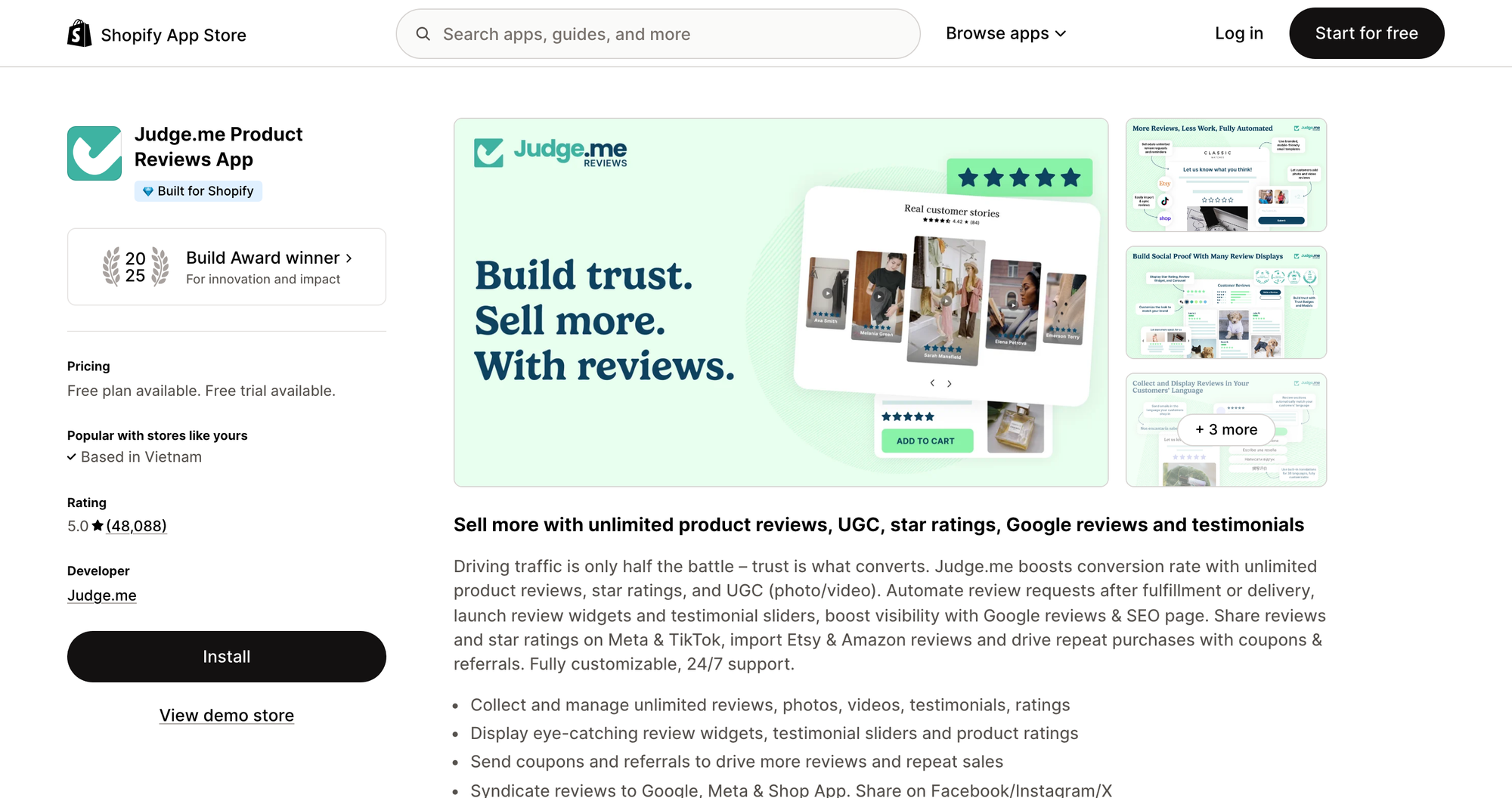
| Judge.me | Coupons and referrals, Awesome $15 | Reviews importer and AliExpress sync, free plan | None named | Not named on the panel |
| Loox | Discounts for photo reviews, free plan | None named | AI smart sorting and highlights, Convert $49.99 | Not named on the panel |
| Okendo | Review Rewards Engine, free plan | None named | AI review summaries and keywords, Growth $119 | Review Moderation, free plan |
| Stamped | Loyalty product line, $299 | None named | None named | Not named on the panel |
| Yotpo | None named | None named | Sentiment and Profanity Check, free plan; Smart Sorting, Pro $119 | Not named on the panel |
| Importer group | Varies | Core function | None named | Varies |
"Not named on the panel" means exactly that. App Store pricing cards carry a handful of feature bullets rather than a feature matrix, so an absence here is an absence of documentation, not of capability.
Judge.me — the incentive and the importer are both on the free plan
Best for: brands wanting unlimited first-party collection with no order cap and no incentive at all. Judge.me's Forever Free plan collects unlimited product and store reviews without metering orders, so the compliance surface stays small: no coupon mechanic switched on, no sentiment condition to word badly.
Not ideal for: brands that want the import capability absent from the tool rather than merely switched off. Judge.me's free plan lists a reviews importer and AliExpress sync, so the ability to put another seller's reviews on your product page ships in the box, and governing it is a policy decision somebody has to own.
592,507 live Shopify stores run Judge.me. The listing read 5.0 stars from 48,164 reviews on 8 October 2026.
What to check before you commit
Two switches. First, the AliExpress sync: Section 465.2 addresses reviews that misrepresent whether the reviewer used the product, and a review of a similar item bought from a different seller raises exactly that question. Second, coupons and referrals on Awesome at $15: the coupon is lawful, and the wording of the email offering it is where Section 465.4 applies. The panel shows two plans and links out via "See all pricing options", so it is not a complete view of the ladder.
Loox — the incentive mechanic is the product
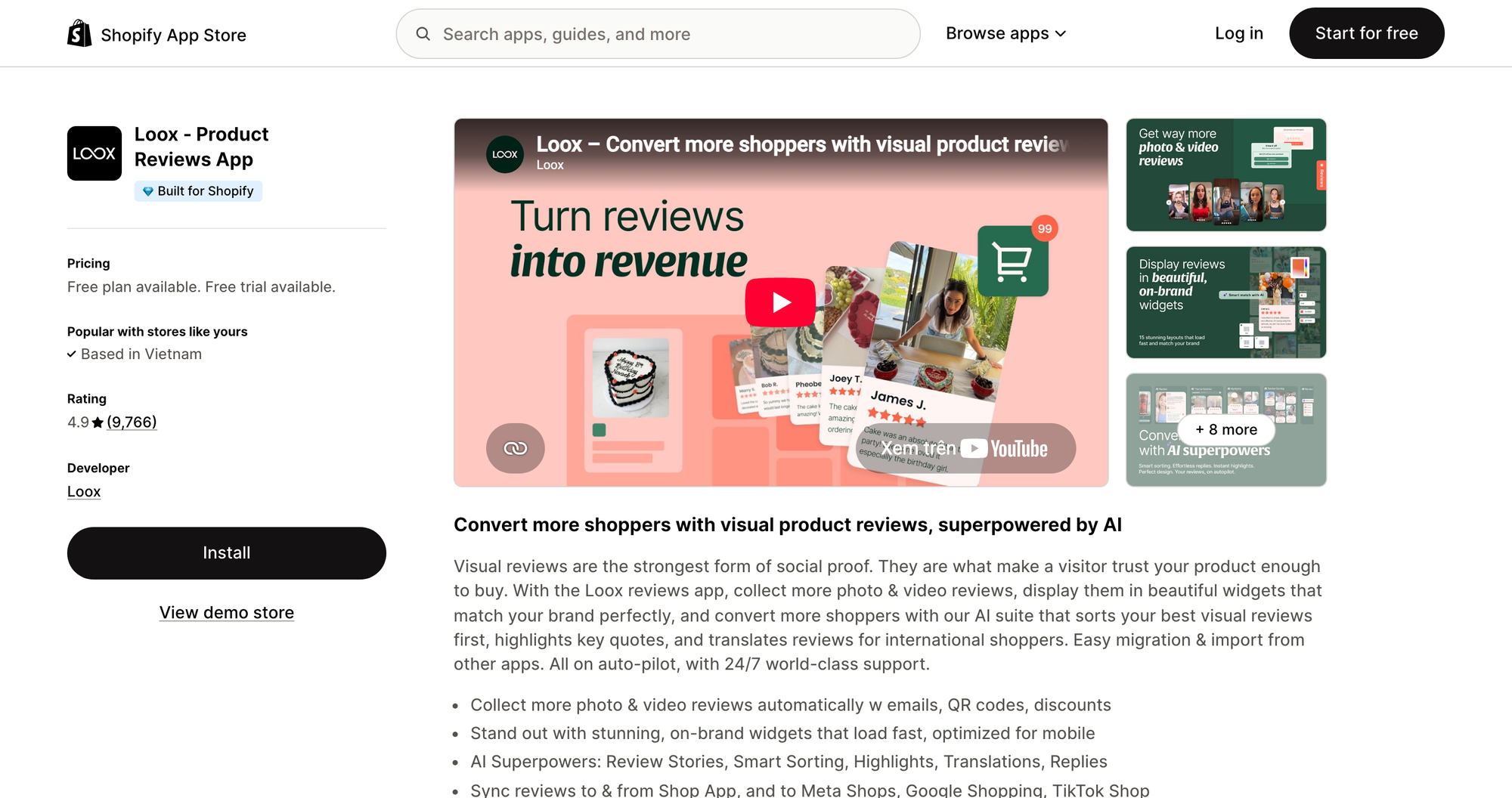
Best for: apparel, beauty and homeware brands where photo reviews carry the sale and the discount-for-photo trade is run deliberately. Loox puts "Offer discounts for photo reviews" on the free Beginner plan, so the incentive is the core mechanic rather than an add-on, and the compliance work concentrates in one piece of copy you can get right once.
Not ideal for: brands that want sentiment-neutral request copy written for them. Loox documents no compliance guidance on its listing, so the wording of the offer is yours, and "show us how much you love it and get 15% off" is the FTC's own implied-sentiment example in different clothes.
129,584 live Shopify stores run Loox. The listing read 4.9 stars from 9,775 reviews on 8 October 2026.
What to check before you commit
The discount-for-photo offer is the highest-value piece of copy in your review programme, legally and commercially. Write it as a request for a photo review, not for a happy one. Loox's AI Smart Sorting and Review Highlights sit on Convert at $49.99: sorting is not suppression under the rule, and a default that buries negatives can still be unfair under Section 5, so check the default rather than assuming it.
Okendo — the only panel naming both a rewards engine and moderation
Best for: beauty, apparel and supplement brands that need attribute filtering and want the reward mechanic and the moderation controls under one vendor. Okendo's free plan lists a Review Rewards Engine and Review Moderation together, so the two decisions that matter most under the rule, what you offer and what you publish, are configured and auditable in one place.
Not ideal for: stores above 3,500 monthly orders, where the published ladder stops, or any brand treating moderation as a convenience. The moderation queue is where Section 465.7 risk accumulates: excluding reviews that mention other products is permitted only if, in the FTC's words, "your policy treats all such reviews equally, whether they are positive or negative".
19,344 live Shopify stores run Okendo. The listing read 4.8 stars from 1,427 reviews on 8 October 2026.
What to check before you commit
Write the moderation policy down before you switch the queue on, and make it rating-blind on its face. The FTC confirms a business may refuse to publish a review about the wrong business, and may exclude reviews discussing only customer service, as long as those exclusions apply to positive and negative reviews alike. Pricing runs free to 50 orders a month, $19 to 200, $119 to 1,500 and $299 to 3,500, and the panel renders four cards, the App Store maximum, so a higher tier may exist.
Stamped — the only vendor publishing its own FTC guidance
Best for: brands that want reviews and a points programme from one vendor and value the vendor having read the rule. Stamped publishes a dedicated help article on complying with the FTC final rule for reviews, which no other vendor here was found to do, and that signals who will warn you before a setting becomes a problem.
Not ideal for: anyone who wants to prove the app before paying. Stamped shows no free plan, starting at $23 a month for up to 200 orders, and its reviews and loyalty lines are priced as separate products rather than tiers, so a brand wanting both at 5,000 orders faces $199 plus $299 before anything else.
31,212 live Shopify stores run Stamped. The listing read 4.7 stars from 3,753 reviews on 8 October 2026.
What to check before you commit
Read the three Reviews tiers side by side: the feature bullets are identical across $23, $99 and $199, and the only variable is the order cap, so the upgrade buys headroom rather than compliance capability. Then read Stamped's FTC article against your actual earning rule, because a vendor documenting the rule does not configure your programme for you.
Yotpo — a sentiment check on the free plan
Best for: brands already inside Yotpo's suite for loyalty, SMS or subscriptions, where keeping reviews in the same account removes a data-sync problem. Yotpo is also the only listing in this group naming a Sentiment and Profanity Check on the free plan, which is the one feature here that touches the rule's language directly rather than by implication.
Not ideal for: anyone buying reviews alone, and anyone who assumes a feature called "sentiment check" is a compliance feature. The listing names it and does not say what it does, so whether it flags profanity for a human, scores tone for reporting, or affects what gets published is unresolved from the panel, and the difference between those three is the difference between a reporting tool and a suppression risk.
37,639 live Shopify stores run Yotpo. The listing read 4.8 stars from 4,630 reviews on 8 October 2026.
What to check before you commit
Find out exactly what the Sentiment and Profanity Check does to a submitted review before switching it on, and get the answer in writing. If it can stop a negative review publishing on the basis of tone, that is a Section 465.7 conversation; if it tags reviews for a moderator, it is not. Neither paid tier publishes a schedule: Starter at $15 and Pro at $119 both say "Pricing changes based on order volume" without saying how.
The importer group — the one category where the rule is structural
Best for: nothing a brand building first-party proof should rely on. Apps whose core function is pulling reviews from AliExpress, Amazon, eBay, Temu, Etsy, Walmart or DHgate put reviews of other sellers' products on your product pages, and Section 465.2 is about reviews that misrepresent whether the reviewer used the product at all.
Not ideal for: any brand that will one day be large enough to be worth a complaint. The group includes Trustoo Ali Reviews Importer, Ali Reviews, AliReviews, Areviews and EZ Amazon Reviews Importer, running on 112,651 live Shopify stores between them, and the category is the only part of the review space shrinking rather than growing.
What to check before you commit
Distinguish the two acts the same feature performs. Importing reviews of your own products from your own marketplace accounts mirrors proof you already earned. Importing a stranger's AliExpress reviews does not. The tooling does not know the difference, so the policy has to.
Shopify's own rule is a different rule
On 6 July 2026 Shopify published App Store requirement 1.3, "Always use honest and transparent review practices". The shopify.dev changelog post states the consequences verbatim as "removal of a portion of reviews, demotion or delisting of your app, or termination of your Partner account", instructs developers to ask "only in neutral language", and says "offering any incentives within or outside the app is not allowed". A Shopify staff post on community.shopify.dev dated 3 September 2026 confirms it applies continuously to listings already published: "Reviews that are visible today may be hidden over time, or vice versa."
That rule governs reviews of apps, by merchants, on the Shopify App Store. It has no bearing on the product reviews on your storefront. The overlap worth knowing is this: Shopify's policy is stricter than the FTC's on its own turf, because Shopify bans incentivised app reviews outright while the FTC permits incentivised product reviews carrying no sentiment condition.
What to audit in your own programme this week
Three checks, in the order they pay:
- Read your review request email, not your app settings. Any copy praising the purchase before asking for the review is the FTC's John's Steakhouse example. "Tell us what you thought" earns the same points and reads as neutral.
- Make the earning rule rating-blind in the product, not only in the wording. If your loyalty app can award different points for different star ratings, that capability is a liability. Award on submission, once, at the same amount.
- Write the moderation policy before you need it. Rating-blind on its face, applied identically to positive and negative reviews, and dated.
Points for reviews is a loyalty mechanic before it is a compliance question, and the way to keep it clean is to reward the behaviour rather than the outcome. How loyalty points work covers the earning-rule mechanics, loyalty programme best practices covers the design around them, and loyalty fraud prevention covers the adjacent problem of customers gaming an earning rule written too generously. For the apps themselves, Judge.me, Okendo and Yotpo compared covers reviews and loyalty together.
Where this leaves a Shopify brand
The rule is narrower than its reputation and the exposure is wider. Incentivising reviews is lawful, sorting by rating is lawful, and quoting a flattering review in an ad is lawful, yet each sits one sentence of bad copy away from a Section 465.4 or Section 5 problem. The app decides which switches exist. The copy decides whether you are compliant.
So pick the app for the job, then audit the request email and the earning rule. Both are yours, and neither lives in a vendor's compliance page. Nothing here is legal advice, and a programme that pays customers to say something is worth running past a lawyer who reads 16 CFR Part 465 for a living.
Frequently asked questions
Can I give loyalty points for a product review on Shopify? Yes. The FTC states the rule does not prohibit incentives for reviews "as long as there isn't an express or implied requirement that the reviews have to express a particular sentiment". Points for submitting a review of any rating is the compliant shape. Disclosing the incentive is a separate obligation under the FTC Act. This is not legal advice.
Is it illegal to offer a discount for a 5-star review? Asked whether a business may pay incentives for five-star reviews on third-party platforms if the incentive is disclosed, the FTC answers "No. That conduct would violate Section 465.4." The section applies whether the reviews sit on your own site or a third-party platform.
What are the penalties under the FTC review rule? The rule authorises courts to impose civil penalties for knowing violations. In its December 2025 warning letters the FTC put the figure at up to $53,088 per violation.
Can I hide or delete negative reviews on my Shopify store? Section 465.7(a) covers suppression, and the FTC's guidance turns on equal treatment. Refusing to publish a review about the wrong business is permitted, and excluding reviews that mention other products is permitted "as long as your policy treats all such reviews equally, whether they are positive or negative". Deleting reviews because they are negative is the conduct the section addresses.
Does sorting five-star reviews first count as suppression? Not under the rule. The FTC answers "No, the rule does not cover that situation", then warns that organising reviews so consumers struggle to find negative ones could be unfair or deceptive under Section 5 of the FTC Act.
Did Shopify change its review rules in 2026? Yes, on 6 July 2026, and the change covers app reviews rather than product reviews. Requirement 1.3 states that offering incentives for reviews of your app "within or outside the app is not allowed", with consequences up to delisting and Partner account termination.

Written by
Thomas Nguyen is the CEO & Co-founder of Joy, a loyalty solution for Shopify and eCommerce brands. With years of experience building high-performance Shopify apps, Thomas aims to help merchants grow through customizable and retention-focused tools.
Related reading
 Shopify apps
Klaviyo Pricing: $20 on the App Store, $150 at 10,000
The Shopify listing stops at $20 for 500 contacts. Klaviyo's own slider reads $150 at 10,000 active profiles and keeps going to 150,000.
 Thomas Nguyen
 Shopify apps
LoyaltyLion Pricing: Free to 400 Orders, Then $199
The largest free-to-paid step in the category, with no tier in between. That step costs $1.99 per extra order against 4 cents on Appstle.
Thomas Nguyen Shopify apps
UpPromote Alternatives: The 300-Referral Cap Nobody Meters
UpPromote's Growth plan caps at 300 reviewed referrals a month, a unit no rival meters. Seven alternatives compared on cap mechanics.
Thomas Nguyen Shopify apps
Smile.io Pricing: The $999 Plan Is Not on the App Store
The listing stops at Growth $199. smile.io adds Plus at $999 billed annually, and the crossover sits near 6,500 monthly orders.
Thomas Nguyen Shopify apps
Omnisend Pricing: $16 Buys 12 Emails per Contact
Standard is $16 a month with a 6,000-email cap, which is twelve sends per contact. Unlimited email starts at $59 on Pro.
Thomas Nguyen How-to Guide
BFCM Readiness: Shopify Tests Checkout, Nobody Tests Your Widget
Shopify scale-tests checkout at 80,000 a minute. The risk you own is the storefront, measured on the signed-in path.
Thomas Nguyen