
Postscript Pricing: Free to Install Means $49 a Month
Free to install carries a $49 monthly minimum, then $0.009 per SMS plus carrier fees the listing never puts a number on.

Summarize this post with AI
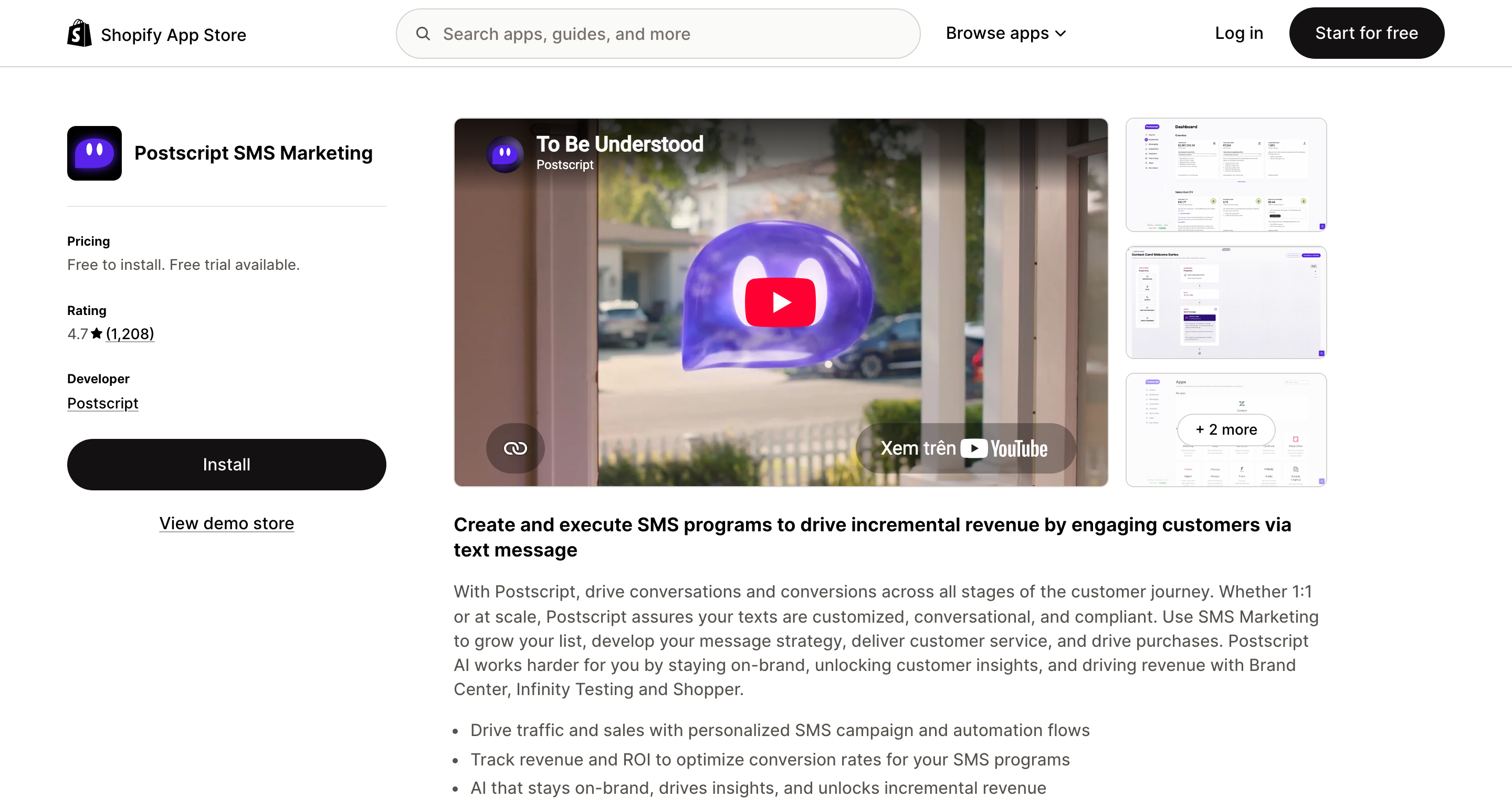
"Free to install" on the Postscript listing means a $49 monthly minimum spend, then $0.009 per SMS and $0.045 per MMS, then carrier fees on top. The listing prints the words "+ Carrier fees" three times across three plan cards and attaches a number to them exactly zero times, read on 8 October 2026.
Postscript's own pricing page does attach numbers: average US carrier fees of $0.00330 per SMS and $0.00799 per MMS, listed as a pass-through that Postscript bills "without any additional markup". That makes the real Starter rate $0.0123 per SMS rather than $0.009, and it produces the finding nobody ranking for this query has published: the carrier share of your per-message cost rises as you buy down Postscript's rate, from 27% of the all-in cost on Starter to 32% on Professional.
Key takeaways
- The Starter plan is free to install with a $49 monthly minimum spend and a $100 credit for the first 30 days, then $0.009 per SMS and $0.045 per MMS plus carrier fees.
- Growth is $100 a month at $0.008 per SMS and $0.03 per MMS. Professional is $500 a month at $0.007 per SMS and $0.024 per MMS. Carrier fees are additive on all three.
- Postscript publishes average US carrier fees of $0.00330 per SMS and $0.00799 per MMS on its own pricing page. The Shopify listing quantifies them nowhere.
- On SMS alone, Growth only costs less than Starter above 100,000 messages a month. On MMS, that crossover collapses to 6,667 messages a month, because the MMS rate gap is 15 times larger than the SMS gap.
- The listing shows three plans and links out. Postscript's pricing page adds an Enterprise tier at contact-sales pricing and a separate Postscript AI plan at $699 a month, neither of which appears on the listing.
- Postscript's listing read 4.7 stars from 1,208 reviews on 8 October 2026, with 34 one-star reviews, and the listing does not carry the Built for Shopify badge.
What the listing does not tell you
Every price, rate and rating below was read from the live Shopify App Store listing on 8 October 2026, and from Postscript's own pricing page the same day. Both were needed, because three separate figures a merchant needs to budget are missing from the listing.
| Plan | Monthly | Per SMS | Per MMS | Carrier fees |
|---|---|---|---|---|
| Starter | free to install, $49 minimum spend | $0.009 | $0.045 | additive, not quantified on the listing |
| Growth | $100 | $0.008 | $0.03 | additive, not quantified on the listing |
| Professional | $500 | $0.007 | $0.024 | additive, not quantified on the listing |
| Enterprise | not shown on the listing | not published | not published | not published |
Three gaps, in order of how much money they move.
The carrier fee has no number on the listing. It appears as the phrase "+ Carrier fees" appended to each rate line. A merchant modelling 100,000 messages a month from the listing alone will under-budget by $330, every month, and will not know why the invoice is wrong.
The $49 minimum has no definition. The listing says "$49 monthly minimum spend" without stating whether carrier fees count toward it. At Postscript's own rate, $49 buys about 5,440 SMS. If carrier pass-through counts, it buys about 3,980. That is a 27% difference in what the floor actually covers, and the listing does not resolve it. Ask before you model a low-volume month.
The ladder has a fourth rung. Postscript's pricing page carries an Enterprise tier routed to sales, plus a distinct Postscript AI plan at $699 a month with per-message rates quoted as a range from $0.003 to $0.30 depending on product and message type. A brand pricing Postscript from the listing sees three plans and believes it has seen the ladder.
What the carrier fee actually does to the rate
Carrier fees are set by the mobile networks, not by the SMS platform, and Postscript's pricing page is explicit that it passes them through: "The cost on your invoice is defined by carriers and Postscript lists that exact amount on your invoice without any additional markup." The page publishes averages for US and Canadian traffic: $0.00330 per SMS, $0.00799 per MMS, $0.0047 for text RCS and $0.0087 for media RCS.
Averages are the right word, and they are not a quote. Carrier fees vary by carrier and by message type, so the figures below are an estimate built from Postscript's published average rather than a billable rate. That is the honest ceiling on this arithmetic, and it is still far more useful than the listing's silence.
| Plan | Postscript SMS rate | Average carrier fee | All-in per SMS | Carrier share |
|---|---|---|---|---|
| Starter | $0.00900 | $0.00330 | $0.01230 | 26.8% |
| Growth | $0.00800 | $0.00330 | $0.01130 | 29.2% |
| Professional | $0.00700 | $0.00330 | $0.01030 | 32.0% |
The carrier share rises on the way up the ladder, and that is the structural point. Buying down from Starter to Professional cuts Postscript's own rate by 22%, but it cuts the all-in rate by only 16%, because a third of the cost is a line neither you nor Postscript sets. The component you can negotiate shrinks. The component you cannot grows.
MMS is worse in both directions. On Starter, $0.045 plus $0.00799 is $0.05299 a message, which is 4.3 times the all-in SMS cost. On Professional it falls to $0.03199. An MMS campaign to 10,000 subscribers costs about $530 on Starter and about $320 on Professional, before the monthly fee.
The crossover depends on MMS, not SMS
Here is the arithmetic that decides which plan a Shopify brand should be on, and it is not the one a sales conversation leads with. Carrier fees are identical across the three tiers, so they cancel out of every crossover. What remains is the monthly fee against the rate gap.
On SMS alone:
- Growth's $100 fee has to be recovered by a $0.001 rate saving, so Growth costs less than Starter only above 100,000 SMS a month.
- Professional's $500 fee has to be recovered by a $0.002 saving against Starter, so Professional wins only above 250,000 SMS a month.
- Against Growth, Professional's extra $400 needs a $0.001 saving, which arrives at 400,000 SMS a month.
On MMS, every one of those numbers collapses. The MMS gap between Starter and Growth is $0.015 a message, 15 times the SMS gap, so Growth costs less than Starter above just 6,667 MMS a month.
Work a realistic month. A brand with 10,000 SMS subscribers sending four campaigns:
| Send mix | Starter | Growth | Professional |
|---|---|---|---|
| 40,000 SMS | $492 | $552 | $912 |
| 30,000 SMS + 10,000 MMS | $899 | $819 | $1,129 |
Same subscriber list, same four campaigns, and swapping one campaign from SMS to MMS flips the cheapest plan. Nothing on the listing would let a merchant work that out, because the listing does not carry the carrier figures and does not frame the rates against the monthly fee.
The practical rule: if you send SMS only, stay on the free-to-install Starter plan until you pass about 100,000 messages a month. If MMS is a meaningful share of your calendar, run the MMS arithmetic separately, because that is where the $100 plan pays for itself at roughly a fifteenth of the volume.
Postscript at a glance
Best for: brands running SMS as a primary revenue channel at high volume, where per-message rates and a dedicated CSM are worth a four-figure monthly commitment. Postscript puts campaigns, automations, unlimited segments and a toll-free number on the free-to-install plan, so the entry point is genuinely usable rather than a demo, and the $100 credit for the first 30 days covers roughly 8,100 SMS at Starter rates before any money moves.
Not ideal for: brands that need to budget SMS to the dollar before committing. The listing publishes a minimum spend it does not define, rates it quantifies, and carrier fees it does not, which means the only way to produce an accurate forecast is to leave the App Store and read the vendor's own pricing page. For a brand with no SMS programme yet and no sense of monthly volume, that uncertainty sits on the wrong side of the decision.
Postscript runs on 22,945 live Shopify stores. Its listing read 4.7 stars from 1,208 reviews on 8 October 2026, with 34 one-star and three two-star reviews.
What it actually does
- Campaigns and automations, unlimited segments, a unique toll-free number, reporting and subscriber acquisition tools on the free-to-install Starter plan.
- Unlimited opt-in keywords from the $100 Growth plan, which is the one capability Starter lacks outright rather than rations.
- Branded short links, customisable opt-in tools and custom integrations from the $500 Professional plan, along with an onboarding specialist and a dedicated CSM.
- RCS messaging, priced separately on the vendor page at $0.0047 for text and $0.0087 for media in average carrier fees.
- A 30-day free trial, which is long enough to measure a full campaign cycle rather than a single send.
What to check before you commit
Get three answers in writing before you sign anything. Whether carrier fees count toward the $49 minimum spend. What the Enterprise tier changes other than the per-message rate. And whether the $100 first-30-days credit applies to carrier pass-through or only to Postscript's own rate.
Then model your own mix. Split your planned monthly volume into SMS and MMS, apply the rates and the average carrier fees separately, and compare across all three tiers. The answer for most Shopify brands is Starter, and a sales conversation will not open there.
Finally, note what the listing does not claim. Postscript does not carry the Built for Shopify badge, so verify theme and checkout integration depth against your own stack if you are replacing an incumbent.
Why the per-message rate is the wrong thing to optimise
SMS is the most expensive owned channel a brand runs per contact, and the arithmetic above shows how little of that cost is negotiable. A third of every message is a carrier fee. The platform rate moves by fractions of a cent between tiers. What actually changes the economics is not the rate, it is how many of those messages produce an order.
That is a retention problem rather than a procurement one. Harvard Business Review's summary of the retention research puts acquiring a new customer at five to 25 times the cost of keeping one, and cites Frederick Reichheld's finding at Bain & Company that a 5% lift in retention raises profit by 25% to 95%. A message with a reason to open beats a cheaper message every time, and a reason to open is usually a reward balance, a tier threshold or an expiring point.
For how the owned-channel costs compare on the email side, read Klaviyo versus Omnisend. For the channel economics underneath this decision, customer acquisition versus retention sets out the trade, what a loyalty program costs prices the retention side on the same basis, and Shopify customer retention tactics covers what to put in the messages.
Budget the message, not the plan
Postscript's listing publishes a plan ladder that cannot be budgeted from and a fee structure that cannot be verified from, and both gaps close the moment you open the vendor's own pricing page. Split your volume into SMS and MMS, add $0.0033 and $0.00799 respectively, and compare all three tiers against the result. Almost every Shopify brand lands on the plan that costs nothing per month, and the ones that do not will know exactly why.
Frequently asked questions
How much does Postscript cost per month? The Starter plan is free to install with a $49 monthly minimum spend, Growth is $100 a month and Professional is $500 a month, read from the listing on 8 October 2026. Postscript's own pricing page adds an Enterprise tier at contact-sales pricing and a separate Postscript AI plan at $699 a month.
What does Postscript charge per text message? $0.009 per SMS and $0.045 per MMS on Starter, $0.008 and $0.03 on Growth, and $0.007 and $0.024 on Professional. Carrier fees are added on top of all three tiers.
How much are Postscript's carrier fees? Postscript's pricing page publishes average US carrier fees of $0.00330 per SMS and $0.00799 per MMS, plus $0.0047 for text RCS and $0.0087 for media RCS, for US and Canadian traffic. It states these are passed through at the exact amount carriers define, with no markup. The Shopify App Store listing quantifies them nowhere.
Is Postscript really free to install? The app installs at no charge, and the Starter plan carries no monthly fee, but it carries a $49 monthly minimum spend. At Starter rates that floor covers roughly 5,440 SMS before carrier fees. The listing does not state whether carrier fees count toward the minimum.
Which Postscript plan should a Shopify brand choose? Starter, for almost all of them. On SMS alone, Growth only costs less than Starter above 100,000 messages a month and Professional above 250,000. If MMS is a real part of your calendar, Growth becomes cheaper above about 6,667 MMS a month, so run that number separately.
What is the $100 Postscript credit? Every plan card states a $100 credit for the first 30 days. At the Starter rate that covers roughly 11,100 SMS on Postscript's own rate, or about 8,100 once average carrier fees are included. The listing does not state whether the credit applies to carrier pass-through.

Written by
Thomas Nguyen is the CEO & Co-founder of Joy, a loyalty solution for Shopify and eCommerce brands. With years of experience building high-performance Shopify apps, Thomas aims to help merchants grow through customizable and retention-focused tools.
Related reading
 Shopify apps
Smile.io Pricing: The $999 Plan Is Not on the App Store
The listing stops at Growth $199. smile.io adds Plus at $999 billed annually, and the crossover sits near 6,500 monthly orders.
 Thomas Nguyen
 Shopify apps
LoyaltyLion Pricing: Free to 400 Orders, Then $199
The largest free-to-paid step in the category, with no tier in between. That step costs $1.99 per extra order against 4 cents on Appstle.
Thomas Nguyen Shopify apps
Appstle vs Seal: Revenue Caps Against Subscriber Caps
Appstle meters subscription revenue, Seal meters subscriber count. Forty subscribers at $400 run free on Seal and cost $100 on Appstle.
Thomas Nguyen Shopify apps
UpPromote Alternatives: The 300-Referral Cap Nobody Meters
UpPromote's Growth plan caps at 300 reviewed referrals a month, a unit no rival meters. Seven alternatives compared on cap mechanics.
Thomas Nguyen Shopify apps
Klaviyo Pricing: $20 on the App Store, $150 at 10,000
The Shopify listing stops at $20 for 500 contacts. Klaviyo's own slider reads $150 at 10,000 active profiles and keeps going to 150,000.
Thomas Nguyen How-to Guide
BFCM Readiness: Shopify Tests Checkout, Nobody Tests Your Widget
Shopify scale-tests checkout at 80,000 a minute. The risk you own is the storefront, measured on the signed-in path.
Thomas Nguyen