Klaviyo Pricing: $20 on the App Store, $150 at 10,000
The Shopify listing stops at $20 for 500 contacts. Klaviyo's own slider reads $150 at 10,000 active profiles and keeps going to 150,000.
Summarize this post with AI
Klaviyo publishes its price ladder. The problem is that the ladder is not on the surface most Shopify merchants read. The Klaviyo listing shows exactly three plans on 8 October 2026: Free for up to 250 contacts, SMS at $15 a month, and Email at $20 a month "for 251-500 contacts". Then it stops.
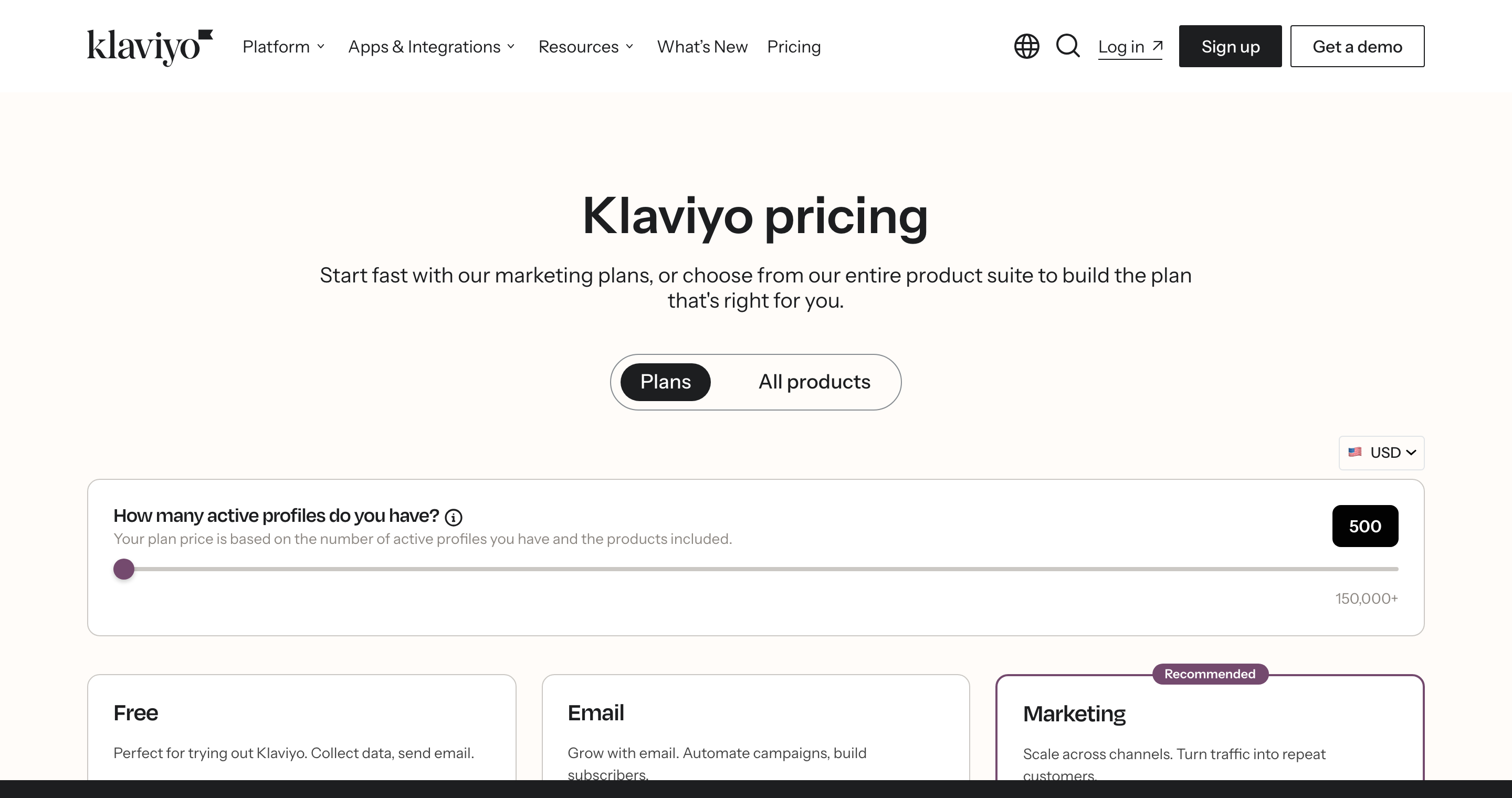
One page away, Klaviyo's own pricing page carries a self-serve calculator with a slider running from 500 to 150,000+ active profiles, no login and no sales form, and it prints a monthly figure at every step. At 10,000 active profiles it reads $150 a month for Email and $220 for Marketing, read on 8 October 2026, and only the 150,000+ step is sales-gated. A merchant pricing Klaviyo from the App Store alone sees none of that, and the gap is the finding.
Key takeaways
- The Shopify App Store listing publishes three plans and stops at 500 contacts. klaviyo.com publishes 50 slider steps from 500 to 150,000+ active profiles with a price at each one.
- Klaviyo's own calculator reads $20 at 500 profiles, $100 at 5,000, $150 at 10,000, $400 at 25,000 and $1,785 at 135,000 on the Email plan. Custom pricing starts at 150,000+.
- The Marketing plan jumps from $220 at 10,000 profiles to $321 at 10,500, a 46% price increase for 5% more profiles, because the bundled Customer Hub component's first tier ends at 10,000.
- Ten thousand active profiles is the cheapest rung on the Email ladder at $15 per 1,000 profiles. At 12,500 profiles the same measure is $22 per 1,000.
- Klaviyo bills on active profiles, defined in its own documentation as any contact that can receive marketing, and states that suppressed profiles are not billed. List hygiene lowers the invoice directly.
- Klaviyo's listing read 4.7 stars from 3,362 reviews on 8 October 2026, with 263 of those at one star. That is 7.8%, the highest one-star share of any major app in the Shopify email category.
Two surfaces, two very different price lists
Every figure below was read on 8 October 2026 from the live Shopify App Store listing, from Klaviyo's own pricing calculator, and from Klaviyo's documentation on how its billing works.
What the App Store listing publishes:
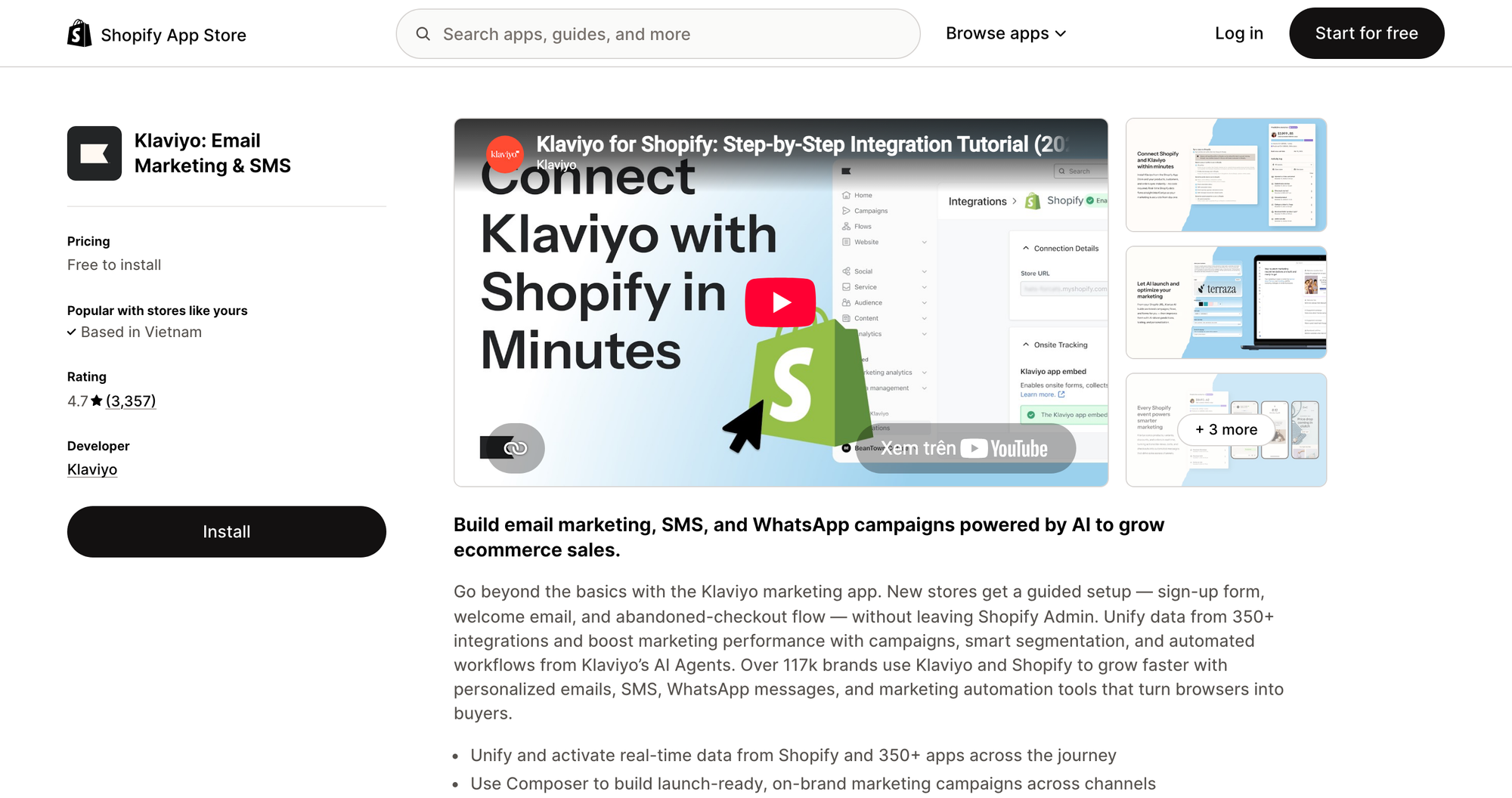
| Plan | Monthly | What the card says |
|---|---|---|
| Free | free to install | "Email free forever for up to 250 contacts. SMS free for up to 150 SMS/MMS credits." |
| SMS | $15 | "Up to 1250 SMS/MMS credits. Includes carrier fees. Upgrade as you grow." |
| $20 | "251-500 contacts. Upgrade as you grow." |
Three cards, a 500-contact ceiling, and the phrase "Upgrade as you grow" standing in for every number above it. The panel also carries a "See all pricing options" link, which is the App Store's way of saying this is not the whole ladder.
That matters more here than on most listings, because Klaviyo is the default email choice for Shopify brands at exactly the scale the listing does not cover. A brand with 8,000 active profiles reading the listing learns that Klaviyo costs $20, which is wrong by a factor of seven.
The ladder Klaviyo actually publishes
Klaviyo's pricing page asks "How many active profiles do you have?" and shows an estimated monthly price on three cards as you move the slider: Free, Email, and Marketing. Here is what it displayed at selected steps on 8 October 2026, at list price.
| Active profiles | Email plan | Marketing plan |
|---|---|---|
| 500 | $20 | $90 |
| 1,000 | $30 | $100 |
| 2,500 | $60 | $130 |
| 5,000 | $100 | $170 |
| 6,500 | $140 | $210 |
| 10,000 | $150 | $220 |
| 10,500 | $175 | $321 |
| 12,500 | $275 | $425 |
| 25,000 | $400 | $575 |
| 60,000 | $860 | $1,263 |
| 135,000 | $1,785 | $2,299 |
| 150,000+ | Custom | Custom |
Two structural facts come out of that table.
The Marketing premium is flat at $70 until 10,000 profiles, then it scales. At 500 profiles the gap between Email and Marketing is $70. At 10,000 it is still $70. At 10,500 it is $146, at 25,000 it is $175, and at 135,000 it is $514. The Marketing plan bundles Klaviyo's Customer Hub, and Klaviyo's billing documentation prices Customer Hub separately "starting at $20 per month for up to 10,000 active profiles". The bundle re-prices once that component's first tier is exceeded.
A promotion was running on the day of reading. The pricing page displayed "$19 off your first month on the $20 email plan", which rendered the 500-profile Email card as $1 struck through $20. Every figure in the table above is list price, which is what month two costs.
The 46% step at 10,500 active profiles
The sharpest thing on Klaviyo's ladder is a cliff, and it sits in a place nobody warns about.
Between 10,000 and 10,500 active profiles, the Marketing plan goes from $220 a month to $321. That is a $101 increase, or 46%, for 5% more profiles. The Email plan steps too, from $150 to $175, a 17% increase for the same 5%.
The cause is published, in Klaviyo's documentation rather than on the pricing page: Customer Hub is priced from $20 a month for up to 10,000 active profiles. Cross 10,000 and the bundled component moves to its next tier, and the bundle price moves with it.
For a brand sitting between 9,000 and 10,000 active profiles, that is an actionable number rather than trivia. Five hundred extra profiles acquired in a popup campaign can cost $1,212 a year on the Marketing plan, which is more than the campaign's incremental revenue in most cases. Check the profile count before you run the list-growth push, not after.
Ten thousand profiles is the cheapest rung on the ladder
Price per profile is the right way to read a contact-metered tool, and Klaviyo's Email ladder is not monotonic.
| Active profiles | Email plan | Cost per 1,000 profiles |
|---|---|---|
| 2,500 | $60 | $24.00 |
| 5,000 | $100 | $20.00 |
| 6,500 | $140 | $21.54 |
| 10,000 | $150 | $15.00 |
| 11,000 | $200 | $18.18 |
| 12,500 | $275 | $22.00 |
| 25,000 | $400 | $16.00 |
| 135,000 | $1,785 | $13.22 |
The Email plan rises just $10 between 6,500 and 10,000 profiles, a 54% increase in capacity for 7% more money, which makes 10,000 a local minimum at $15 per 1,000. Immediately above it the measure deteriorates to $22 per 1,000 at 12,500, and it does not recover to the 10,000-profile level until roughly 25,000 profiles.
Two decisions follow. If you are below 10,000, you have more room than the price suggests, so there is no cost reason to hold the list artificially small until you are near the ceiling. If you are between 10,000 and 25,000, you are on the most expensive stretch of the ladder per profile, and the fastest lever is suppression rather than negotiation.
What Klaviyo counts, and what it does not bill
Three definitions from Klaviyo's own billing documentation decide the invoice, and all three are published.
An active profile is "any contact in your database that can receive marketing." Not a subscriber, not a customer, not an email address. The unit is permission, so an unengaged profile that has not opted out still counts.
Suppressed profiles are not billed. That is the single most useful sentence in Klaviyo's billing documentation, because it converts list hygiene into a direct line-item saving. A brand with 11,000 active profiles and 1,200 that have not opened an email in a year can suppress its way back under 10,000 and off the expensive stretch of the ladder.
The email send allowance is ten times the maximum number of profiles in your plan. At a 10,000-profile plan that is 100,000 emails a month, which is ten sends per profile. For comparison, Omnisend publishes its Standard allowance as 12 times the list. Neither tool sells unlimited email at the bottom of its ladder, and both ceilings bind on cadence rather than on list size.
Klaviyo also publishes separate add-on prices in the same documentation: Customer Hub from $20 a month for up to 10,000 active profiles, Helpdesk from $10 a month for up to 50 tickets, and Marketing Analytics from $100 a month for up to 13,500 active profiles. Those stack on top of the ladder above, and none of them appear on the App Store listing.
Klaviyo at a glance
Best for: brands at 5,000 active profiles and above that want one tool covering email, SMS, push and predictive analytics with the deepest Shopify data sync in the category. Klaviyo's ladder is genuinely self-serve to 135,000 active profiles, so a brand can forecast its own cost through two years of list growth without a sales call, which no enterprise-grade marketing platform in the loyalty or incentives space offers.
Not ideal for: brands under 500 contacts that will send often, and brands with a large unengaged file. At the bottom of the ladder the $20 Email plan carries a 5,000-email monthly allowance on 500 profiles, and the ten-times rule means cadence is capped at every rung. A brand at 35,000 active profiles pays $550 a month on the Email plan, and if half of that file is dormant, half of the $550 buys permission nobody is using. The only fix is suppression discipline, and in most teams nobody owns it.
Klaviyo runs on 415,351 live Shopify stores. Its listing read 4.7 stars from 3,362 reviews on 8 October 2026, with 263 one-star and 37 two-star reviews, and the listing does not carry the Built for Shopify badge.
What it actually does
- Syncs Shopify tags, catalogue and coupons natively, plus segmentation, A/B testing, forms and push notifications on the free plan.
- Predictive analytics and send-time optimisation on the Email plan, which is the feature most often cited as the reason brands stay.
- Reputation repair AI for deliverability, named on the Email plan card.
- An SMS plan at $15 a month for up to 1,250 SMS or MMS credits with carrier fees included, which is unusual: most SMS platforms pass carrier fees through on top of the per-message rate.
- Transactional SMS, two-way conversations and branded SMS links on the SMS plan.
What to check before you commit
Count your active profiles using Klaviyo's definition, not your subscriber count, and then price the slider yourself. The listing's $20 is the floor of a 50-step ladder, and the difference between what you assume and what you will pay is measured in hundreds of dollars a month at mid-market scale.
Then check two thresholds against your current file: 10,000 active profiles, where the Marketing plan steps 46%, and whichever slider step sits just above your count, because the ladder moves in uneven jumps rather than smoothly.
Finally, read the one-star reviews. At 7.8% of 3,362, the one-star share is the highest in this category among apps with a comparable install base, and billing surprises are a recurring theme in a contact-metered tool. Knowing the unit and the ladder before you install is the defence.
The honest version of the Klaviyo pricing question
The claim circulating about Klaviyo is that it hides its prices. It does not. What it does is publish them on a different surface from the one Shopify merchants start on, render them client-side so they do not appear in the page source, and leave "Upgrade as you grow" standing in for a 50-step ladder on the App Store listing.
That is still a real problem for a buyer, and it is fixable in two minutes: open the pricing calculator, move the slider to your own active profile count, and write down the number. Then do the same for the alternative. A platform decision made from two plan cards is a decision made with 3% of the price list.
For the head-to-head on features and total cost, read Klaviyo versus Omnisend. For what to actually send once the platform is chosen, loyalty program email templates covers the sequences that produce repeat orders, what a loyalty program costs prices the retention layer on the same basis, and customer acquisition versus retention sets out why the owned channel earns the budget.
Price the slider, not the plan card
Klaviyo's ladder is checkable, uneven and free to read, and two numbers on it decide most of the budget: your active profile count under Klaviyo's definition, and whether that count sits above or below 10,000. Open the calculator, move the slider to your real number, note the figure, then suppress every profile you are paying for and not mailing. That is a five-minute exercise that frequently pays for itself in the first invoice.
Frequently asked questions
How much does Klaviyo cost per month? From $20 a month on the Email plan for 251 to 500 contacts. Klaviyo's own calculator showed $100 at 5,000 active profiles, $150 at 10,000, $400 at 25,000 and $1,785 at 135,000 on 8 October 2026. The Marketing plan ran $70 above Email up to 10,000 profiles and more above it.
Does Klaviyo publish its pricing above 500 contacts? Yes. klaviyo.com/pricing carries a self-serve slider from 500 to 150,000+ active profiles with a monthly figure at every step, with no login and no sales contact required. Only the 150,000+ step replaces the price with "Custom". The Shopify App Store listing is the surface that stops at 500 contacts.
What is an active profile in Klaviyo? Klaviyo's billing documentation defines it as any contact in your database that can receive marketing. Suppressed profiles are not billed, so suppressing unengaged contacts reduces the bill directly.
How many emails can I send on a Klaviyo plan? Ten times the maximum number of profiles in your plan, per Klaviyo's billing documentation. On a 10,000-profile plan that is 100,000 emails a month, or ten sends per profile.
Why does the Klaviyo Marketing plan jump at 10,500 profiles? The Marketing plan bundles Customer Hub, which Klaviyo prices separately from $20 a month for up to 10,000 active profiles. Crossing 10,000 moves that component to its next tier, and the bundle price goes from $220 to $321, a 46% increase for 500 extra profiles.
Is Klaviyo's free plan worth using? For validation, yes: 250 contacts with email free forever, 150 SMS or MMS credits, native Shopify sync, segmentation, A/B testing and forms. It is a trial sized to prove the integration rather than to run a programme, and the $20 Email plan is where a real list starts.

Written by
Thomas Nguyen is the CEO & Co-founder of Joy, a loyalty solution for Shopify and eCommerce brands. With years of experience building high-performance Shopify apps, Thomas aims to help merchants grow through customizable and retention-focused tools.
Related reading
 Shopify apps
UpPromote Alternatives: The 300-Referral Cap Nobody Meters
UpPromote's Growth plan caps at 300 reviewed referrals a month, a unit no rival meters. Seven alternatives compared on cap mechanics.
 Thomas Nguyen
 Shopify apps
Postscript Pricing: Free to Install Means $49 a Month
Free to install carries a $49 monthly minimum, then $0.009 per SMS plus carrier fees the listing never puts a number on.
Thomas Nguyen Shopify apps
Best Shopify Membership Apps: Appstle $19, No Member Fee
Appstle charges $19 with no per-member fee. Inveterate publishes no price at all. Seven apps and what each pricing panel does not say.
Thomas Nguyen Shopify apps
Klaviyo vs Omnisend: Scale Against a Readable Bill
Klaviyo runs on 415,351 Shopify stores and stops publishing prices at 500 contacts. Omnisend publishes a bill you can forecast.
Thomas Nguyen Shopify apps
Smile.io Pricing: The $999 Plan Is Not on the App Store
The listing stops at Growth $199. smile.io adds Plus at $999 billed annually, and the crossover sits near 6,500 monthly orders.
Thomas Nguyen How-to Guide
BFCM Readiness: Shopify Tests Checkout, Nobody Tests Your Widget
Shopify scale-tests checkout at 80,000 a minute. The risk you own is the storefront, measured on the signed-in path.
Thomas Nguyen