Klaviyo vs Omnisend: Scale Against a Readable Bill
Klaviyo runs on 415,351 Shopify stores and stops publishing prices at 500 contacts. Omnisend publishes a bill you can forecast.
Summarize this post with AI
Klaviyo runs on 415,351 Shopify stores, Omnisend on 66,190 and Avada Email on 2,747, measured 7 October 2026. On adoption this is not a close contest.
On cost it is. Omnisend publishes a price you can read: $16 at 500 contacts with 6,000 emails a month, $59 at 2,500 contacts with unlimited email. Klaviyo publishes $20 for 251 to 500 contacts and then stops publishing — the rest of its ladder lives on Klaviyo's own site, not on the Shopify listing. Avada Email is $16 at 500 contacts and $47 at 2,500, with unlimited sends on both, and is the only one of the three that bills everything through your Shopify invoice.
Pick Klaviyo if predictive segmentation and a deep data model are worth the setup time. Pick Omnisend if you want flows running this week and a bill you can forecast. Pick Avada Email if you are under 2,500 contacts, send a lot, and want one invoice.
Key takeaways
- Ratings are nearly identical: Klaviyo 4.7 from 3,357 reviews, Omnisend 4.7 from 3,186, Avada Email 4.8 from 818. The merchants running each are equally satisfied; the install counts differ by 150 times.
- Omnisend's free plan caps you at 500 emails a month to 250 contacts. That is two emails per contact per month.
- Klaviyo and Omnisend both warn on their listings that some charges are billed separately from your Shopify invoice. Avada Email carries no such notice.
- Omnisend is the only one of the three whose listing advertises an MCP integration for ChatGPT and Claude.
- Omnisend's listing reveals the ladder goes past $400 a month, in a feature line offering an email expert on "$400/mo+ plans".
- Deliverability is now a compliance question, not a craft question. Google and Yahoo's bulk sender rules require authenticated domains, one-click unsubscribe and a spam complaint rate under 0.3%.
What actually decides this
Three things separate these platforms, and none of them is the template editor.
Deliverability is a set of rules you must meet. Since February 2024, Google's bulk sender requirements have required anyone sending over 5,000 messages a day to Gmail accounts to authenticate with SPF, DKIM and DMARC, offer one-click unsubscribe, and keep the reported spam rate below 0.3%. Yahoo matches it. This is the floor every platform here sits on, which means "better deliverability" is no longer a feature claim you should accept without asking which of those obligations the platform handles for you and which it leaves to your DNS.
Segmentation depth is a time cost, not just a capability. A flexible data model only pays off when someone models the data. The honest question is not which platform can build the segment, but who in your team will.
The automation surface extends past email. Loyalty tier, point balance, subscription status and order history all live in Shopify, and Shopify Flow is how most of them move. Whether your email platform can trigger from, and write back to, those events decides whether your campaigns can be about anything other than browsing and carts.
Finally, the reason any of this is worth budget: Harvard Business Review's summary of the retention research puts acquiring a new customer at five to 25 times the cost of keeping one, and cites Frederick Reichheld's work at Bain & Company showing a 5% lift in retention raises profit 25% to 95%. Email is the cheapest channel that acts on that, which is why the platform choice deserves more than a price comparison.
How the three compare
Every rating, review count and price below was read from each app's live Shopify App Store listing on 7 October 2026, and each app name links to its listing so you can check it in one click. Install counts are the number of live Shopify stores running the app on the same date.
| Klaviyo | Omnisend | Avada Email | |
|---|---|---|---|
| Installs | 415,351 | 66,190 | 2,747 |
| Rating / reviews | 4.7 / 3,357 | 4.7 / 3,186 | 4.8 / 818 |
| Live since | Sep 2012 | Mar 2014 | Aug 2020 |
| Free plan | 250 contacts | 250 contacts, 500 emails/month | 14-day trial |
| At 500 contacts | $20 | $16, 6,000 emails/month | $16, unlimited emails |
| At 2,500 contacts | not published on the listing | $59, unlimited emails | $47, unlimited emails |
| Billed outside Shopify | yes | yes | no |
1. Klaviyo — the deep data model, priced off the listing
Best for: stores that will invest weeks in segmentation and want predictive analytics — churn risk, next order date, purchase likelihood — driving the flows rather than decorating a dashboard. Klaviyo is also the safest ecosystem bet: with 415,351 installs, every agency, every integration and every tutorial assumes it.
Not ideal for: anyone who needs to forecast a bill from the Shopify listing, and any team without someone who will own segmentation. Klaviyo rewards configuration time, and a store that never gives it any is paying a premium for a list-blast tool.
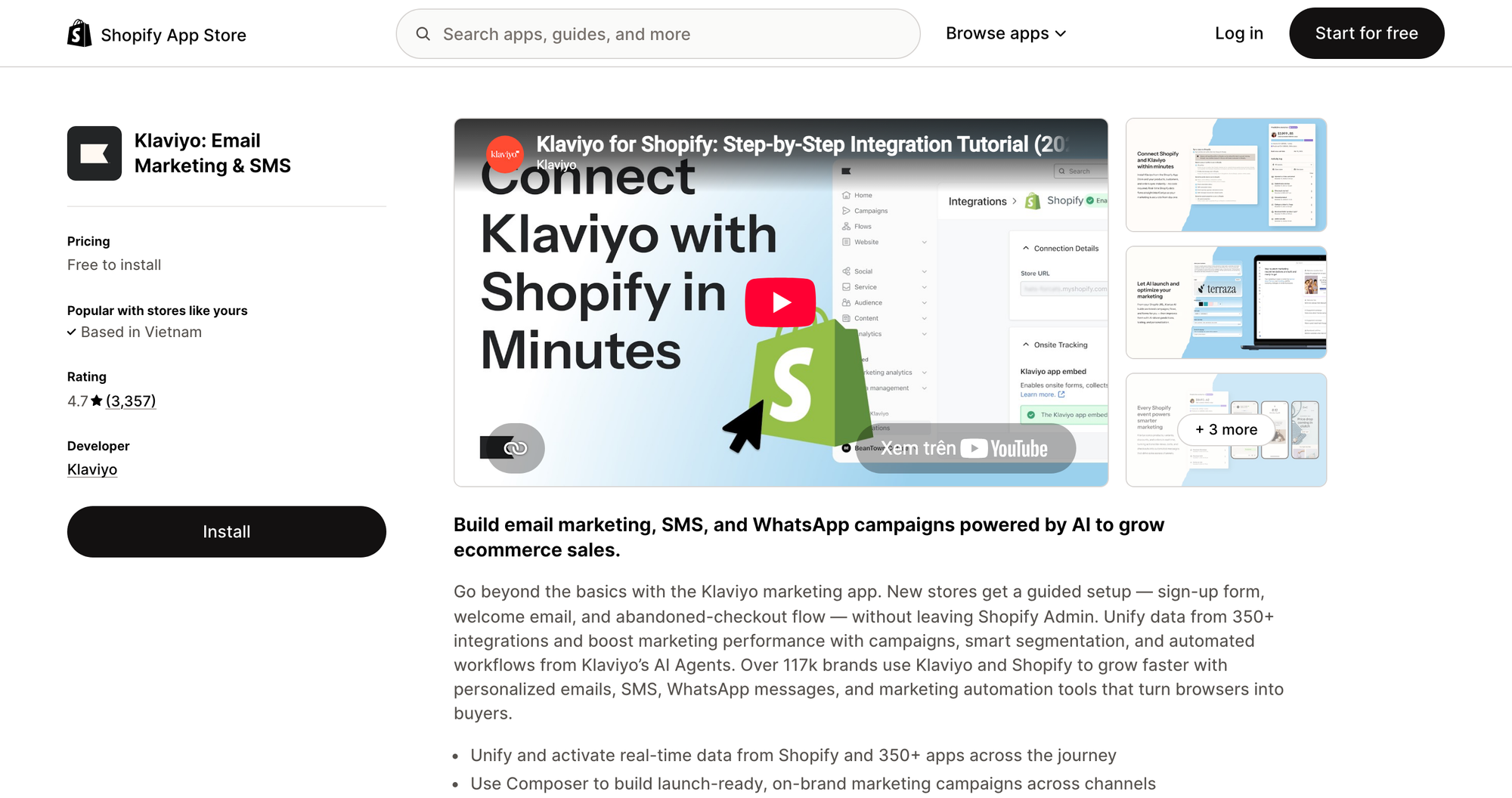
415,351 installs, 4.7 stars from 3,357 reviews, live since September 2012.
What it actually does
- Klaviyo syncs Shopify tags, catalogue and coupons natively, and builds segmentation on that data rather than on a generic contact list.
- Predictive analytics on the Email plan: send time optimisation, purchase likelihood and reputation repair AI for deliverability.
- 160+ campaign templates, multi-channel A/B testing and customisable multi-channel attribution.
- SMS sold as a separate $15 plan covering 1,250 SMS/MMS credits including carrier fees, rather than as a tier of the email plan — which means the SMS decision is a separate budget line, not an upgrade.
What to check before you commit
The listing publishes Free for up to 250 contacts, SMS at $15, and Email at $20 for 251 to 500 contacts, each with the line "upgrade as you grow". What the next step costs is not on the Shopify page. Open Klaviyo's own pricing page and price your actual contact count before you install, because the number that matters to you is not the number on the listing.
The listing also warns that external charges may be billed by Klaviyo separately from your Shopify invoice. For a finance team reconciling app spend inside Shopify, part of the Klaviyo bill will not appear there.
2. Omnisend — the bill you can read
Best for: stores that want abandoned cart and welcome flows live within days and a price they can project against a list-growth forecast. Omnisend's AI builds a segment or a popup from a plain description, which is the shortest path from install to a running flow in this group — it suits a team where email is someone's third job.
Not ideal for: stores needing segmentation deeper than template-driven rules, and anyone planning to stay on the free plan while sending weekly. The free tier's 500-email cap runs out at one send a fortnight to a full list.
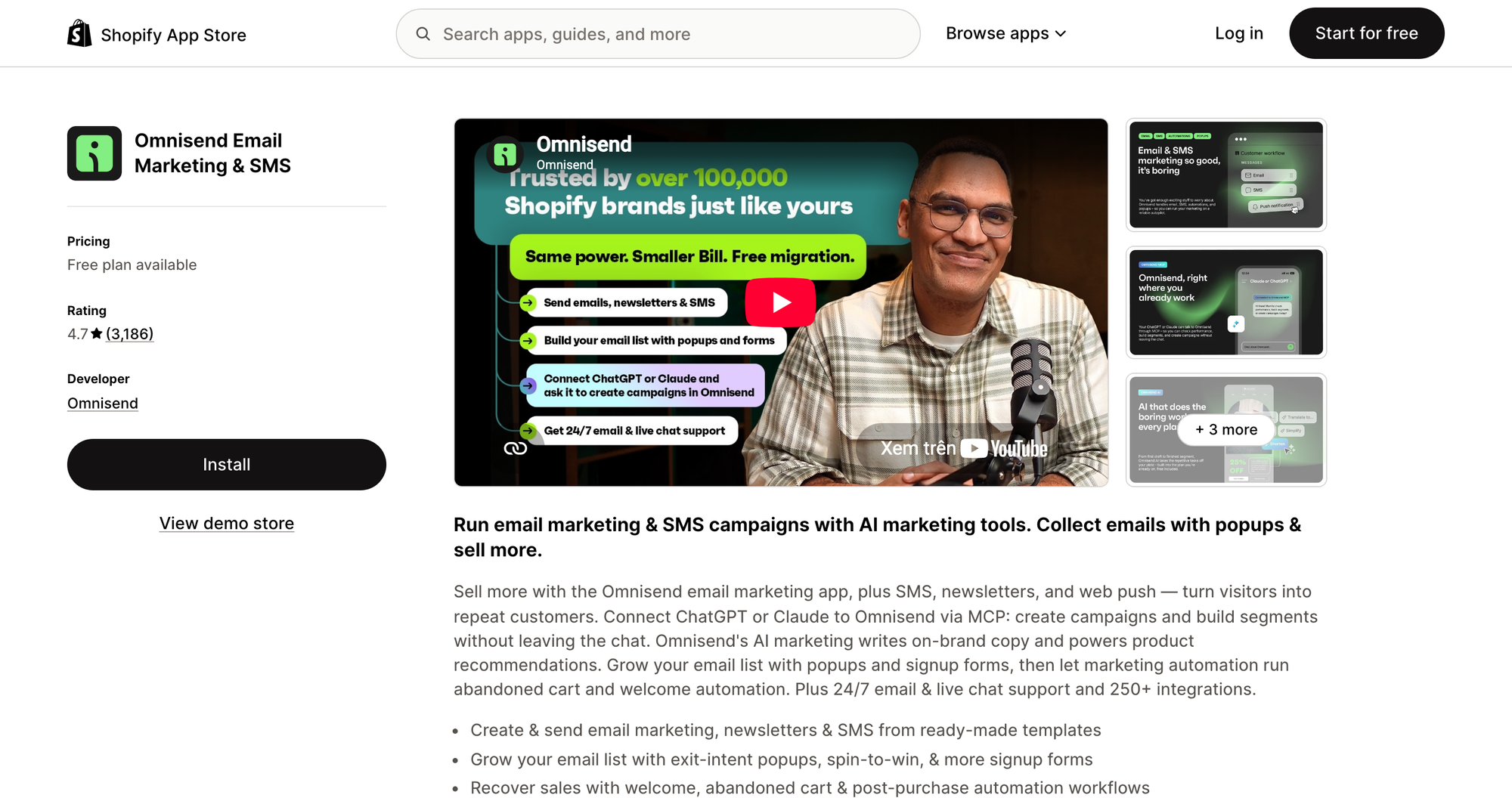
66,190 installs, 4.7 stars from 3,186 reviews, live since March 2014.
What it actually does
- Omnisend includes 250+ customisable email templates, popups and forms, with abandoned cart and welcome automations on the free plan.
- An AI that builds a segment or a popup from a plain description.
- Unlimited web push notifications on paid plans — a channel Klaviyo does not treat as core.
- SMS from $0.007 a message, added on the Pro plan.
- An MCP integration that lets you drive Omnisend from inside ChatGPT or Claude. No other app in this comparison lists one.
- 24/7 live support on the free plan, which is unusual at that price.
What to check before you commit
The free plan's real limit is 500 emails a month, not the 250 contacts. A store with 250 contacts sending a weekly campaign uses 1,000 emails a month and is already over.
Both paid prices are starting prices that rise with list size: $16 "covers up to 500 contacts and rises as your list grows", $59 covers up to 2,500 on the same terms. The 30% discount on the first three months applies to both. And a feature line on Standard — an email expert available on "$400/mo+ plans" — tells you where the ladder ends up, even though those tiers are not shown.
Like Klaviyo, Omnisend warns that some charges are billed separately from your Shopify invoice.
3. Avada Email — unlimited sends at the small end, one invoice
Best for: stores under 2,500 contacts that send frequently and want the whole bill on the Shopify invoice. Unlimited sends on a $16 plan is the thing neither leader offers: Omnisend caps Standard at 6,000 emails a month and only removes the cap at $59.
Not ideal for: stores growing past 2,500 contacts, and any team that needs a deep integration ecosystem. 2,747 installs means fewer agencies who have configured it and fewer public answers when something breaks at 11pm.
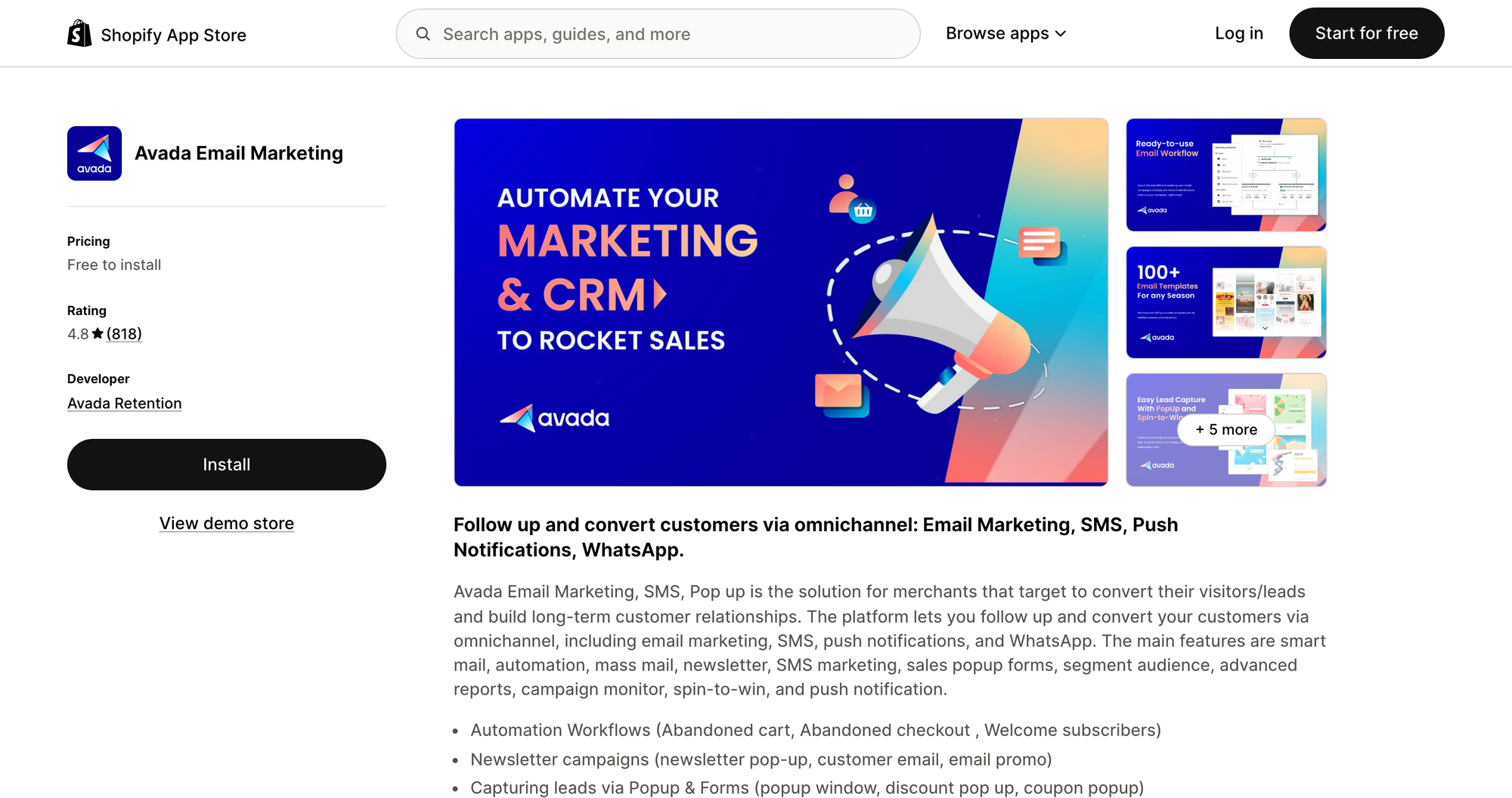
2,747 installs, 4.8 stars from 818 reviews, live since August 2020. It is built by Avada, the same company that builds Joy, so read this section as a disclosure rather than a recommendation.
What it actually does
- Avada Email includes unlimited emails sent on both paid plans.
- Pro at $16 covers up to 500 contacts with unlimited automation flows, all templates, SMS and WhatsApp, and removable branding.
- Advanced at $47 covers up to 2,500 contacts and adds Google and Facebook ads integration, an account manager, and deliverability and implementation support — which is the part worth most to a store that has never configured SPF, DKIM and DMARC.
- No notice of external billing on the listing: charges go through Shopify.
What to check before you commit
The free entry is labelled "Free to install" with a 14-day trial covering 12,000 emails and 500 contacts. Read that as a trial, not a free tier, and plan on $16 from week three.
Then weigh the ecosystem honestly against the price. At 818 reviews and 4.8 stars the merchants running it are satisfied; there are simply far fewer of them. If your store depends on a long tail of integrations, that is the trade you are making.
Which one fits your store
Under 500 contacts, sending often: Avada Email or Omnisend at $16. Avada removes the send cap at that price; Omnisend gives you 6,000 emails and a much larger ecosystem. If you send more than twice a week, the send cap decides it.
500 to 2,500 contacts: Omnisend at $59 or Avada Email at $47, and the $12 gap is not the deciding factor — the ecosystem is. Omnisend has 24 times the installs.
Above 2,500 contacts, or you want predictive segmentation: Klaviyo. Price it on Klaviyo's own site before you install, because the Shopify listing will not tell you.
Any size, if your team is small: Omnisend. Pre-built flows that turn on with light configuration beat a flexible data model nobody has time to model.
Where loyalty data fits once you have picked
Whichever platform you choose, the email tool does not know who your best customers are until something tells it. Loyalty tier, point balance and redemption history are the three fields that turn a generic campaign into a segment worth sending to — a VIP-tier flow and a points-expiring flow are the two highest-performing loyalty emails most stores run.
Joy pushes those fields into Klaviyo and Omnisend natively, and the loyalty program email templates worth building first are covered separately, along with examples of loyalty emails that get opened.
Frequently asked questions
Is Klaviyo or Omnisend cheaper? Omnisend, at every published price point. Omnisend is $16 at 500 contacts against Klaviyo's $20, and $59 at 2,500 contacts where Klaviyo publishes nothing on its Shopify listing. Both warn that some charges are billed outside your Shopify invoice.
Which email app do most Shopify stores use? Klaviyo, with 415,351 installs as of 7 October 2026. Omnisend is second among dedicated email tools with 66,190.
Does Omnisend's free plan have a send limit? Yes. 500 emails a month to up to 250 contacts. A weekly campaign to a full 250-contact list uses roughly 1,000 emails a month, so the free plan supports about two sends a month.
Can I send unlimited emails on a cheap plan? On Avada Email, yes — both the $16 Pro and $47 Advanced plans list unlimited emails sent. Omnisend removes its send cap at $59. Klaviyo does not publish send caps on the Shopify listing.
What do I need for emails to reach Gmail inboxes? Google's bulk sender requirements apply to anyone sending more than 5,000 messages a day to Gmail: SPF, DKIM and DMARC authentication on your sending domain, one-click unsubscribe, and a reported spam rate kept below 0.3%. Every platform here can send authenticated mail; publishing the DNS records is still your job.
Which one should I pick if I already run a loyalty program? Any of the three, as long as it receives loyalty tier and point balance as customer fields. That integration, not the email features, is what makes a loyalty-driven campaign possible.

Written by
Thomas Nguyen is the CEO & Co-founder of Joy, a loyalty solution for Shopify and eCommerce brands. With years of experience building high-performance Shopify apps, Thomas aims to help merchants grow through customizable and retention-focused tools.
Related reading
 Shopify apps
UpCart vs AfterSell: Both Apps Belong to Rokt
Merchants comparing them are choosing between two SKUs from one owner. UpCart meters orders, AfterSell prices by surface.
 Thomas Nguyen
 Shopify apps
EU Withdrawal Button Apps: Two Start Free, One Charges
EU Directive 2023/2673 became mandatory on 19 June 2026. Four withdrawal-button apps on price, scope and what each listing leaves out.
Thomas Nguyen Shopify apps
Shopify Loyalty App Pricing: $30 to $199 at 2,000 Orders
Appstle costs $30 at 2,000 monthly orders and Smile costs $199. Eight loyalty apps priced at 500, 2,000 and 10,000 orders.
Thomas Nguyen Shopify apps
Loloyal Alternatives: Loloyal Is Now CWILL Loyalty
Same install base and review history under a new name. Its $69 Growth plan jumps to $599 for API access, and five alternatives priced.
Thomas Nguyen Shopify apps
UpPromote vs GoAffPro: Only One Takes a Cut
UpPromote charges 2% of referred sales on top of its monthly fee. GoAffPro and BixGrow charge no percentage at any tier.
Thomas Nguyen Shopify apps
Best Shopify Order Editing Apps: Orderify Costs $8.99
Orderify prices by your Shopify plan, not your order volume, where OrderEditing.com charges $99. Seven apps and who each one suits.
Thomas Nguyen