
Omnisend Pricing: $16 Buys 12 Emails per Contact
Standard is $16 a month with a 6,000-email cap, which is twelve sends per contact. Unlimited email starts at $59 on Pro.
Summarize this post with AI
Omnisend's Standard plan is sold on contacts and billed on contacts, but the limit that actually binds is sends. The $16 Standard plan covers up to 500 contacts and allows 6,000 emails a month, read from the Omnisend listing on 8 October 2026, and 6,000 divided by 500 is 12. Omnisend's own pricing page states the allowance as "12x List", so the cap is a multiplier rather than a number.
That single detail decides whether $16 is cheap or unusable. Twelve sends per contact per month is roughly three emails a week across campaigns and automations combined, and the multiplier does not loosen as your list grows: 2,500 contacts gets 30,000 emails, 10,000 contacts gets 120,000, and both are still 12 sends each. Unlimited email starts at the $59 Pro plan, which is 3.7 times the Standard price.
Key takeaways
- The Shopify App Store listing shows three plans on 8 October 2026: Free, Standard at $16 a month and Pro at $59 a month, then links out. The vendor page adds a Custom tier for 150,001+ contacts and a contact slider the listing does not show.
- Standard's 6,000-email allowance is 12 times the 500-contact entry band. Omnisend publishes the allowance as "12x List", so the ratio is the plan rule.
- Free allows 250 contacts and 500 emails a month, which is 2 times the list. The step from 2x to 12x costs $16; the step from 12x to unlimited costs $59.
- Pro's entry price of $59 covers up to 2,500 contacts, so a brand with 600 contacts that needs unlimited sending pays for a 2,500-contact plan.
- Omnisend publishes no overage rate. Its pricing page says exceeding the send limit on Free or Standard produces an upgrade option, not a per-email charge.
- Omnisend's listing read 4.7 stars from 3,186 reviews on 8 October 2026, with 166 one-star reviews, and the listing does not carry the Built for Shopify badge.
What the listing publishes, and where it stops
Every price, rating and limit below was read from the live Shopify App Store listing on 8 October 2026, and from Omnisend's own pricing page the same day. Both surfaces were checked because the listing is not a complete price list.
| Plan | Monthly | Contact band | Email allowance | Ratio |
|---|---|---|---|---|
| Free | $0 | up to 250 | 500 emails a month | 2x list |
| Standard | $16 | up to 500, rises with the list | 6,000 emails a month | 12x list |
| Pro | $59 | up to 2,500, rises with the list | unlimited emails | no cap |
| Custom | not published | 150,001+ contacts | not published | not published |
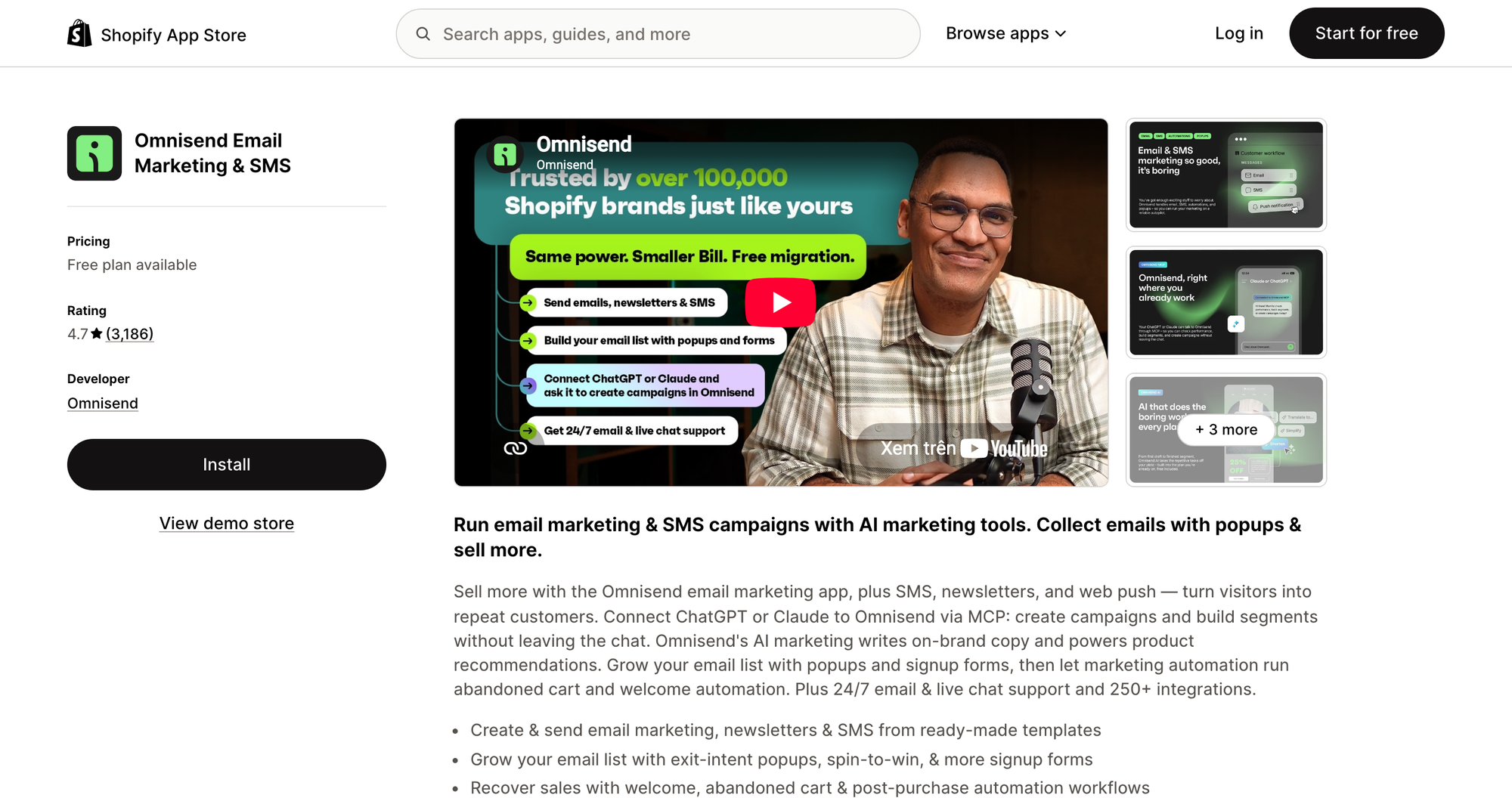
Two things sit outside the App Store panel and matter to a buying decision.
The contact slider. omnisend.com/pricing carries a slider running from 0 to 150,001+ contacts, and both paid plan prices rise as you move it. The App Store panel shows only the floor of each plan, so a brand with 8,000 contacts cannot price Omnisend from the listing at all. The listing's own wording admits this: both paid cards say the starting price "rises as your list grows".
The promotion. On 8 October 2026 the vendor page was displaying Standard at $11.20 and Pro at $41.30, which is 30% off for the first three months. The list prices are $16 and $59, and the listing prints the discount as "Starter deal: 30% off for first 3 months". Budget from list price, because month four is the real number.
The 6,000-email cap is a multiplier, not a ceiling
The number that appears on the plan card is 6,000. The rule behind it is 12x, and Omnisend states it that way on its own pricing page. Those two facts behave very differently as a list grows.
| Contacts on Standard | Published email allowance | Sends per contact per month |
|---|---|---|
| 500 | 6,000 | 12 |
| 2,500 | 30,000 | 12 |
| 10,000 | 120,000 | 12 |
| 50,000 | 600,000 | 12 |
A brand reading "6,000 emails a month" assumes the constraint will loosen with scale. It does not. Standard is a 12-sends-per-contact plan at every list size, so the question is never whether your list fits. It is whether your sending cadence fits.
Twelve sends a month across all email is tighter than most retention programmes run. Two campaigns a week is 8.7 sends a month on its own. Add a welcome flow, an abandoned-cart flow, a browse-abandonment flow and a post-purchase sequence, and an engaged subscriber receives several more. The cadence that an ambitious brand considers normal consumes the allowance before the campaign calendar is full.
One question decides this, and Omnisend does not answer it on either page: whether automated flow emails count toward the 12x allowance alongside campaigns. The pricing page refers to an "email sending limit" without separating the two. Ask before you buy Standard, because the answer changes the plan's capacity by a factor of two or more for any brand running serious automation.
What happens when you hit the limit
Omnisend's pricing page states that exceeding the email sending limit on Free or Standard produces an option to upgrade, plus a notification email. No overage rate is published anywhere on either surface.
That is a better failure mode than it sounds, and worth saying plainly because the alternative is worse. A plan with a published overage rate converts a cadence mistake into an invoice. A plan with an upgrade prompt converts it into a decision. Neither is free, but one of them you find out about before the money moves.
It also means the Standard plan has a hard operational edge rather than a soft financial one. If a Black Friday calendar needs 20 sends in November, Standard does not stretch for a fee. The plan changes.
What unlimited email actually costs
Pro at $59 is where the multiplier disappears, and the arithmetic at the bottom of the ladder is unflattering.
A brand with 600 contacts pays $16 on Standard for 7,200 emails a month, or $59 on Pro for unlimited. That is $43 a month more, a 3.7x increase, to remove a cap on a list of 600 people. The Pro entry band covers up to 2,500 contacts, so the brand is buying four times the contact capacity it needs in order to buy the one thing it does need.
The crossover is a cadence question rather than a list-size question. At 600 contacts, Standard allows 7,200 emails a month. A brand sending 12 campaigns plus four automated flows to an engaged segment will pass that. A brand sending four campaigns a month will not come close. Count your planned sends per contact per month, and if the number is above 10, price Pro from the start rather than upgrading mid-quarter.
Pro also carries the features that make high-frequency sending worth doing: advanced reporting, dynamic content personalisation, a product recommender and SMS from $0.007 a message. Omnisend's own pricing page publishes the SMS volume rates, from $0.009 a message at low volume down to $0.007 above $10,000 of spend.
Omnisend at a glance
Best for: brands with a large list and a disciplined campaign calendar, where 12 sends per contact a month is a ceiling nobody will hit. Omnisend's 12x rule scales with the list, so a brand with 40,000 contacts sending two campaigns a week and three flows gets 480,000 emails a month on Standard pricing rather than on a Pro contract. The multiplier is generous at scale and tight at the bottom, which is the opposite of how most email tools are priced.
Not ideal for: small lists that send often. A brand with 400 highly engaged subscribers running a weekly campaign plus a full flow library is capped at 4,800 emails a month on Standard, and the only route past it is a $59 plan sized for 2,500 contacts. Omnisend's pricing punishes frequency on a small list, which is exactly the shape a new retention programme takes in its first six months.
Omnisend runs on 66,190 live Shopify stores. Its listing read 4.7 stars from 3,186 reviews on 8 October 2026, with 166 of those at one star and 24 at two stars.
What it actually does
- Email, SMS and web push in one automation builder, with unlimited web push on Standard and above.
- Describe-a-segment and describe-a-popup AI builders, plus 250+ email templates, on the free plan.
- An MCP server, named on the listing as "Use Omnisend inside ChatGPT/Claude", which lets a marketer build campaigns from a chat interface. No other app in the Shopify email category publishes that on its free tier.
- Omnisend branding removal from Standard, which is the practical reason most brands leave the free plan.
- A dedicated email expert, stated on the listing as available on plans from $400 a month upward.
What to check before you commit
Start with the send maths, not the contact count. Multiply your contacts by 12 and compare it with your planned monthly send volume including every automated flow. If the planned figure is within 20% of the allowance, buy Pro.
Then check the two things the listing omits. The panel shows three cards and links out, so confirm your own price on the contact slider rather than from the $16 and $59 floors. And note the Custom tier at 150,001+ contacts, which means the published ladder has a sales-gated top.
Finally, read the one-star reviews. 166 of 3,186 is 5.2%, which is not alarming for an app with this install base, but the app does not carry the Built for Shopify badge, so theme and checkout integration depth is worth verifying against your own stack before migration.
Where the $16 plan earns its place
Email is the cheapest retention channel a brand owns, and the economics are not close. Harvard Business Review's summary of the retention research puts acquiring a new customer at five to 25 times the cost of keeping one, and cites Frederick Reichheld's finding at Bain & Company that lifting retention by 5% raises profit by 25% to 95%. A $16 plan that drives repeat orders is the highest-leverage line in a D2C marketing budget.
The caveat is the cadence ceiling. A retention programme does its work through frequency: a welcome series, a points-balance reminder, a reward-expiry nudge, a replenishment prompt. Those are automated, they fire per customer, and they are exactly what consumes a 12x allowance. If your loyalty programme is the engine behind your email calendar, price Pro and keep the cap out of the architecture.
For a direct comparison of Omnisend against the other serious option in this category, read Klaviyo versus Omnisend. For the sends that actually produce repeat orders, loyalty program email templates and the loyalty emails worth copying cover the sequences, and redemption rate benchmarks show what good looks like once they are running.
Count the sends before you count the contacts
Omnisend's ladder is priced on contacts and limited by sends, and the two numbers pull in opposite directions for the brands most likely to buy the $16 plan. Multiply your contacts by 12, compare the result with your real monthly send volume including automations, and buy the plan that clears it with room. A cadence ceiling discovered in November is a far more expensive problem than a $43 difference decided in October.
Frequently asked questions
How much does Omnisend cost per month? Free for up to 250 contacts and 500 emails a month, $16 a month on Standard covering up to 500 contacts and 6,000 emails, and $59 a month on Pro covering up to 2,500 contacts with unlimited emails, read from the listing on 8 October 2026. Both paid prices rise as the contact list grows.
What is Omnisend's email sending limit? Twelve times your contact count per month on the Standard plan, which Omnisend publishes as "12x List". That works out to 6,000 emails at the 500-contact entry band and 120,000 at 10,000 contacts. The Free plan allows 500 emails a month on 250 contacts, which is 2x the list. Pro has no email cap.
What happens if I exceed the Omnisend email limit? Omnisend's pricing page states that exceeding the limit on Free or Standard gives you the option to upgrade your plan, along with a notification email. No overage rate per email is published on the listing or the pricing page.
Is Omnisend Pro worth $59 a month? For any brand sending more than about 10 emails per contact per month, yes, because Standard will not carry the cadence. Pro also adds advanced reporting, dynamic content personalisation, a product recommender and SMS from $0.007 a message. For a brand sending four campaigns a month, Standard at $16 is enough.
Does Omnisend charge for SMS separately? Yes. SMS is an add-on starting at $0.007 a message on Pro, and Omnisend's pricing page publishes volume rates from $0.009 a message at low spend down to $0.007 above $10,000.
Does Omnisend have the Built for Shopify badge? No. The badge markup was not present on the listing when it was read on 8 October 2026, which is worth noting for a brand depending on deep theme and checkout integration.

Written by
Thomas Nguyen is the CEO & Co-founder of Joy, a loyalty solution for Shopify and eCommerce brands. With years of experience building high-performance Shopify apps, Thomas aims to help merchants grow through customizable and retention-focused tools.
Related reading
 Shopify apps
LoyaltyLion Pricing: Free to 400 Orders, Then $199
The largest free-to-paid step in the category, with no tier in between. That step costs $1.99 per extra order against 4 cents on Appstle.
 Thomas Nguyen
 Shopify apps
Appstle vs Seal: Revenue Caps Against Subscriber Caps
Appstle meters subscription revenue, Seal meters subscriber count. Forty subscribers at $400 run free on Seal and cost $100 on Appstle.
Thomas Nguyen Shopify apps
Smile.io Pricing: The $999 Plan Is Not on the App Store
The listing stops at Growth $199. smile.io adds Plus at $999 billed annually, and the crossover sits near 6,500 monthly orders.
Thomas Nguyen Shopify apps
Postscript Pricing: Free to Install Means $49 a Month
Free to install carries a $49 monthly minimum, then $0.009 per SMS plus carrier fees the listing never puts a number on.
Thomas Nguyen Shopify apps
Klaviyo vs Omnisend: Scale Against a Readable Bill
Klaviyo runs on 415,351 Shopify stores and stops publishing prices at 500 contacts. Omnisend publishes a bill you can forecast.
Thomas Nguyen Shopify apps
Best Shopify Membership Apps: Appstle $19, No Member Fee
Appstle charges $19 with no per-member fee. Inveterate publishes no price at all. Seven apps and what each pricing panel does not say.
Thomas Nguyen