
The Customer Loyalty Journey: 3 Problems That Break It (And the Framework That Fixes It)
46% of executives predict their loyalty program will be irrelevant within three years. The reason: most programs reward transactions but ignore the journey between them. Inside: three problems that break the customer loyalty journey, and the 5-stage framework that puts it back together.
Summarize this post with AI
A customer signs up for your loyalty program after their first purchase. They earn 200 points, then nothing happens for two months. By the time they hear from you again, a competitor has already won them.
That's not a marketing failure, it's a journey failure. Most loyalty programs treat enrollment as the finish line, but the customer loyalty journey is just beginning. Everything between purchases - engagement, recognition, progression - is where retention is actually built or lost.
This article breaks down three structural problems that break the customer loyalty journey, and the 5-stage framework that fixes them
The Loyalty Paradox No One Talks About
True loyalty fell to 29% in 2025. The SAP Emarsys Customer Loyalty Index 2025 measured a 5 percentage point drop from the year before. Merchants are spending more on loyalty than ever. And getting less back.
The paradox is hard to ignore. Loyalty program enrollment sits at record highs. Customers are signing up in record numbers. Yet actual loyalty, the kind that survives a competitor's better offer, is shrinking. As PwC's 2025 Customer Experience Survey reports, 70% of executives now admit that customer expectations are outpacing their organization's ability to adapt.
So what's going wrong? The root cause is structural. Most programs are built around a single moment, the purchase, instead of a journey. They reward transactions but ignore everything that happens between them. On the surface, it appears to be loyalty. Underneath, it's a revolving door.
This article breaks down three research-backed problems that explain why loyalty journeys fail, then introduces the 5-stage framework that addresses all three.
Merchants Treat All Loyalty Journey Stages the Same
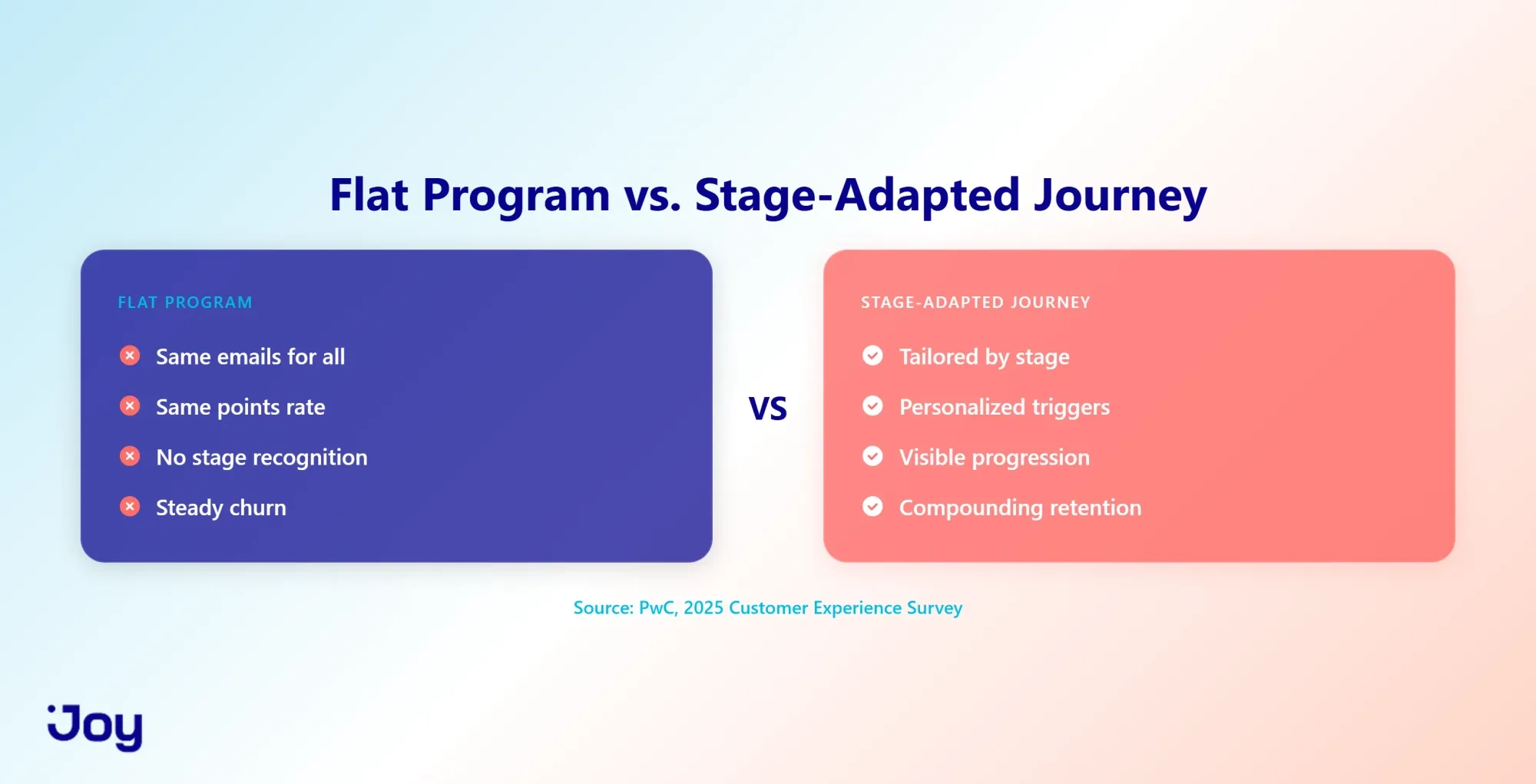
PwC's 2025 report, "The Loyalty Illusion," paints a stark picture. Beyond the 70% who say expectations are outpacing their ability to adapt, there's an even more telling finding: 46% of executives predict their own loyalty program will be irrelevant within three years.
That second number deserves attention. Nearly half of the people running these programs don't believe they'll survive. And the reason comes down to one structural flaw.
The One-Size-Fits-All Trap
Most loyalty programs are built as flat structures. Every customer gets the same emails, the same points rate, and the same rewards, regardless of where they are in their relationship with the brand. A first-time buyer who enrolled five minutes ago receives the exact same treatment as a three-year repeat customer with 15 orders.
That's a design problem. Programs are built around mechanics (earn X, redeem Y) instead of stages (where is this customer in their journey, and what do they need right now?).
What This Costs Merchants
New members feel overwhelmed because they're presented with too many options and no guidance. Mid-stage members feel ignored because there's no progression, no recognition of growth. Long-term members feel undervalued because they receive the same perks as newcomers. Why stay?
High enrollment, low engagement, and steady churn at every stage. That's the pattern repeating across industries.
The Psychology Behind It
Different stages of the customer relationship trigger fundamentally different psychological questions. Early-stage customers ask, "Will I belong here" They need community signals. Mid-stage customers ask, "Is this worth my time" They need personalization and visible progress. Late-stage customers ask, "Am I special here" They need exclusivity and recognition.
Treating every stage the same answers none of these questions. The customer never feels the program is for them. And when a program feels generic, the exit becomes frictionless.
The PwC Warning
When nearly half of executives expect their own loyalty program to become irrelevant, the message is clear. Flat structures have an expiration date. The programs that survive will be the ones that adapt to the customer's stage. The ones that treat loyalty as a checkbox? They won't.
Programs Focus Only on the Purchase Moment
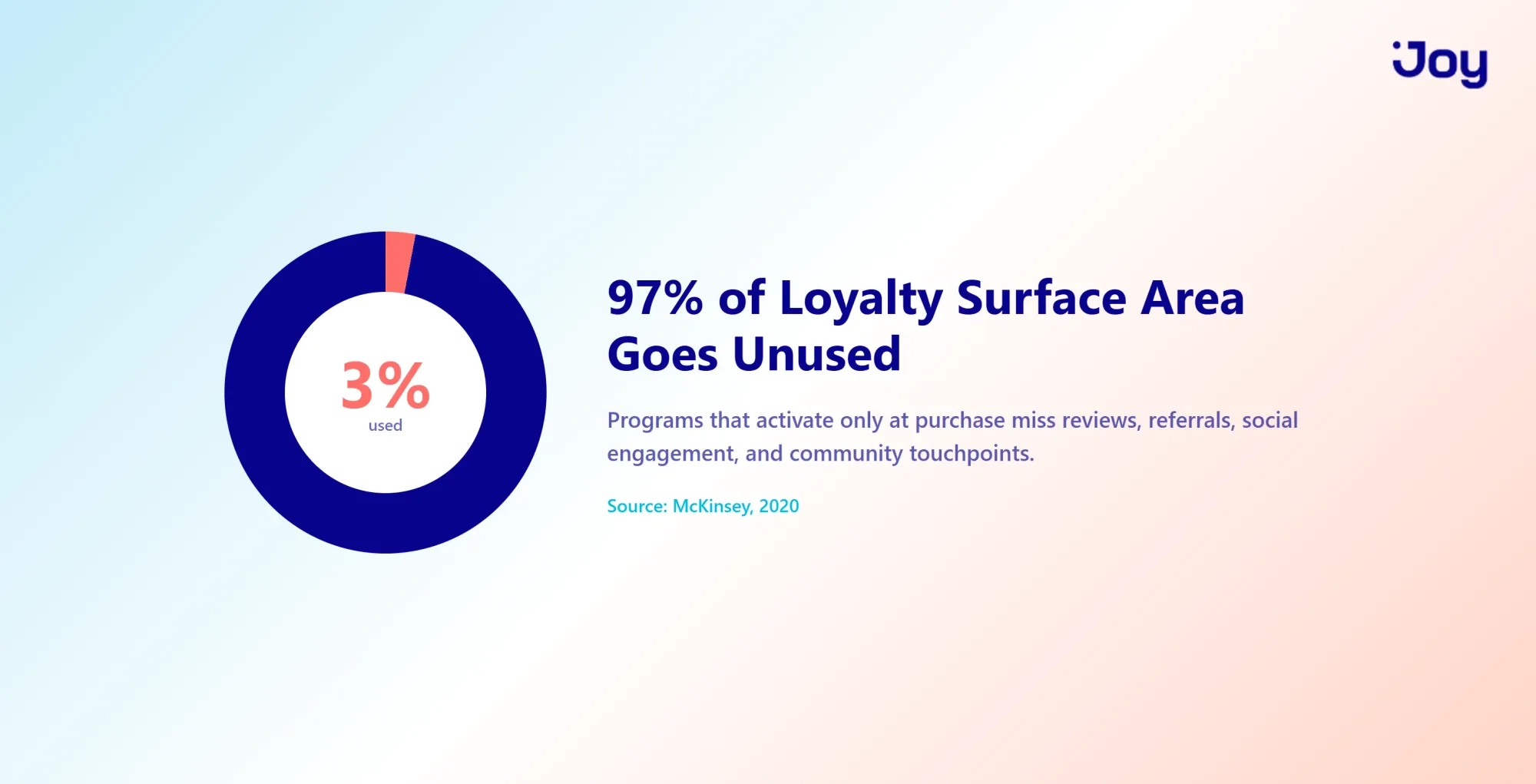
Research from McKinsey's 2020 analysis of paid loyalty programs found that 50% of cancellations happen within the first year. The primary reason members gave: they didn't use the benefits enough to justify the cost.
At first glance, that sounds like a rewards problem. But look closer and the real issue surfaces. Nothing happened between the rewards.
The Purchase-Moment Obsession
Most loyalty programs only activate at one moment: the transaction. Buy something, earn points. Redeem points, buy again. Between purchases? Complete silence.
The entire journey between transactions is empty. No engagement, no communication, no reason to remember the program exists. Customers enroll for a discount, use it once, and never return. Not because they disliked the experience, but because there was no experience to speak of.
What the McKinsey Data Actually Reveals
The 50% first-year cancellation rate tells the same story. McKinsey found that members cancel because they don't use benefits enough to justify the cost, and the underlying reason is often that nothing happens between the rewards to keep them engaged.
Think about the timeline. A typical loyalty journey has gaps measured in weeks or months where the program is completely invisible to the customer. No touchpoints, no communication, no reminders that the relationship exists. By the time the next purchase trigger arrives, the customer has already forgotten they're a member. Or worse, they've found a competitor who stayed in touch during that silence.
The Non-Transactional Earning Gap
This problem becomes even clearer when you look at what's being left on the table. Purchase-only earning means engagement stops the moment a transaction ends. The entire space between purchases (reviews, referrals, social engagement, community participation, content interaction) goes completely untouched.
Here's the key insight: these non-transactional touchpoints are where loyalty is actually built. Transactions are outcomes of loyalty, not its causes. A customer who writes a review, refers a friend, or engages with your community between purchases is demonstrating behavioral loyalty. A customer who only shows up when they need something is demonstrating a habit. And habit is far more fragile.
Why This Matters at Scale
A merchant with 10,000 loyalty members and monthly purchase cycles has roughly 10,000 purchase moments. But that same merchant has approximately 300,000 potential non-purchase touchpoints: emails opened, site visits, social interactions, referral opportunities.
Programs that activate only at purchase are using about 3% of their available loyalty surface area. The other 97% is where competitors steal your customers. Because when the journey is empty, someone else will fill it.
True Loyalty Is Declining, And Programs Are Accelerating It
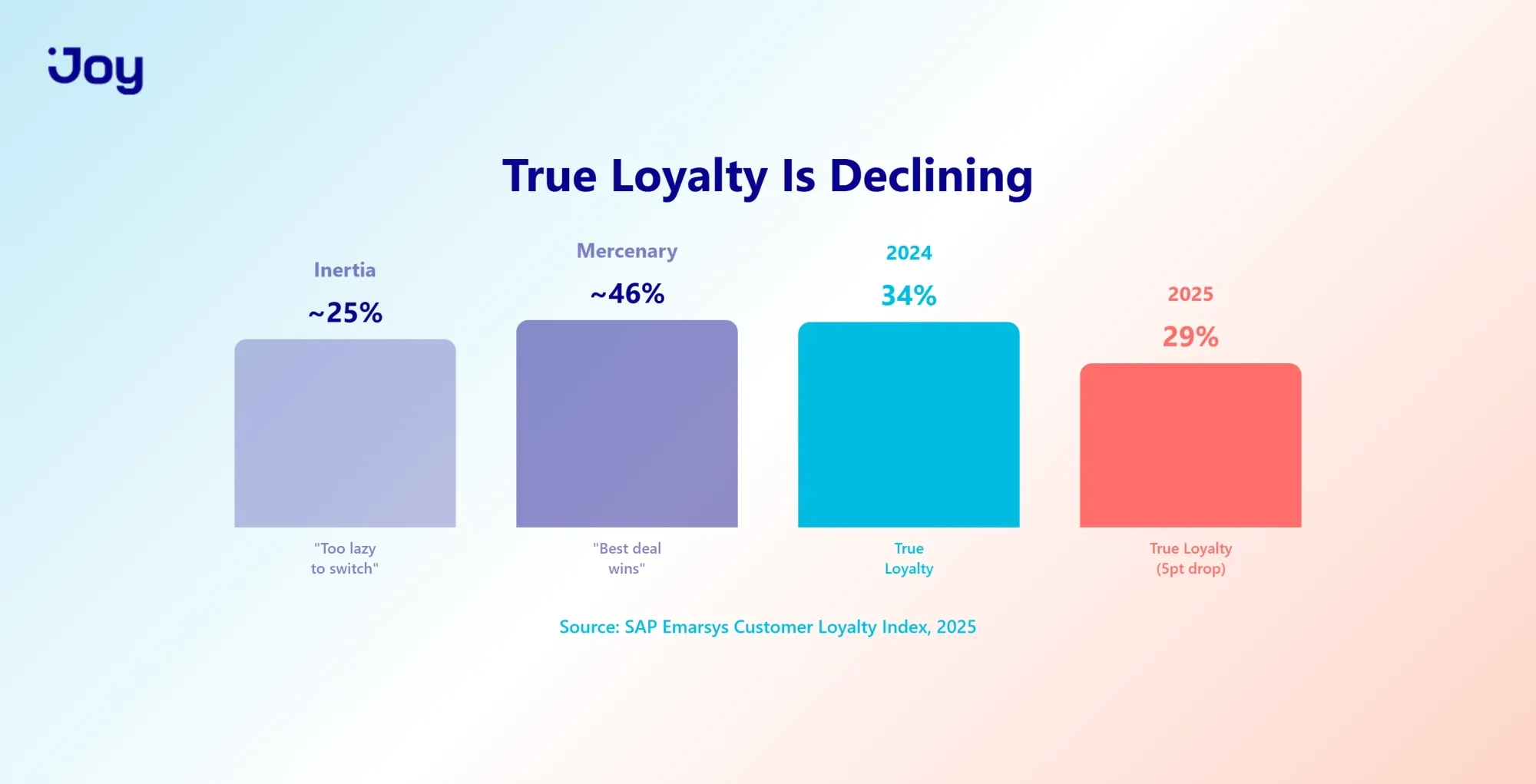
As reported in the SAP Emarsys Customer Loyalty Index 2025, "true loyalty" (deep, trust-based brand devotion) stood at 34% in 2024. By 2025, it had dropped to 29%. A 5 percentage point decline in a single year.
Why does that matter? Because of what true loyalty actually is, and how it differs from what most programs measure.
What "True Loyalty" Means
The Emarsys research distinguishes between several types of customer loyalty, and understanding how each type works matters here. Inertia loyalty describes customers who stay because switching feels like too much effort. Mercenary loyalty describes customers who go wherever the best deal is. True loyalty is something deeper: genuine trust, emotional connection, and a relationship that survives price competition, stockouts, and even the occasional bad experience.
True loyalty is the only type that creates advocates. The only type that compounds over time. And the type that's shrinking fastest.
Why Loyalty Programs Are Making It Worse
The first two problems connect directly to this third one. Most programs reinforce mercenary loyalty. The structure is simple: earn points, get discounts, repeat. The relationship is purely transactional.
When every brand offers points, customers become deal shoppers, loyal to the discount rather than the brand itself. Programs designed around transactions effectively train customers to be mercenaries. Then, merchants wonder why they leave for a better offer.
The programs built to create loyalty are actively eroding it. That's the irony.
The Journey Connection
True loyalty requires progression through stages. Customers need to move from transactional buyers to engaged members to emotionally connected advocates. That progression doesn't happen on its own. It requires different experiences at different stages, which is exactly what the first problem (same treatment at every stage) prevents.
And the emotional connection that defines true loyalty? It's built between purchases through community interaction, personalized recognition, and visible progress. That's exactly what the second problem (purchase-only focus) eliminates.
Customers get stuck in the early, transactional stages of the journey. They never experience community, recognition, or belonging, the ingredients true loyalty requires. Programs aren't building the path to true loyalty. They're building a points treadmill that customers eventually step off.
The Macro Trend
The 29% figure is a warning that operates at the industry level. Merchants who continue building flat, purchase-focused programs are swimming against a structural tide. The question isn't whether to change. It's whether you change before your customers leave.
The 5-Stage Customer Loyalty Journey Framework
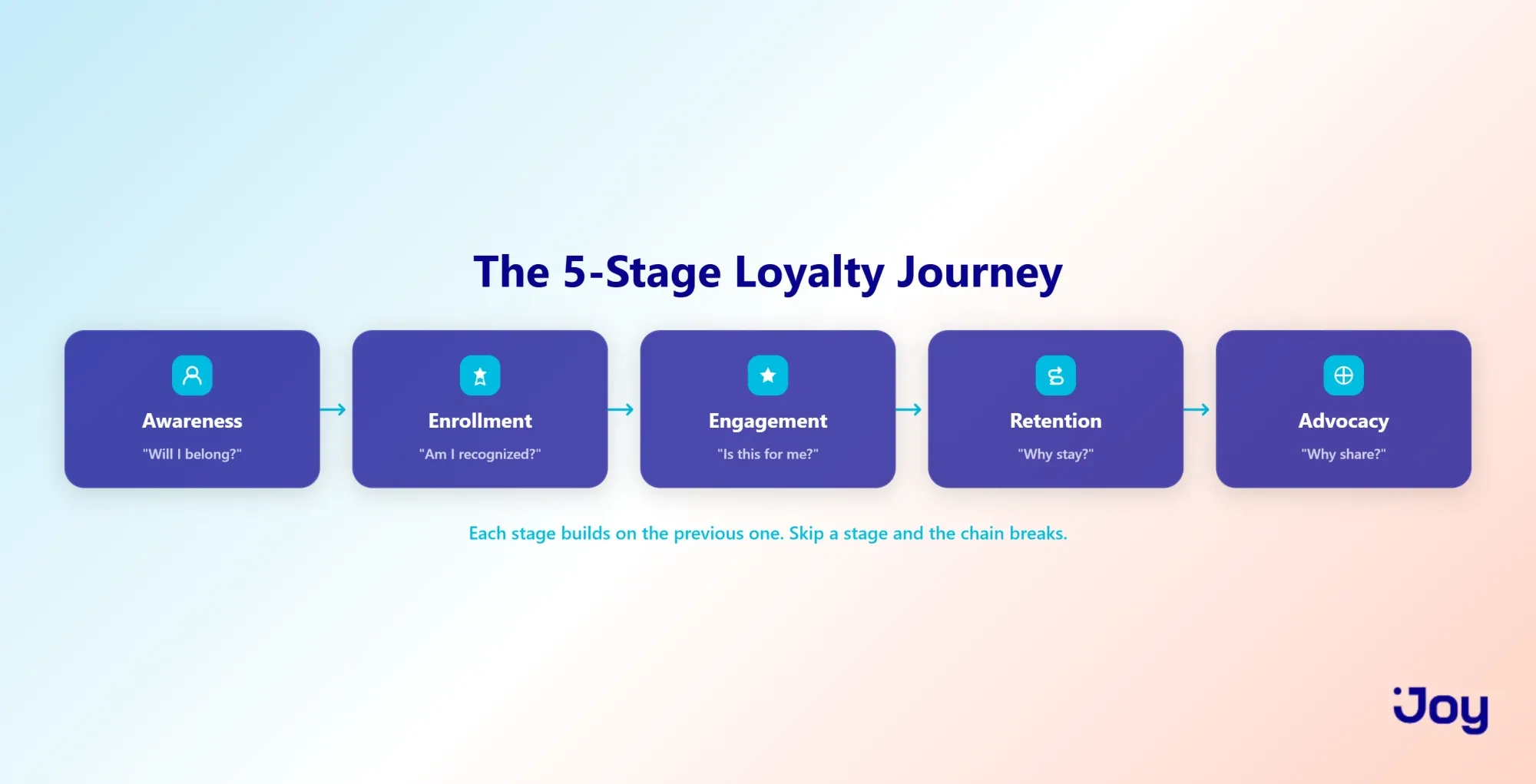
The three problems above aren't separate issues. They're symptoms of the same structural flaw: loyalty programs built around mechanics instead of journeys.
The 5-stage framework addresses this by giving each phase of the customer relationship its own strategy, its own psychology, and its own metrics. Rather than treating loyalty as a single state (member or not member), it recognizes that customers move through distinct stages, each with a different dominant question:
- Awareness: "Will I belong here" Driven by community and identity signals
- Enrollment: "Am I recognized" Driven by status and welcome experiences
- Engagement: "Is this for me" Driven by personalization and non-transactional earnings
- Retention: "Why stay" Driven by exclusivity and emotional connection
- Advocacy: "Why spread the word" Driven by leadership and belonging
The framework isn't linear. It's a compounding cycle. Each stage builds on the previous one, and skipping a stage breaks the chain. Advocacy feeds directly back into Awareness, creating a self-sustaining loop.
And it directly addresses all three problems: stage-specific treatment solves the flat experience, full-journey engagement fills the gaps between purchases, and a structured path to advocacy creates the conditions for true loyalty to form.
Stage 1: Awareness, The Permission Stage
Awareness is where customers decide: "Does this program align with who I am" If this stage fails, nothing downstream works. No amount of great rewards or personalization can compensate for a first impression that felt irrelevant.
At this stage, customers evaluate whether the program feels relevant to their identity, not just their wallet. The value proposition needs to lead with belonging and community rather than "earn points." This is also where you set journey expectations by showing customers what the stages look like, so they commit to the progression and not just the signup.
Instead of a generic "join and earn" message for everyone, Awareness-stage communication should answer the new customer's specific question: "Will I belong here" That means leading with community and belonging rather than mechanics. Making the journey visible so customers understand what progression looks like. And personalizing the signup experience by customer segment, whether they're new buyers or returning customers.
The metrics that matter here are enrollment rate, day-7 engagement (did they take any action within the first week?), and journey comprehension (do they understand the stages?).
Stage 2: Enrollment, The Recognition Moment
Enrollment is the recognition stage. The customer has joined, and now they need to feel welcomed and seen. The first badge, tier assignment, or welcome reward is your one opportunity to create a sense of belonging before they go dormant.
What makes this stage critical is the speed of recognition. Customers want status now, not after earning 100 points. Gating recognition behind an earn threshold kills momentum at the exact moment when engagement potential is highest. Immediate tier assignment, combined with a personalized welcome tailored to the customer segment, creates the feeling that the program already knows who they are. As to how tiered loyalty programs work, programs that assign status from day one consistently outperform flat structures.
In practice, this means assigning a tier or badge immediately on signup with no friction. Showing the customer their status bar and next milestone visually. And recognizing them across channels: email, SMS, and in-app, not just one.
Instead of silence after signup, Enrollment creates an active touchpoint. The customer sees their status, their next milestone, and a reason to come back, even before their next purchase. This directly addresses Problem 2 by filling the gap that usually appears right after enrollment.
The metrics here are the first-month engagement rate, the first-reward redemption rate, and the day-30 repeat-purchase rate compared to non-members.
Stage 3: Engagement, The Compounding Stage
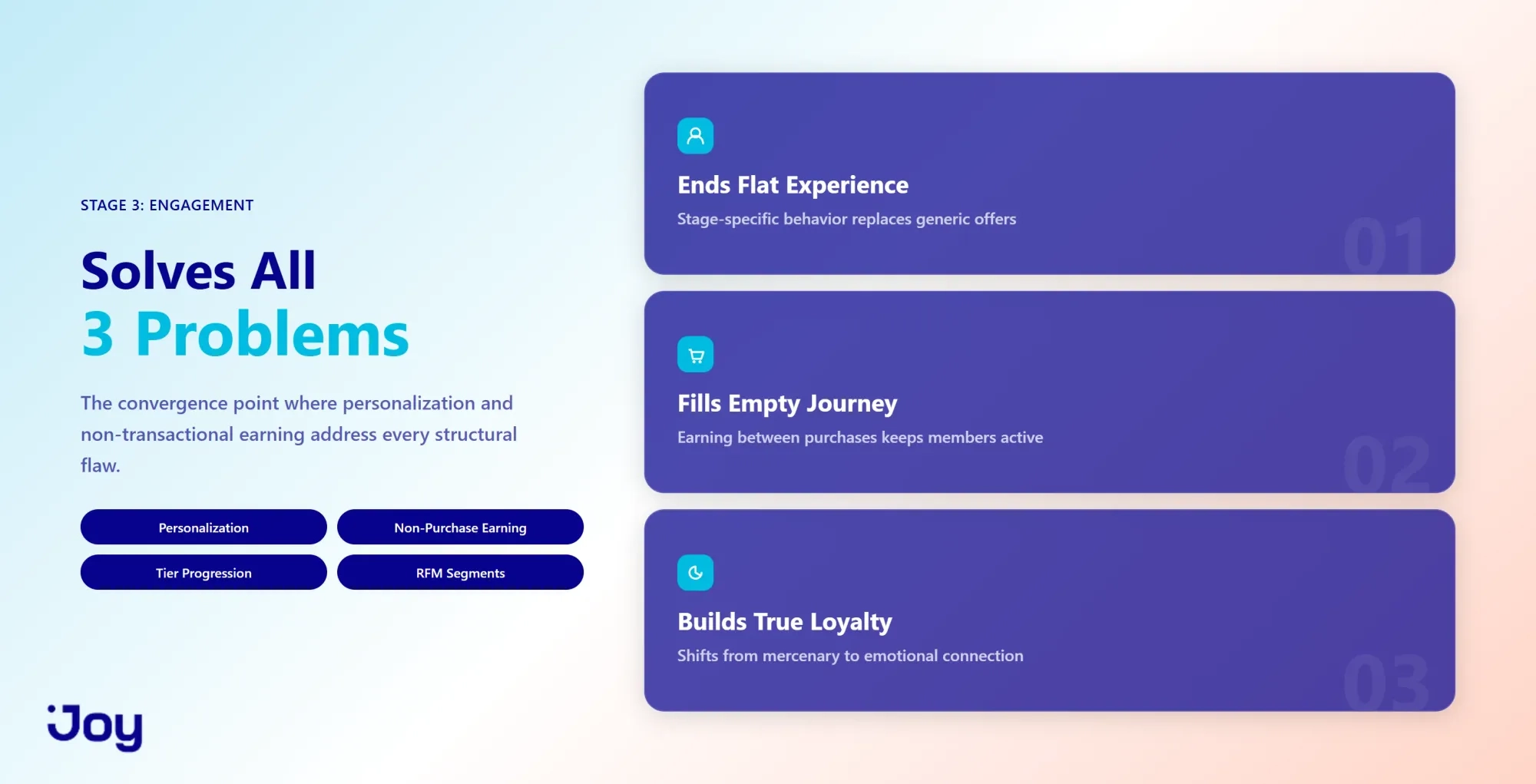
Engagement is the linchpin of the entire framework. This is where loyalty shifts from transactional to behavioral. Personalization and non-transactional earning create the psychological stickiness that prevents churn. If this stage fails, Retention and Advocacy become irrelevant because there's nothing to retain and no one to advocate.
Three things happen simultaneously at this stage. First, personalization at scale: offers based on purchase history, browsing behavior, and RFM segments (recency, frequency, monetary value) replace blanket discounts. Second, non-transactional earnings: customers earn points for referrals, reviews, social shares, and community participation, which means loyalty is built between purchases rather than just during them. As outlined in this guide on how loyalty and referral programs complement each other, the compounding effect of combining these channels is something purchase-only models simply can't match. Third, tier progression visibility: customers see exactly how far they are from the next level and what actions will get them there faster.
Why is this the convergence point? Because it addresses all three problems at once. It solves the flat experience (Problem 1) because engagement-stage customers receive personalized experiences tailored to their specific behavior, not the same generic offers as newcomers. It fills the empty journey (Problem 2) because non-transactional earnings give customers reasons to engage daily, not just when they buy. And it creates the conditions for true loyalty (Problem 3) because this is where customers transition from mercenary loyalty (points and discounts) to emotional loyalty (belonging and identity).
The key tactics are segmenting offers by RFM data, adding non-transactional earning channels (referrals, reviews, social engagement, community), and making personalization transparent ("We noticed you love skincare, so here's something picked for you"). For merchants looking for a deeper dive into this approach, this resource on data-driven loyalty programs covers how analytics turn generic programs into personalized experiences.
The metrics to track include engagement score, the split between transactional and non-transactional earnings (ideally 70/30), CLV increase at this stage, and churn rate.
Stage 4: Retention, The Exclusivity Stage
Retention is about making leaving feel like a loss. Customers at this stage have proven their loyalty. Your job is to reward it with exclusivity, community, and experiences that non-members and lower tiers simply can't access.
As detailed in this guide to VIP loyalty programs, this means tier-exclusive perks such as VIP-only sales, early product access, and surprise rewards. It means community belonging through private forums, member spotlights, and quarterly events, creating the social fabric that makes switching feel like abandoning a community rather than just canceling a membership. And it means value communication: showing customers their earned value in dollars, not points. "You've saved $340 this year" hits differently than "You have 5,000 points."
This stage is where true loyalty is built. The exclusivity and community create the emotional connection that, as SAP Emarsys found, currently sits at just 29% and is falling. Without this stage, customers remain mercenaries who leave for better offers. With it, switching costs become psychological and social, not just financial.
The metrics here are repeat purchase frequency, churn rate segmented by tier (VIP churn should be significantly lower than base), community participation rate, and CLV growth trajectory.
Stage 5: Advocacy, The Amplification Stage
Advocacy is where your most loyal customers become your sales force. They refer friends, write testimonials, and amplify your brand organically. And most importantly, this stage feeds directly back into Stage 1 (Awareness), turning the journey into a self-sustaining cycle rather than a one-time funnel.
At this stage, top-tier members are invited into formal ambassador programs automatically, with no friction. Ambassadors receive exclusive tools: referral links, social media templates, and early product access. Public recognition through leaderboards, monthly spotlights, and testimonial showcases makes sure ambassadors see their impact celebrated.
The compounding effect here is significant. According to Salesforce research, referred customers enter the journey with higher trust and 16% higher CLV than non-referred customers. Ambassador-driven revenue grows because advocates are self-sustaining. They don't need ad spend to activate. The journey becomes circular: Advocacy brings new customers into Awareness, who progress through Enrollment, Engagement, and Retention, and eventually become advocates themselves.
The metrics to track are referral conversion rate, ambassador CLV compared to the general customer base, word-of-mouth attribution, and repeat referrals per ambassador.
The Journey Is the Program
The three problems mapped in this article aren't separate failures. They're symptoms of the same root cause: programs built around mechanics instead of journeys.
When every customer gets the same flat experience, as PwC documented, when the journey goes silent between purchases, as McKinsey's data revealed, and when true loyalty erodes year over year, as SAP Emarsys tracked, the underlying issue is always structural. These programs were never designed to move customers forward through stages. They were designed to reward a single moment and hope it repeated. For a deeper look at the structural patterns behind these failures, this analysis of why loyalty programs fail covers the most common root causes and how to address them.
The 5-stage framework solves this by giving each phase of the relationship its own psychology, tactics, and metrics. The linchpin is Stage 3, Engagement, where non-transactional earning and personalization shift loyalty from transactional to emotional. And the multiplier is Stage 5, Advocacy, where the journey feeds back into itself, becoming self-sustaining.
The merchants who win in the long run won't be the ones with the best rewards. They'll be the ones who architect the best journeys.

Written by
Thomas Nguyen is the CTO of Joy, a loyalty solution for Shopify and eCommerce brands. With years of experience building high-performance Shopify apps, Thomas aims to help merchants grow through customizable and retention-focused tools.
Related reading
 Loyalty Strategy
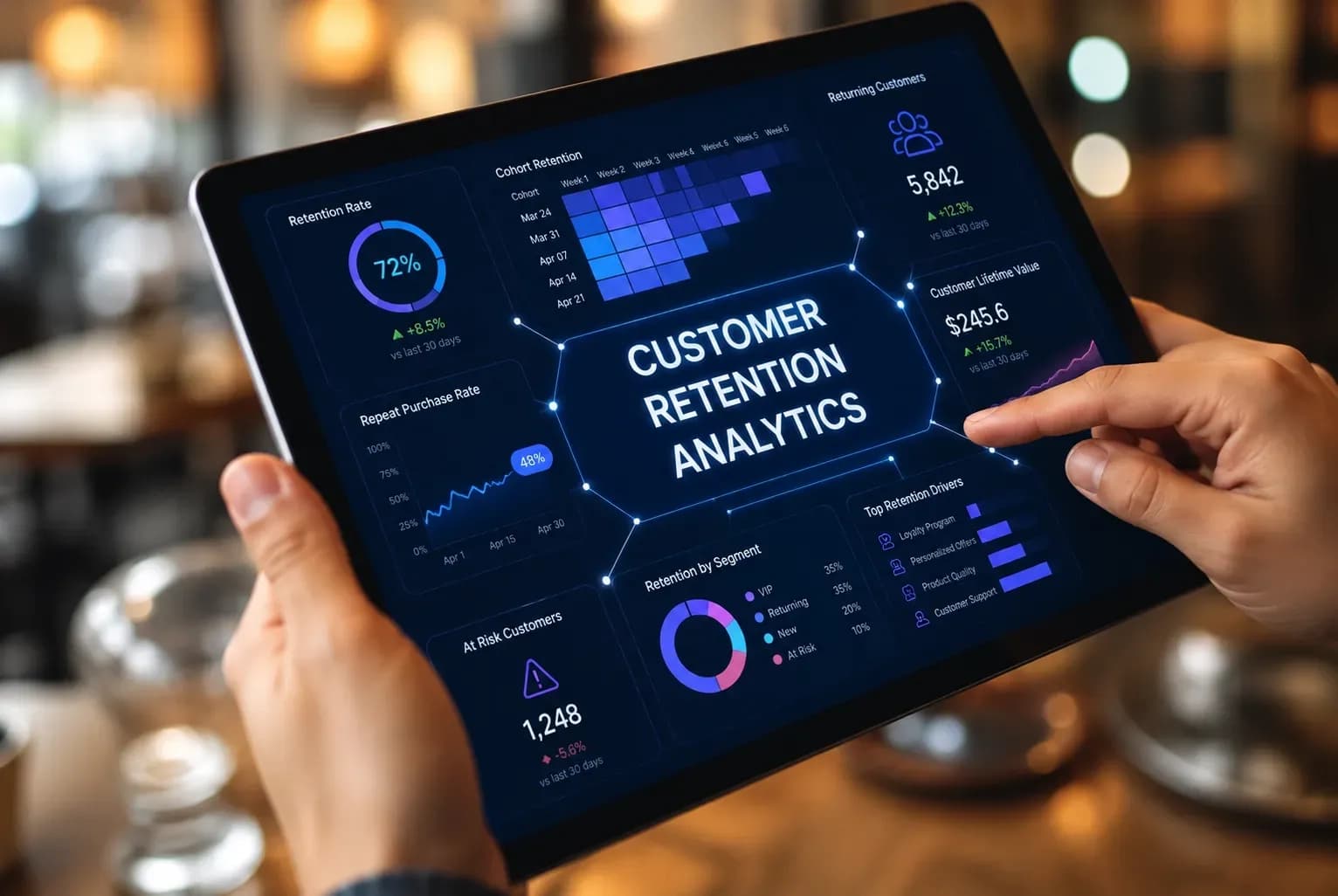
Customer Retention Analytics: Turn Your Data Into Retention Action
Most retention guides stop at the numbers. This one shows how to read your retention data and turn each metric into a concrete loyalty play for your Shopify store.
 Thomas Nguyen
 Loyalty Strategy
The Customer Loyalty Loop: Why Retention Beats Acquisition
More than half of loyalty memberships sit inactive — the fix isn't a better funnel, it's a loop. Here's the 4-stage customer loyalty loop framework, where most Shopify programs break down, and how to diagnose which stage yours is missing.
Thomas Nguyen Loyalty Strategy
Customer retention benchmarks for ecommerce: What's a good rate?
A clear-eyed look at ecommerce retention benchmarks: the one number worth trusting, why most by-industry tables mislead, and how to benchmark against yourself.
Thomas Nguyen Loyalty Strategy
How to set up customer retention automation (without a big team)
A step-by-step guide to automating customer retention across the customer lifecycle, from onboarding to win-back.
Thomas Nguyen Loyalty Strategy
The Customer Loyalty Life Cycle: 5 Stages and Where Most Brands Lose Customers
Ad costs keep climbing, but customers buy once and disappear. The customer loyalty life cycle is the framework that shows exactly where the journey breaks; five stages, the warning signs of each stage failing, and how to diagnose your weakest link before it costs more revenue.
Thomas Nguyen Loyalty Strategy
Customer Acquisition vs Retention: Where to Put Your Next Dollar
Customer acquisition and retention aren't a contest. Here's what each really costs, when to prioritize which, and a simple LTV:CAC way to decide your split.
Thomas Nguyen